

It begins at 4 a.m., with a flashlight and a chipped bowl
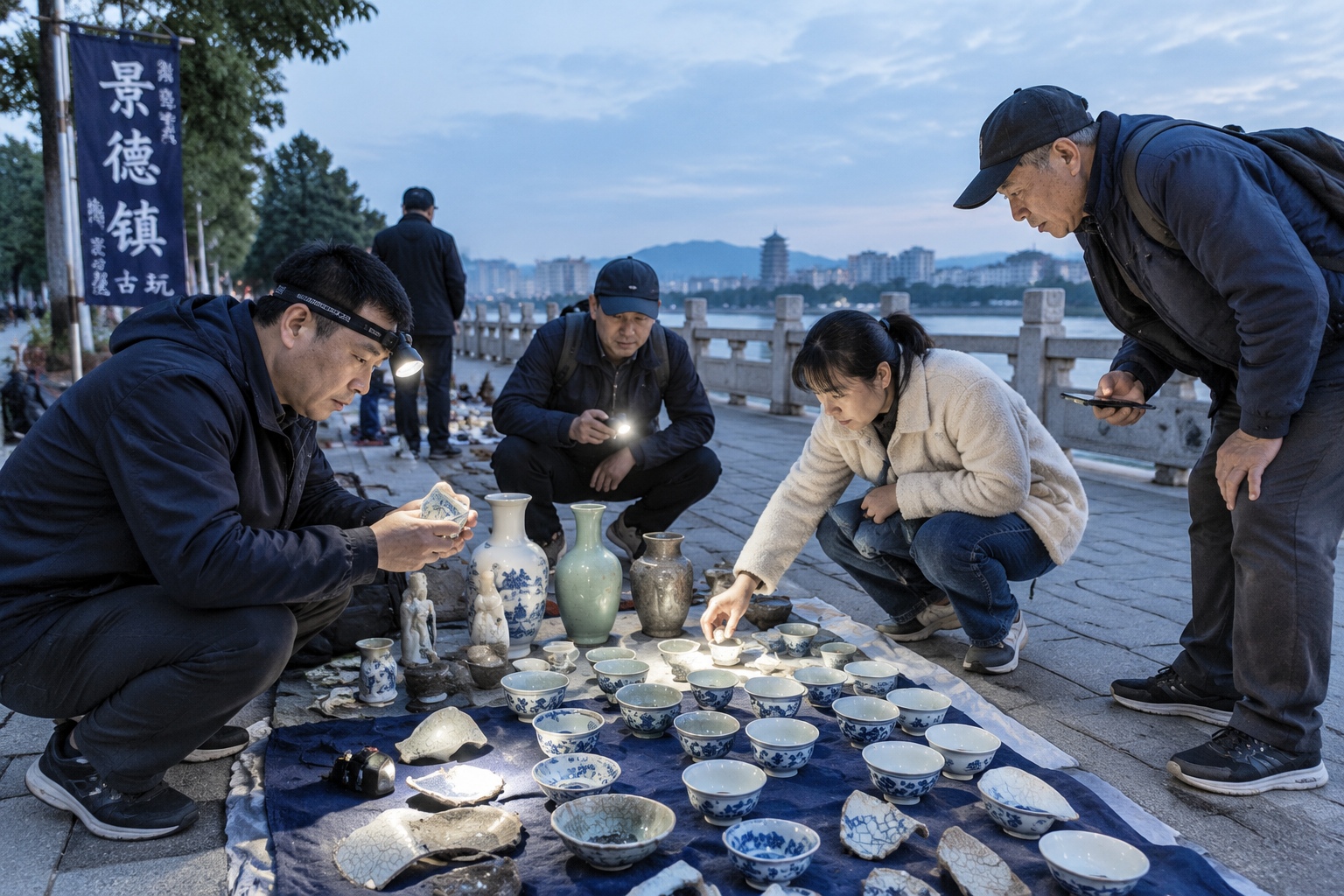
The Monday market in Jingdezhen starts before sunrise. Nobody advertises it. Vendors lay cloth along the pavement on Shuguang Road, snap on headlamps, and unpack crates of cups, cracked vases, broken shards and small unglazed test tiles. Buyers crouch in the dark, turning pieces over, checking for a maker’s seal, a hairline crack, a glaze that went strange in the kiln.
A woman in her twenties buys four small celadon cups for 60 yuan — about $8. They are seconds, slightly off-round. She says she wants them as glaze reference. She moved here from Chengdu two years ago, rents a studio, throws pots six days a week, and sells online at night.
People like her have a name here: 景漂, jingpiao — “Jingdezhen drifters.” Nobody has an exact number. Local reports and government figures usually land around 30,000, arriving from every province in China and dozens of other countries. In a city of about 1.6 million people in Jiangxi province, that is not a footnote. It is a demographic.
Why move to a small city to make cups?
The first answer is money, and it is not romantic at all.
In Shanghai or Shenzhen, a ceramics studio with room for a wheel, a kiln and a drying shelf can run 6,000 to 12,000 yuan a month before you have made anything. In Jingdezhen, a workable studio in one of the villages on the edge of town can be 800 to 2,000 yuan. A room in a shared courtyard house can be cheaper still. Ten years ago, makers talk about renting whole houses here for a few hundred yuan a month. That era is mostly over, but the comparison still holds.
The tools are affordable in the same way. A decent potter’s wheel costs a few thousand yuan. A small electric kiln runs 3,000 to 6,000. Glaze materials are sold by the scoop in shops where the staff understand you when you say “I need something that breaks orange over copper red.” For a 25-year-old with savings from a design job and no family money, those numbers are the difference between a hobby and a business.
Ten minutes away is Fanjiajing, where you can buy a “Ming dynasty” vase that was made last week. It is a strange kind of comfort: the city will sell you the look of history without making you compete with a museum.
What actually keeps them here
Cheap rent explains arrival. It does not explain why people stay for five, eight, ten years. The deeper reason is that Jingdezhen has an industrial ecosystem almost no other city has.
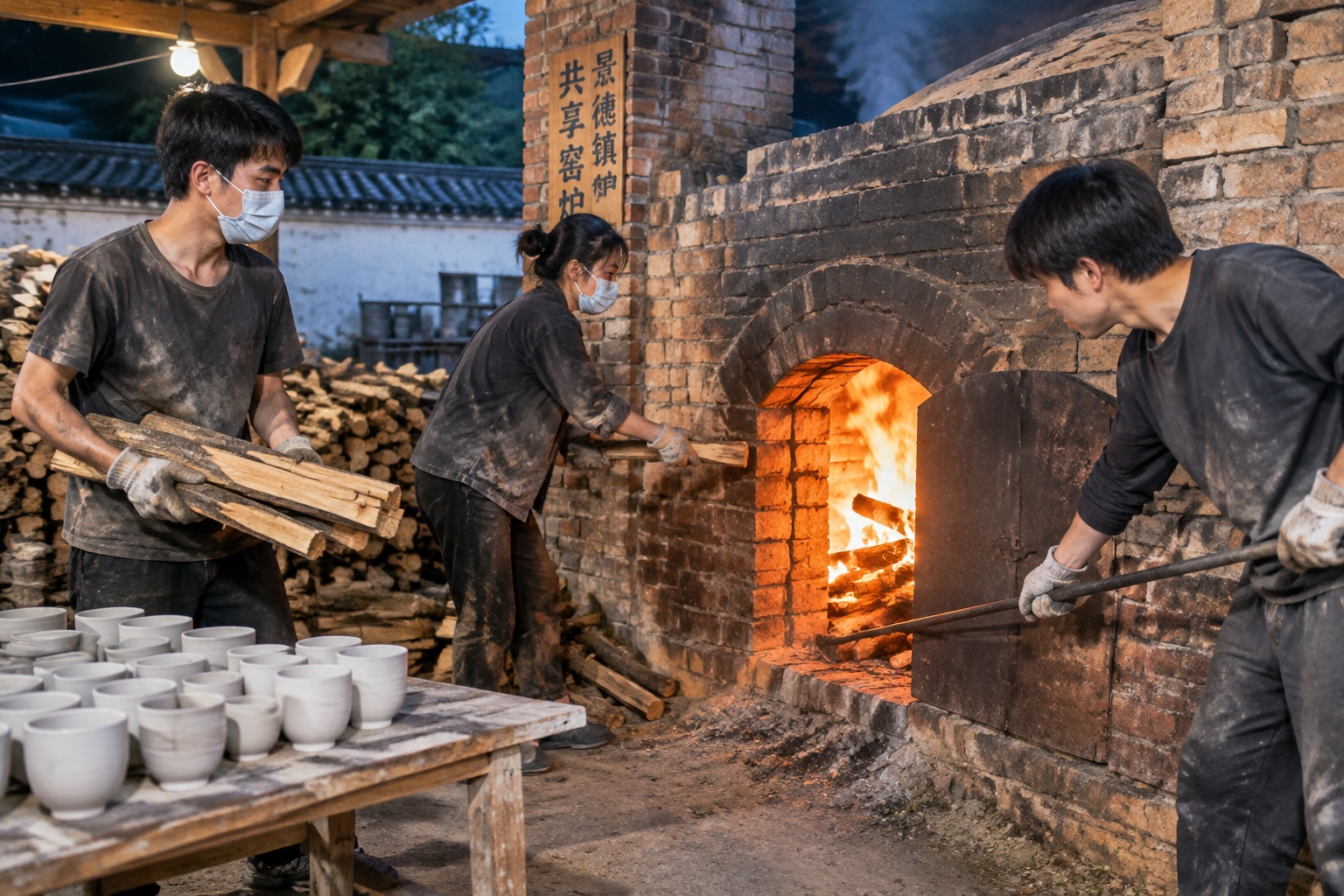
Clay arrives by truck from mines nearby. The word “kaolin” itself comes from Gaoling, a village about 40 kilometers from the city center — the white clay that made hard-paste porcelain possible in Europe after 1700 was named after this place. There are commercial kilns you can pay to fire in, shared wood kilns where twenty makers split the cost of a three-day firing, and repair specialists who can rebuild a wheel or a kiln controller for 200 yuan. In most cities, a ceramicist is running a small factory alone. Here, you plug into a supply chain that has been tuning itself since the Song dynasty.
How do they make a living?
Mostly not by selling to tourists.
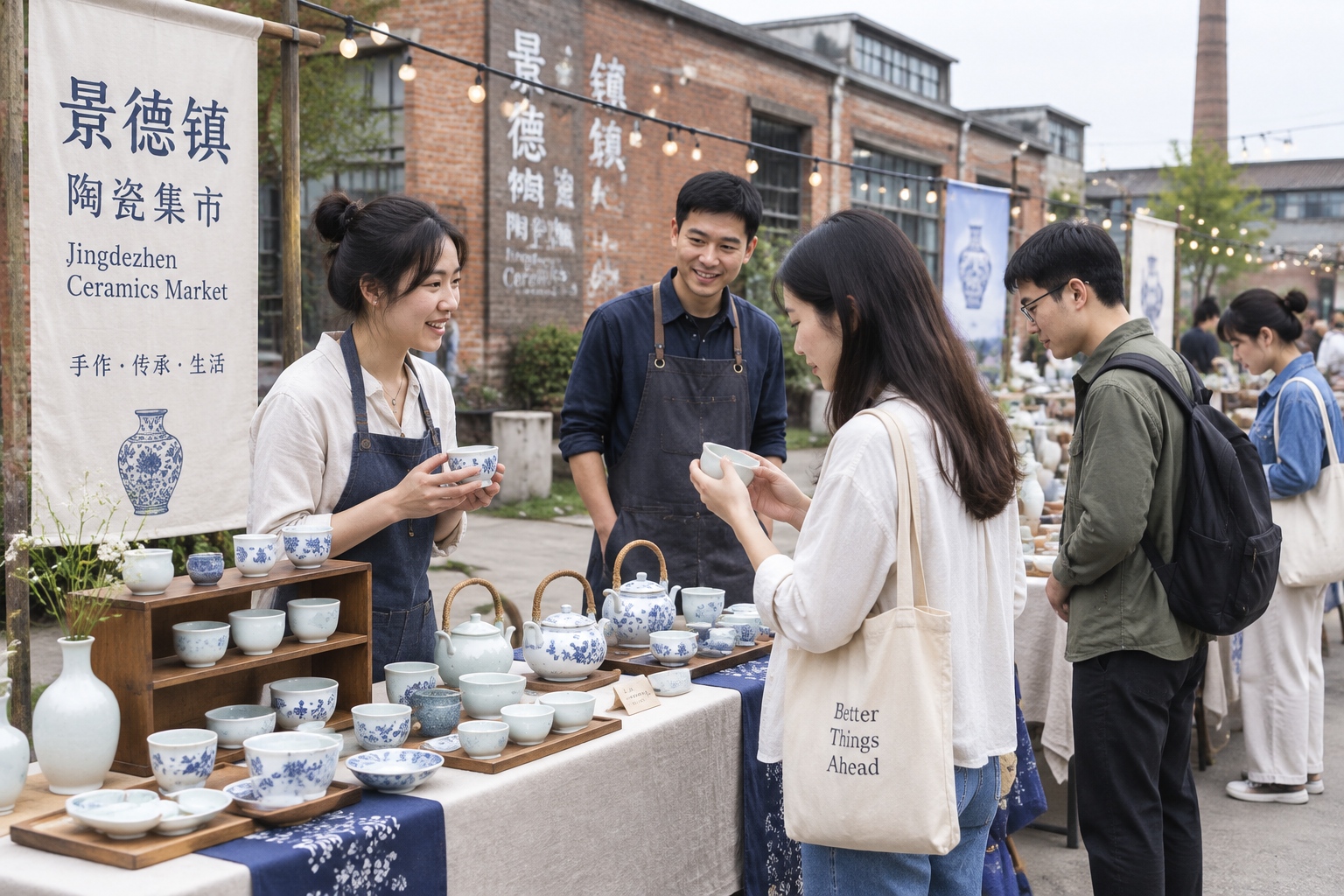
There are two big physical markets. The weekend market at the Sculpture Factory, started in 2005 by the Hong Kong ceramicist Caroline Cheng and her Pottery Workshop, is where young makers apply for a booth and get juried in. Taoxichuan, a former state porcelain factory turned into a studio-and-retail district in 2016, runs its own weekend fair and evening market. A good weekend can bring in a few thousand yuan. A rainy one can bring in 200.
So the makers I spoke with treat the market as marketing, not income. The money comes from online.
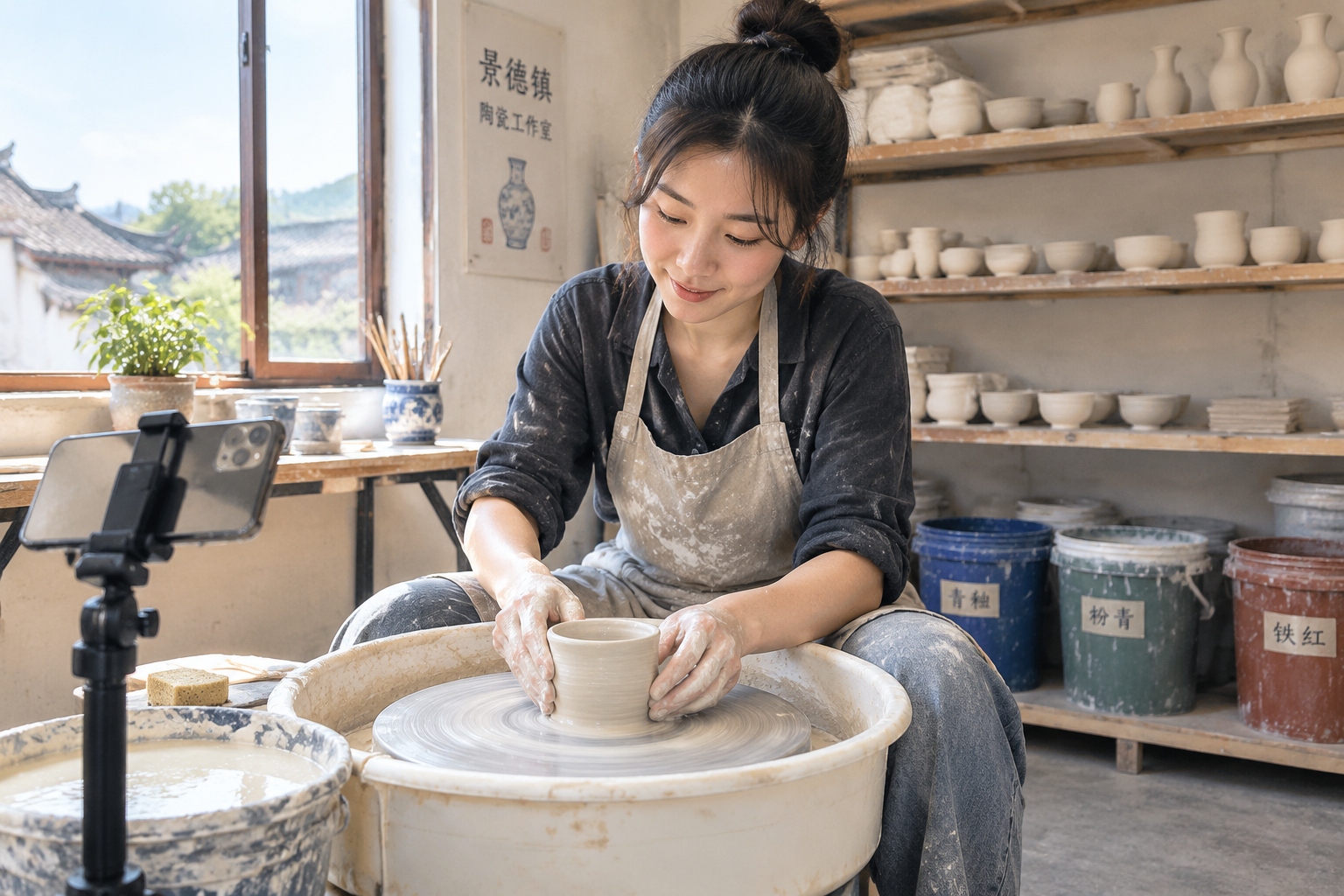
“I livestream three nights a week,” a 29-year-old maker named Liu told me, sitting in a studio with a phone clamped to a tripod next to her wheel. “People watch me throw for an hour, then they buy. They want to see the hands.” She sells on Douyin and through WeChat groups. Roughly three-quarters of her income comes from people who have never been to Jingdezhen.
That is the part outsiders miss. The old model was: make pots, sell pots to a wholesaler. The current model is: make pots, film the making, build a following, ship worldwide. Jingdezhen’s revival is as much a story about Chinese e-commerce and short video as it is about clay.
A day, itemized
Here is roughly what a single, thrifty maker told me her month looks like. Studio plus a small sleeping space in a village: about 1,200 yuan. Twenty-five kilos of porcelain clay body: 60 to 120 yuan. One electric kiln firing, bisque plus glaze: 100 to 250 yuan in electricity. A share in a wood-kiln firing: 500 to 1,500 yuan per person, plus three days of unpaid work feeding the fire. A weekend market booth: a few hundred yuan, depending on the market and the season. Breakfast noodles: 8 yuan. Coffee, because everyone eventually gives in: 20 yuan.
Add it up and the model only works if you sell. Which is why the wheel and the phone are usually in the same room.
The foreigners, and the second wave
Jingdezhen is unusual among Chinese cities in how many foreigners live there long-term — Japanese, Korean, American, Dutch and Australian ceramicists, some for a decade or more, drawn by the same supply chain. Sanbao, a village in a valley south of the city, became an international ceramic settlement after the artist Li Jianshen started building there in the late 1990s.
What has changed is who is arriving now. The first wave was often people leaving something behind: a job, a city, a life plan. The current wave includes people who grew up watching ceramics on Xiaohongshu, took a weekend class in Beijing or Hangzhou, and showed up with a business plan and 50,000 followers already.
The hard parts
Nobody I talked to pretended it was easy.
- Rents are climbing. Sanbao, once the cheap option, is now the expensive one. Makers are pushing further out — Xianghu, Laoyatan, villages with no cafes and a longer bus ride.
- Success is visible, which makes it worse. Social media shows the maker whose cups sell out in ten minutes. It does not show the six months of failed glaze tests before that.
- Income is lumpy. A firing can ruin a month of work. Glaze crawls, pieces crack, a whole shelf comes out the wrong color.
- The city is small. Fewer jobs, fewer schools, fewer fallbacks if ceramics stops working. Some people leave at 30 for exactly that reason.
There is a subtler pressure too. As Jingdezhen’s reputation grows, several makers mentioned the same worry: that the market rewards “photogenic” work over difficult work, and that what sells in a livestream quietly starts to set the aesthetic of an entire city.
What Jingdezhen says about the rest of China
For decades, the story about Chinese cities was about moving to the biggest one. Young people left small places for Beijing, Shanghai and Shenzhen and rarely looked back. Jingdezhen is one of a small set of counterexamples — places like Dali in Yunnan or Anji in Zhejiang — where the calculation flips, at least for a specific group.
The calculation is not lifestyle versus career. It is: where can I afford to work on the thing I actually want to do? A city with one industry, and an old one, turns out to be a good place to be a specialist, because everyone around you speaks the same language.
Back to the dark market
By 6:30 the sky over Shuguang Road is gray and the good pieces are gone. Vendors fold their cloth. The woman with the celadon cups walks to a breakfast stall and orders rice noodles. Then she goes back to her studio to start the day’s work — twelve cups, maybe ten that will survive.
She is not, she says, trying to revive a thousand-year-old tradition. She wants to make things with her hands and pay her own rent. Jingdezhen happens to be the one city in China where those two sentences still fit together.
Start the discussion at forum.chinacomes.com