
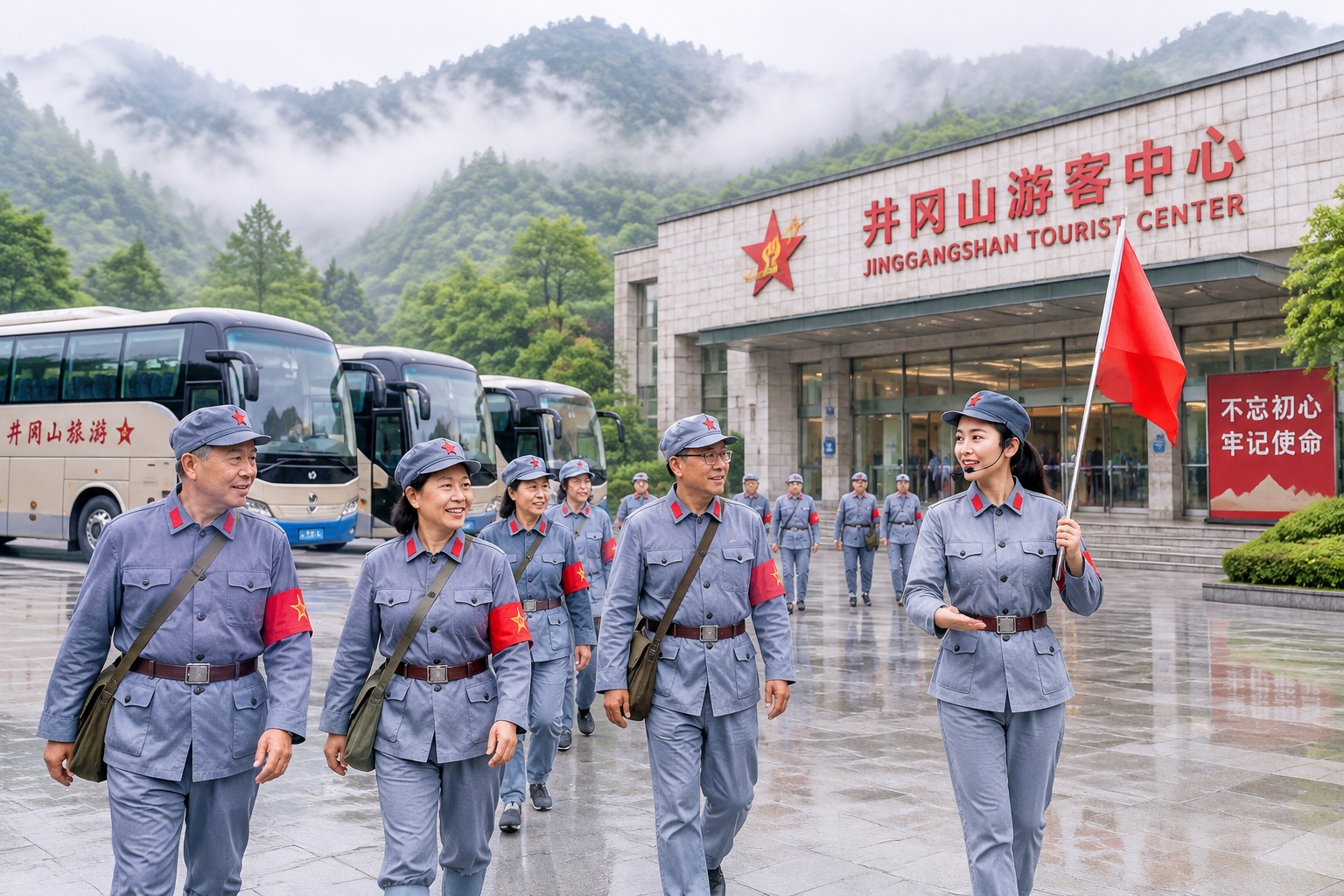

Early Morning in Jinggangshan
The alarm clock has not yet rung in the sleepy town of Ciping, but the parking lot of the Jinggangshan Tourist Center is already a mechanical hum of idling buses. A group of men and women, all wearing the same gray Mao-style uniforms, stands in orderly rows, each person’s chest bearing a small red star pin. They are not actors. They are civil servants from a distant province, here for a week-long “red training” course. A thin morning mist clings to the surrounding peaks, and the air smells of damp earth and car exhaust.
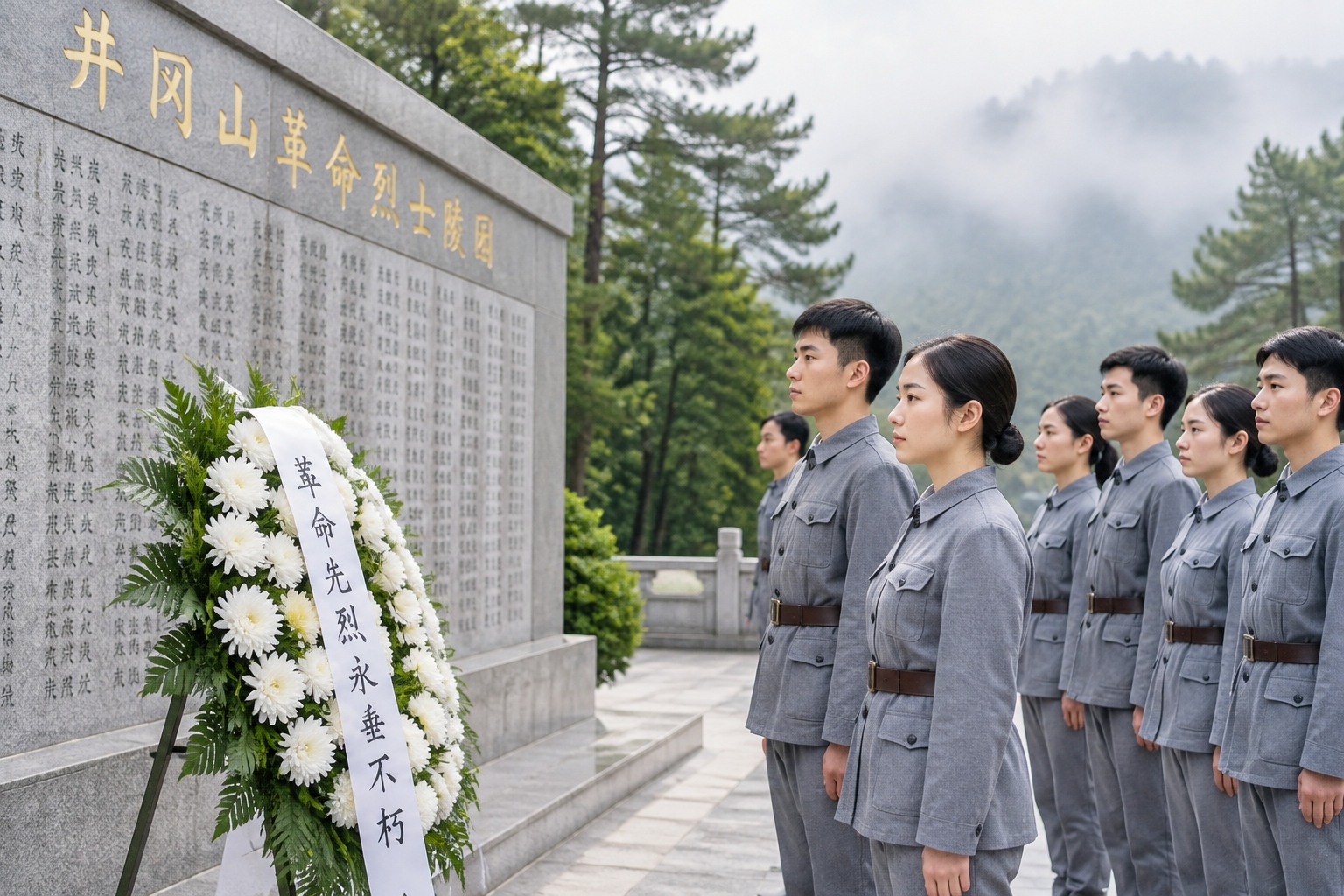
A young instructor, 26-year-old Zhang Wei, raises a red flag and leads the group up the granite steps to the Martyrs’ Cemetery. She has made this walk perhaps a thousand times. “The first time I did it, I was moved to tears,” she says to her trainees. “But now, I notice details—like the way the pines here seem older than the stones.” Her tone is practiced, but her eyes are alert, watching for anyone who stumbles on the wet stone.
The group stops at the memorial wall, etched with the names of nearly 15,000 soldiers who died in the region between 1927 and 1934. For a moment, the only sound is the wind in the pines. Then Zhang Wei speaks again: “We are not here to cry, but to understand why they made this choice.”
This scene is a microcosm of what has turned Jinggangshan—a once-impoverished mountain county in Jiangxi province—into one of China’s most visited “red tourism” destinations. Every year, more than 15 million visitors come here to walk the paths of Mao Zedong and his comrades. And in doing so, they are also feeding an economic engine that has lifted thousands of local families out of poverty.
From Revolutionary Base to Tourist Destination
In the late 1920s, Jinggangshan was the first rural revolutionary base established by the Chinese Communist Party. Mao and a small army of soldiers and peasants retreated to these remote mountains after the collapse of the urban uprising in 1927. They survived through guerilla warfare and sheer will, eventually expanding the base and gaining a foothold for the Party’s 20-year march to power.
For decades after the Communist victory in 1949, the region remained a symbol of revolutionary spirit, but also a place of economic stagnation. Its rugged terrain made agriculture difficult, and industry was scarce. As late as the 1990s, many villages had no paved roads and no electricity.
The turning point came in 2004, when the central government launched the National Red Tourism Development Plan. The aim was twofold: to preserve and promote revolutionary history, and to bolster the economies of old revolutionary bases—areas that had made sacrifices for the Party but were left behind by China’s coastal boom.
Jinggangshan, known as the “cradle of the Chinese revolution,” was given top priority. Money flowed into infrastructure: new roads, a high-speed rail line opened in 2019, and an enlarged airport with direct flights to Beijing and Shanghai. The historic sites—Mao’s former residence, the Huangyangjie border defence post, and many others—were restored and turned into museums and memorial parks.
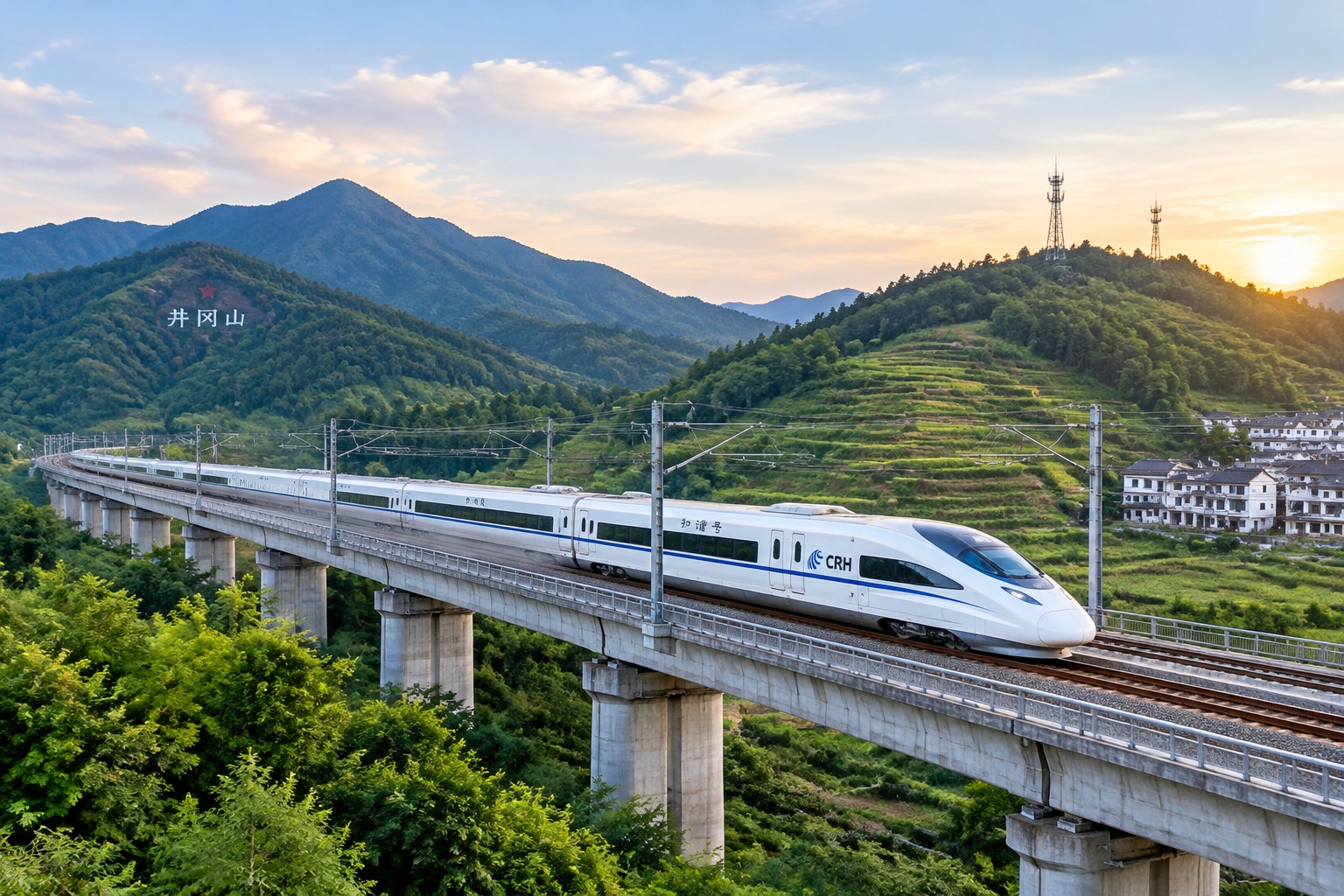
The visitor numbers tell the story. In 2000, Jinggangshan received roughly 500,000 tourists. By 2019, that number had surged to over 15 million, generating tourism revenue exceeding 13 billion yuan (about $1.9 billion). The COVID-19 pandemic caused a dip, but 2023 saw a strong rebound, with many training programs fully booked months in advance.
But the story is not just about ticket counters. The economic ripple extends into every corner of local life.
Red Training: A New Kind of Classroom
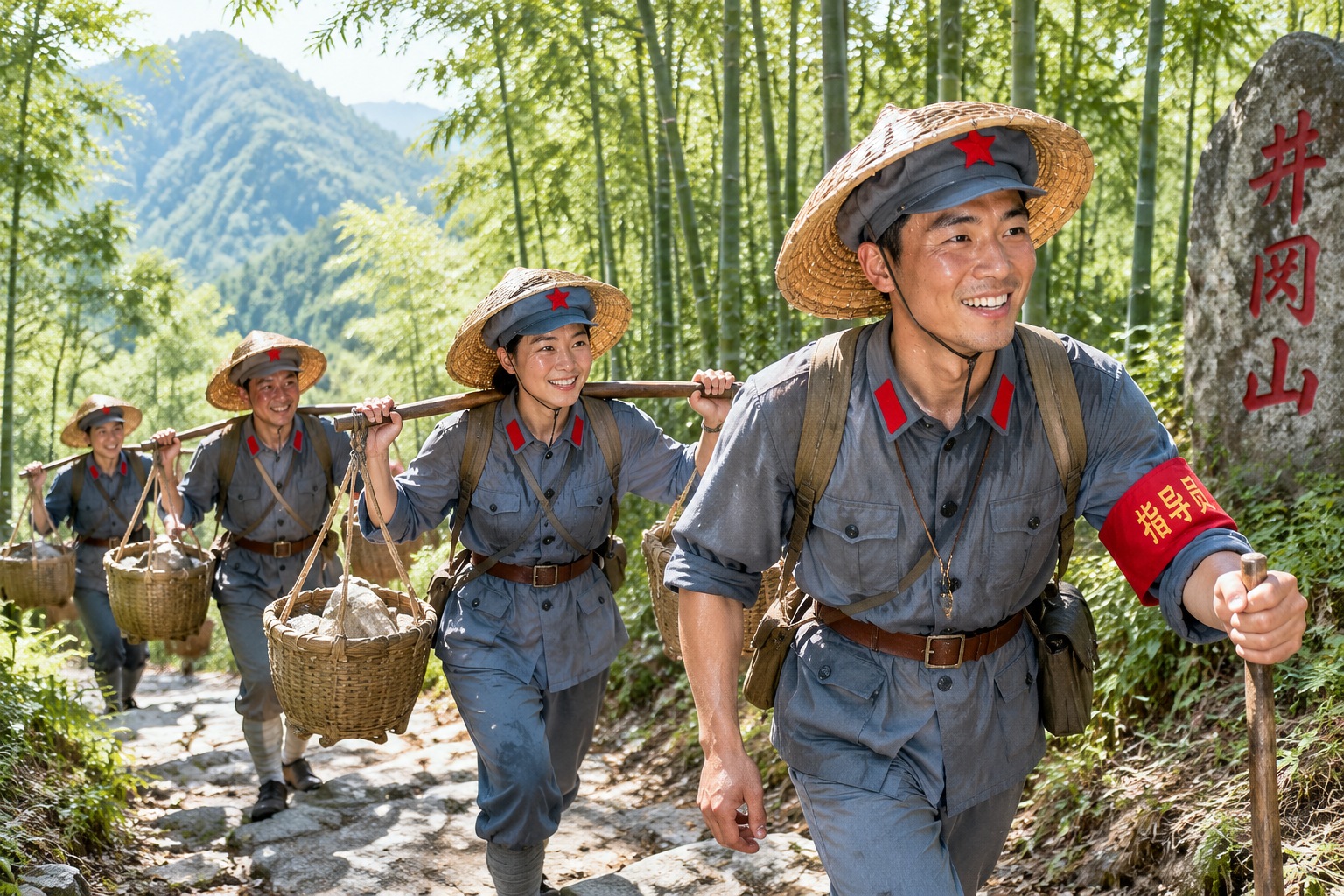
One of the most unexpected drivers of Jinggangshan’s economy is the “red training” industry. Many government agencies, state-owned enterprises, and universities organize residential courses that combine classroom lectures with physical activities. Participants stay for several days, eat “red army meals” (pumpkin soup, wild greens, and coarse grain rice), and hike parts of the old mountain trails.
Liu Qiang, 35, is a freelance trainer who designs such programs. He used to be a tour guide, but saw the potential in this niche. “A guided tour lasts three hours. A training course lasts five days,” he says. “That means visitors stay longer and spend more. I now have five instructors working with me, and we source all our props—uniforms, shoulder poles, first-aid kits—from local shops.”
His company also books accommodation and meals for groups. During the busy season, he works with more than twenty guesthouses and six restaurants. “When a group of fifty comes, it’s like a small festival for the village,” he jokes.
The demand is so high that specialized institutions have been set up, such as the Jinggangshan Cadre Training College, which claims to train tens of thousands of officials each year. They come from almost every province, seeking a visceral connection to the Party’s founding story.
Local Economy: Beyond the Souvenir Stalls
In downtown Ciping, the main street is crowded with shops selling identical red-star caps and bronze Mao badges. It can feel monotonous, but dig a little deeper and you’ll find a diverse local economy taking shape.

In a back alley, a coffee shop called “Hollow” is doing brisk business. The owner, Chen Rong, 31, returned home two years ago after working in Shenzhen. “I wanted to escape the crazy hours of tech marketing,” she says, while pulling an espresso shot on a machine she saved six months to buy. The tourists who come here are increasingly young—many are graduates on “gap year” trips or employees from nearby cities on a short getaway. They don’t want instant noodles; they want flat whites and homemade cakes.
Chen Rong bakes using local ingredients, like sweet potatoes from a nearby village. She also hosts small workshops where tourists can learn to make rice wine. “At first, my parents thought I was crazy. But now they see that this brings a different kind of customer—the ones who appreciate quality and don’t bargain over two yuan.”
Another striking example is the “Red Army Meal” cooperative, which supplies restaurants with authentically plain dishes. Farmers in the surrounding villages grow okra, lotus roots, and red sweet potatoes, all processed and packaged under a brand that evokes revolutionary nostalgia. The cooperative has 200 member households, and each receives a dividend based on their harvest. “In the past, we sold raw vegetables for pennies at the market. Now, we get a stable contract price,” says 58-year-old farmer Yu Guoliang.
Local specialties such as white lotus seeds, bamboo shoots, and citron tea have become popular souvenirs, sold in modern packaging through e-commerce platforms like Taobao and Pinduoduo. Many shops now accept mobile payments and offer delivery to anywhere in China.
Bringing Young People Home
For generations, young people from Jinggangshan saw no future in their hometown. They left for manufacturing jobs in Guangdong or Fujian, sending money home to aging parents. But the tourism boom has reversed this tide for many.
Wu Hua, 34, is one of them. After working as a factory supervisor in Dongguan for a decade, he returned in 2019 to take care of his father. Initially, he planned to leave again after a few months. But then he noticed that tourists were asking about local wine. His family had a small rice wine recipe, and he started selling bottles to neighboring restaurants. Today, he runs a 10-hectare winery and hosts daily tasting sessions.
“The new generation of tourists is not just looking for a photo. They want stories. So I tell them about how rice wine was used to send soldiers off to battle. It makes them feel the history,” he says, laughing. He now employs six people, all under 30.
According to the local government, more than 3,000 young people have returned to Jinggangshan to start businesses since 2015. Many open boutique hotels, serve as guides, or work in the rapidly growing livestream commerce sector, selling local products to nationwide audiences. The influx of youth has changed the social fabric. There are now co-working spaces, bike-sharing stations, and even a small art gallery that hosts exhibitions of “revolutionary pop art.”
Challenges and the Road Ahead
Despite the successes, the economy of Jinggangshan is not without its contradictions and vulnerabilities.
The first challenge is seasonality. As a mountain destination, Jinggangshan is most popular from May to October. During the cold winter months, visitor numbers drop sharply, and many businesses close their doors. Some entrepreneurs are diversifying into year-round offerings like winter hiking and tea-tasting, but these remain niche.
The second challenge is over-reliance on communist “red training” programs. These are funded by public money, and any tightening of budgets or a shift in political priorities could cause a sudden chill. Local businesses are aware of this. “If the government stops sending people, we’re in trouble,” admits Liu Qiang, the trainer. “We are trying to attract independent leisure travelers too, but we still have a long way to go.”
Thirdly, the gap between the central town of Ciping and the surrounding villages remains wide. While Ciping has been transformed into a polished tourist hub, some nearby villages like Shenshan still struggle with aging populations and lack of investment. The locals there have started their own homestays, but they lack the marketing skills to compete with the professionally run hotels in Ciping. A volunteer initiative called “Village Vision” has been providing free photography and social-media training to these residents, but progress is slow.
Environmental concerns are also emerging. The construction of hotels and visitor facilities has put pressure on the region’s water resources and waste management. In 2022, the local government banned new hotels in certain scenic areas and is now investing in wastewater treatment plants. There are also efforts to preserve the traditional wooden architecture of the old centers.
Conclusion: Walking the Same Ground
As dusk settles, the last training group poses for a wreath-laying ceremony at the Martyrs’ Cemetery. The red flags ripple in the mountain breeze. These visitors—and the millions like them—are not merely tourists. They are participants in a dual transaction: they come to inhale history, and in doing so, they exhale economic life into a region that once bore the weight of revolution.
For the residents of Jinggangshan, the revolutionary past is not a frozen museum artifact. It is a renewable energy source, perpetually feeding the present. The children of farmers now serve coffee to city visitors. The sound of chanting trainees mixes with the chirping of birds. And on the battlefields of the 1920s, a new battle is being fought—for a decent living, with the same old spirit.
Start the discussion at forum.chinacomes.com