
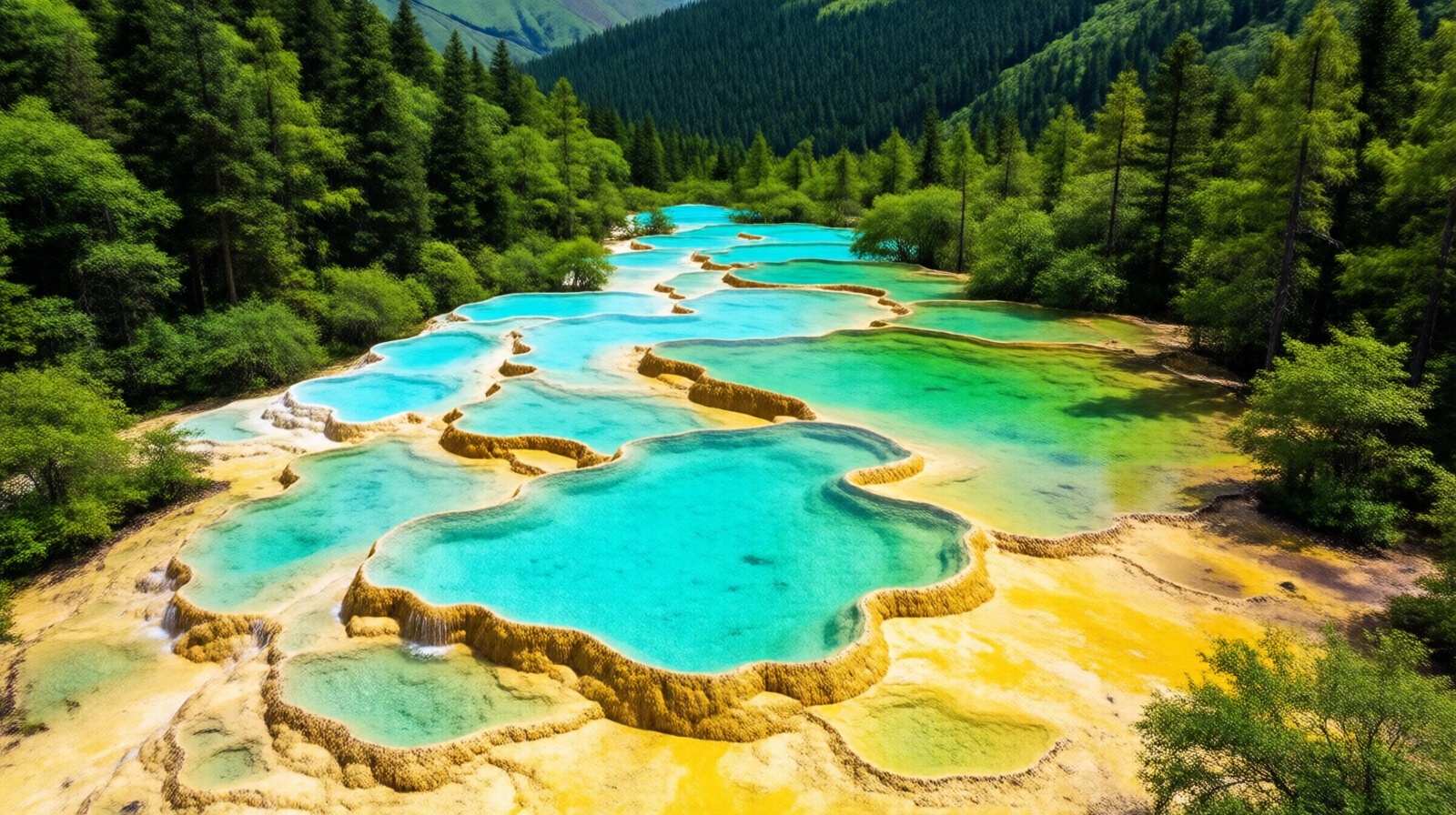

“It looks like a giant staircase poured with liquid gemstones.” That’s how a first-time visitor from Europe described Huanglong, a UNESCO World Heritage Site in the mountains of northwestern Sichuan Province, China. At an altitude of 3,100 to 3,569 meters, Huanglong Valley stretches for about 3.6 kilometers, filled with thousands of terraced pools whose water ranges from turquoise to amber, from emerald green to pale yellow. The effect is so surreal that many travelers assume the colors must be artificially enhanced. But they are not. The terraces and colors are the result of a natural process called travertine deposition, which has been at work here for millions of years.
This article explains the science behind Huanglong’s famous calcified pools: what travertine is, why the pools display so many colors, and how they formed their terraced shapes.
The Building Blocks: What Is Travertine?
Travertine is a type of limestone that precipitates from mineral springs, especially hot or cold springs rich in calcium bicarbonate. At Huanglong, snowmelt from the surrounding Minshan Mountains seeps through fissures in the karst bedrock, dissolving calcium carbonate along the way. When this water resurfaces at the valley floor, it spreads out and flows over the slope. As the water is disturbed by waterfalls, small steps and plant stems, it loses carbon dioxide into the air. This shift in chemistry causes calcium carbonate (CaCO₃) to solidify — first as microscopic crystals, then slowly building up into larger deposits. That accumulation is travertine.
The process is continuous but painstakingly slow. Scientists have measured that the rate of travertine buildup in Huanglong varies from a few millimeters to a few centimeters per year, depending on water flow, temperature and biological activity. Over thousands of years, these thin layers become thick barriers, forming the rimstone pools that give Huanglong its distinctive staircase look.
Why Are the Pools Colored?
Walk along the boardwalk that winds through Huanglong and you’ll notice that the pools are not all the same color. The deeper ones are often an intense blue or green, while the shallow edges glow with yellow and orange. The colors come from a cocktail of natural ingredients: mineral content, water depth, light, and living organisms.
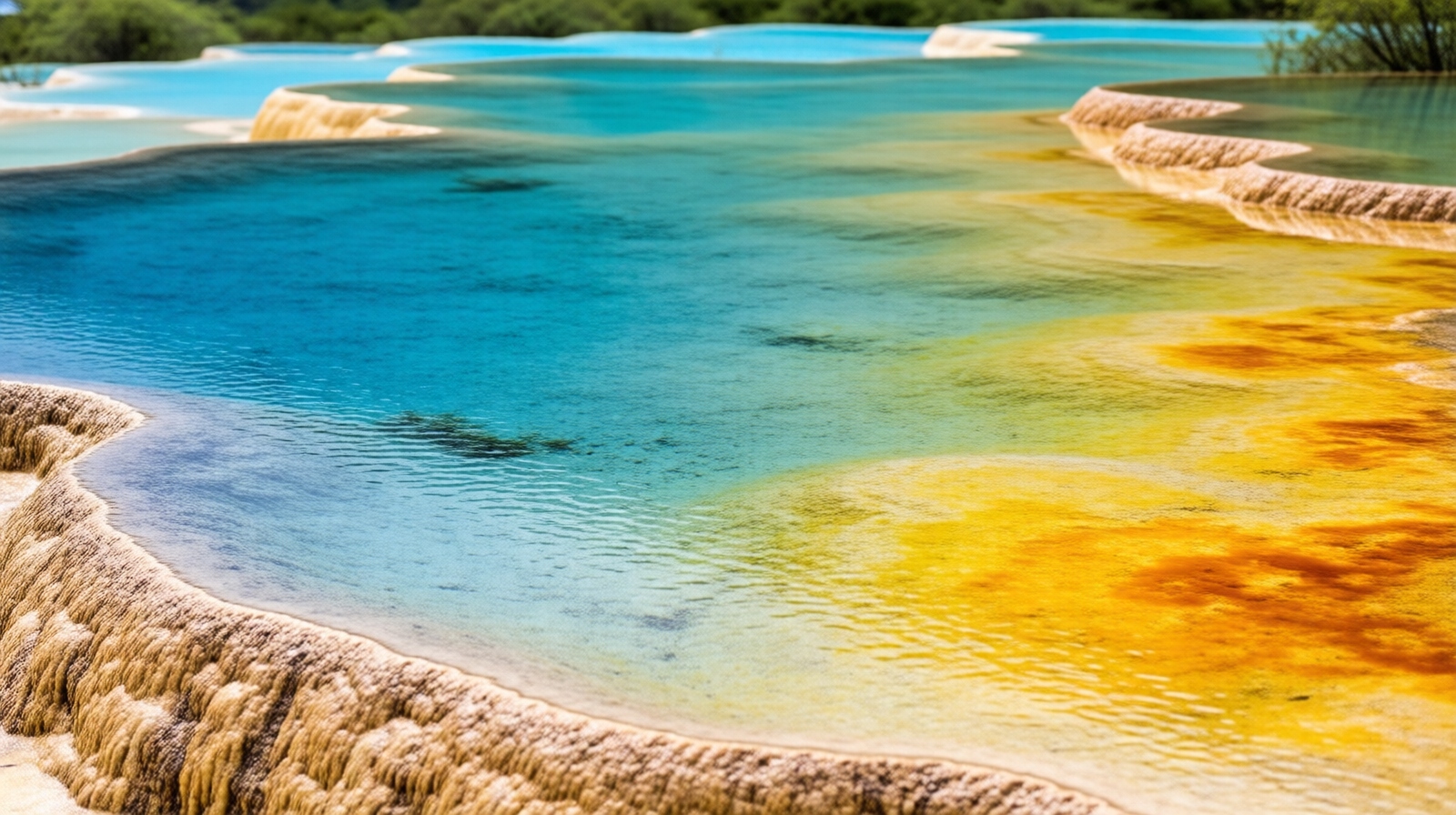
The blue-green pools
The clearest, deepest pools appear blue or turquoise because water absorbs red light and reflects blue and green wavelengths. The white or pale gray travertine at the bottom acts like a mirror, intensifying the effect. The higher the concentration of dissolved calcium carbonate, the more the water scatters light, creating that rich, acrylic-like color.
The yellow-orange pools
In shallower pools, the color shifts to yellow, orange and even reddish brown. This is largely due to iron oxide — rust, essentially — that precipitates from the water and tints the travertine surface. Another contributor is microbial life. Thin mats of cyanobacteria, algae and other microorganisms grow on the pool floor. Their pigments, combined with trapped sediment, give the deposits warm, earthy tones. Researchers have identified more than a dozen species of algae and bacteria in Huanglong’s waters, each tolerating slightly different temperatures, flow speeds and sunlight levels. As the ecology changes from pool to pool, so does the palette.
The role of tiny organisms
Bacteria and algae are not just color makers. They actively help build travertine. Many microbes extract carbon dioxide from the water for photosynthesis, which shifts the chemical balance and encourages calcium carbonate to settle on their sticky surfaces. In this way, living organisms accelerate the deposition process and shape the texture of the rock, much like reef-building corals in the ocean.
How Did the Terraces Form?
The terraced form of Huanglong — a series of pools stepping downhill — is created by a self-reinforcing natural mechanism.
The natural dam mechanism
When water carrying dissolved calcium cascades over a slight irregularity in the slope, it separates into thin sheets and turbulence increases. This turbulence releases carbon dioxide more rapidly, so calcium carbonate precipitates faster at that point. Over time, the deposit grows into a rim or dam. Behind the dam, water slows down, allowing more precipitation to build a flat pool floor. The water then spills over the new rim, starting the process again on the next lower level. In this way, a sequence of rimstone pools forms, like a series of tiny rice paddies carved by nature.
Slow growth, dramatic shapes
This is not quick work. It takes centuries to build a rim just tens of centimeters high. The largest dams in Huanglong stand several meters tall and took tens of thousands of years to grow. The valley’s continuous water supply, mineral-rich source, and the protection of the surrounding forest have allowed this process to run uninterrupted far longer than any human-made structure has existed.
Protecting a Fragile Landscape
Because travertine is so vulnerable to physical damage, Huanglong National Park has installed an elevated wooden boardwalk system that keeps visitors off the formations. Since the park opened in the 1980s, management has also monitored water quality, flow and sediment levels. In some areas, rangers restrict access to allow the rock to recover from natural erosion. Even the boardwalks are designed to minimize shade, as shadows can change the microhabitats of the algae and bacteria that color the pools.
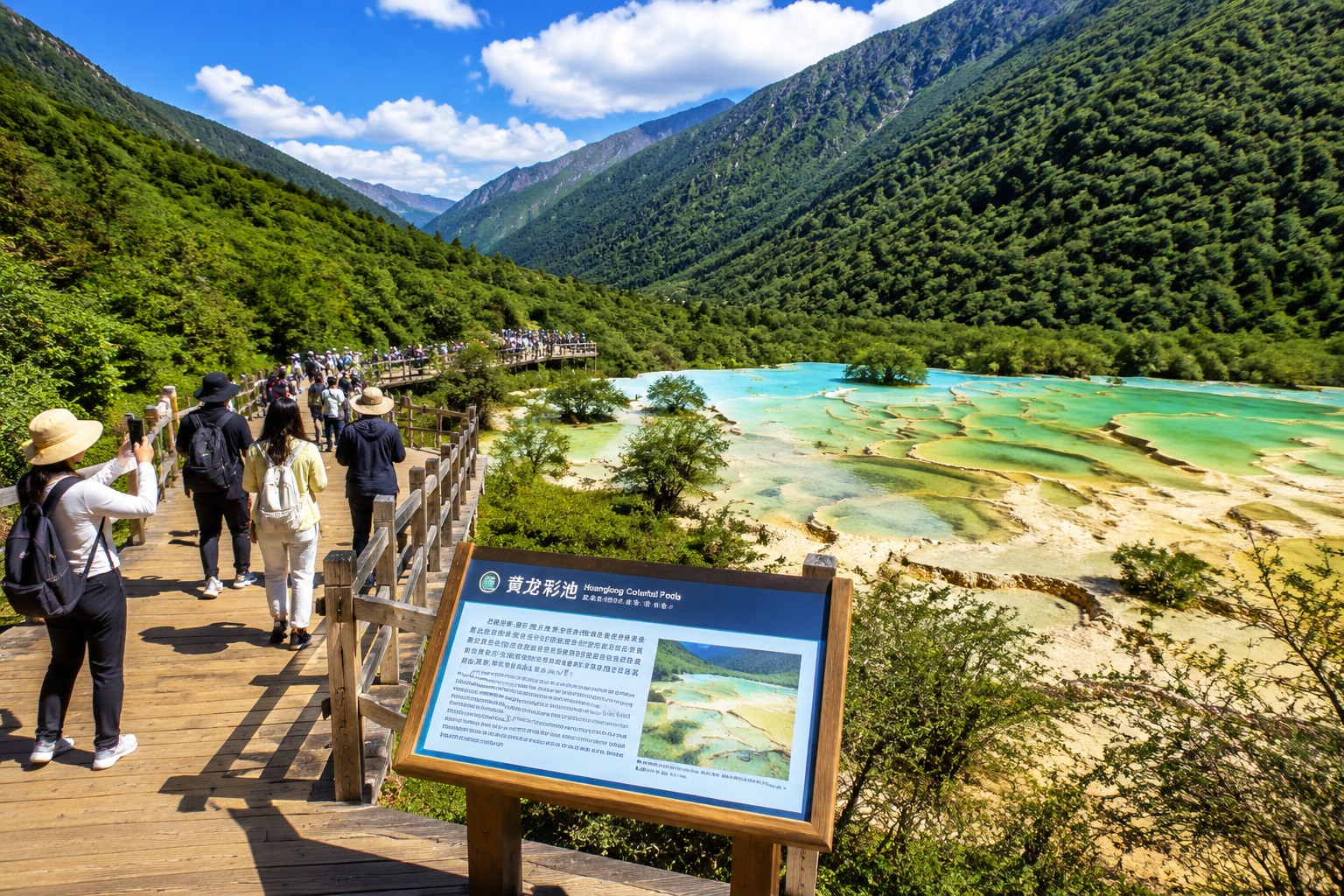
In 1992, Huanglong was added to the UNESCO World Heritage List, recognized for its “outstanding universal value” as a natural landscape. It remains one of the few places on Earth where you can watch living geology in action — not through a window or a screen, but at your feet.
Conclusion
The colors of Huanglong’s pools are generated by a beautiful chemistry: mineral-laden water, light, and microorganisms working together. The terraced shapes are a slow-motion architecture, engineered by thousands of years of waterflow and deposition. Understanding the science behind this landscape makes it feel even more remarkable. It reminds us that some of the most dazzling structures on our planet are not designed by us — they are built by time and water.
Start the discussion at forum.chinacomes.com