

A barge that doesn’t rattle
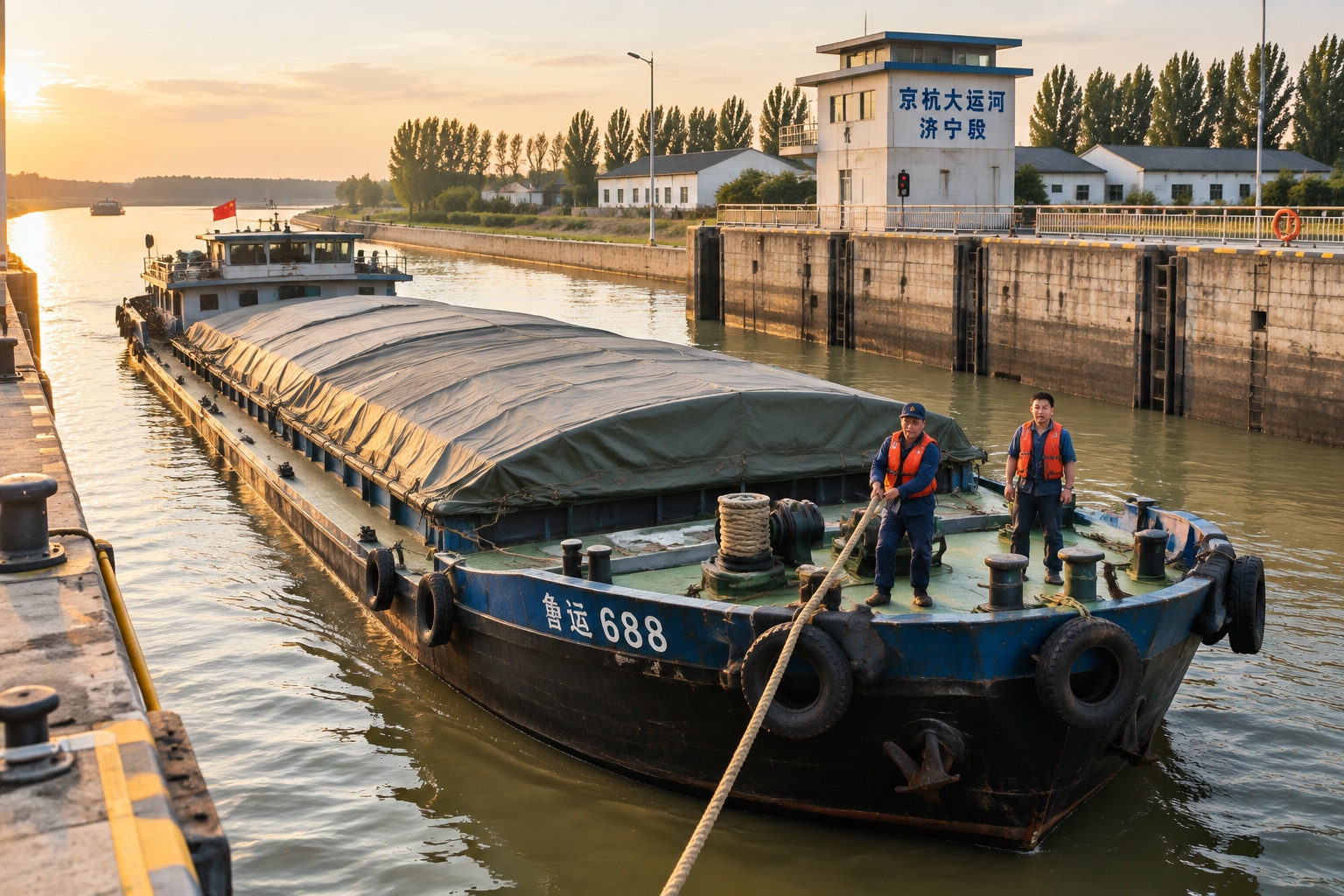
On the Grand Canal south of Jining, in Shandong province, a 2,000-tonne coal barge eases away from the wharf and something is missing. The diesel knock that normally travels up through the steel and into your teeth is gone. The loudest things on board are the water running along the hull and a fan cooling the battery compartment.
Crews who have switched from diesel to battery describe the first night as strange. The engine noise that used to rock them to sleep isn’t there, and for a few days the quiet keeps them awake. Then they stop noticing it.
That is a small detail, and it points at something much bigger: a part of China’s transport system that almost nobody outside the country thinks about — its rivers.
China’s canals are working infrastructure, not just heritage
The Grand Canal was dug in sections over more than a thousand years and became a continuous north-south route in the 7th century. It is still moving coal, gravel, steel and containers today. The Yangtze is the busiest inland waterway on earth; ports along its main line handled roughly 4 billion tonnes of cargo in 2024. Rotterdam, Europe’s largest port, moves a bit over 400 million tonnes a year by comparison.
Almost all of that river freight runs on diesel. A mid-sized barge can burn several hundred litres a day, and fuel is usually the single biggest cost an owner carries — bigger than crew, bigger than maintenance. That number, not the environment, is what made batteries interesting to shipowners long before anyone said the word decarbonisation.
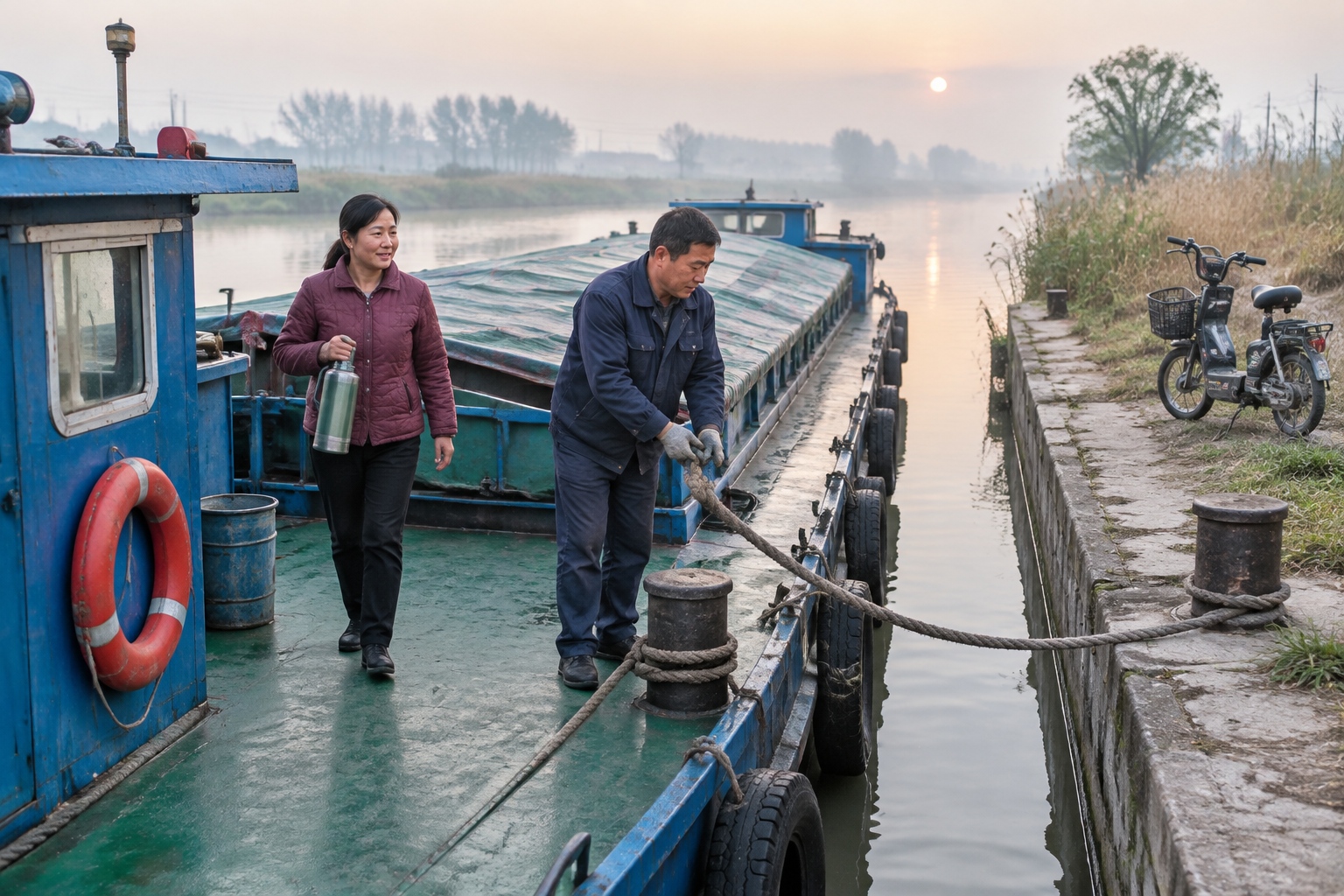
On the container shuttle that has been running between Huzhou, in Zhejiang, and Shanghai since 2022, local operators have put the energy cost per trip at roughly half the diesel equivalent. Electricity is cheap in China, especially at night. And a barge like this is close to the ideal battery vehicle: heavy, slow, on a fixed schedule, and back at the same wharf every night.
The scale changed in 2024
For years the demonstrations were small. A 64-container shuttle on a Zhejiang canal. A sightseeing boat in Yichang. A handful of ferries. Then the size jumped.
In April 2024, a shipyard in Yangzhou delivered COSCO Shipping Green Water 01, a 700-TEU container ship with about 50,000 kilowatt-hours of battery on board — the largest pure-electric container vessel in service anywhere. It runs between Nanjing and the deep-water port at Yangshan, outside Shanghai, a distance its builders put at around 380 kilometres on a charge. Yards in Jiangsu and Shandong are now laying keels for 5,000-tonne-class electric bulk carriers, the size that carries coal, gravel and grain on the canal and the lower Yangtze.
You can’t plug in a 50-megawatt-hour battery
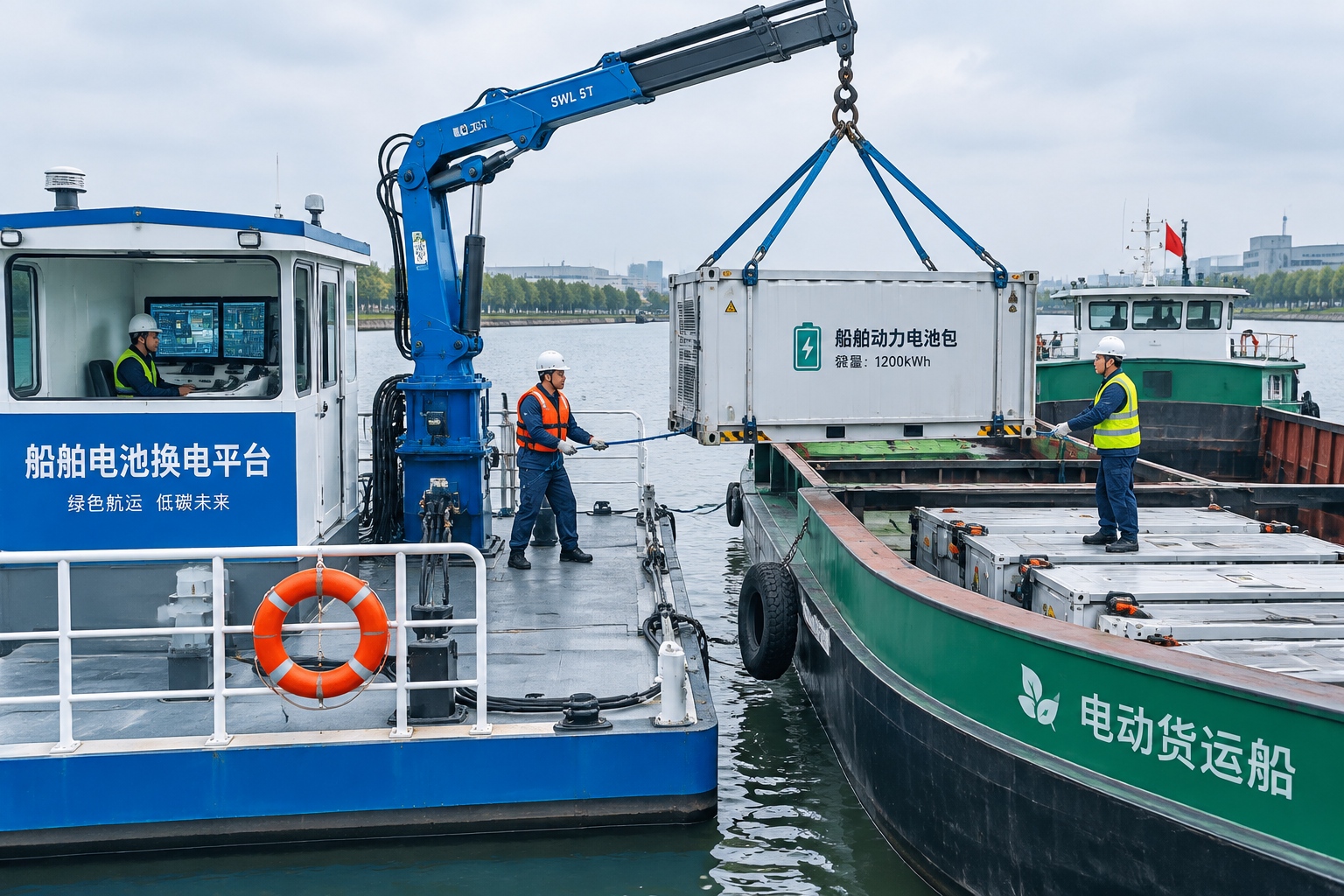
Charging a battery that size from a cable would eat most of a day, which is time a working ship does not have. So the industry borrowed a trick from Chinese scooters and cars: it made the battery removable.
On the Huzhou shuttle, the batteries sit in standardised containers. A crane on a pontoon lifts the spent boxes off the deck and drops charged ones in, a job that takes around twenty minutes — about as long as a fuel stop and a cup of tea. China Classification Society has issued guidance for these battery containers, and the current push is standardisation, so that a pack charged at one port can be used at the next.
Ports have been part of this for longer than most people realise. China has spent more than a decade fitting shore power at berths so that ships can shut down their generators while moored — unglamorous plumbing that decides whether any of the rest works.
Shipyards, battery makers, and a subsidy that cuts both ways
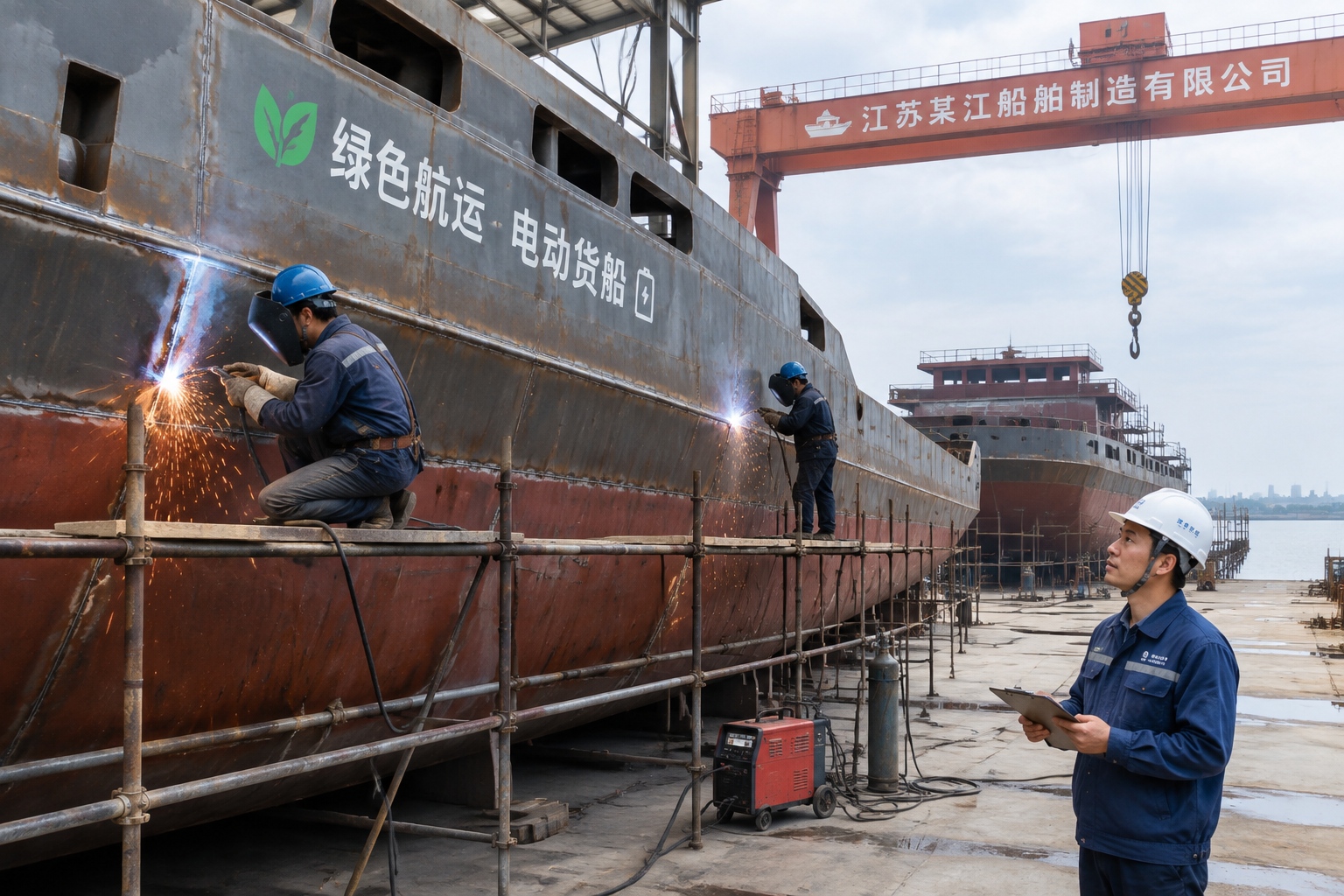
The centre of gravity is Jiangsu, where the river yards around Yangzhou, Taizhou and Nantong have been the fastest to tool up for electric hulls. Battery suppliers that built their business on electric cars — CATL, EVE Energy, Guoxuan High-Tech — now list marine systems among their products. Policy has followed: in 2023 five ministries published a plan to accelerate green and smart inland vessels, and in 2024 the transport and finance ministries began paying subsidies to scrap old operating ships and replace them, as part of a wider national equipment-upgrade programme.
The scrapping subsidy cuts in two directions. It speeds the exit of old, dirty hulls. It also sends barges that could have worked another ten years to the breakers, and somebody has to borrow money for the replacement.
The parts that aren’t easy
Range. Battery ships work where swaps are close together. That is why the successes are on defined runs: a canal corridor, a harbour shuttle, a river crossing. A 2,000-kilometre haul up the Yangtze from Shanghai to Chongqing is still diesel or LNG territory, and will be for a while.
Money. China’s inland fleet is not run by big logistics groups. A large share of barges belong to families, often one boat per household, with a hull that was paid off years ago. An electric ship costs more up front, and a battery swap is a monthly bill rather than a tank of fuel you buy when you have cash. State-owned shipping companies can absorb that. A couple running one barge has to think harder.
The grid. A swap station needs megawatts and a fat connection to the local network. Not every rural wharf has one, and building it takes longer than building the pontoon.
Upstream emissions. China’s grid is still coal-heavy, though the Yangtze basin has plenty of hydropower. Per tonne-kilometre, a battery barge charged from a mixed grid still beats a diesel one, but the gain is smaller than a zero-tailpipe picture suggests.
Standards. If two or three battery-box designs survive, swaps stay local and the economics get worse.
Why it is happening here first
Europe’s inland fleet — the Rhine, the Dutch and Belgian barge network — is also looking at electrification, and Dutch operators have been testing it. What China has is three things in the same place: a grid that can be told to run a line to a wharf, shipyards that can turn out hulls quickly, and a battery industry that already supplies most of the world’s cells. Add short, dense, repeatable routes and the arithmetic works.
The result is that the world’s largest inland fleet is also becoming the first large one to move off diesel, and almost nobody has announced it. There is no ribbon to cut at a lock in Shandong.
What to watch
Whether the battery boxes converge on one standard. How many swap pontoons appear along the canal and the lower Yangtze over the next three years. Whether family owners follow the state shipping firms, or wait. And one small thing: on the barge south of Jining, the crew have stopped noticing the silence. The interesting question is whether the boat behind them is quiet too.
Start the discussion at forum.chinacomes.com