
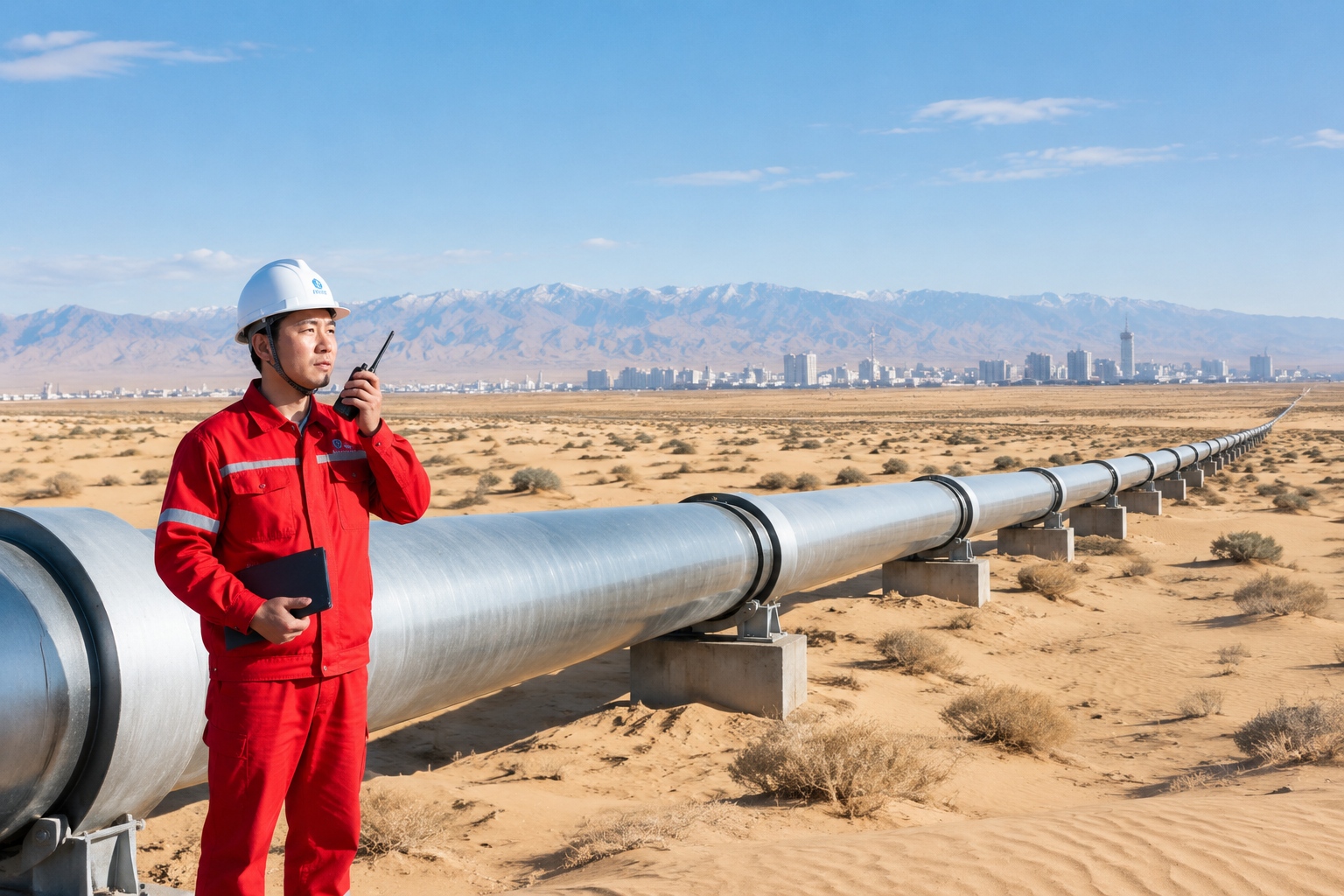

The Flame That Travels 4,000 Kilometers
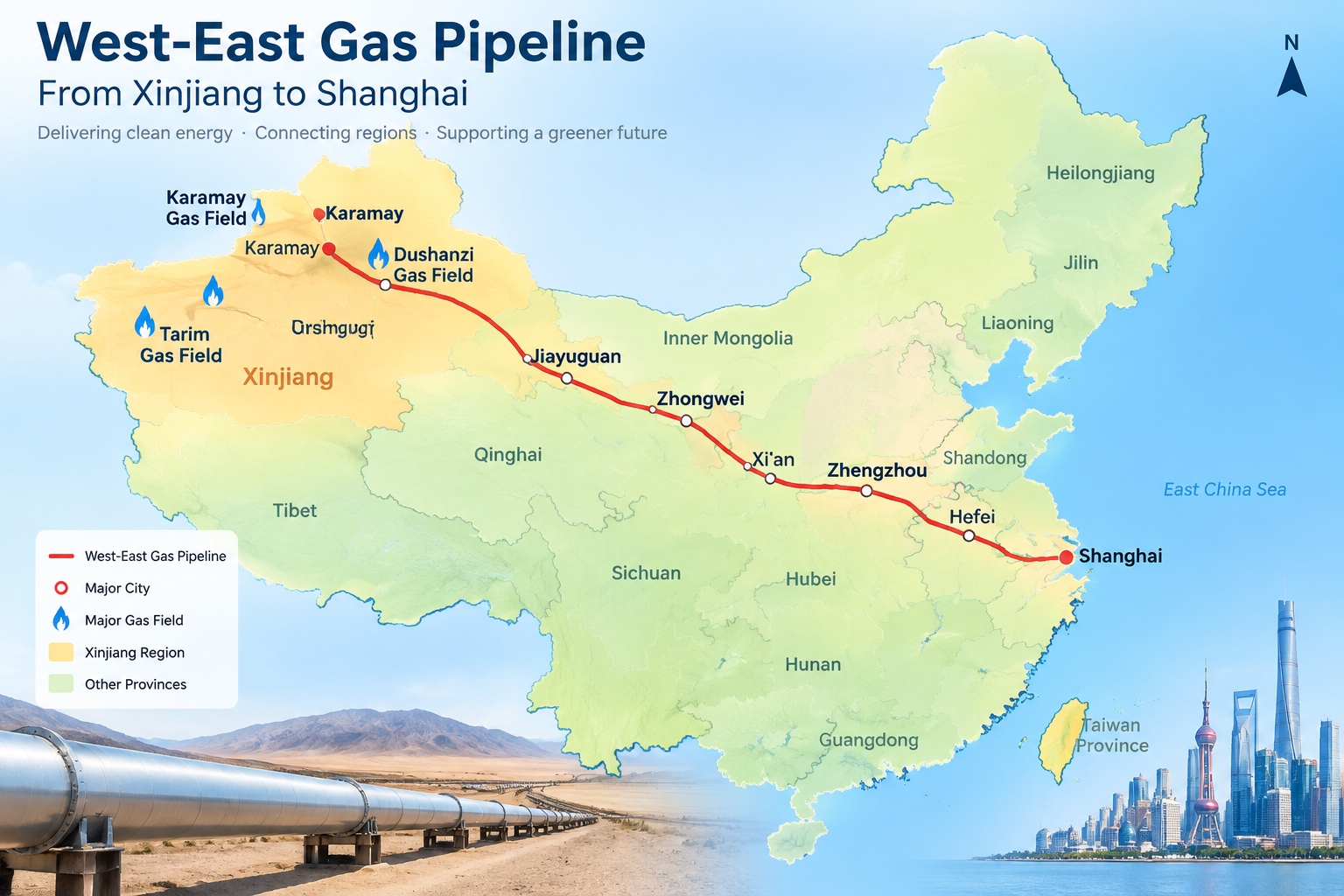
In a sixth-floor apartment in Shanghai’s Putuo District, Li Wei turns the knob on her gas stove. A ring of blue flame appears, steady and quiet. She puts a wok on it and starts dinner. It’s an ordinary moment, repeated in millions of Chinese homes every day. But the gas that feeds that flame may have traveled more than 4,000 kilometers—from a gas field in the Tarim Basin in Xinjiang, deep in China’s northwest. Before it reached her kitchen, it crossed deserts, climbed over mountains, and passed through dozens of compressor stations. The journey takes days, but for Li Wei, it is invisible. All she sees is the flame.
That journey is possible because of the West–East Gas Pipeline, a project so large it is often called the longest natural gas pipeline network in the world. It is not a single pipe but a system of lines that stretch across China, connecting the country’s energy-rich west to its energy-hungry east. For people in Shanghai, Nanjing, Guangzhou, and hundreds of other cities, the pipeline has quietly reshaped daily life—how they cook, how they heat their homes, and how factories make things.
Why China Built a Pipeline Across the Country
The logic behind the West–East Gas Pipeline is simple geography. Western China, particularly the Tarim Basin in Xinjiang, holds some of the country’s largest natural gas reserves. Eastern China, where most of the population and industry are concentrated, has little gas but enormous demand. For decades, eastern cities relied on coal and bottled liquefied petroleum gas (LPG) for cooking and heating.
Coal was cheap but dirty. It filled kitchens with soot and contributed to severe air pollution. In 2000, coal accounted for about 70% of China’s primary energy consumption. Bottled gas was cleaner but inconvenient—families had to haul heavy steel canisters up stairs and worry about running out. Both were inefficient at scale. A pipeline, by contrast, could deliver gas continuously, safely, and in large volumes. It could also replace coal in industrial boilers and power plants, cutting emissions.
The first line of the West–East Gas Pipeline began construction in 2002 and started commercial operation in 2004. It runs from Lunnan in Xinjiang to Shanghai, a distance of about 4,000 kilometers. Building it required tens of thousands of workers, who laid pipe through the Taklamakan Desert, the Loess Plateau, and across the Yangtze River. Later, Line 2 and Line 3 extended the network to Guangzhou and Fuzhou, adding thousands more kilometers. Together, the West–East Gas Pipeline system now stretches nearly 20,000 kilometers and can deliver more than 70 billion cubic meters of gas per year—enough to supply hundreds of millions of people. It now reaches more than 300 cities and 4,000 large industrial users, according to pipeline operator PipeChina.
How the Pipeline Changed Daily Life
From Coal Briquettes to a Blue Flame
For older residents in eastern cities, the change is vivid. In the 1990s, many families used coal briquettes for cooking and winter heating. A typical morning involved lighting a stove, dealing with ash, and ventilating the kitchen. Piped gas changed that. By the 2010s, most urban households in Shanghai, Jiangsu, Zhejiang, and Guangdong had access to natural gas. Turning a knob replaced hauling canisters or shoveling coal.
In Nanjing, a retired teacher named Zhang recalls the first winter after her neighborhood was connected to the pipeline. “We didn’t have to buy coal or carry gas bottles anymore,” she says. “The stove was always ready.” For her, the pipeline meant less physical labor and a cleaner home. Her gas bill is automatically deducted from her bank account, and she no longer worries about running out in the middle of cooking.

Cleaner Air, Different Factories
The impact went beyond kitchens. Industrial users were among the biggest beneficiaries. Ceramic factories in Foshan, textile mills in Shaoxing, and chemical plants in Nanjing switched from coal to natural gas. The result was less sulfur dioxide and particulate matter. According to China’s Ministry of Ecology and Environment, emissions of major air pollutants have dropped significantly since 2013, with natural gas playing a role in replacing coal in key regions. In Shanghai, the average PM2.5 concentration fell from 60 micrograms per cubic meter in 2013 to 32 in 2020, though other factors also contributed.
The pipeline also enabled winter heating in parts of northern and eastern China. In provinces like Shandong and Henan, gas-fired boilers replaced coal-fired ones. While the “coal-to-gas” transition has faced challenges—sometimes gas supply couldn’t keep up with demand—it has improved air quality in many cities. For factories, gas is more expensive than coal, but it burns more cleanly and requires less maintenance. In the ceramics hub of Foshan, Guangdong, more than 80% of kilns now run on natural gas, up from less than 10% in 2010, according to local government data. A factory owner told a local newspaper that switching to gas reduced defects in his products and made his workers healthier.
The Costs and Challenges Behind the Flame
Maintenance and Geological Risks
Building and maintaining a pipeline across 4,000 kilometers is not easy. The line crosses the Taklamakan Desert, the Loess Plateau, and several seismic zones. It must withstand extreme temperatures, shifting ground, and corrosion. Operators use intelligent inspection devices called “pigs” to monitor the inside of the pipe, and they conduct regular emergency drills. Any leak or rupture could be catastrophic. In 2013, a pipeline explosion in Qingdao killed 62 people, a reminder of the risks involved in moving gas at high pressure.
Supply Security and Price
China’s domestic gas production is not enough to meet demand. The country imports natural gas from Central Asia via pipelines and liquefied natural gas (LNG) from Australia, Qatar, and the United States. In 2021, China’s gas imports reached 160 billion cubic meters, making it the world’s largest importer. This makes supply vulnerable to international price swings and geopolitical tensions. In winter, when demand spikes for heating, some factories are asked to curtail production to ensure residential supply. In 2021, a global energy crunch pushed LNG prices to record highs, and some Chinese industrial users faced higher costs.
Price is another issue. Residential gas prices in China are often regulated by local governments, while industrial users pay market-based rates. This cross-subsidy keeps household bills affordable but can distort the market. For families, the cost of cooking with gas is still lower than using electricity or bottled gas in most cities, but it is not free. In Shanghai, residential gas costs about 3 yuan per cubic meter, while industrial users may pay more than 4 yuan. The difference is absorbed by the system.
The Limits of a Pipeline
Not everyone is connected. Many rural villages and small towns still rely on coal, wood, or bottled gas. Extending pipelines to remote areas is expensive, and the economics don’t always work. In some regions, the “coal-to-gas” program was implemented too quickly, leading to shortages and complaints. The West–East Gas Pipeline is a remarkable piece of infrastructure, but it is not a universal solution. It serves mostly cities and large industrial parks, leaving a patchwork of energy sources across the country.
Conclusion: The Same Flame, Four Thousand Kilometers Away
Back in Li Wei’s kitchen in Shanghai, the blue flame continues to burn. It looks like any other flame—ordinary, almost invisible. But it is the end point of a journey that begins in a desert in Xinjiang, passes through compressor stations, crosses rivers and mountains, and finally arrives at her stove. The pipeline didn’t just change energy logistics; it changed the texture of daily life. It made cooking cleaner, factories less polluting, and winters warmer for millions of people. It is a quiet revolution, one blue flame at a time.
Start the discussion at forum.chinacomes.com