
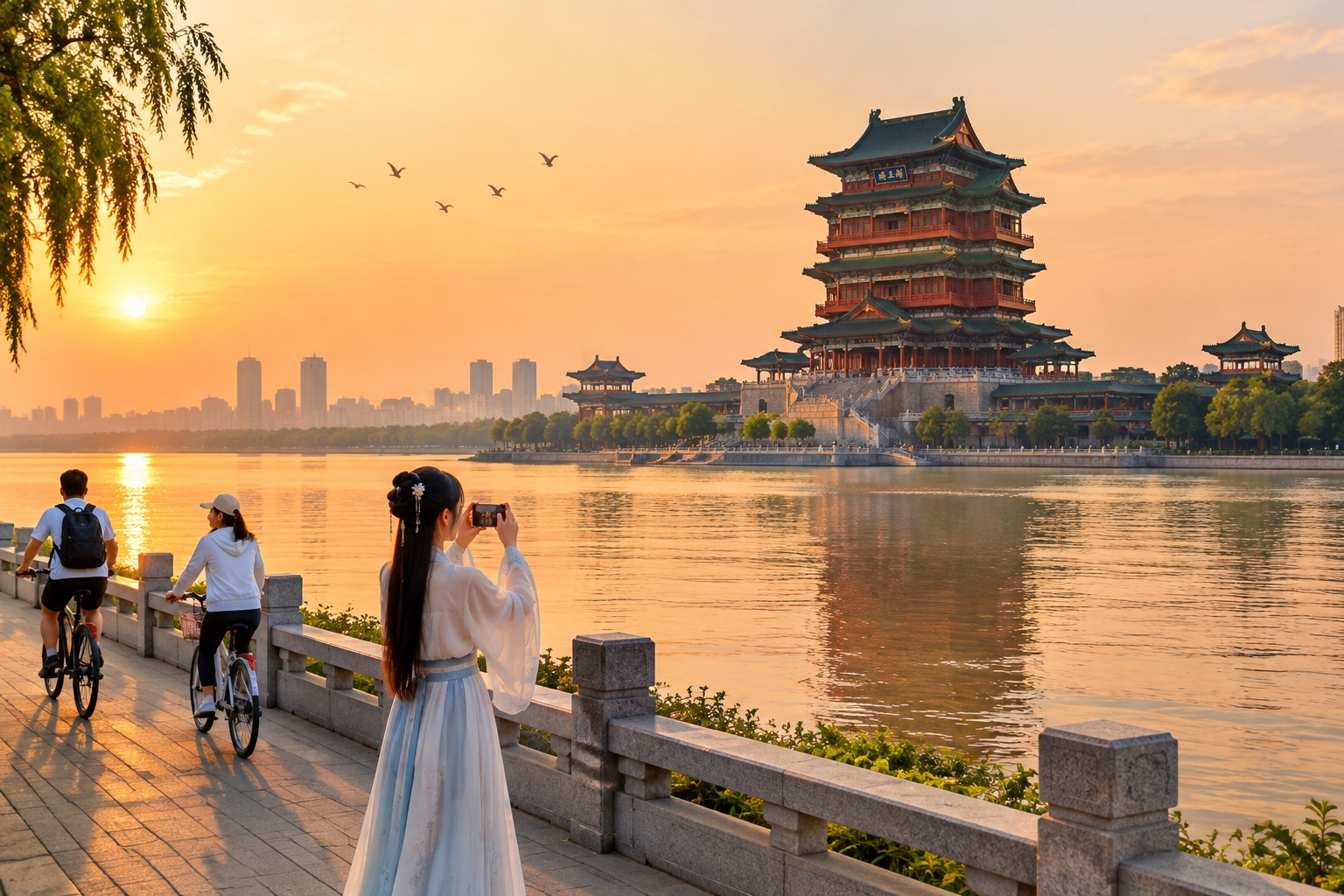

A Poem, a River, and 5:40 p.m.
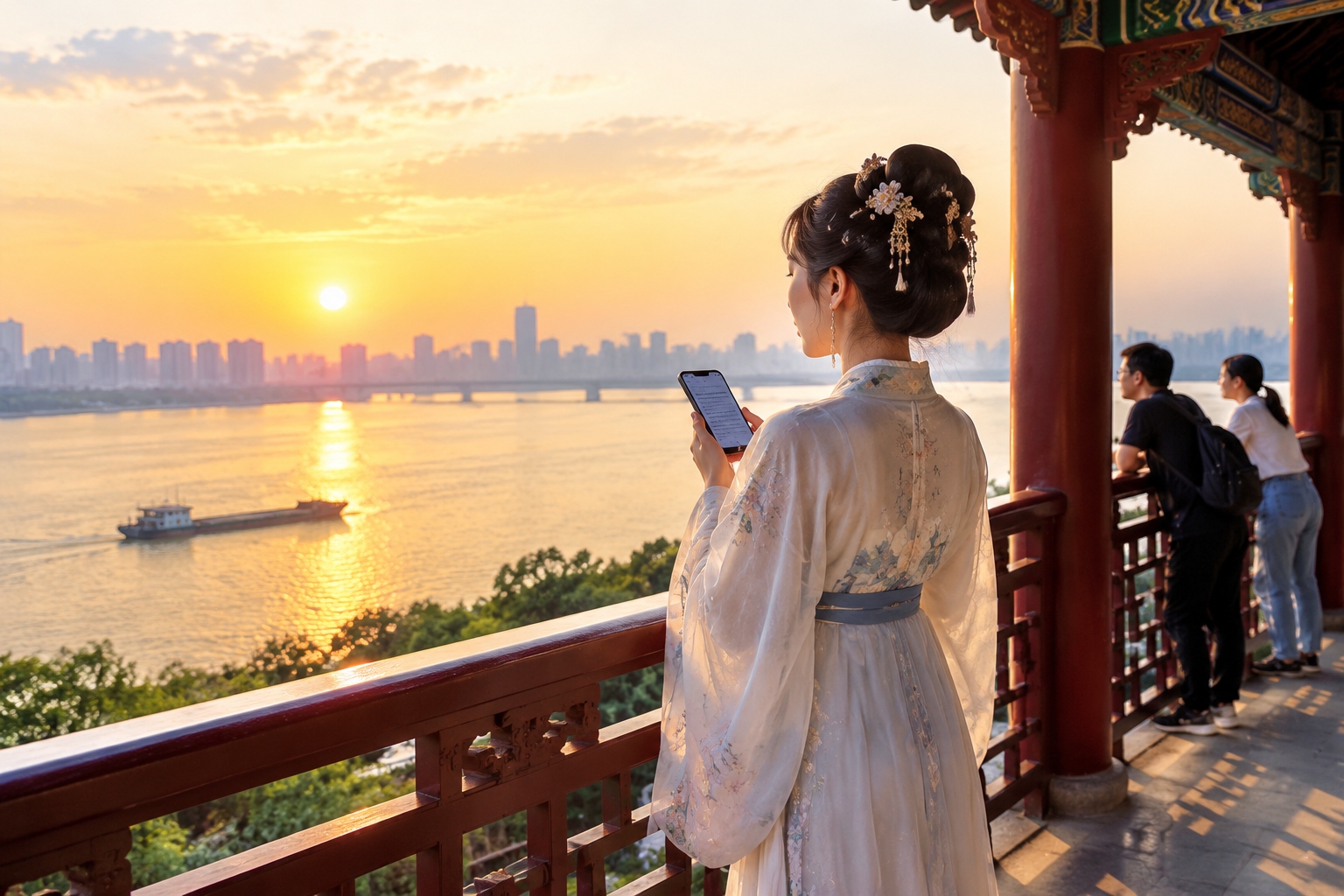
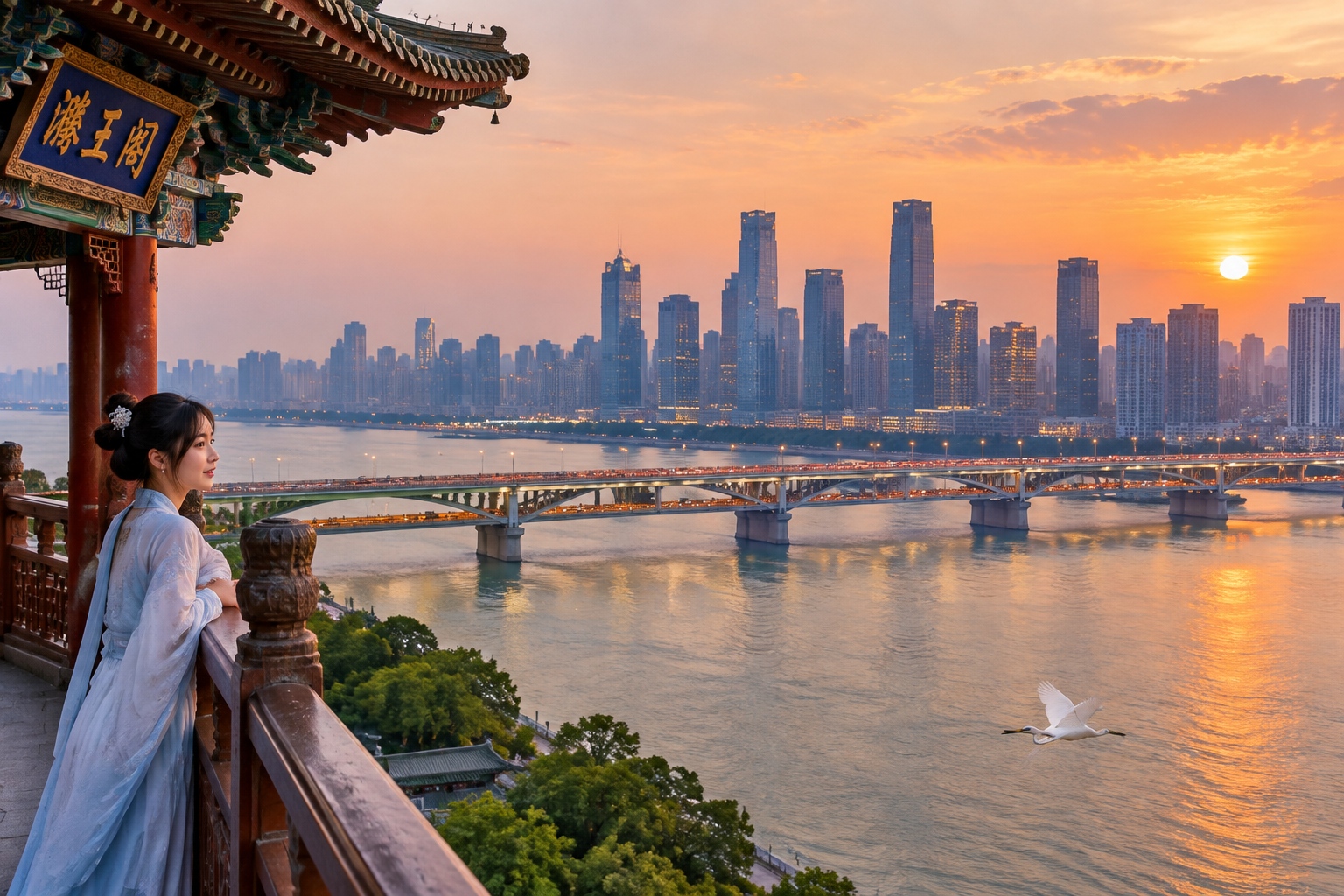
The wind on the top gallery of the Pavilion of Prince Teng smells faintly of river water and, from somewhere down the hill, of fried rice. It is 5:40 on an October afternoon and the Gan River below has gone the colour of weak tea. A woman in a wide-sleeved Tang-style robe stands at the railing with her phone held out in front of her, reading aloud — not to anyone in particular, just reading, in the flat, careful voice of somebody who has practised.
She is reciting the Preface to the Pavilion of Prince Teng, a piece of parallel prose written in 675 AD by a 25-year-old named Wang Bo. Almost anyone in China who finished middle school can produce its two most famous lines from memory. At dusk up here, you will usually hear them more than once.
落霞与孤鹜齐飞,秋水共长天一色。
Word for word: falling sunset-clouds and a lone wild duck fly together; autumn water and the long sky are one colour. A common English rendering goes something like the sunset clouds and a solitary duck fly together; the autumn river and the vast sky merge into one hue. The Chinese is tighter and more physical than that. It is not describing a scene so much as pinning a single second to the page: two things moving at once, and water and sky refusing to stay separate.
That is why people climb up here at the end of the day. The building is a container for one sentence.
A Building That Has Been Destroyed About 29 Times
Here is what nobody tells you before you arrive, and it is the most interesting fact about the place: the Pavilion of Prince Teng has been destroyed and rebuilt roughly 29 times by most counts.
Wang Bo was writing about a pavilion built in 653 by Li Yuanying, a younger brother of the Tang emperor, who had been posted to this bend of the Gan River as a provincial governor. Wang Bo passed through in 675 on his way to visit his father, was handed a brush at a banquet, and wrote the text that made the building immortal. Less than a year later he drowned crossing the sea on his way south, aged 26.
After that the pavilion burned, was struck by lightning, was wrecked in war, was rebuilt by Song, Ming and Qing officials, rebuilt again after the Taiping Rebellion, and rebuilt again after a fire in 1926. What you climb today is a concrete-and-timber reconstruction finished in 1989 — nine storeys, 57.5 metres tall, in Song style, partly based on drawings the architect Liang Sicheng made in 1942 for a rebuild that never happened.
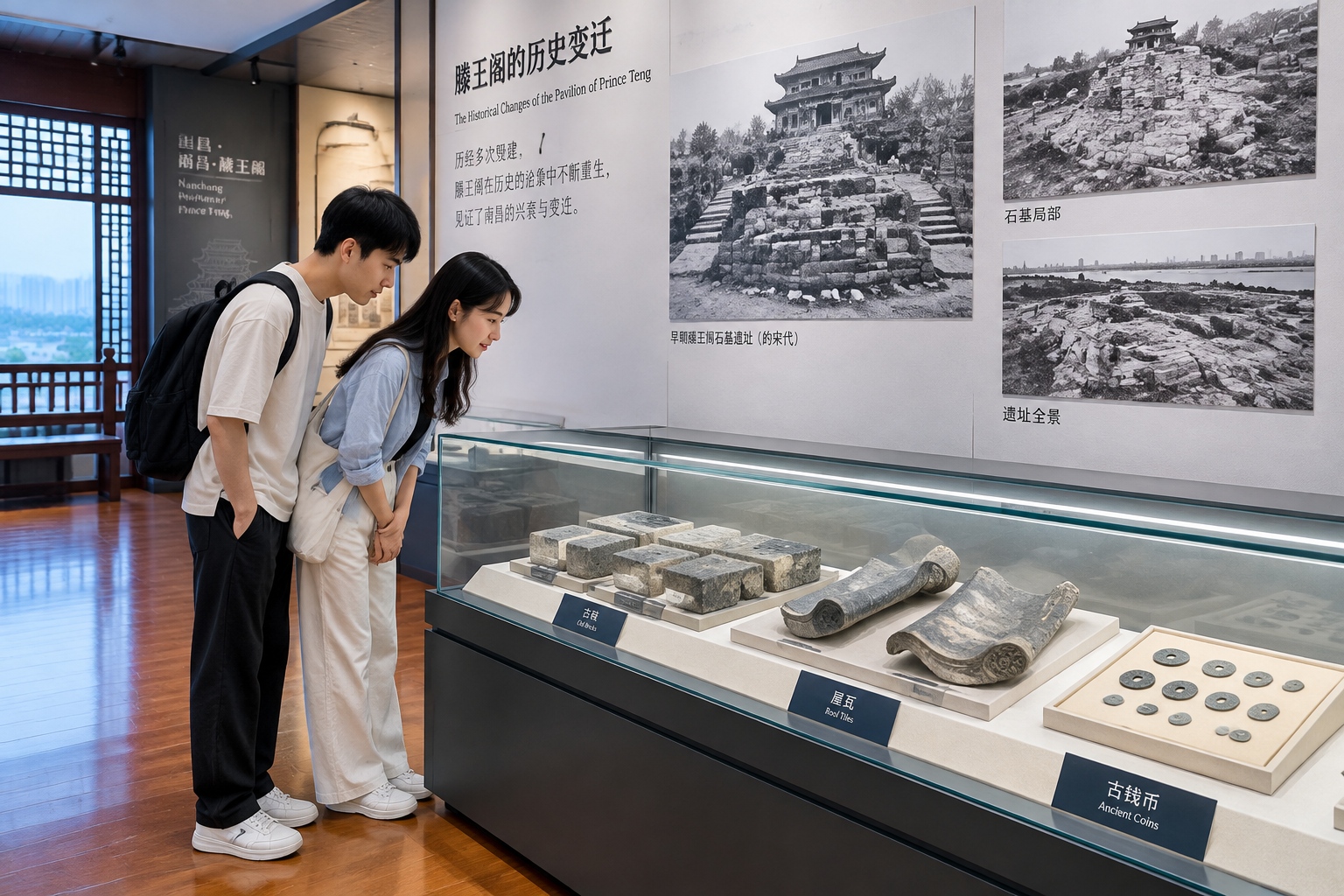
This is not a disappointment. It may be the opposite. On the second floor there is a small exhibition of bricks, roof tiles, coins and repair records dug out of earlier versions of the pavilion, alongside photographs of the 1942 site: a bare stone base and weeds. You are looking at a building that exists because generation after generation kept deciding it should.
Which Floors to Climb, and Which to Walk Through
The pavilion is a stack of experiences, and it is easy to spend ninety minutes on the wrong ones.
- Ground floor: a large bronze relief and the ticket gates. Busy and loud. Move through.
- Floors 2 to 4: ceramics, calligraphy, a room of reconstruction relics, and galleries of 20th-century Chinese painting that are surprisingly good and almost empty, because everyone is queueing for the view.
- Floor 5: the open gallery, the famous external walkway with the red railings everyone photographs.
- Floor 6: the top viewing level, where the Gan River, the bridge and the new city across the water line up properly.
The quietest thing in the building, and the one I would keep if I could only keep one, is a wall of literary replies. For roughly 1,300 years, poets who came here wrote their own poems back at Wang Bo. Dozens survive. A few are excellent, most are not, and the display has the honesty to show both.
The People Who Keep the Poem Alive
What turns the pavilion from a photo stop into something else is the crowd.
On the afternoon I visited — a Thursday, not a holiday — the gallery held three university students in rented hanfu taking two hundred photographs of each other; a man in his sixties in a plain grey jacket reciting the whole Preface from memory with his eyes shut; a mother reading the poem aloud to a bored seven-year-old; and a group of middle-aged women passing around a thermos of hot water.
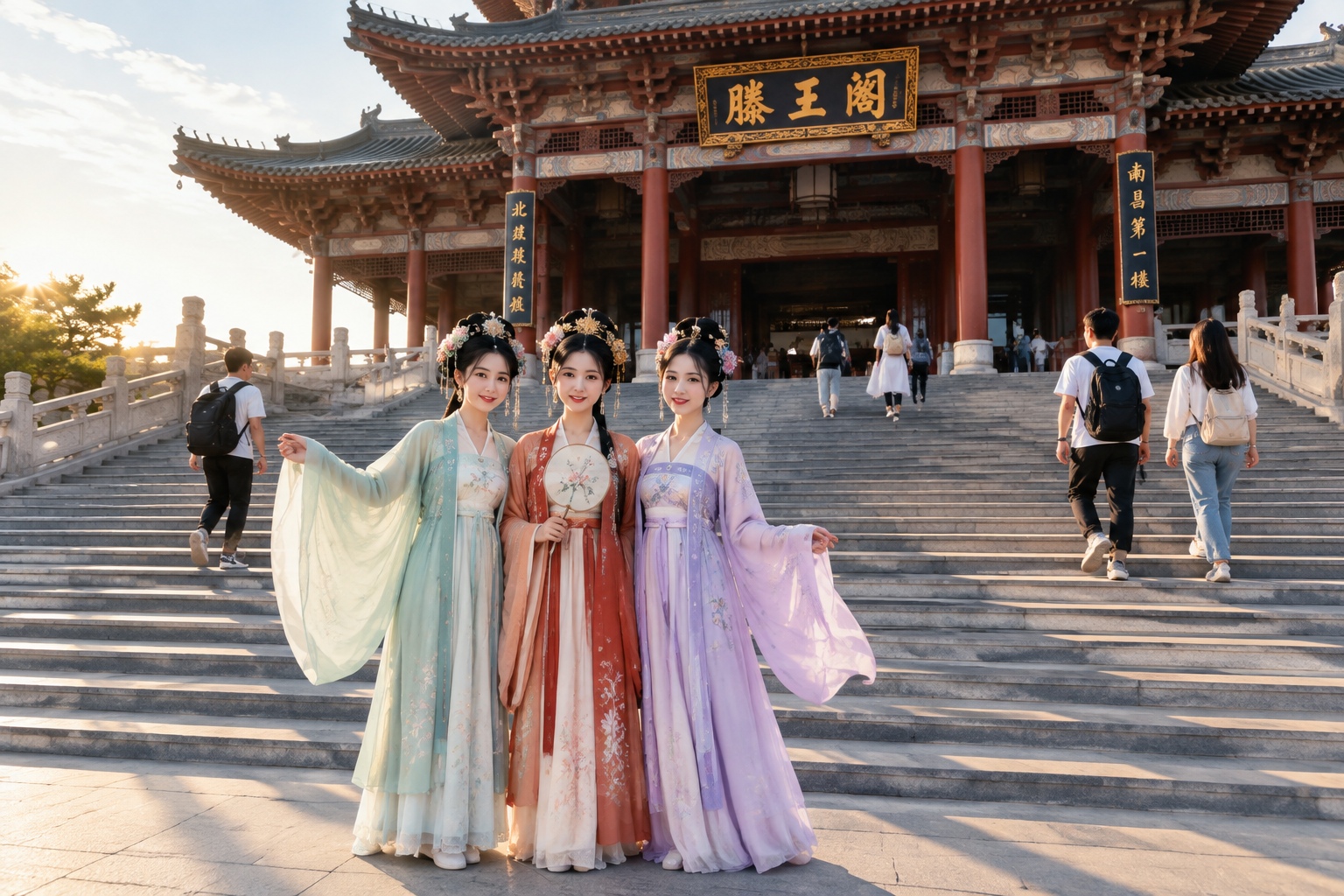
Renting a Tang or Song outfit at the gate costs roughly 100 to 200 yuan and comes with hair styling and half an hour of a photographer’s time. To Western eyes it can read as cosplay. Talk to the people doing it, though, and the description is usually closer to re-enactment — a way of standing inside a poem rather than just reading one.
The pavilion leans into this. In recent years it has run an offer at the gate: recite the full Preface from memory, no prompts, and your ticket is free. The text runs about 770 characters and takes most people three to six minutes. On a busy weekend a short queue forms.
Sunset Over the Gan, and the Bridge Wang Bo Never Saw
Stand on the sixth-floor outer walkway facing north-west about 40 minutes before sunset and you get the composition everyone is hunting for. Below and to the left, the Gan River, wide and green-brown, with a barge moving downstream. Straight ahead, the Bayi Bridge: a double-decked road-and-rail crossing opened in 1997, cars on top, the Beijing–Kowloon railway underneath. It is not a beautiful bridge, but at dusk the traffic on it turns into a line of moving lights and it works as a horizon.
Across the river is Honggutan, a district of towers that did not exist twenty years ago. Behind you is the older city and the imitation-ancient shopping street at the north gate.
The lone wild duck is still possible. Egrets and herons work the shallows on the east bank, and on most evenings a bird crosses the frame at some point during the twenty minutes of best light. Nobody catches it in time. That is fine. Wang Bo probably did not either.
If You Go
Getting There
Metro Line 1 to Tengwang Pavilion station, then a walk of about eight minutes toward the river. The pavilion sits on the east bank of the Gan River in Donghu District. A taxi from Nanchang West railway station takes 30 to 40 minutes depending on traffic.
Tickets and Timing
Adult admission is around 50 yuan (roughly US$7); students, seniors and children pay less. Daytime hours run about 8 a.m. to 6 p.m. The free-recitation offer comes and goes, so ask at the gate rather than counting on it.
Arrive 60 to 80 minutes before sunset so you can work through the lower floors before the light goes. Sunset in Nanchang falls around 5:20 p.m. in December and around 7:15 p.m. in June. Late spring and October are the comfortable months; July and August are punishingly humid, and the upper galleries have little shade.
Worth Adding
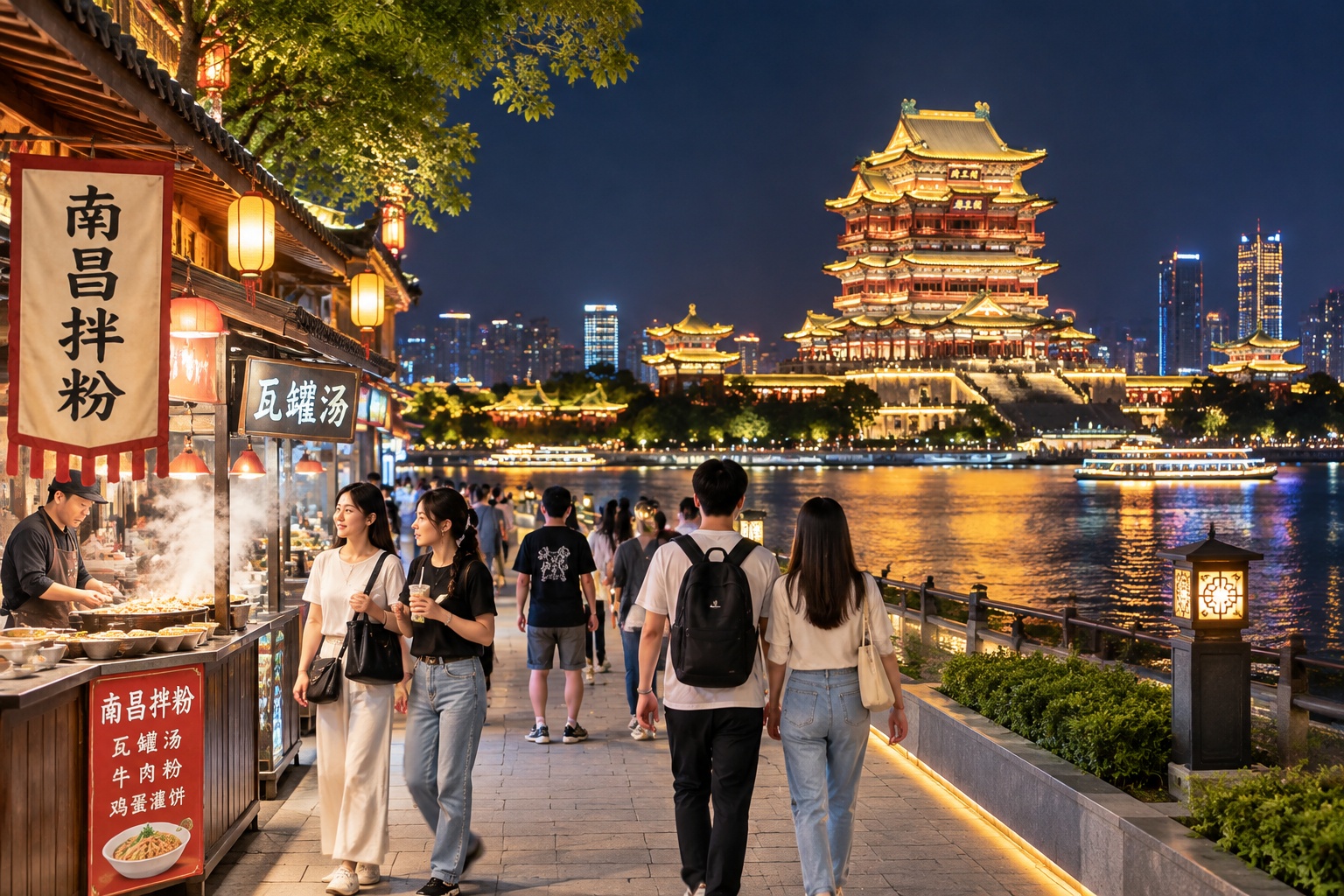
Wanshou Palace historic block, a 15-minute walk away, for street food and a completely different crowd. In summer the pavilion has also run evening sessions with the building lit up and river cruises running — check locally before you plan an evening around it.
Last Light
By 6:20 it is over. The woman in the Tang robe has gone, the gallery empties, and the guards begin the polite circling motions that mean down. Along the riverbank the lights come on, and the towers opposite line up in rows of blue-white windows.
You walk out through the north gate into a shopping street selling the same souvenirs as every other historic site in the country. A speaker outside a tea shop is playing a recording of the Preface. You do not understand it. You have heard it four times today. That is more or less how a piece of writing survives for 1,350 years: not in a museum case, but on a Thursday, at 5:40 in the afternoon, said out loud by a stranger with a phone.
Start the discussion at forum.chinacomes.com