

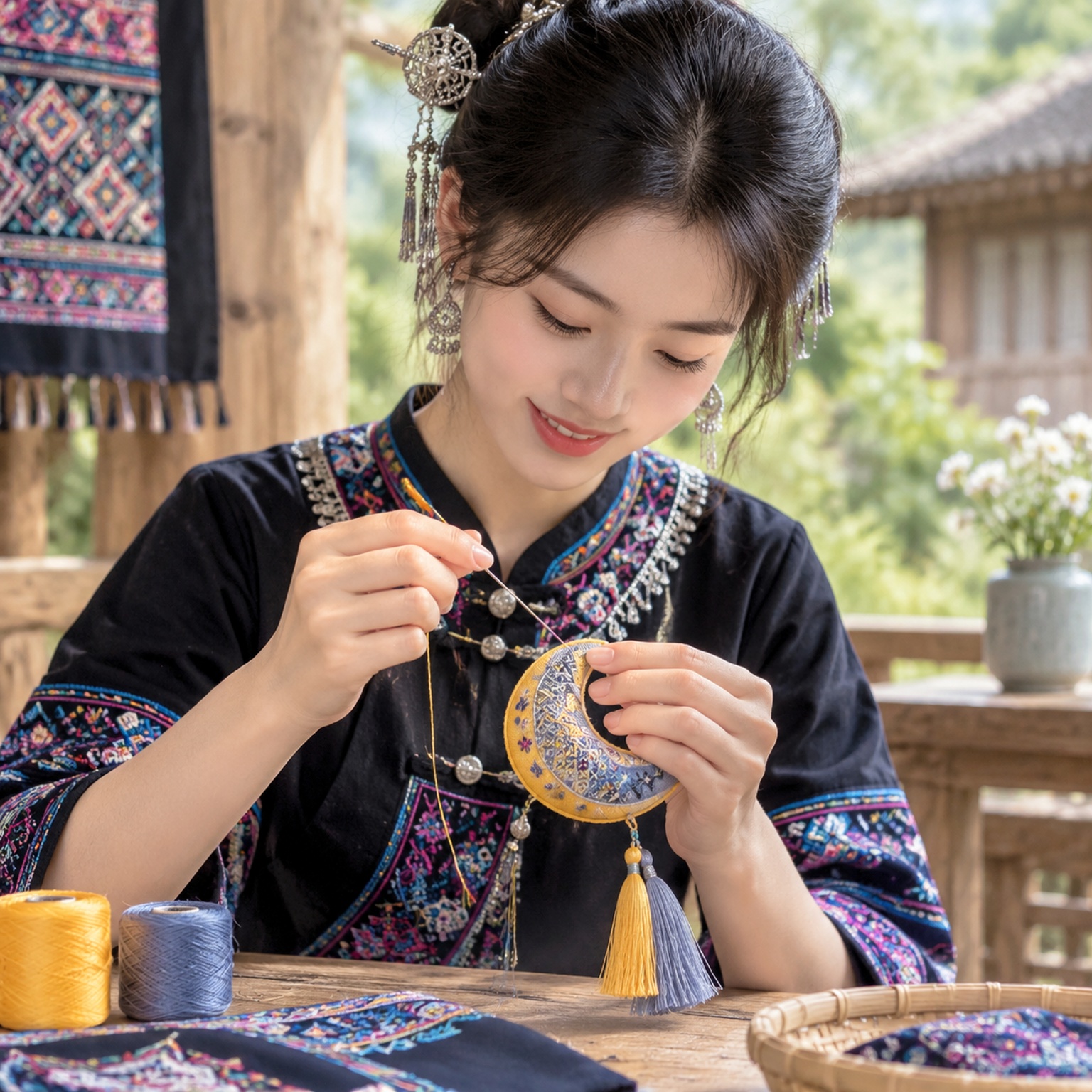
On a sunny morning in Nanning, the capital of Guangxi in southern China, Huang Lijuan is doing two things at once. Her hands are busy with a needle, sewing the edges of a fist-sized sachet, while her phone buzzes with a new order. The sachet is shaped like a moon, with tassels in muted yellow and gray—not the bright red and green you might expect from a “traditional” Chinese craft. “This design is for a Japanese client,” she says, without looking up. “She wants something that goes with a beige coat.”
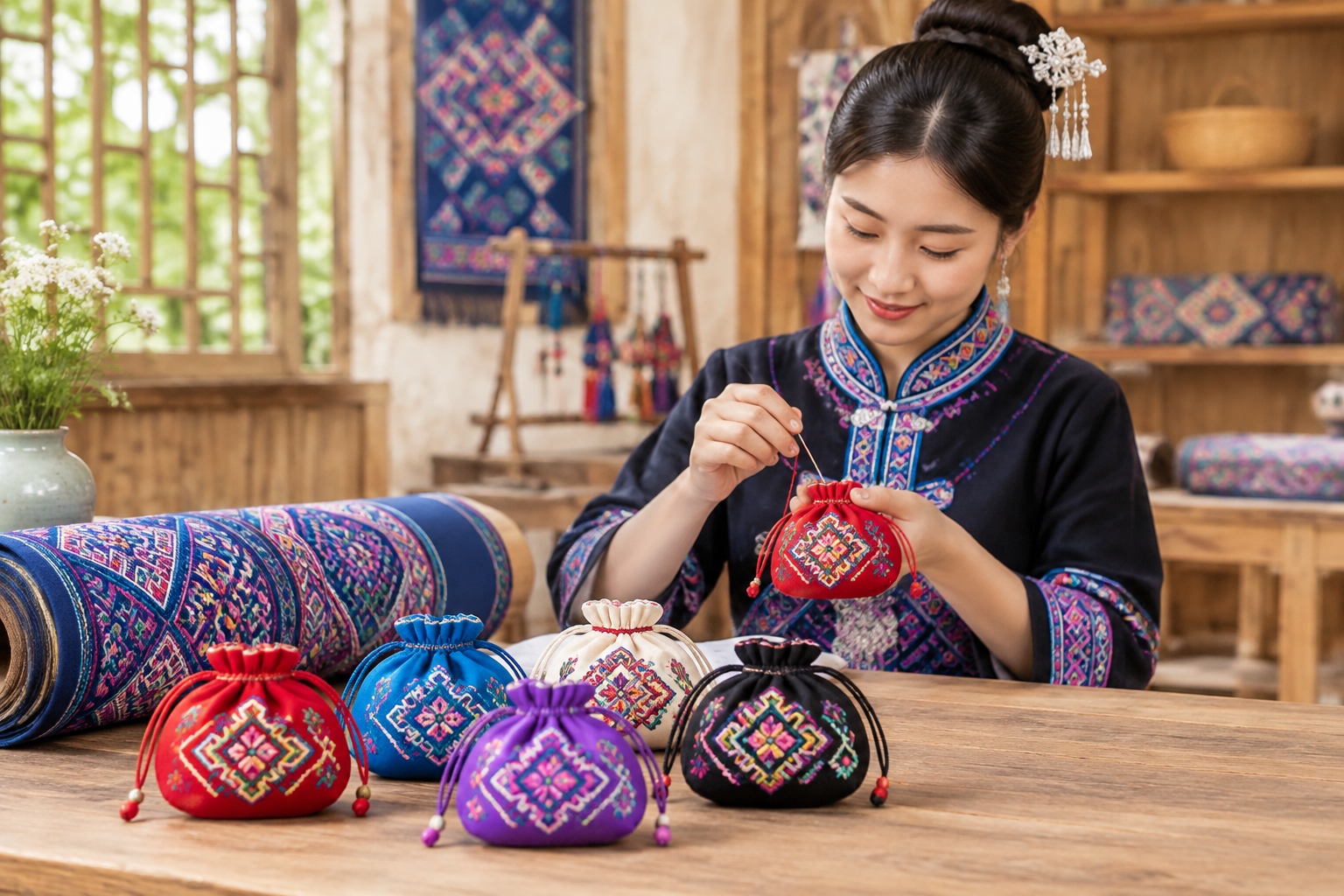
Huang is part of a quiet revolution in one of China’s most culturally rich but often overlooked regions. Guangxi, a mountainous province bordering Vietnam, is home to the Zhuang people, China’s largest minority group. For centuries, Zhuang women have made two signature crafts: zhuangjin (Zhuang brocade), a heavy woven textile with geometric patterns; and xiuqiu, embroidered sachets typically shaped as spheres or hearts, often filled with herbs and worn as love tokens. Both are now inscribed on China’s national intangible cultural heritage list—and both are finding new audiences in the age of fast online shopping.
This is not a story about preserving artifacts in glass cases. It’s about living crafts adapting to modern taste, and about how a consumer in London or Los Angeles can end up with a piece of a Zhuang girl’s history in their shopping cart.
A Love Token with a Modern Twist
The xiuqiu is perhaps Guangxi’s most recognizable cultural export. Traditionally, a Zhuang girl would hand-stitch one for a man she loved, hiding small mirrors or seeds inside as symbols of luck and fertility. During festivals, young people would toss them to express affection. The classic form is a round ball made of 12 petals, but contemporary versions have exploded into a universe of shapes: stars, moons, even coffee beans.
In a workshop on the outskirts of Nanning, I watched a group of women assemble sachets with machine precision, but the hand-stitching remains. The workshop is run by a cooperative that connects families from nearby villages to urban customers. “Before, we sold at market for 5 yuan each. Now, we sell online for 50 yuan, and if you add a design or custom embroidery, it’s 100 yuan,” says Wei, a 50-year-old who has been embroidering since she was nine. The extra income matters in a region where farming is the only alternative.
Younger designers are pushing the craft further. In a studio in Shanghai, a designer named Chen Le has been incorporating xiuqiu into jewelry—miniature sachets hanging from earrings or attached to handbags. “The technology is simple, but the meaning is deep,” she told me. “It’s a little secret pocket you can carry. I think that’s universal.”
Zhuang Brocade: A Fabric That Took Centuries to Weave
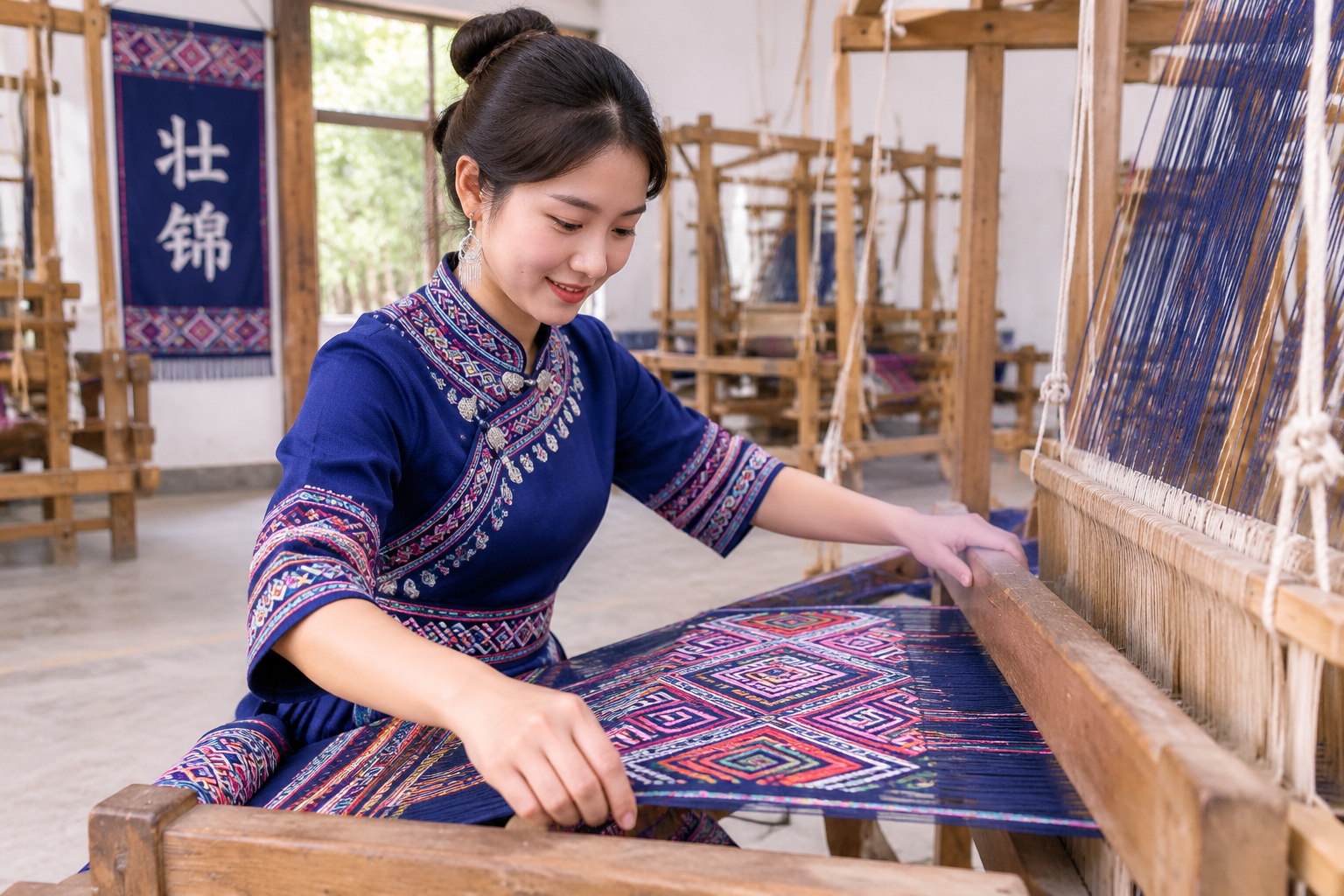
Zhuang brocade is less famous than sachets but arguably more significant. It’s a thick, durable fabric woven on wooden looms, with patterns that carry symbolic meanings—the frog represents rain, the dragon represents power. The dye comes from plants and minerals: indigo for blue, sappanwood for red, and sometimes a particular yellow from a local herb.
The problem is that the traditional process is painfully slow. A skilled weaver can produce only a few centimeters in a day. This made brocade expensive and, in an era of machine-made textiles, nearly obsolete. By 2000, only a handful of elderly women still knew how to do it.
But the revival is real. Local governments have set up “brocade villages” where master weavers take apprentices. Fashion designers have embraced the fabric for jackets, bags, and even sneakers. A university in Nanning now offers a course in Zhuang textile design, blending digital pattern software with hand weaving. Visitors to the region can watch weavers at work at places like the Guangxi National Museum, but the more interesting scene is on Instagram, where a young woman from Bama County posts photos of her brocade-covered iPhone cases.
The E-commerce Effect: From Village to Global Mailbox
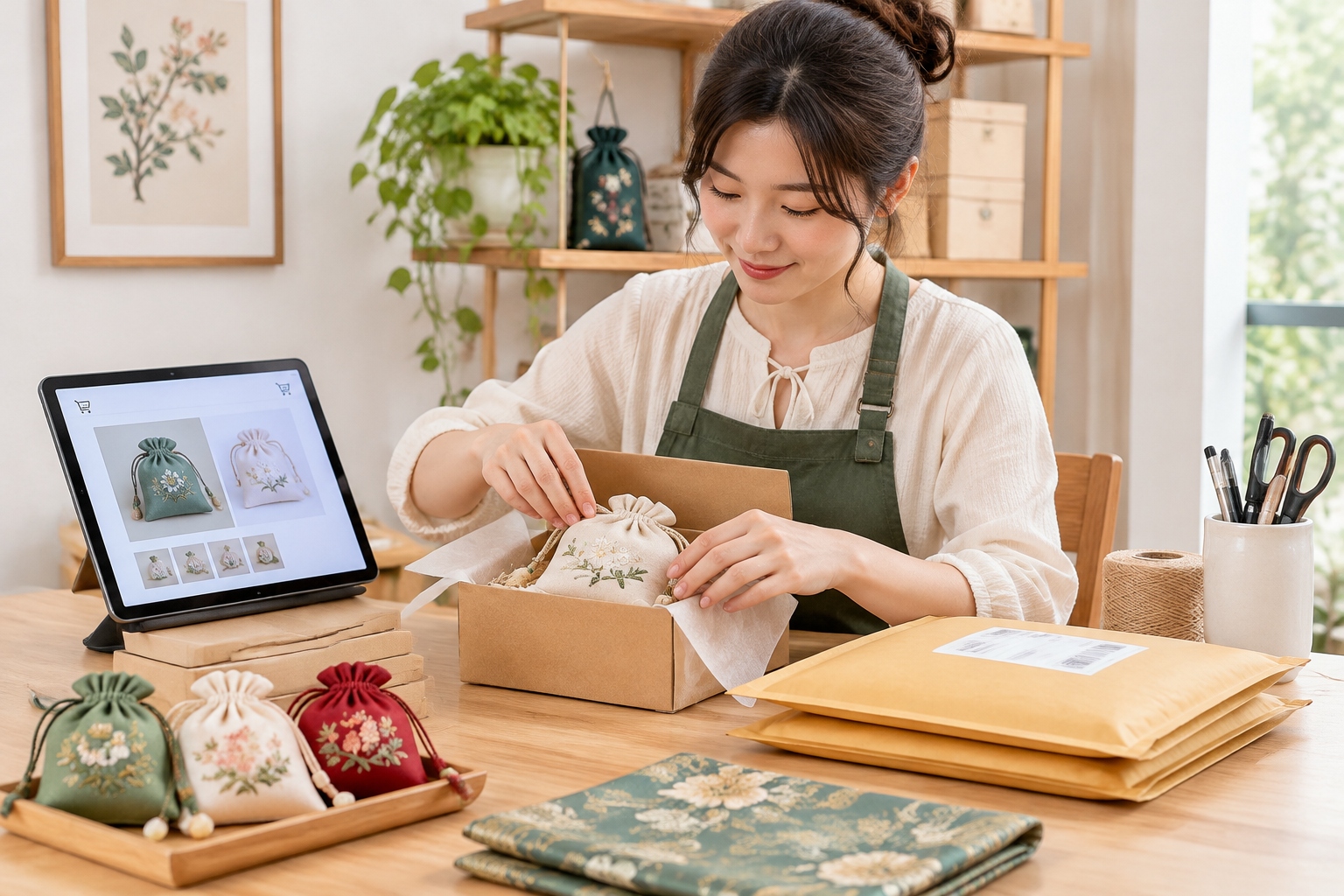
If you are reading this from outside China, you might be curious about how a tiny sachet from an inland village ends up in your mailbox. The answer lies in the same digital infrastructure that does everything else in China: mobile payments, live-streaming, and hyper-efficient logistics.
On Taobao, China’s largest e-commerce site, sellers like “Guangxi Feelings” offer custom sachets with free shipping to anywhere in the world. A typical listing shows a video of a Zhuang woman narrating her craft as she stitches. In recent years, platforms like Alibaba’s “Taobao Village” program have helped rural artisans set up online shops, sometimes teaching them how to package goods and write product descriptions.
The results can be surprising. A craftsman in Jingxi County told me he once received an order from Paris for 200 xiuqiu-shaped keychains. He had never heard of Paris, but his daughter looked it up on her phone. “The customer wanted them for a fashion show gift bag,” he said, grinning. “I thought, these old things can go places.”
Live-streaming has become a powerful tool. A Douyin (Chinese TikTok) streamer may sit on a hilltop in Guangxi, surrounded by colorful sachets and brocade, explaining to 20,000 viewers why a particular pattern is called “the happiness of a hundred birds.” Some streams end with a “limited drop” of 100 handmade pieces, which sell out in seconds. The combination of storytelling and urgency taps into the same psychology as luxury brand drops in the West, but here the “luxury” is a centuries-old skill.
What Western Readers Might Find Familiar
If this resonance feels familiar, that’s because the West has had its own crafts revivals. Think of the Arts and Crafts movement against Victorian industrialization, or the current appreciation for “slow fashion” and handmade ceramics in Scandinavia and Japan. The difference is that China’s revival is happening at a larger scale and with more digital acceleration. Where a French embroiderer might sell on Etsy, a Zhuang artisan can reach the same global consumer but also a domestic market of 1.4 billion people, many of whom are eager to reconnect with rural roots.
There is also a political dimension. In China, intangible heritage (非遗) is promoted by the government as a way to build cultural confidence and support rural development. That means subsidies, tax breaks, and state-sponsored exhibitions. One sees this in the rise of “national style” (国潮) brands, which use traditional motifs in sneakers, tea boxes, and even cosmetics. Zhuang patterns are now spray-painted on walls in Nanning’s art districts and printed on mugs sold in museum shops.
Yet the transition is not always smooth. Some purists worry that the crafts are being “diluted” for the mass market, that a sachet filled with polyester instead of herbs is not really Zhuang anymore. There is also the persistent problem of machine knockoffs. On e-commerce sites, cheap machine-made sachets are labeled “handmade”, undercutting the artisan work.
Wei, the embroiderer, has a pragmatic view. “People used to think this was only something you did for your loved one. Now it’s a product. But the hands still do the same work. I’m not going to turn away a customer just because she likes the color gray.”
Heritage Is Not a Museum Piece
Every year, thousands of tourists visit Guangxi’s famous rice terraces and karst mountains. In the evenings, they watch performances with dancers holding giant xiuqiu. That might seem like a tourist trap, but it is also how traditions survive. For young Zhuang people, seeing their heritage honored gives them a reason to learn the craft.
The next time you see a colorful ball ornament in a travel store or a brocade pencil case on a design website, you are looking at a living dialogue between a village woman and a global consumer. The thread, the pattern, the careful stitching—it all carries a history that hasn’t ended. It’s just being chosen, adapted, and loved by people who never expected to own a piece of it.
Start the discussion at forum.chinacomes.com