

7 a.m. on the Square Outside Dazhao Temple
The first thing you notice is not the building. It’s the smell.
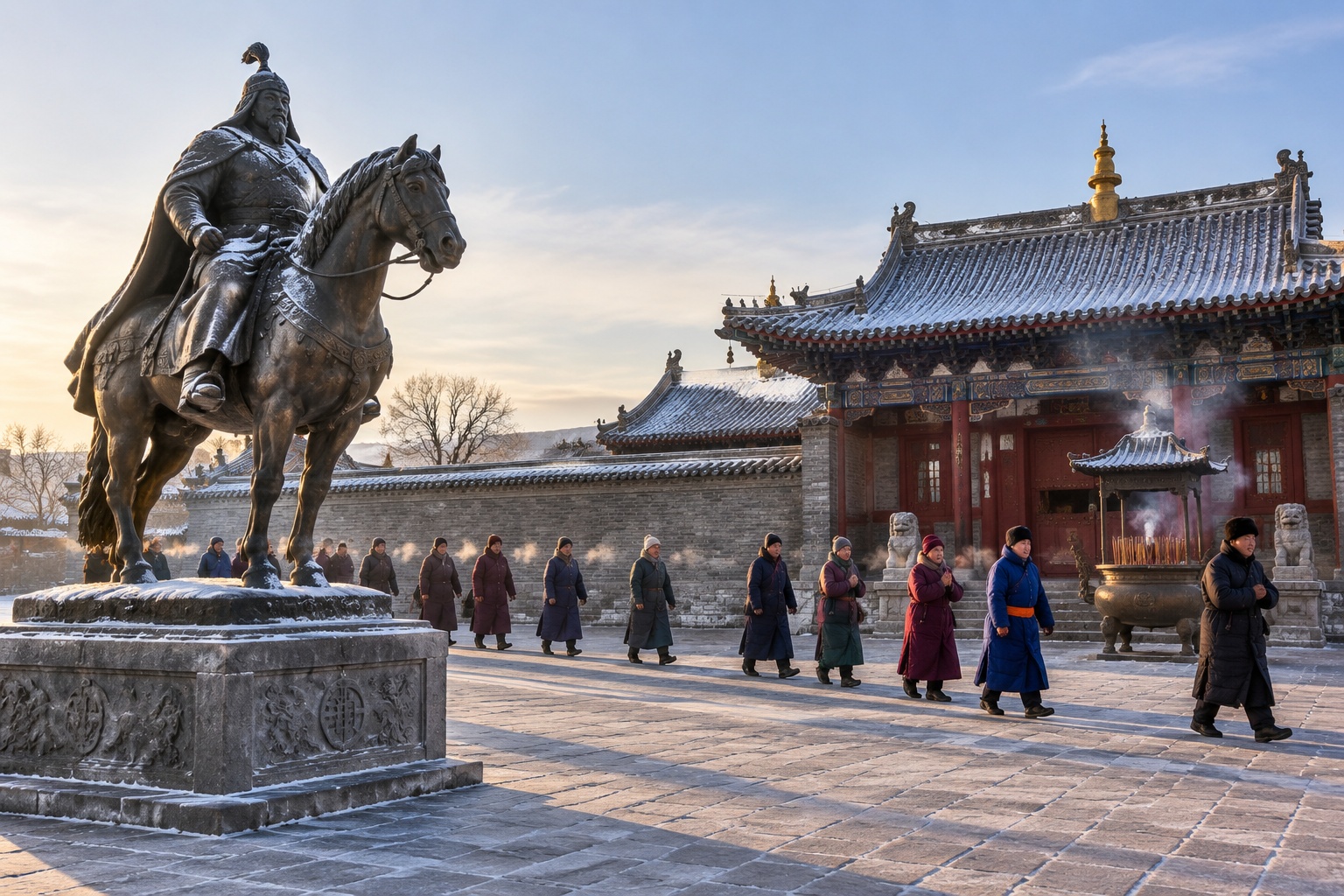
Butter — the sharp, faintly smoky smell of yak butter burning in dozens of small copper lamps — drifts out through the temple doorway and across the grey stone square, mixing with cold air coming down off the mountains north of the city. It is minus nine degrees Celsius. My phone says the sun rose eleven minutes ago. Nobody around me seems to have noticed.
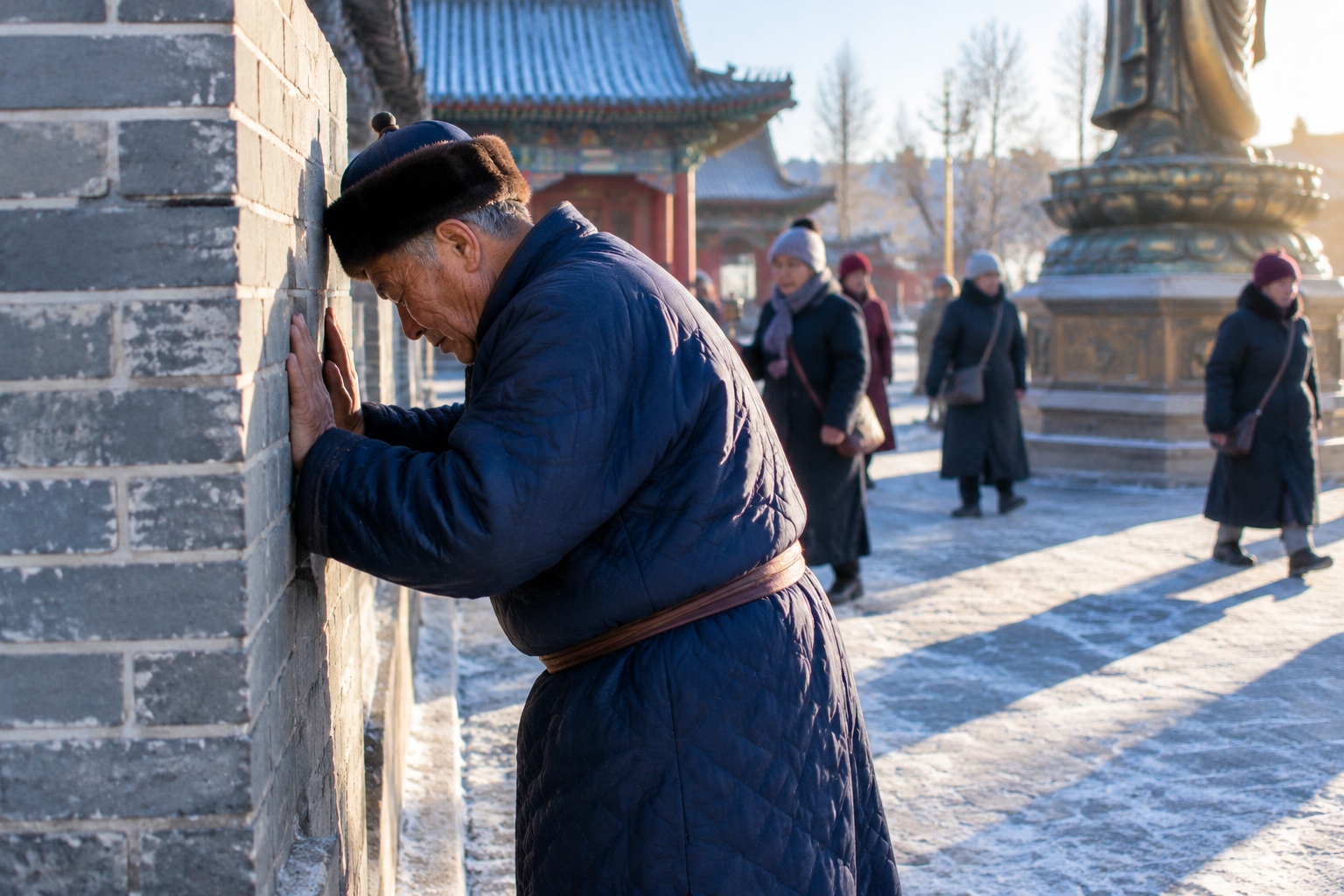
Behind me stands a mounted bronze of Alatan Khan, the 16th-century Mongol leader who founded this city and commissioned the temple in front of me. Around his plinth, a slow current of people moves clockwise: women in quilted coats and knitted hats, a few men in dark blue deel — the Mongolian robe — carrying plastic bags of fruit and boxes of milk. An old man stops at the corner of the wall, presses both palms flat against the brick, and bows his head for maybe fifteen seconds. Then he picks up his bag and keeps walking.
This is Hohhot’s oldest surviving Buddhist temple, and it is also, on an ordinary winter morning, a neighbourhood. That combination — a monument four centuries old that still functions as somebody’s daily errand — is the reason Dazhao deserves more than the forty minutes most tour itineraries give it.
How a Temple Built a City
To understand what you’re looking at, you need a little backstory, and it isn’t the kind you get from a plaque.
In the 1570s, the Mongol chieftain Alatan Khan (often written Altan Khan) controlled the Tümed plains where Hohhot now sits. He had fought the Ming dynasty for decades; then, in 1571, he made peace with it and was recognised as a vassal king. One consequence of that peace was religion. Alatan Khan had already been courting Tibetan Buddhism — specifically the Gelug, or “Yellow Hat,” school — and in 1578 he met Sonam Gyatso, the monk he addressed as Dalai Lama, a title that stuck and eventually became the name of the whole lineage.
In 1579, Alatan Khan began building a temple in his new city, Guihua — the walled settlement that would grow into Hohhot. It was finished the following year. The Ming court gave it the name Hongci Temple. In Mongolian, people simply called it Ikh Zuu, the Great Temple; in Chinese, Dazhao.
So when you see the characters 大召 on the gate, you are reading a Mongolian nickname dressed in Chinese clothing. Half a century later, in 1640, the Qing emperor Hong Taiji renamed it Wuliang Temple. Locals kept calling it Dazhao anyway. They also called it the Silver Buddha Temple, for reasons you’ll see in a minute.
That mixture — a Mongol patron, a Tibetan Buddhist lineage, a Ming emperor’s blessing, a Qing emperor’s new signboard, and a Chinese name carrying a Mongolian word — is what people mean by “zhaomiao culture” (召庙文化) in Inner Mongolia. It isn’t a fusion you have to squint to see. It’s the plain description of what happened here.
Inside: Silver, Dragons, and a Hundred Small Flames
The temple faces south, laid out along a single axis: gate, courtyards, halls, one after another. The courtyards are smaller than Beijing’s and the scale is intimate — you can walk from the entrance to the main hall in about five minutes, which means you’ll actually look at things instead of just covering ground.
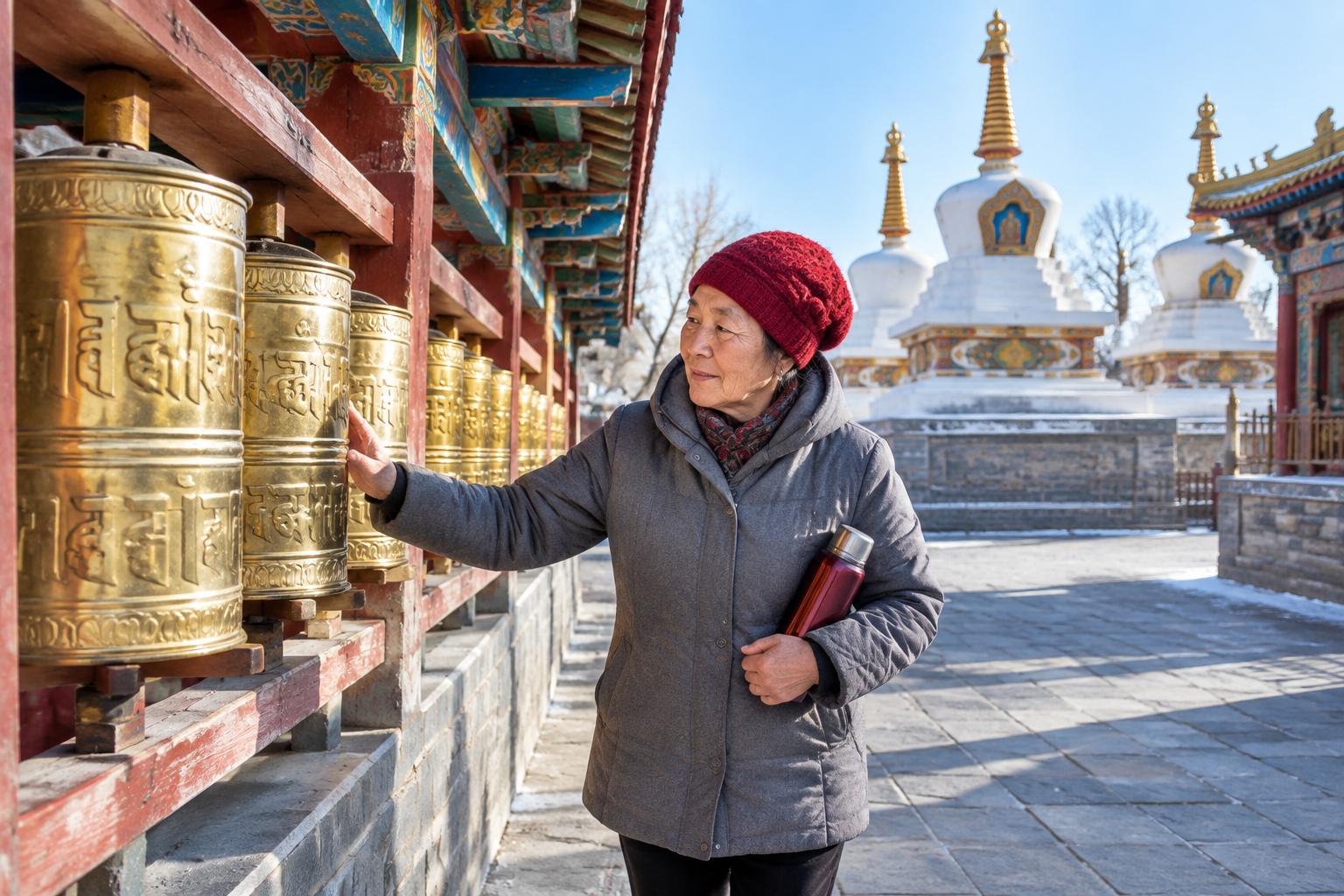
In one of the front courtyards stands a row of eight stupas, white and bell-shaped, each marking a stage in the Buddha’s life. On the day I visited, two women walked around them clockwise, one counting on a string of beads, the other holding a thermos of tea. Brass prayer wheels line the eastern walkway; you spin them with your right hand, and they clatter, and then they keep spinning for a while after you let go, which is oddly satisfying.
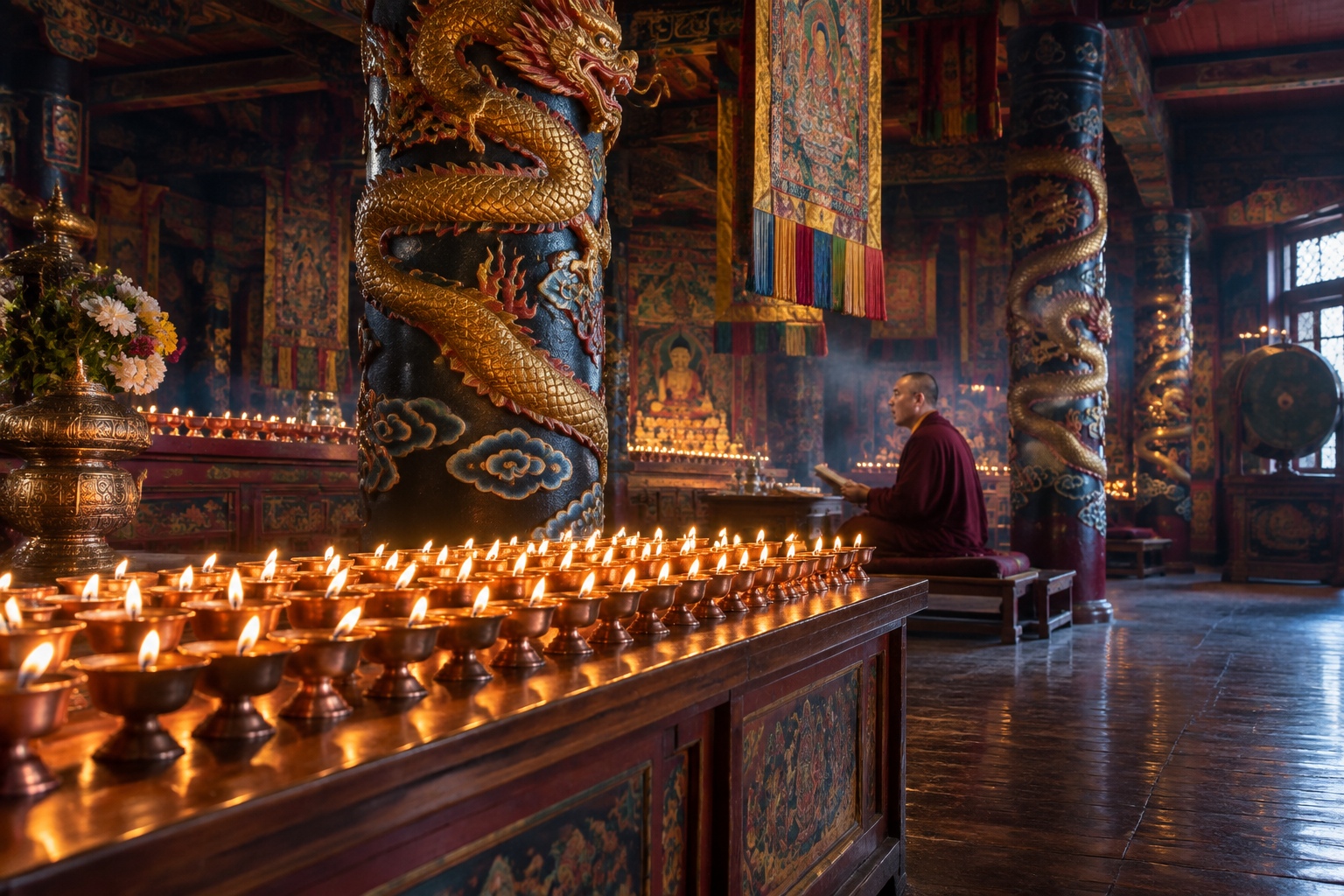
Then you step into the main hall, and the temperature changes. Butter lamps. Hundreds of them, small flames in copper cups, and above them the reason for the temple’s old nickname: a seated Shakyamuni Buddha cast in silver, roughly two and a half metres tall and — by the accounts local guides give — made from about 1.5 tonnes of the metal. It is dark in there, and the silver doesn’t shine so much as glow.
Look up. The pillars are wrapped with carved dragons, coiled and painted. Look sideways and the walls are covered in murals that have survived four centuries of incense smoke and, according to one monk I asked, a lot of careful restoration. Guides here call the silver Buddha, the dragon pillars and the murals the temple’s “three wonders.”
Two things I’d tell a first-time visitor: put your phone away for a minute, and don’t photograph anyone mid-prayer. Nobody will shout at you, but you’ll feel it.
What Worship Actually Looks Like
Most days at Dazhao are quiet. Then the first and fifteenth days of the lunar month come around, and the place changes character completely.
On those mornings the square fills before dawn. Families arrive with offerings — fruit, boxes of milk, bricks of tea, sometimes just a scarf tied to a railing. Lines form at the main hall. Inside, monks chant, and if you stand at the back for twenty minutes you’ll still hear the rhythm an hour later.
The most interesting thing is the mix of people doing the bowing. Hohhot is roughly a tenth Mongolian by official count, so you’ll see Mongolian families alongside Han Chinese residents, and it is rarely obvious at a glance who is who — the clothing is the same puffer jackets, the posture is the same. A woman in a Canada Goose jacket prostrates full-length on the stone. A man in a monk’s robe checks his phone between chants. Both are entirely normal.
If you want the full spectacle, aim for the Lunar New Year period. Around the Lantern Festival — the fifteenth day of the first lunar month — the temple has in past years hosted cham, the masked ritual dance shared by Mongolian and Tibetan Buddhist traditions, along with crowds thick enough that you shuffle rather than walk. It’s remarkable, and it is not relaxing. Pick your priority.
A Short Walk, Several Religions
One reason Dazhao works better as a half-day than a sprint is what surrounds it. Cross the street to the east and you’re at Xilitu Zhao, another Tibetan Buddhist temple, founded slightly later as a residence for a Tibetan lama and best known for its white pagoda. Walk twenty minutes south and you reach the Five Pagoda Temple, whose wall carries a carved astronomical chart — a Mongolian-built, Indian-influenced, Chinese-carved object that tells you most of what you need to know about this city.
Head west instead and you enter the Hui district, where the Grand Mosque, founded in the Qing dynasty and expanded several times since, sits a few minutes from a street remade as a Muslim cultural quarter. Add the Catholic and Protestant churches scattered through the older neighbourhoods, and a city of about 3.5 million people ends up with a religious map that looks like a port city’s — except that it’s a thousand kilometres from the sea.
This is worth holding on to, because Hohhot usually gets one of two labels abroad: “gateway to the grasslands,” or “the milk city.” Both are true. The dairy giants Yili and Mengniu are headquartered here, and the city calls itself China’s Dairy Capital. The grasslands really are close: drive out and you can be among sheep and yurts within an hour or two. But the city itself has a metro, universities, a large museum of Mongolian history, and a temple square where a bronze of a 16th-century khan watches grandmothers from three ethnic groups walk in circles around him.
If You Go
Getting there
Dazhao sits in Yuquan District, in the old part of Hohhot, on Dazhao Qian Street. Taxis and ride-hailing (DiDi works normally) are the simplest option from downtown hotels; the trip is short and inexpensive. Several city buses stop on Da’nan Street, a few minutes’ walk away. Hohhot has a metro, but the stations nearest the old town still leave you with a walk, so don’t count on it as a door-to-door solution.
Cost and hours
Adult admission has hovered around 35 yuan in recent years — under five US dollars — with discounts for students and free entry for children and seniors. Prices and free-entry promotions do change, so check at the gate or online before you go. Opening hours run roughly 8 a.m. to 6 p.m. in summer and end earlier in winter. The courtyards empty in late afternoon, which is also the best light.
Best time
Early morning, any season, especially if you want the temple without tour groups. Winter is genuinely cold — minus 15 to minus 20 Celsius is normal in January — but a hall full of butter lamps feels right in cold air, and you’ll have the place almost to yourself. Summer, June to August, is the green season and the time to pair the temple with a grassland trip; it’s also the busiest. Avoid the 1st and 15th of the lunar month only if you dislike crowds. Go on those days if you want to see the temple doing what it was built for.
Etiquette
Walk clockwise around stupas and prayer wheels. Take your hat off inside the halls. Don’t point at statues. Ask before photographing monks, and don’t photograph people mid-prostration. If the butter lamps make you want to add one, small donations are usually fine — there’s often a box for it.
Eat nearby
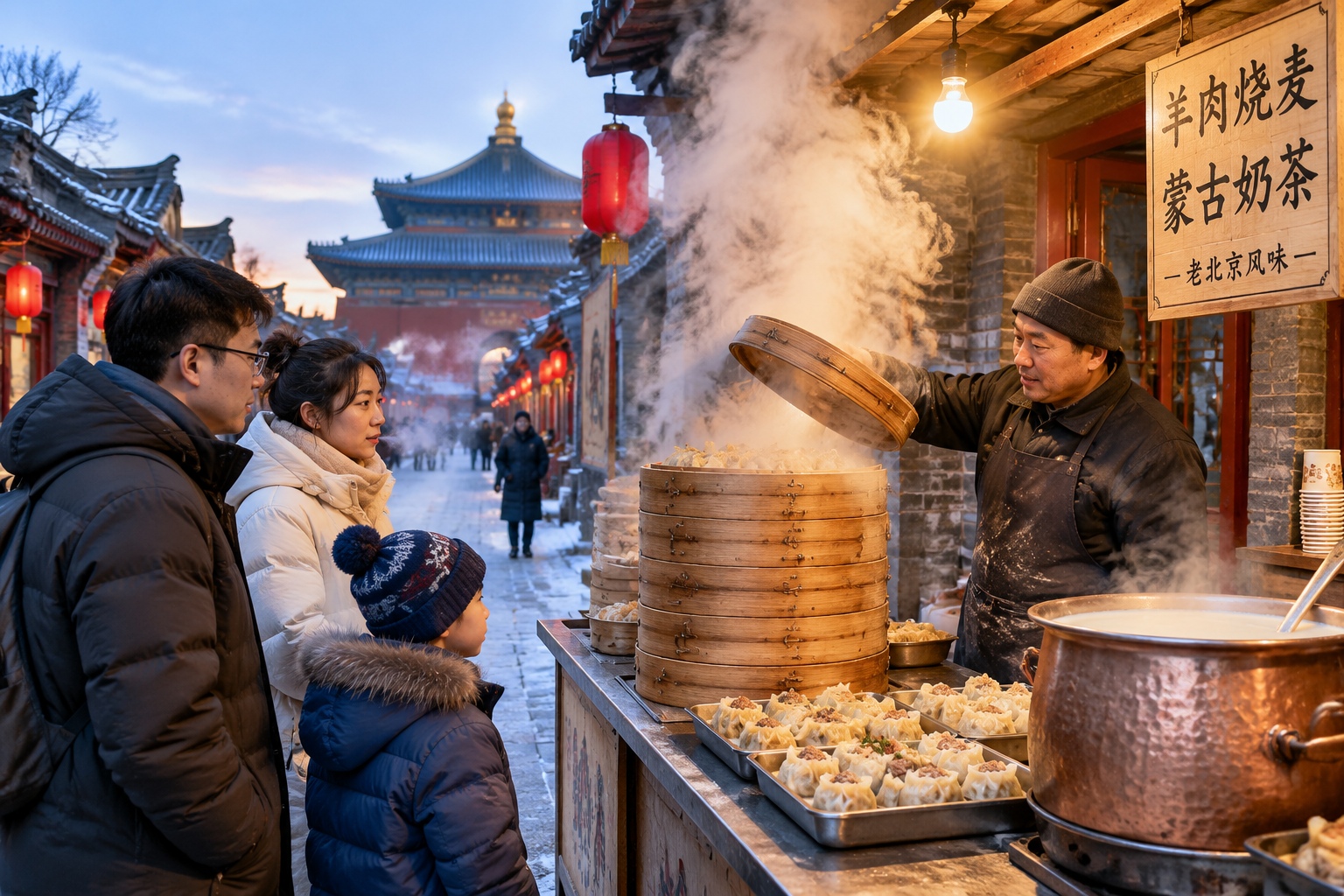
Step out of the gate and you’re at the entrance to Sai Shang Old Street, a rebuilt Ming-Qing style commercial lane: touristy, but useful. Order shaomai — Hohhot’s breakfast obsession, lamb and scallion steamed dumplings sold by weight — with a pot of brick tea, or find a small shop for lamb offal soup and a baked beizi flatbread. The milk tea here is savoury, salted and served in bowls. It is not the sweet bubble tea you may be expecting.
Combine with
Xilitu Zhao (five minutes east), the Five Pagoda Temple (about 20 minutes on foot), the Inner Mongolia Museum (a short drive; free, usually closed Mondays) and Zhaojun Tomb on the city’s southern edge. With a spare day, the Xilamuren or Huitengxile grasslands are reachable as a long day trip — though the honest version of that trip involves a hired car and an early start.
Back on the square, the sun is properly up, and the butter smell has thinned out. A monk in maroon robes crosses the courtyard carrying a plastic bucket. The old man who pressed his palms to the wall is nowhere to be seen; the grandmothers are still circling. Nobody is performing anything for anyone. That, more than the silver or the dragons, is what I’d tell a friend to come and look at.
Start the discussion at forum.chinacomes.com