
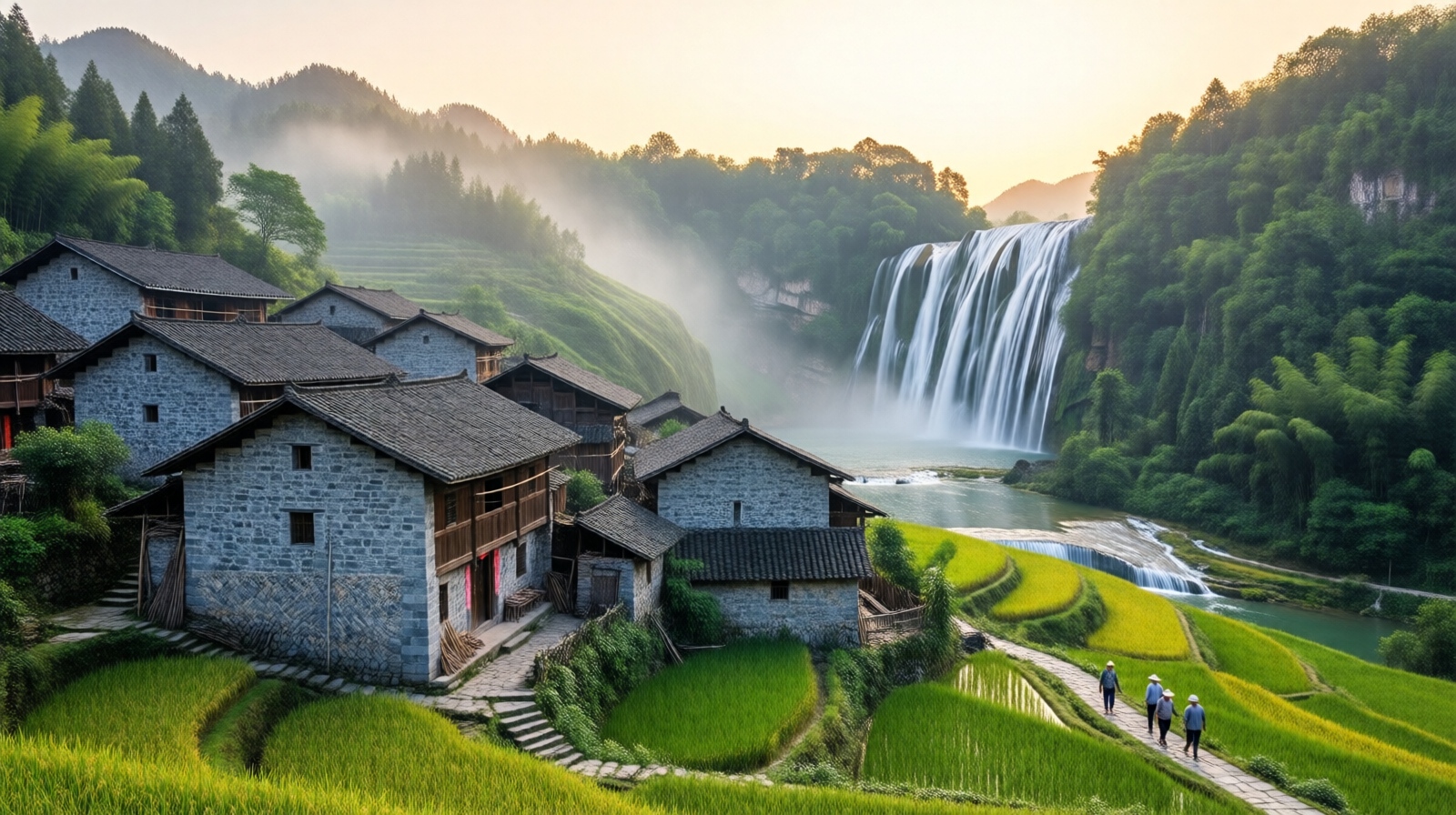

Morning by the waterfall
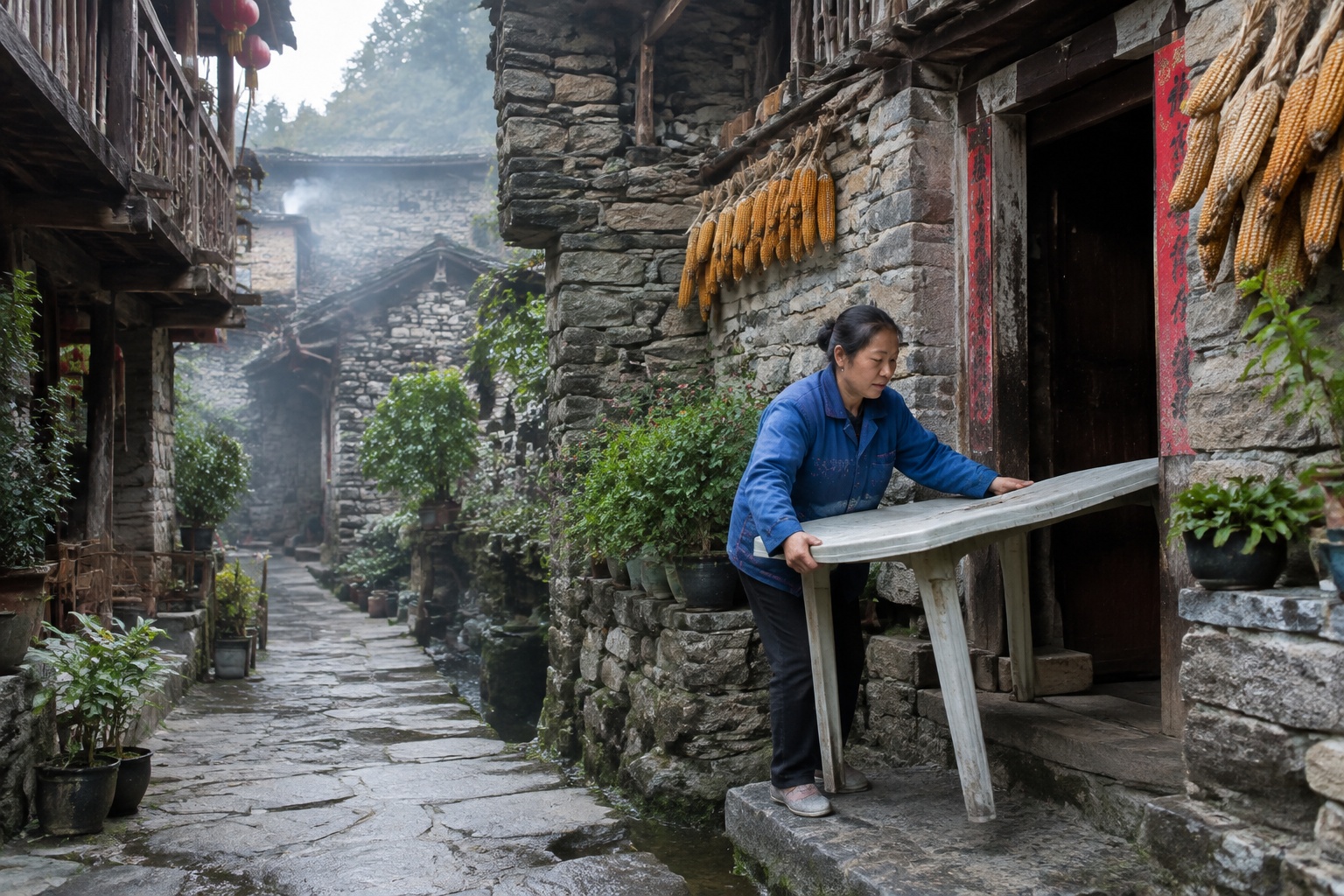
The water is still cold at seven in the morning, but the village is already awake. Chen Li, 46, drags plastic tables into the narrow stone alley outside her house, where the sound of the Huangguoshu Waterfall — three kilometers away — hums in the air like a constant bass note. She sets out a jar of pickled radish and a bowl of chili sauce, then checks her phone for new reservations.
Chen Li grew up in Shitouzhai, a Buyi ethnic village in southwest China’s Guizhou Province. The village’s gray stone houses, with their slate roofs and wooden balconies, have stood for generations. But for most of her life, the waterfall meant little to her. It was just a dramatic pile of falling water that tourists came to see, photograph and leave. They rarely entered her village. She spent her early twenties in a garment factory in Guangdong, thousands of kilometers away, packing clothes for export.
The old poverty
Shitouzhai sits only a few kilometers from one of China’s most iconic natural attractions. Yet until recently, the village had almost no way to benefit from the crowds. The land was rocky and poor, good for only a little corn and beans. There were no paved roads leading in. Young people like Chen Li had to leave to find work. “We could hear the tourists but we couldn’t reach them,” she remembers. A few neighbors sold bottled water from baskets at the roadside, but that was about it. The traditional stone houses, seen today as charming heritage, were then considered old and uncomfortable — something to replace, not preserve.
Turning the doorstop into a doorstep
Around 2016, the local government began paving roads into surrounding villages and encouraging farming communities to enter the tourism business. Grants were offered to families willing to renovate their old homes. Chen Li, after years of saving, decided to be one of the first. She took out a loan, rebuilt her Buyi-style stone house with modern bathrooms, and opened an eight-room guesthouse.
Her timing was good. Domestic tourism was booming, and visitors were starting to look beyond the waterfall itself. The stone village — with its ancient Buyi architecture, forested hills and rice terraces — became reason enough to stay the night. Within two years, Chen Li’s homestay was fully booked on most weekends. She hired two female cooks from the village, both of whom had lost their factory jobs during the pandemic.
The new economy of a village
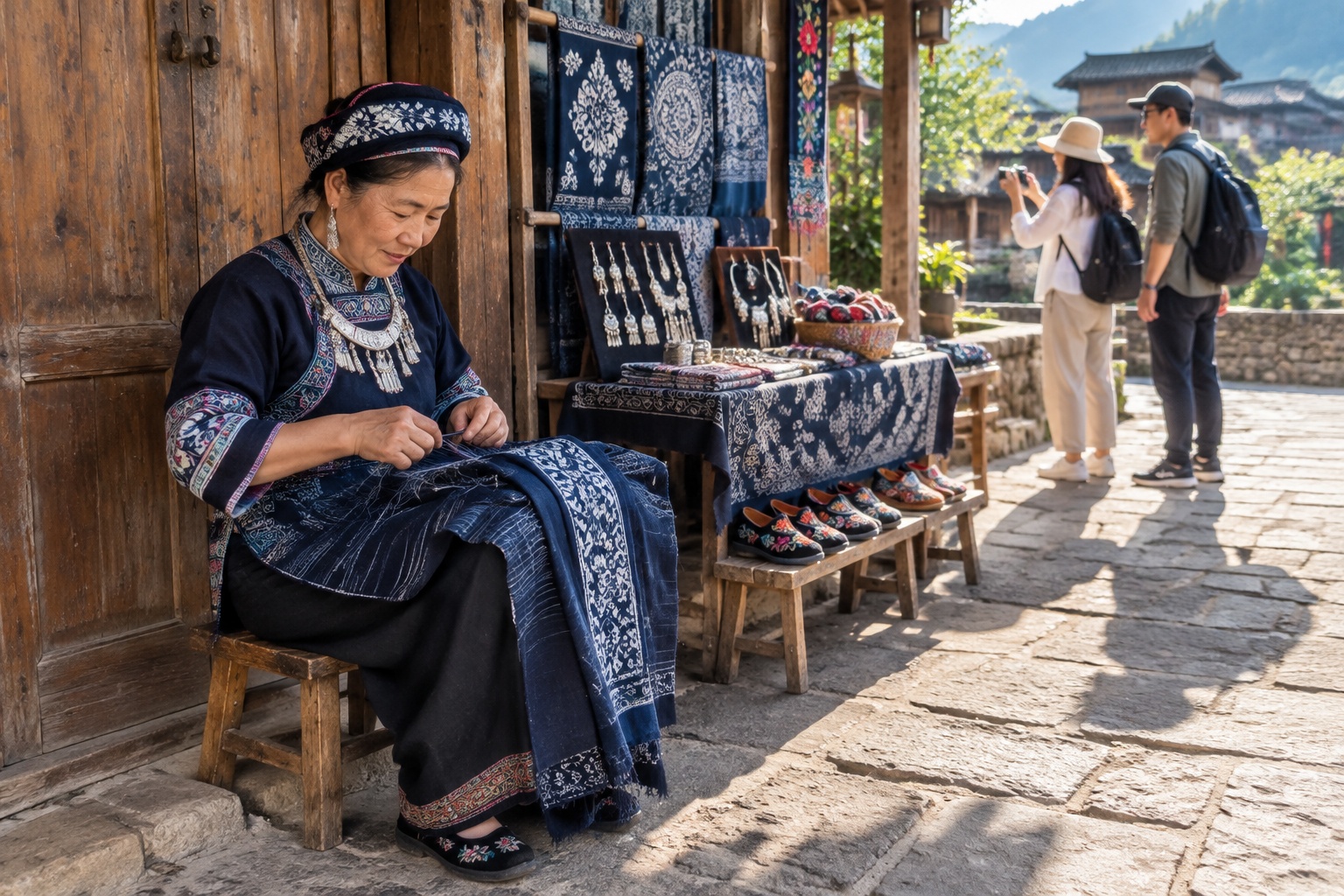
Today, Shitouzhai has nearly fifty homestays and a dozen small restaurants. The village lanes are lined with handicraft stalls selling batik cloth, silver ornaments and embroidered shoes. Many are run by middle-aged women who once farmed or worked in factories.
“I make more in a month selling embroidery than my husband earns as a construction worker,” says Luo Xiuying, 52, who sits at her wooden door every afternoon, weaving patterns into blue indigo cloth. Tourists from Beijing, Shanghai and even from overseas often ask to take photos of her. Some buy her cloth on the spot; others order a custom piece through WeChat. She started her stall in 2019, and now earns around 3,000 yuan a month during the peak season.
Younger villagers are also returning. Luo’s son, a former logistics worker in Shenzhen, now leads small hiking groups to a hidden cave behind the waterfall. Another returnee opened a coffee stall that serves cold brew in a bamboo cup. A young woman who studied photography set up a studio that rents ethnic costumes and shoots portrait sessions for visitors. Even the village bakehouse, once run by an old woman for village weddings, now sells rice cakes to tourists.
What the numbers say
The change shows up in statistics. In 2019, the surrounding Huangguoshu district received 12 million visitors. In 2023, after the pandemic, that number recovered to nearly 10 million. Villages like Shitouzhai now capture a share of overnight stays and meals. Average annual income per villager in these tourism-driven communities has grown from roughly 5,000 yuan in 2015 to more than 20,000 yuan in 2024 — still modest by city standards, but life-changing in a place where cash used to be scarce.
Local produce has also found a market. Farmers who once grew only corn now plant vegetables for the guesthouses. Buyi rice wine, once brewed only for festivals, is bottled and sold in small ceramic jars. Chen Li sources most of her ingredients from her neighbors, creating a small local circular economy.
The hard side of the boom
But not every storyline is a success. During the May Day holiday, roads to the waterfall turn into parking lots. Villages become crowded; trash bins overflow. Some homestays fill up only on weekends and sit empty midweek. A new hotel chain has opened near the scenic area’s main gate, pulling guests away from family-run inns. Water supply is another problem: in dry months, some guesthouses have to ration showers. And despite the economic gains, not all young people want to return. Some parents prefer their children to stay in cities, seeing tourism work as unstable.
Environmental pressure is real, too. The waterfall’s flow has fluctuated in recent years, partly because of droughts. Officials now limit the number of boats in the river and require wastewater treatment facilities for larger guesthouses. The village has had to balance growth with conservation — a tightrope walk that sometimes turns into conflict, when an upstream homestay pipes its sewage into the stream.
Beyond one village
Shitouzhai is not unique. Across Guizhou, dozens of remote villages have tried to copy the model. Some succeeded by adding attractions like glass bridges or hot springs. Others failed when the money ran out or the visitors didn’t come. The result is a patchwork of opportunities and inequalities — proof that tourism is not a magic fix. It depends on location, infrastructure, and a little bit of luck.
Still, for Chen Li, the change feels real. She used to spend weeks on a train to Guangdong to earn a modest wage. Now she walks across her courtyard to work. She’s also been able to send her daughter to university in Kunming — something she says was unimaginable a decade ago.
Evening at the long-table dinner
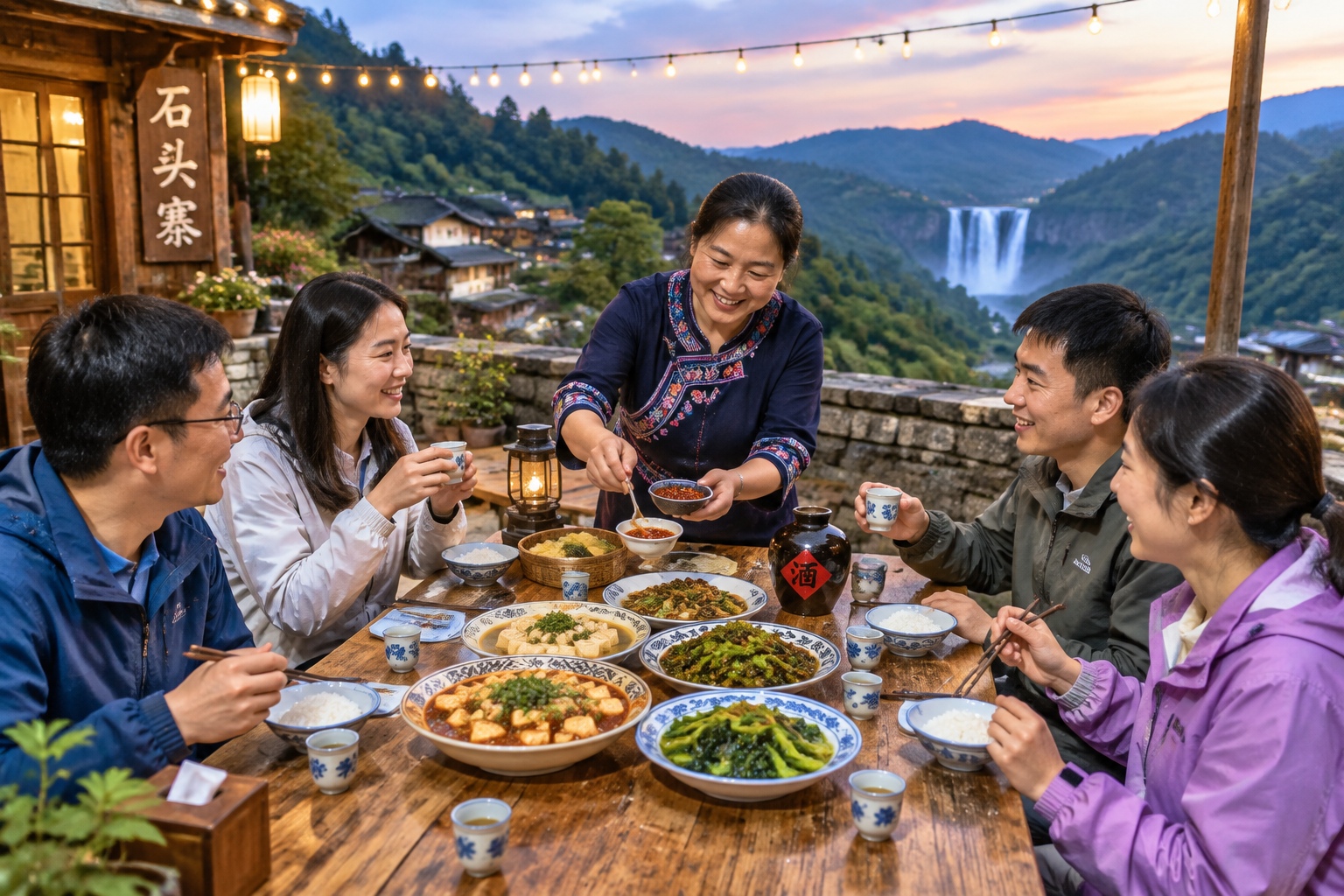
As dusk arrives, the village lights come on. On a stone terrace, Chen Li sets a long table for a group of tourists from Chongqing. They dip tofu in her chili sauce, sip the local wine, and listen to the waterfall’s distant roar. One of them asks her if she ever gets tired of the noise.
She smiles and shakes her head. “It used to be the sound of something far away,” she says. “Now I hear it as my front door.”
Start the discussion at forum.chinacomes.com