
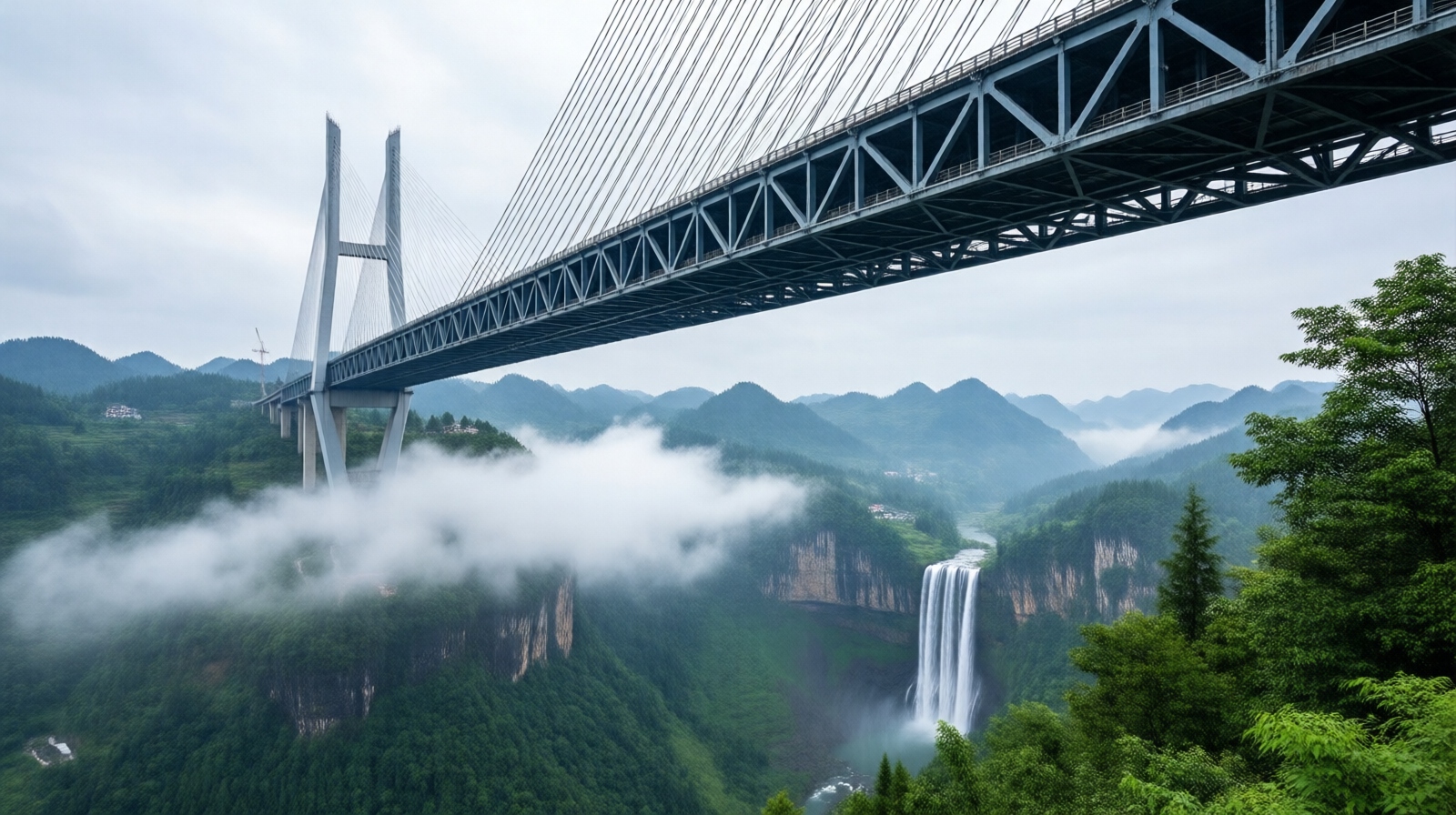

At first glance, the visitor standing at the edge of the Beipan River Canyon in Guizhou sees two impossibilities at once. Below, water has cut a gorge more than 500 meters deep over millions of years. Above, a road floats across that void, supported by a bridge so long and so high that clouds pass beneath its deck. It took nature hundreds of millions of years to carve this landscape. It took engineers just five years to build a crossing that now feels like an ordinary part of the highway.
This contrast—between what nature created and what humans added—runs through all of Guizhou. The province, tucked in the mountainous southwest of China, is home to both world-famous waterfalls and more than half of the world’s ten tallest bridges. The same rugged terrain that isolates communities also creates natural wonders, and the same engineering determination that conquers the terrain now links those communities to the modern economy.
A Bridge Above the Clouds
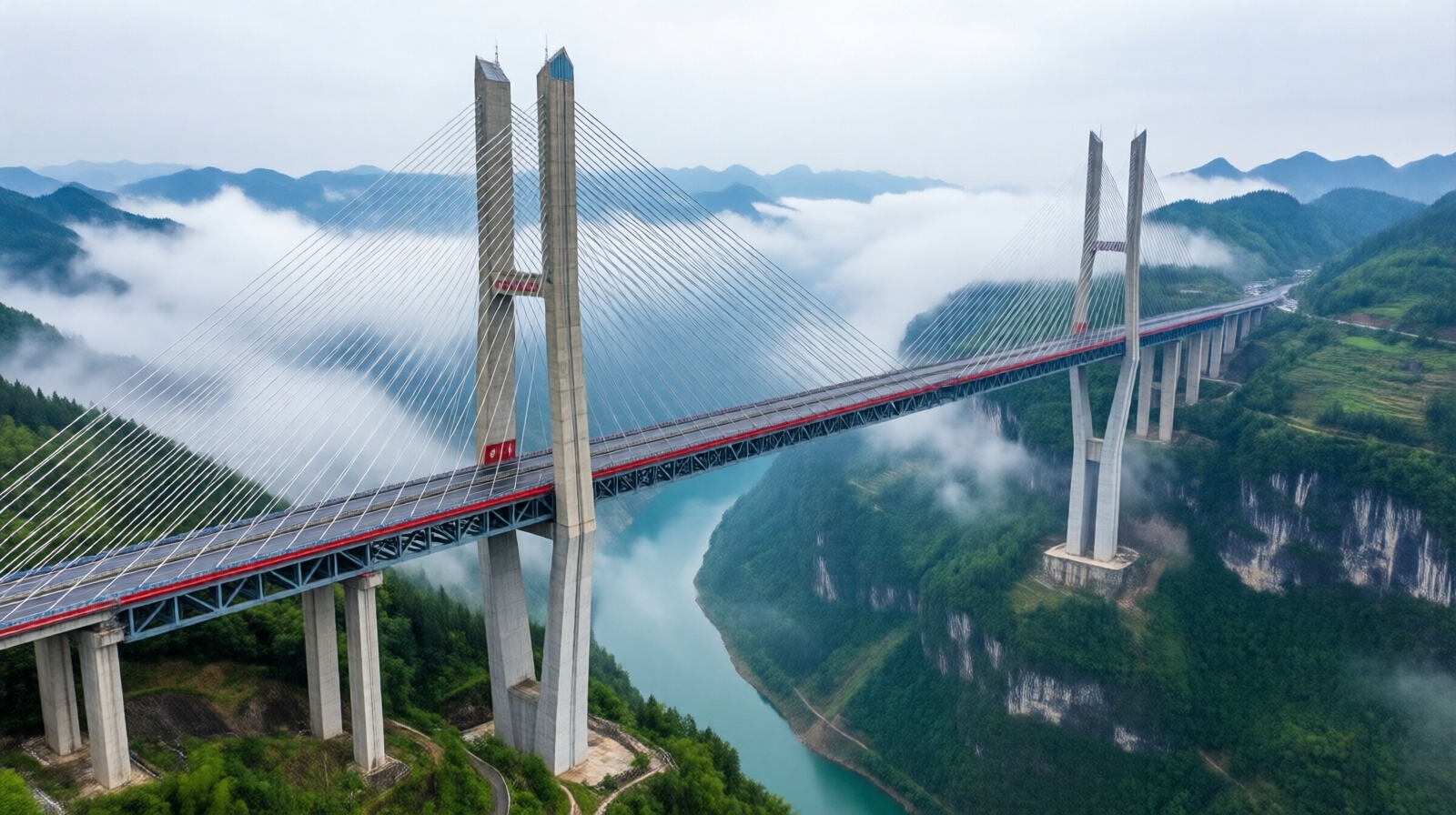
Take the Beipan River Bridge, also called the Duge Bridge. It opened to traffic in 2016 as part of the Hangrui Expressway, which connects Hangzhou on the coast to Ruili on the Myanmar border. According to the Guinness Book of Records, the bridge’s deck is 565 meters above the river below, making it the tallest in the world at the time. Its span of 720 meters makes it one of the longest cable-stayed bridges—a type where cables are pulled diagonally from towers to the deck, holding it up like a gigantic harp.
To a traveler, the bridge might feel unreal. Walking across the pedestrian walkway, you look down through the guardrail and see only mist, or sometimes the river looking like a silver thread. Yet for a truck driver, this bridge is simply the road. It cuts what used to be a five-hour descent and ascent through mountain switchbacks down to a drive of less than ten minutes. That time savings is not a statistic. It is hours of tiredness avoided, fuel saved, and goods moved faster between cities and villages.
Not every bridge in Guizhou is the tallest. But many are remarkable in their own way. The Pingtang Bridge, for instance, is a cable-stayed structure with three massive diamond-shaped pylons that rise above the valleys. Local residents have nicknamed it “Sky Bridge” because its deck sits high above the village below. Every year, thousands of visitors park along the service area to take photos, making it an impromptu scenic stop on a mountain highway.
Engineers point out that building these bridges requires solving problems that few other places have faced. The limestone bedrock common in Guizhou is porous and uneven. Heavy rain erodes the soil. Deep canyons create wind gusts that would dance with a flexible bridge deck. To stabilize the structure, engineers sink foundations into solid rock, sometimes dozens of meters below the surface. They use high-strength steel and lightweight concrete to reduce weight. They also run wind tunnel tests on scale models to see how the deck will behave in a storm. These are well-known techniques elsewhere, but the scale and difficulty of applying them in these canyons are exceptional.
Why Guizhou Needed Bridges in the Sky
When Chinese people say “Guizhou is a province of mountains,” they usually add a sigh. For centuries, it was poor and isolated, separated from the rest of the country by high ranges and deep valleys. Transporting anything—grain, coal, medicine, students—required long detours on narrow roads. In some places, villagers had to use rope bridges or chain ladders just to cross a ravine. History textbooks note that land travel in Guizhou was so difficult that it was easier for emperors to govern nearby regions than to send officials into these mountains.
Guizhou’s terrain is a type known as karst, where limestone has been dissolved by rainwater over millennia, creating sinkholes, caves, and tall rocky peaks. The landscape is stunning for tourists but brutal for road builders. Before 2015, most highways had to follow the contours of the mountains, zigzagging down and up, which made trips long and exhausting. A straight highway would need to cut through or jump over obstacles, and jumping over canyons required bridges of unprecedented height.
When China launched its national expressway and high-speed rail expansion in the early 2000s, Guizhou became a priority. The central government poured money into infrastructure, and engineers began to think big. Between 2005 and 2020, the province built nearly 5,000 kilometers of expressway. A major part of that was above deep valleys. By 2020, the province claimed 126 bridges with spans of more than 100 meters, and more than half of the world’s top 100 highest bridges are in Guizhou.
These numbers sound abstract, but they translate directly into daily life. A farmer in a remote village can now get his fresh vegetables to a city market before sunrise. A student can take a bus to school in an hour instead of a two-day walk. A young working mother can visit her parents during a weekend break—something her own mother could not have imagined.
The Engineering Behind the Feat
Let’s look at the construction of the Beipan River Bridge in more detail. The project was not simply a matter of erecting towers. Workers had to haul steel and concrete to a site that had no roads. They built temporary cable cranes across the canyon to move materials. The two towers, each standing more than 200 meters tall, were erected without the use of tall cranes—instead, they were assembled section by section using self-climbing platforms, a technique common in high-rise construction but unusual for bridges.
The main deck is made of steel and weighs thousands of tons. To place it exactly, engineers used a technique called “pushing and rotating” the deck from both sides, with sensors and GPS guiding the final alignment. The procedure had to be done in calm weather, because even a gentle breeze could move the deck segments by meters. The entire bridge was built in about five years, a pace that surprised many Western engineers who visited the site.
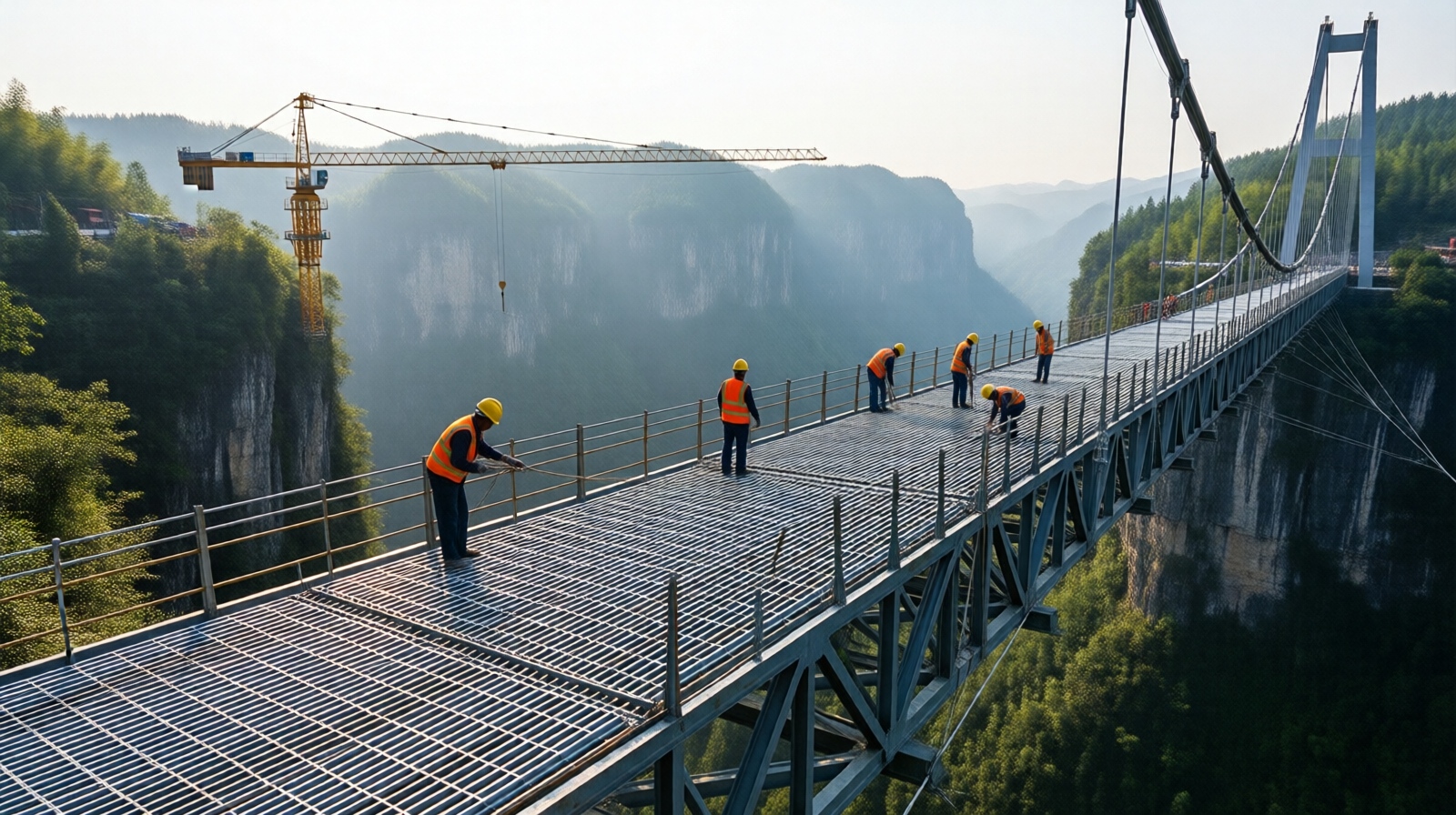
Construction crews themselves came from all over China. Many were trained in the mountains of Sichuan and Yunnan, where similar but smaller bridges had been built. Working at heights is a profession in China, and these crews are proud of their skill. “It looks dangerous, but we follow every safety rule,” a foreman said in an interview. “The hard part is not the height. It is the wind and the dust.”
Guizhou also experimented with new materials and methods. For example, the Pingtang Bridge uses ultra-high-performance concrete (UHPC) for some of its components, a material with very high strength and durability. The designers say this reduces the amount of concrete needed, which matters when every kilogram has to be transported uphill. The bridge also uses a centralized monitoring system with sensors that detect vibration, strain, and temperature. Real-time data is sent to a control room in the provincial capital, so small problems can be fixed before they become big.
From Isolation to Connection: How Bridges Change Daily Life
The most visible impact is on transport. Guizhou’s expressway network now connects every county in the province. The travel time from anywhere to the capital, Guiyang, is under four hours by road, and around two hours by high-speed rail. For many residents, the new roads have changed the sort of jobs they can take. A construction worker may live in town and commute to a work site in a neighboring county, something that was impractical ten years ago.
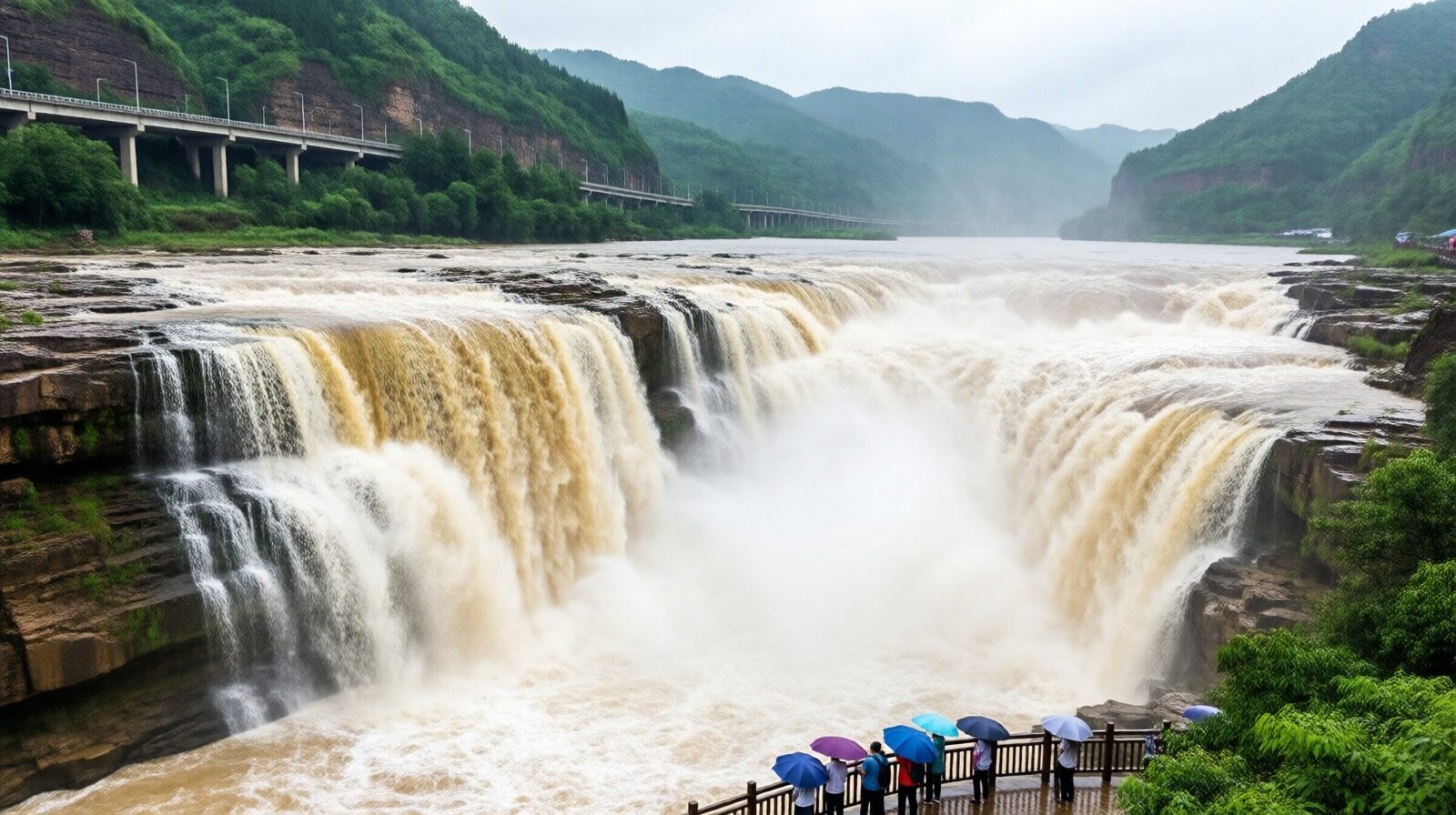
Tourism is also booming. Guizhou’s star attraction, Huangguoshu Waterfall, is one of the largest waterfalls in Asia, nearly 78 meters high and 101 meters wide. For decades, tourists had to take a bumpy ride to see it. Now a smooth expressway brings them directly to the park’s entrance. The same roads that carry concrete trucks also carry tour buses. In 2023, the province received about 600 million domestic visitors; many came to combine natural sights with the “bridge viewing” experience.
But the change is not only about convenience. Bridge construction has created a web of small businesses. Along the highway near the Pingtang Bridge, locals have opened guesthouses and farm restaurants. They serve dishes made from local produce—like bamboo shoots and preserved ham—and welcome visitors who want a closer look at the bridge. The government has also designated some bridges as “viewing platforms,” with parking lots and walkways, making them stops on organized tours.
Waterfalls and Sky Bridges: A New Travel Attraction
There is something poetic about Huangguoshu Waterfall and the highway bridges sharing the same province. The waterfall is a natural bridge of water—a curtain that connects the river above to the pool below. The bridges are artificial waterfalls in reverse, carrying human traffic across the same gap. Tourists who once came only to see the waterfall now ask their guides, “Which bridge is the highest?” Guides have learned to answer with both pride and humor.
Sometimes the two sights appear in a single photograph: in the valley below the bridge, a silver ribbon of water runs over rocks, a miniature version of the famous waterfall. These images circulate widely on social media, prompting young travelers to plan road trips along Guizhou’s “bridge highway.” The province has recognized this trend and is building viewing platforms and a museum dedicated to bridge engineering.
One such exhibit is at the Pingtang Bridge, where a visitor center explains the history of road construction in the province. It shows scale models of different bridge types, photos of construction workers, and a small section on the geology of karst terrain. The tone is educational, not boastful—it acknowledges the difficulty and the teamwork required.
What This Means for the World
Guizhou’s engineering feats are more than a local triumph. They offer a lesson for other mountainous countries, from Nepal to Peru, about what is possible with the right combination of investment, technology, and political will. The methods used here—temporary cable cranes, self-climbing platforms, and advanced monitoring—are documented in Chinese engineering journals and increasingly discussed at international conferences. Some bridges were designed with the help of international consultants, but the core construction teams were entirely Chinese.
The economic return is real. Better transport boosts agriculture, tourism, and manufacturing. According to the provincial statistics bureau, Guizhou’s GDP per capita has tripled since 2010, and poverty rate in rural areas has dropped from roughly 25% to below 1%. It would be naive to credit all of that to bridges alone, but no economist doubts that the new transportation links were a necessary foundation.
Of course, building high in the mountains has its costs. The environmental footprint of giant bridges is not zero, and untouched valleys have been crossed by concrete and steel. Local officials say they try to minimize damage by using existing road corridors and by planting native vegetation on embankments. Still, the debate over how much development is too much exists in China just as it does elsewhere. The difference is that here, the government has consistently chosen progress, and residents have largely welcomed it because they see the benefits in their own lives.
When you look at a photo of a bridge in Guizhou, it is easy to feel awe. But the emotion the locals feel is simpler: pride and relief. The bridge means they can get to work, to school, to the hospital faster. The waterfall remains a wonder, but the bridge has become a part of home.
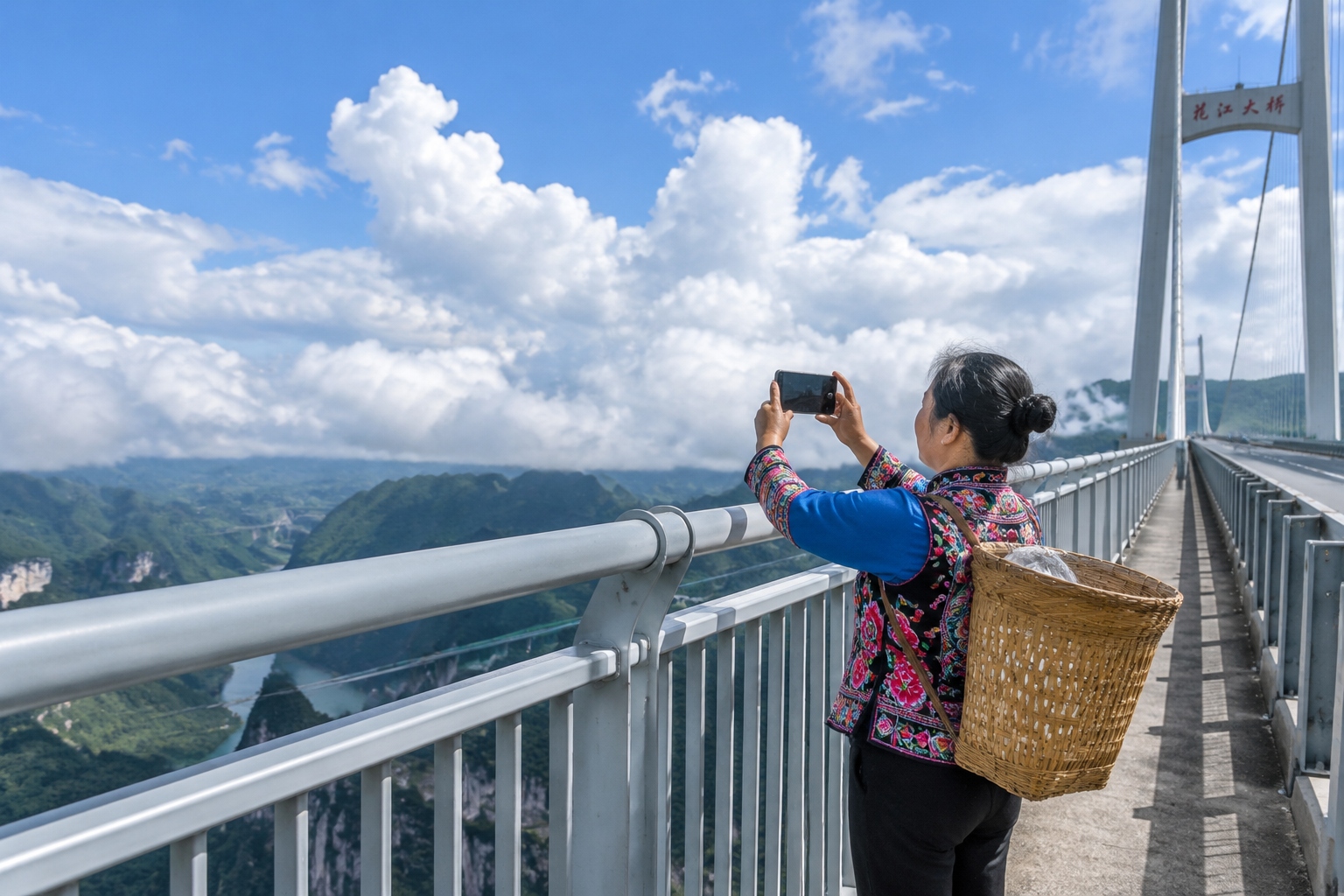
Perhaps the most powerful image from Guizhou is not a single bridge. It is the sight of a woman carrying a basket of vegetables across a pedestrian walkway on the Beipan River Bridge, pausing to take a photo with her phone. In one frame, you see the legacy of the past and the promise of the future. That is what engineering can do when it respects both the scale of the landscape and the scale of everyday life.
Start the discussion at forum.chinacomes.com