


In late 2022, a French software engineer named Bertrand walked into the HR department of a large technology company in Shenzhen for an exit interview. He expected paperwork on handover and the return of his access card. What he did not expect was a reminder about the non-compete agreement he had signed years earlier: for 12 months after leaving, he could not work for any competitor in China or abroad. His future employer, a German networking supplier, happened to compete with his Chinese firm in three product segments. Bertrand wanted to know if that restriction could really stop him.
For many expatriate professionals in China, non-compete clauses are a surprising piece of local employment law. Although the country has a reputation for flexible labour, the law provides a firm framework for protecting technical secrets after a worker leaves. Foreign employees are treated the same as Chinese workers, which means you can be held liable even if you signed a Chinese-language contract and did not read every word. This article explains the rules that matter when you leave a job in China and how to prepare.
What makes a non-compete clause valid in China?
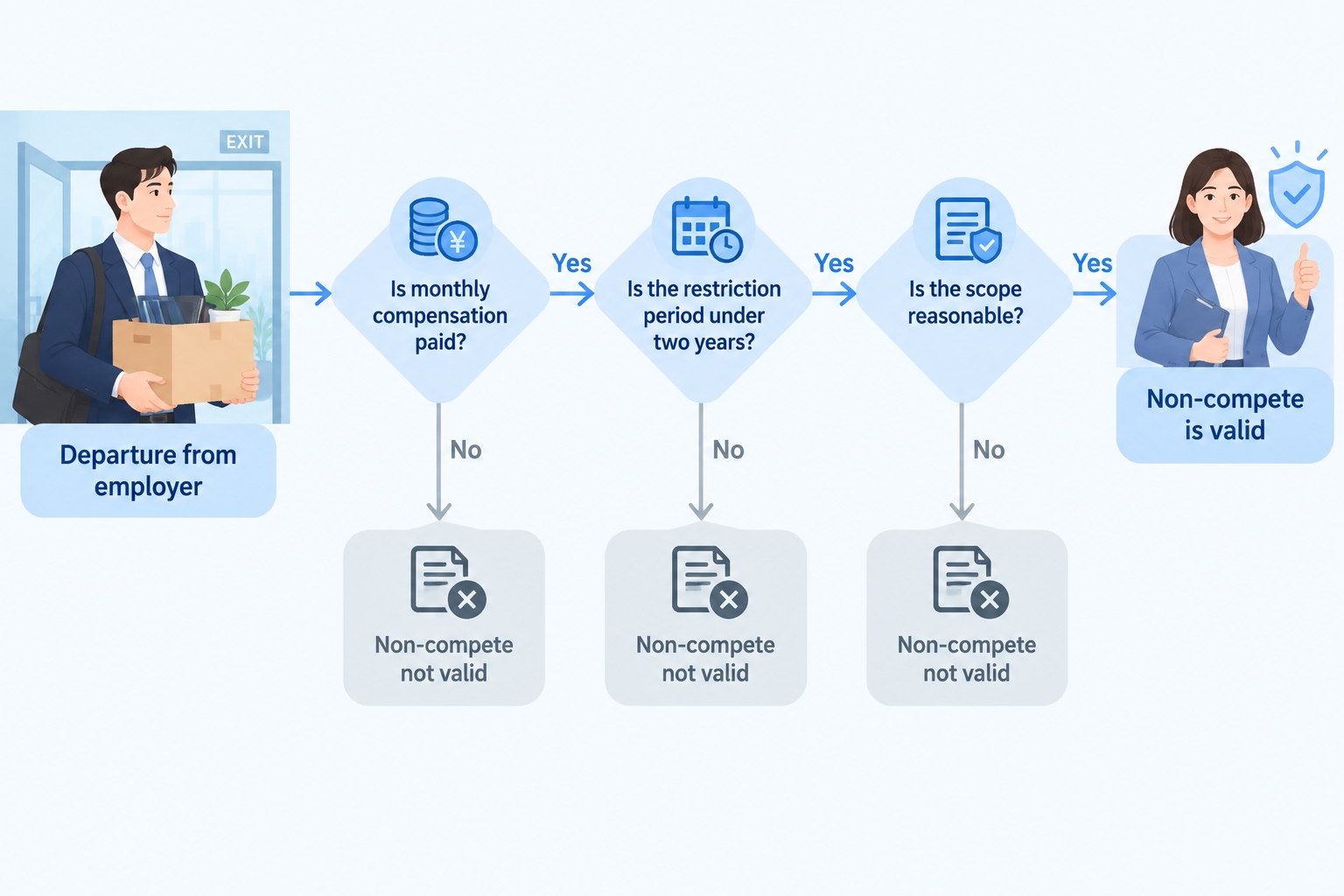
Under China’s Labour Contract Law, a Chinese company cannot impose a non-compete obligation on everyone. It can only do so for senior management, senior technical personnel, and others who could know commercial secrets or intellectual property. And even those employees need two things before the restriction is enforceable.
Condition 1: You must receive economic compensation
The key word here is monthly. The company must pay you compensation after your employment ends, typically in the form of salary-like payments. If the employer never actually pays, you can ask for the amounts. After three months of unpaid compensation, you can go to court and apply to cancel the restriction.
A non-compete clause that says “no compensation will be paid during the restricted period” is invalid. You can still request a statutory minimum. Under the judicial interpretation of the Supreme People’s Court, that minimum is 30% of your average monthly salary over the 12 months before you left. In some cities, the local floor is higher.
Condition 2: The restriction period cannot exceed two years
The law is very clear: a non-compete period starts on your last working day and can last no longer than two years. If the contract says 36 months, the extra 12 months are unenforceable. The first 24 months can still be valid, though.
How Chinese courts define the scope of your restriction
Article 24 of the Labour Contract Law says the restricted scope should cover enterprises that produce or operate the same or similar products, or the same or similar businesses, as your former employer. A typical contract lists direct competitors by name, but many also contain catch-all phrases such as “any entity engaged in similar business.”
When a dispute reaches a labour arbitration committee or a court, judges rarely look only at the wording. They ask three practical questions:
- Is your new employer a direct competitor in the same sector, or do the products overlap?
- Does your new position let you use or leak the technical or commercial information you learned in your previous job?
- Is the geographic limit reasonable based on where your former employer actually operates?
That third question matters for expats. If you move to a city in a different country but your former employer sells the same products there, a global restriction may be upheld. If the old employer has no real business in that region, you have a stronger chance to challenge the restriction.
What compensation are you likely to get?
Many employers choose to pay between 30% and 50% of your last average monthly wage during the restricted period. The 30% figure is not a company guideline—it is the legal minimum set by Chinese judicial interpretation for cases where the contract does not specify an amount. Some local regulations push higher. In the Shenzhen Special Economic Zone, for example, the local labour rule requires compensation of at least 50% of the employee’s average monthly wage for the 12 months before departure.
It is normal for the compensation to be paid every month, just like a salary. If your former employer offers one lump-sum payment after you leave, treat that as a warning sign. Monthly payments can be stopped if you breach the clause, but a lump-sum payment may create a different kind of legal dispute.
A realistic scenario: What happens when an expat engineer ignores the clause?
Consider “Markus,” a composite character based on several Shenzhen labour disputes reported in recent years. Markus is a German algorithm engineer who spent five years at a well-known telecom equipment manufacturer. His non-compete agreement promised RMB 32,000 per month for 18 months after he left—roughly 40% of his final average salary—and prohibited him from taking any role with 18 named rivals “wherever the company conducts business in the world.”
Four months after resigning, Markus accepted a job at one of the listed rivals, but at its Shanghai research lab. A few weeks later, his former employer discovered the move from a LinkedIn post and filed for labour arbitration. The arbitration committee ruled that Markus had violated the non-compete agreement. He was ordered to stop working for the competitor, return all the monthly compensation he had already received, and pay a contractual penalty equal to one year of salary. The total amount Markus ended up paying was more than RMB 300,000, excluding legal costs.

This pattern is not unique. Chinese courts do treat non-compete violations seriously, and foreign nationality does not protect you. What Markus did wrong was simple: he compared job titles, not actual products or competitive risks, and he did not ask for a written confirmation that his new role was outside the scope.
Five practical steps for expat employees
1. Negotiate before you sign
In China, the best time to shape a non-compete clause is before you sign your original employment contract. Ask for a shorter restricted period, such as 12 months. Ask for the competitor list to be limited to named companies rather than a vague description of the whole industry. Make sure the compensation is set at 50% or higher and paid monthly.
2. Keep evidence of every monthly payment
If your employer promises money but does not pay on time, that is a breach. Keep every bank record and salary slip. If the payment is late or short, send a written reminder. This documentation becomes powerful if you later need to cancel the restriction in court.
3. Compare the new job with the old one
Before accepting an offer, read the non-compete description and compare it honestly with your new duties. If you are moving to a different product line or a new industry, ask your former employer for a written release. If you cannot get one, you may need to file an arbitration application and ask a tribunal to confirm that the new position does not fall within the scope.
4. Remember the three-month unpaid rule
After you leave, if your former employer stops paying compensation for three consecutive months, Chinese law allows you to apply to cancel the non-compete agreement. But do not make that decision alone. Talk to a labour lawyer and send a formal notice before you start a new job.
5. Think twice before moving abroad
Taking a role outside China does not automatically release you. If the foreign company sells similar products in China or has a Chinese subsidiary that could benefit from the same technical information, a Chinese court may rule that the new position still violates the agreement.
Final word
Non-compete agreements in China are not designed specifically to trap expats. They are legal instruments with clear boundaries—compensation must be paid, the period is capped at two years, and the scope has to be reasonable. The most common mistakes expats make are ignoring the contract until the exit interview, accepting a rival’s job without checking the scope, and assuming that leaving China removes responsibility.
If you address the issue early, at the contract stage or the moment you resign, you can protect both your reputation and your bank account. A non-compete clause is enforceable in China, and for expats the practical question is rarely whether it applies; it is how well you negotiated the price for staying on the sidelines.
Start the discussion at forum.chinacomes.com