
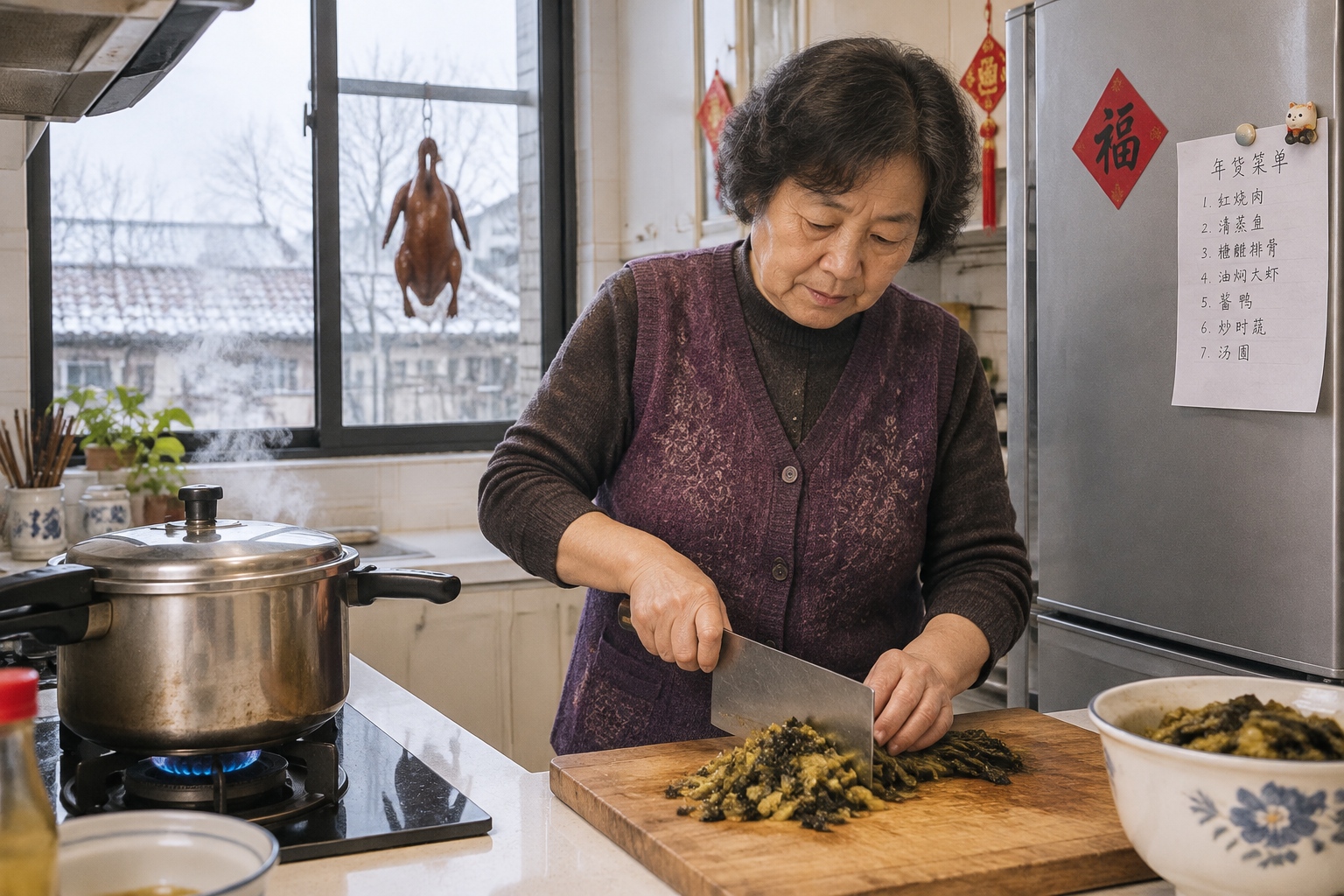

A Menu Held to the Fridge by a Bank Magnet
The menu is a sheet of A4 paper stuck to the fridge door with a magnet from a bank. Chen Aiyu, 68, wrote it in pencil a week before chuxi — New Year’s Eve — and she has already revised it twice. Crossed out: a whole braised duck, too much for eight people. Added in the margin in smaller handwriting: fish cake, because her grandson asked for it.
By 6:40 in the morning, her kitchen in Hangzhou is already loud. A pressure cooker hisses with bamboo shoots and pork. A cleaver works through a pile of pickled mustard greens. The window is open two fingers wide to let the steam out, and the air coming in is the wet 4°C cold that people here complain about all winter and secretly enjoy.
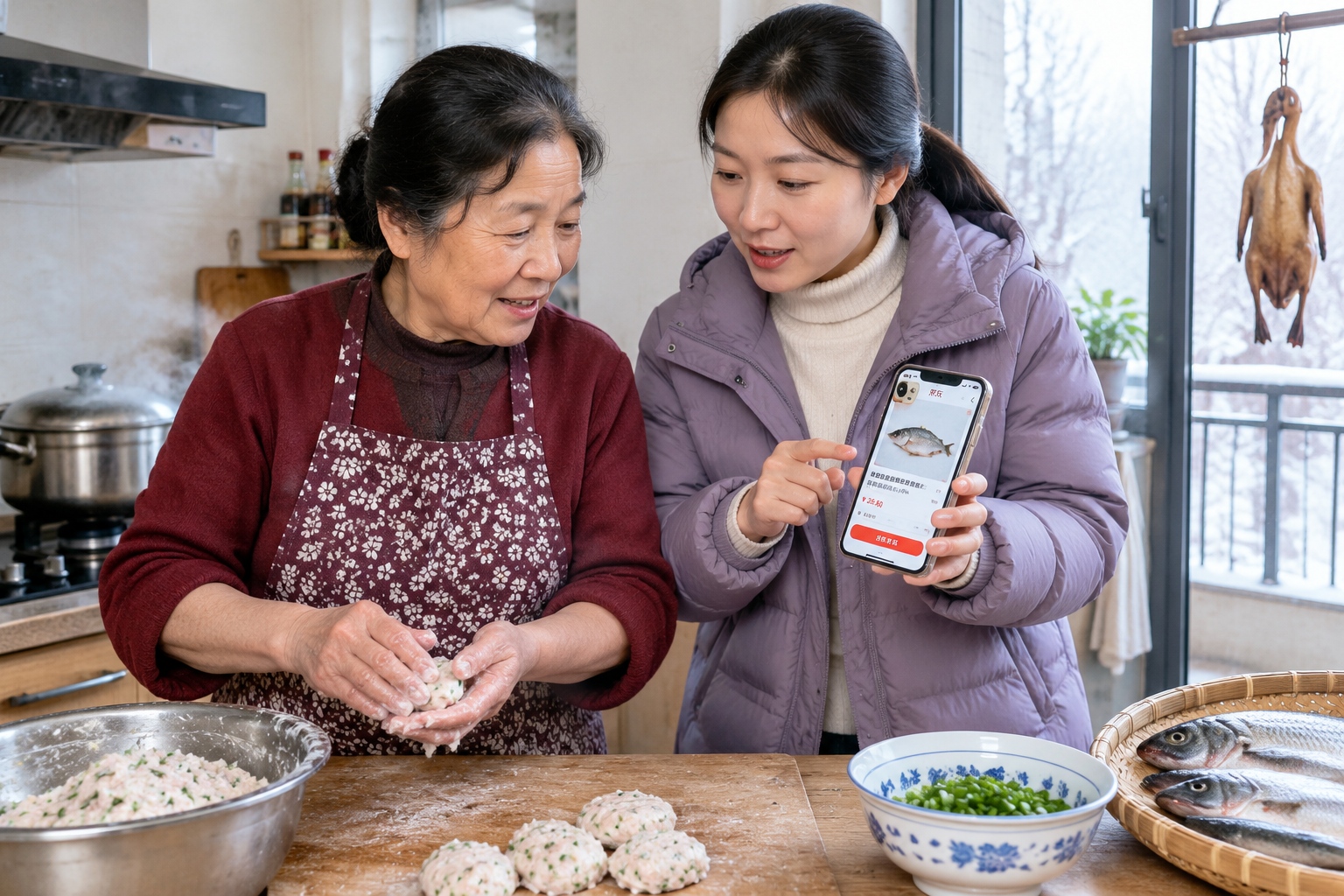
One room away, her daughter-in-law Wang Lin, 37, is doing a newer version of the same job. Phone in one hand, tea going cold in the other, she is comparing the price of fresh fish cake across two delivery apps, checking whether the order will arrive before noon, and texting her husband to ask whether his cousin is vegetarian this year. (He is not. He said so last year too.)
This is what the week before Spring Festival looks like in a great many Chinese homes: two generations, one kitchen, and a quiet negotiation over how much of the meal should still be made by hand.
No Two Zhejiang Tables Look Alike
Zhejiang is a province about the size of Kentucky, with roughly 66 million people packed into hills, river deltas and a long coast. That geography shows up on the table. Ask ten families what a New Year’s Eve dinner is and you get ten answers, all of them certain.
In Hangzhou, the classic cold dish is babaocai — “eight-treasure vegetables”: pickled cabbage, carrot, dried tofu, shiitake, daylily buds, lotus root, all cut to matchstick width and stir-fried in a big wok, then eaten cold for days. It exists because it keeps. Shops close, guests arrive without warning, and a bowl of it can be put on the table in thirty seconds.
Shaoxing families hang a soy-braised duck — jiangya — in a north-facing window for a week or two of cold wind before steaming it. Ningbo people make tangyuan, glutinous rice balls filled with lard and black sesame, and serve salted crab alongside. Wenzhou’s table is not complete without fish cake, steamed in a loaf and sliced cold or stir-fried with greens. In Jinhua, a dry-cured ham hangs in the pantry like a piece of furniture, sliced thin for soup and steamed tofu. Head into the mountains of Lishui or Quzhou and you find cured pork, dried bamboo shoots, and a clay pot of something that has been simmering since morning.
None of this is a fixed liturgy. Every family drops dishes it does not like and adds ones it does. What matters is that the table is bigger than a normal dinner and that nobody leaves hungry.
The Parts You Cannot Rush
Chen Aiyu does two dishes herself and refuses help with either.
The first is the fish cake. She buys a mian fish from the market, has the vendor clean it, and then spends forty minutes at the board with two cleavers, one for chopping and one for scraping, working the flesh off the skin. Salt, a little starch, one egg white, and then beating by hand — she stops when the paste starts to push back against her fingers. “If it doesn’t fight you, it won’t bounce when you eat it,” she says. It steams for about twenty-five minutes. She never times it. She lifts the lid and looks.
The second is the duck. Rubbed with salt, dark soy, star anise and a splash of Shaoxing wine, then hung where the wind comes through the balcony. She checks the weather before she checks the news. If it turns foggy, the duck comes inside and the plan changes for a day.
What strikes me, watching, is how unphotogenic it is. No one is filming. There is no apron with embroidery. It is just an old woman doing a thing she has done since she was twenty, at a speed that comes from repetition, complaining mildly about her knees and the price of fish.
The rice for tangyuan used to start the same way: glutinous rice soaked overnight, carried to a neighbour’s stone mill, ground into a slurry, then pressed under a weight until it was dry enough to shape. The mill still exists in the storage room downstairs. This year the bag of flour came from the supermarket, and she is not entirely happy about it, and she uses it anyway.
What Arrives in a Box
Wang Lin’s half of the meal is a different kind of skill. She is not a bad cook. She is a person with a full-time job, a twelve-year-old and a 45-minute commute.
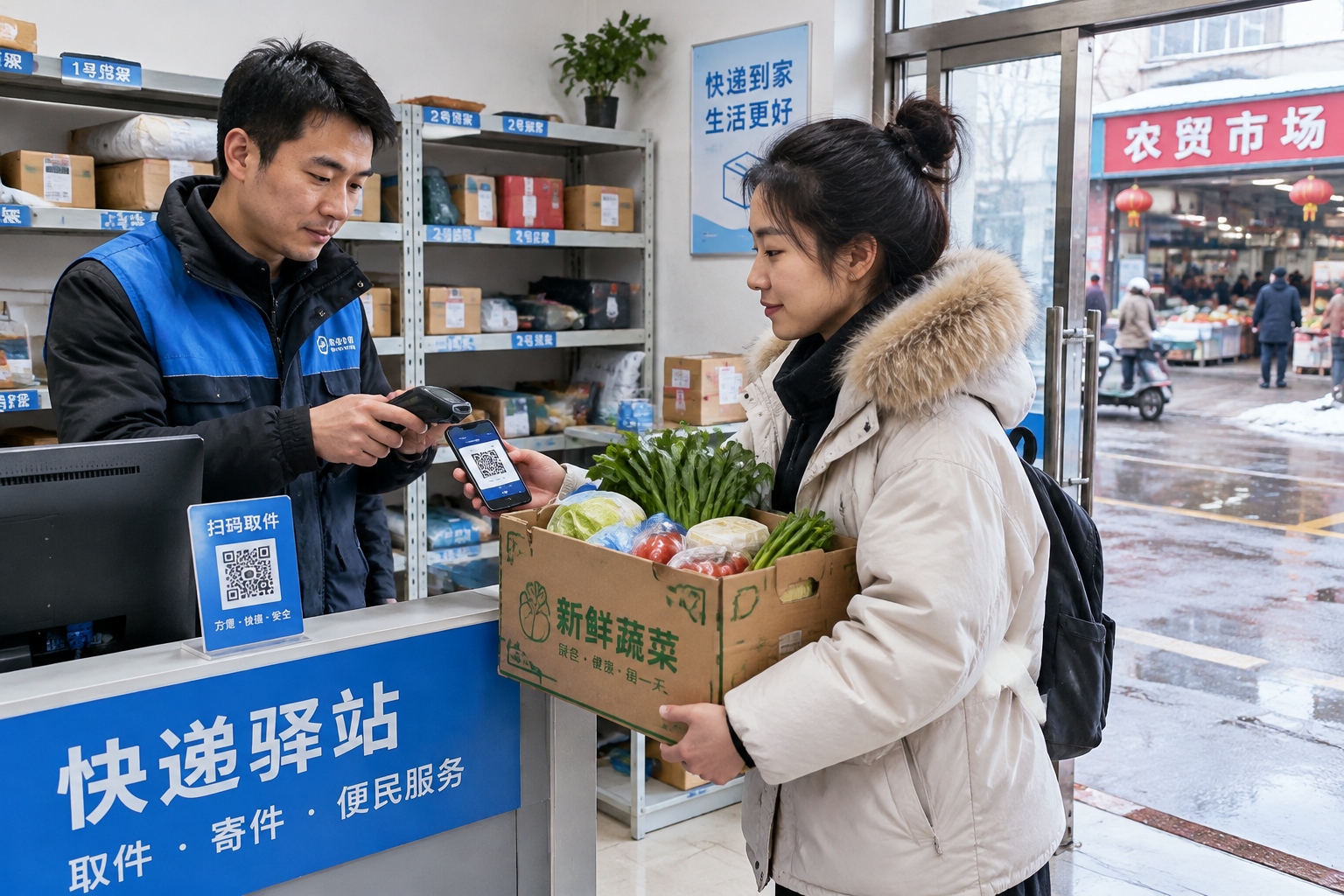
Fresh-food apps such as Dingdong Maicai, Meituan Buy and Freshippo will bring a live crab, cleaned fish or a bag of shredded bamboo shoots to the door in roughly thirty minutes, and during the pre-holiday rush the slots sell out like concert tickets. Community group buying is the cheaper cousin: order in a WeChat group before ten at night, pick it up the next afternoon at the convenience store or parcel station downstairs, and pay perhaps 20 percent less for vegetables.
Then there is the category that causes arguments at every Chinese New Year dinner: prepared dishes. Vacuum-packed meicai kourou, eight-treasure rice, a whole fotiaoqiang in a box, reheated in fifteen minutes. The industry has grown fast and drawn real public criticism — much of the online debate in 2023 and 2024 was about restaurants serving pre-made dishes without telling customers. At home, the argument is simpler. Chen Aiyu thinks a bought eight-treasure rice is “not a proper dish.” Wang Lin thinks it tastes fine, costs 38 yuan, and saves an hour.
They have arrived at a working division. Anything that carries meaning gets made by hand: the fish cake, the duck, the cold vegetables. Anything that is mostly sugar or logistics gets bought: dessert, drinks, fruit, the box of imported cherries that appears on every middle-class Chinese table in late January and costs an amount nobody admits to.
The other modern convenience is not in the kitchen at all. It is the high-speed rail line that opened between Hangzhou and Wenzhou in September 2024, cutting a journey of more than three hours to about ninety minutes, and the half-hour trains to Shanghai. The cousin who used to arrive at midnight now arrives for lunch. The grandmother’s complaint that “nobody comes home early any more” has quietly lost its evidence.
Who Does the Work Now
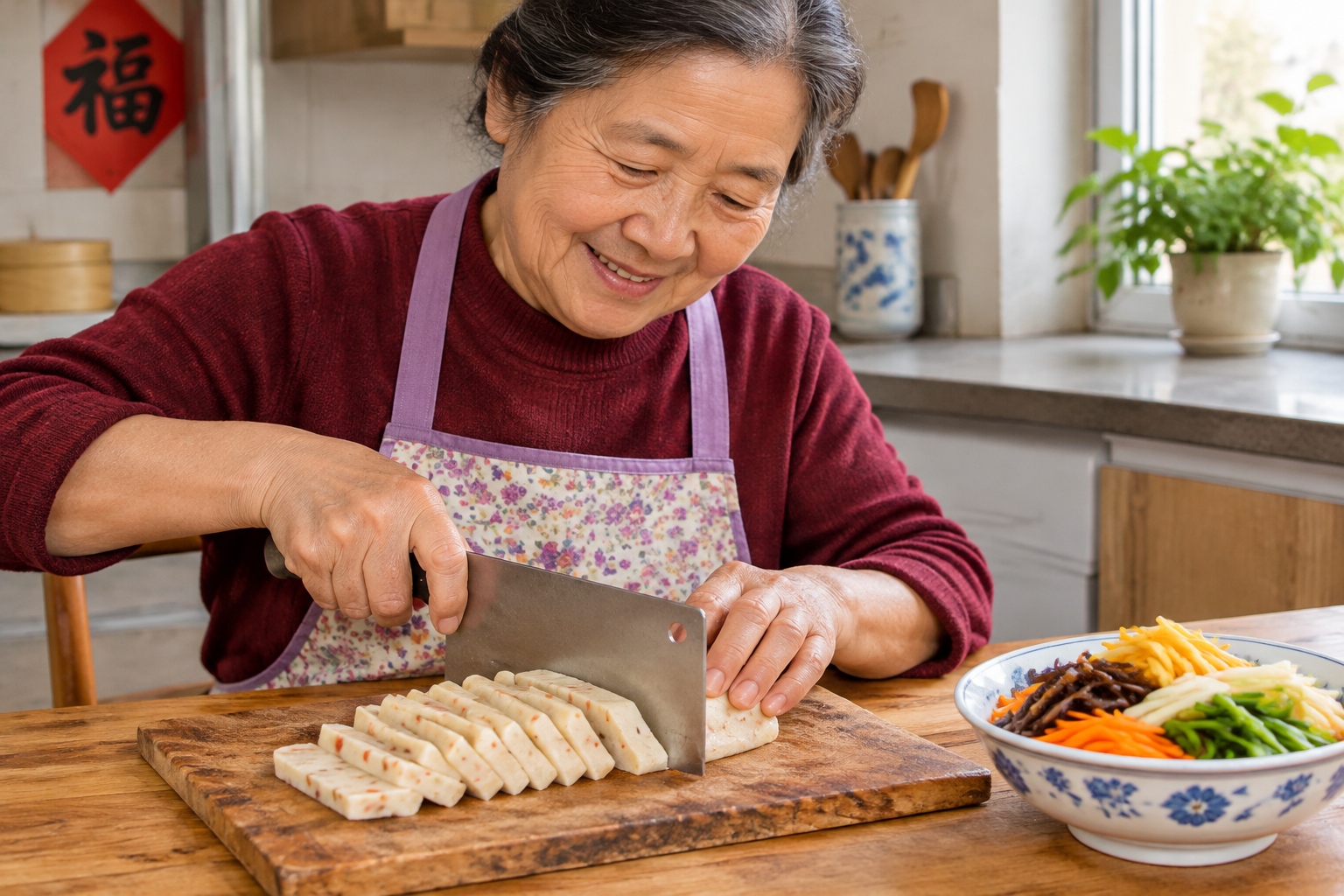
The most visible change is not in the ingredients but in the rota. When Chen Aiyu was 37, she and her sisters-in-law did everything, for two days, and then did the washing up. This year the work is split three ways: two dishes by the person with the skill, all purchasing and prep by the people with the phones, and washing-up by the person who lost at cards.
It is also split by where you live. In a Hangzhou apartment, everything is thirty minutes away. In a village in Lishui or Quzhou, the pork comes from a neighbour who killed a pig that morning, the greens from the yard, and the “app” is the parcel station beside the village committee where the group-buy crate gets dropped off. Both households are modern. They just look different from each other.
People do talk about food safety, in a practical rather than panicked way. Many Zhejiang wet markets run free quick-test rooms where you can bring vegetables in and have them checked for pesticide residue while you shop. Prepackaged goods often carry a QR code linked to Zhejiang Food Chain, a provincial traceability system, and shoppers of Wang Lin’s age do scan them, mostly out of habit. Nobody I spoke to treats this as a guarantee. It is just part of the routine, like checking the date on a carton of milk.
Money is discussed out loud, too. A properly aged Jinhua ham runs into several hundred yuan, and people say so, and then buy a smaller piece. A whole soy duck is sixty to a hundred. The eight-treasure rice is thirty-eight. The arithmetic of a family dinner is not a secret; it is part of the conversation, right before someone says “that’s too much food” and someone else says “it’s once a year.”
Eight People, Twelve Dishes
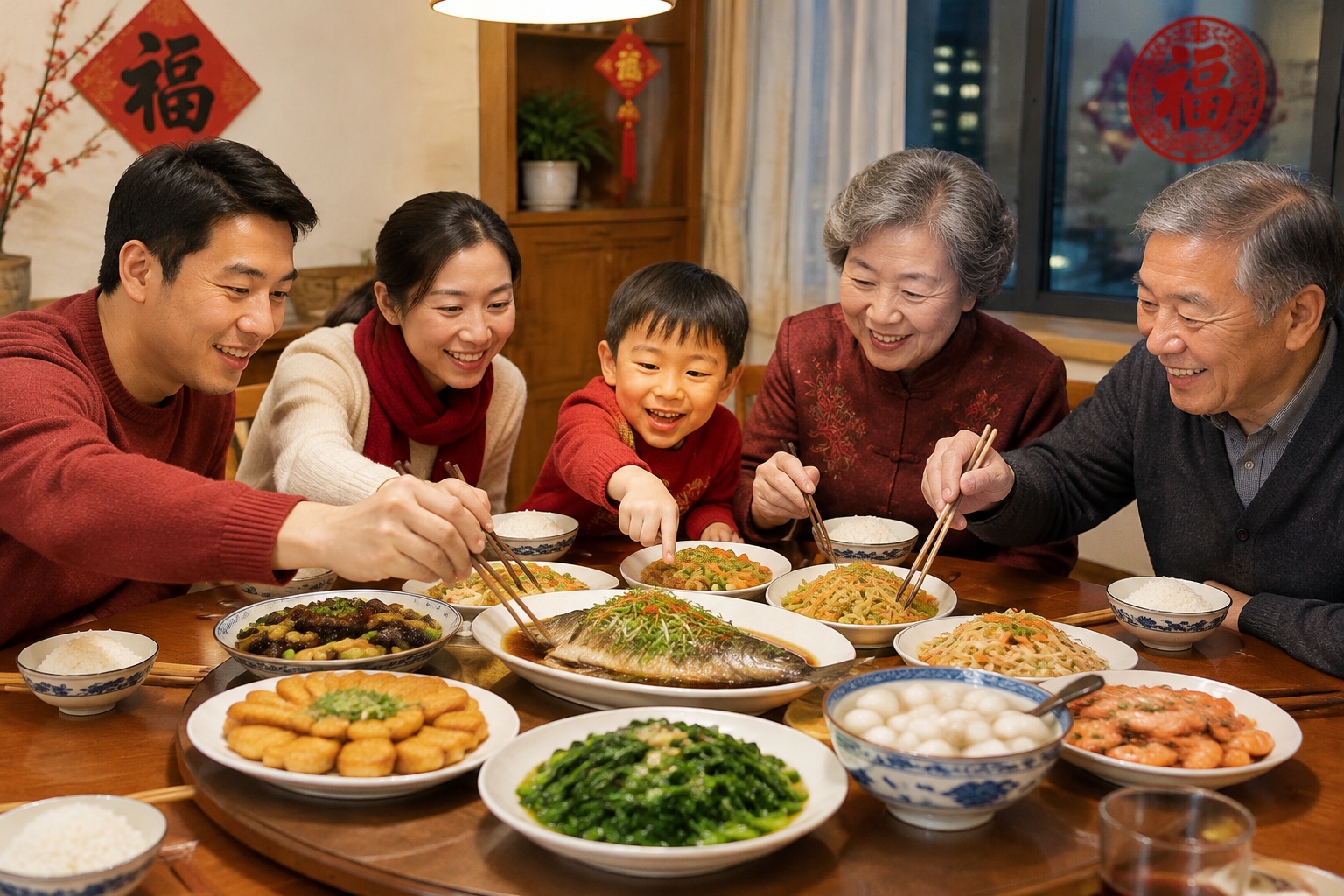
On the night, the table holds twelve dishes for eight people, which is normal and mildly excessive. The fish cake goes first. The bought eight-treasure rice is steamed, served, and nobody comments on it, which is the highest compliment a shortcut can receive.
Halfway through, the grandson points at a whole fish that nobody has touched and asks why it is there if it is not for eating. His grandmother explains, for the fourth or fifth year running, that the word for fish sounds like the word for surplus. The fish is not a dish. It is a sentence: may there be more than enough. He accepts this, mostly because there is a red envelope waiting.
At the end, Chen Aiyu says what she says every year — next year, less food — and everyone agrees, and everyone knows that next January the menu will go back on the fridge and be revised twice.
What stays with me is how little the tradition-versus-convenience question actually matters at the table. The grandmother’s hands know a technique that cannot be downloaded. The daughter-in-law’s phone knows where the fish is cheapest and how to get it here before the rain. Between them, they put dinner on the table at seven o’clock. That is not a compromise between old and new. That is just how a family feeds itself now.
Start the discussion at forum.chinacomes.com