
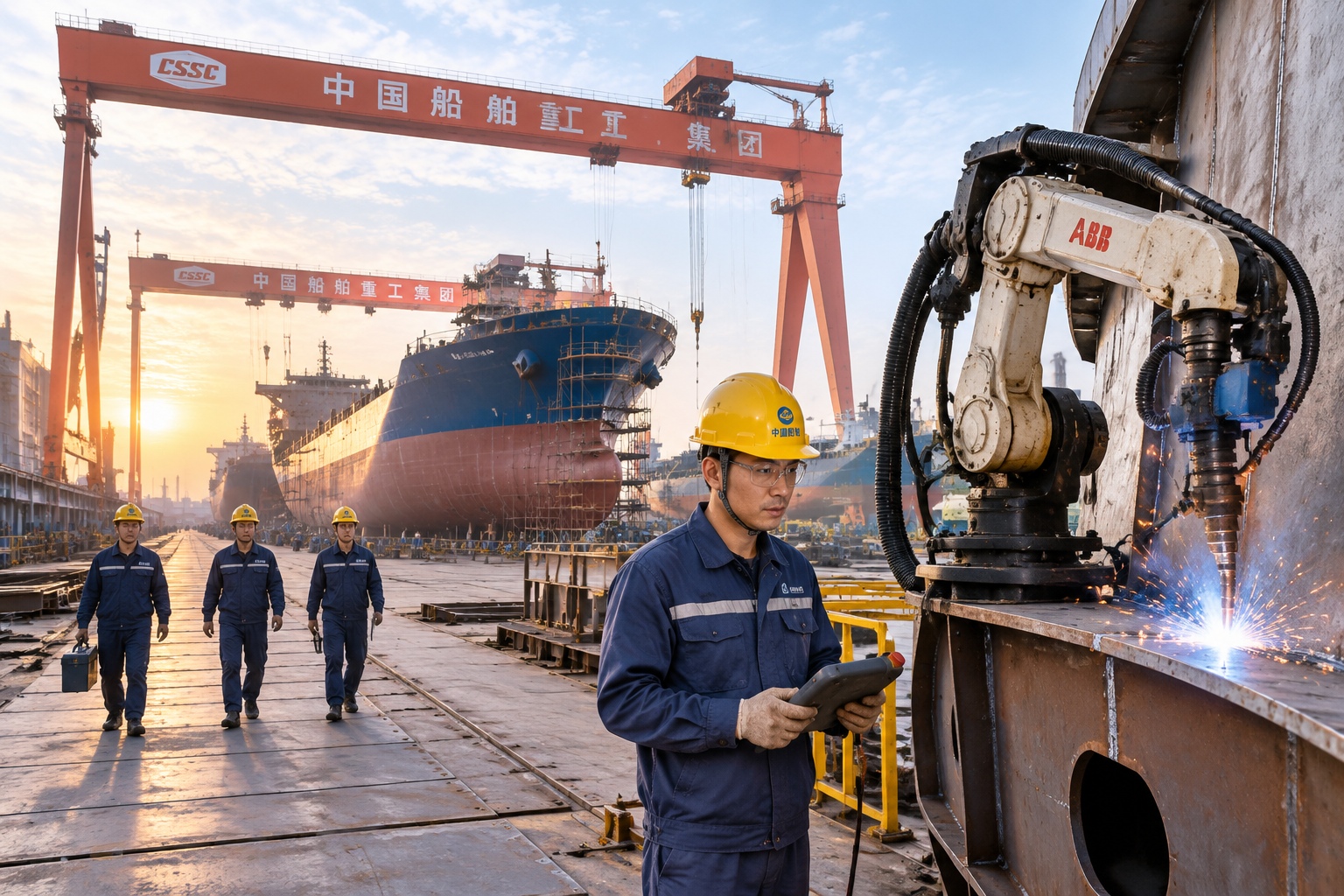

The shipbuilding chart that looked unbeatable
If you follow global manufacturing, you probably saw the shipbuilding chart this year. In the first quarter, China won 84.9% of new global ship orders. Put another way: for every ten new ships ordered worldwide, eight and a half were slated to be built in Chinese yards. That number is so large that it feels like a typo. It is not. Shipyards in Shanghai, Dalian, Jiangsu and Guangzhou have order books stretching years ahead, and the phrase ‘China is the world’s shipyard’ has stopped being a metaphor.
But shipbuilding is the loud number. It is visible from a satellite: steel hulls, gantry cranes, dry docks. There is a quieter number that says more about where manufacturing is going. It is not about the ships China builds. It is about the machines that build almost everything else.
The robot number that breaks the scale
The International Federation of Robotics expects factories worldwide to install about 619,000 industrial robots in 2026. That is the entire planet’s projected annual market. In the first half of this year, China produced 537,700 industrial robots. That is roughly 87% of the global full-year forecast, made in six months by one country. In June alone, China produced 110,700 units, about 2.15 times the global average monthly installation rate.
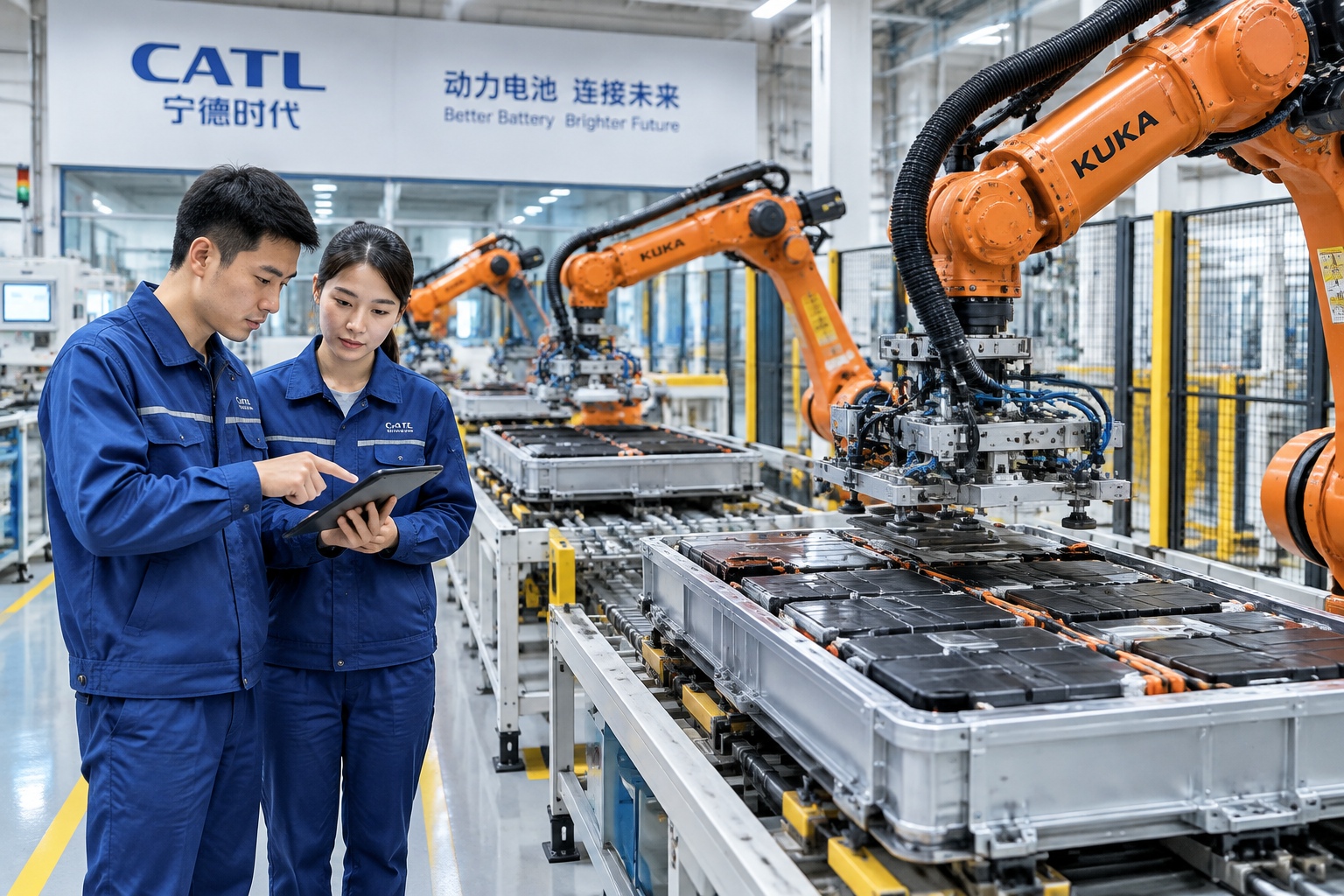
For readers outside China, the word ‘robot’ may still bring up images of a humanoid in a laboratory. Most industrial robots are not like that. They are heavy arms that weld, lift, paint, assemble and inspect. They work behind safety fences in car plants, electronics factories, battery gigafactories and solar panel lines. They do not need to look human to change an economy.
Why a robot is not a phone
To understand why this matters, it helps to look at how the previous leaders described robots when they were on top.
In 2010, Japan’s Ministry of Economy, Trade and Industry published a manufacturing report. At the time, Japanese companies held more than 70% of the global robot market by shipments. The report did not treat robots as a niche product. It said they would solve three problems at once: a shrinking labor force, rising workload, and demands for higher quality. It estimated a market of about 700 billion yen could grow to 9.7 trillion yen by 2035. That is not a gadget forecast. It is a national growth strategy.
Germany’s 2013 Industry 4.0 report was even broader. It barely bothered with market share for a single robot model. It placed smart machines, automated production lines and digital factories at the center of the fourth industrial revolution. The argument was blunt: with high wages and an aging population, Germany could keep manufacturing only if it automated deeply.
The difference between a robot and a phone is what happens after the sale. A phone leaves the factory and its value is mostly realized. A robot enters a factory and its value has just begun. A single arm can raise output, improve quality and speed up delivery at the same time. In semiconductors, where precision and cleanliness exceed what human hands can reliably do at scale, automation is not a choice. It is the condition for production.
The US report that admits a ‘robot deficit’
This year, a US think tank called the Special Competitive Studies Project published a report titled ‘The Robot Deficit’. The word deficit is usually used for trade balances or budget gaps. Applying it to robots is a confession: in this race, the United States is behind.
The report says China has already achieved a decisive lead. It also demolishes a common assumption. Many people hear ‘Chinese robots’ and think cheap. Cheap is a result, not a cause. Money alone cannot buy the result. Between 2018 and 2024, US robotics investment averaged more than $7 billion a year, more than double China’s. Yet recent US startups focused on robot hardware have had a failure rate of 97%, according to the report. A hundred companies enter; ninety-seven come out sideways. Capital can scale an app overnight. It cannot will a machine into reliability.
Machines become reliable inside factories. They are installed, broken, fixed, adjusted and improved by customers. The world’s largest testing ground is in China. In 2024, 54% of all new robots installed worldwide went into Chinese factories. The US took 6%. China has more than 2 million industrial robots in operation, five times the US total.
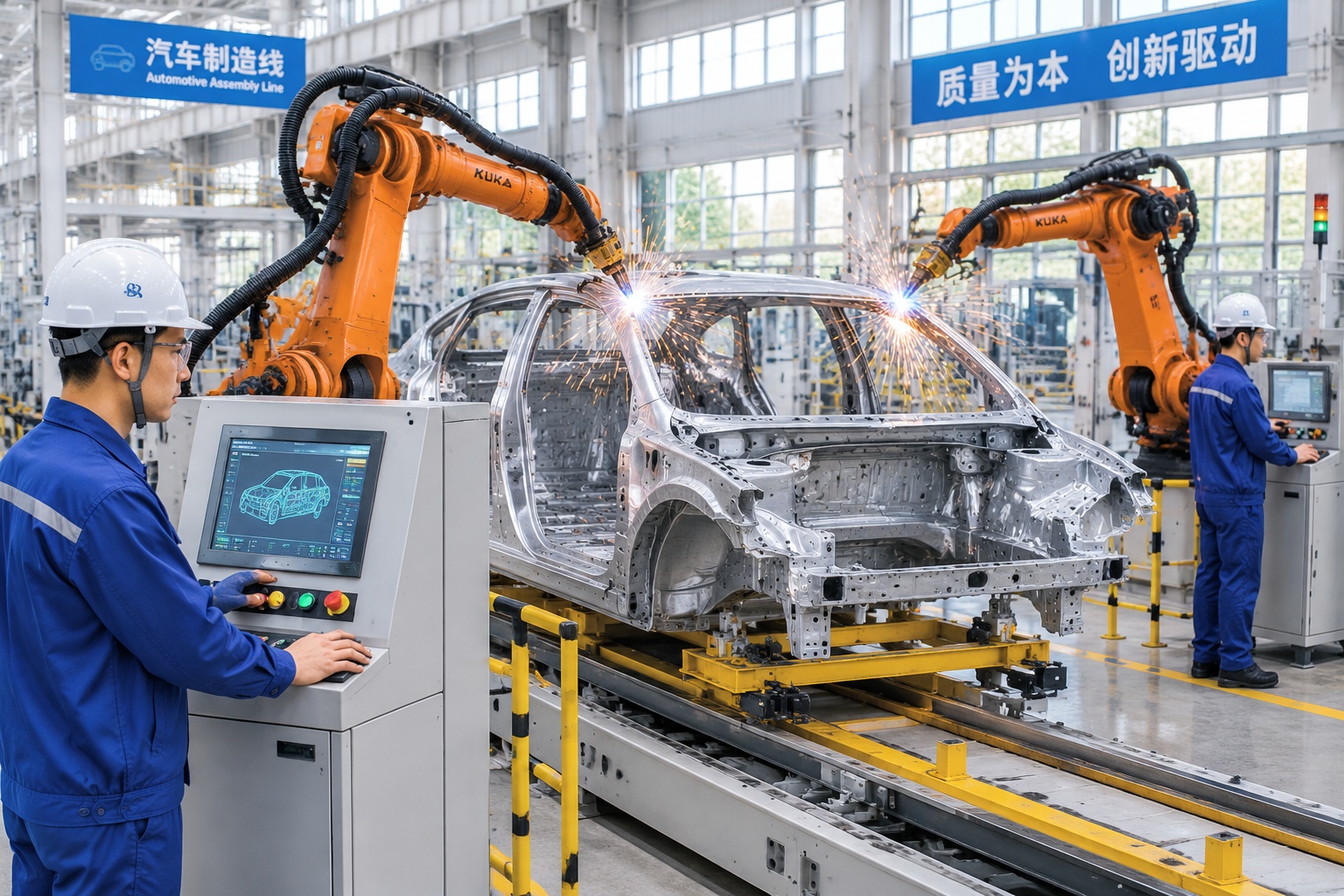
The report also admits that most robots installed in US factories are imported, mainly from Japan and Europe. For the most critical components, the US is even more exposed. Precision reducers, which work like robot joints, are dominated by Japan. Servo motors, which act like muscles, depend on rare-earth magnets and other materials. About 90% of the processing capacity for those materials sits in China. As the report puts it, in a conflict or embargo, the US would lack the ability to produce the tools of automation. By contrast, leading Chinese robot makers can already source about 80% of their components domestically.
The price gap and the reversal
The gap shows up in prices. Morgan Stanley has calculated that a humanoid robot using a non-Chinese supply chain needs about $130,000 in raw materials. Using a Chinese supply chain, the figure falls to $46,000, roughly one-third. In a poker game, holding a hand that costs three times as much as your opponent’s is not a comfortable position.
The shift is not static. In 2014, Chinese brands installed 16,000 robots in the Chinese market; foreign brands installed 41,000. Chinese firms were not even at half. By 2024, Chinese brands installed 170,000, while foreign brands installed 125,000. In the world’s largest robot market, domestic brands now outsell all foreign brands combined. The two lines crossed.
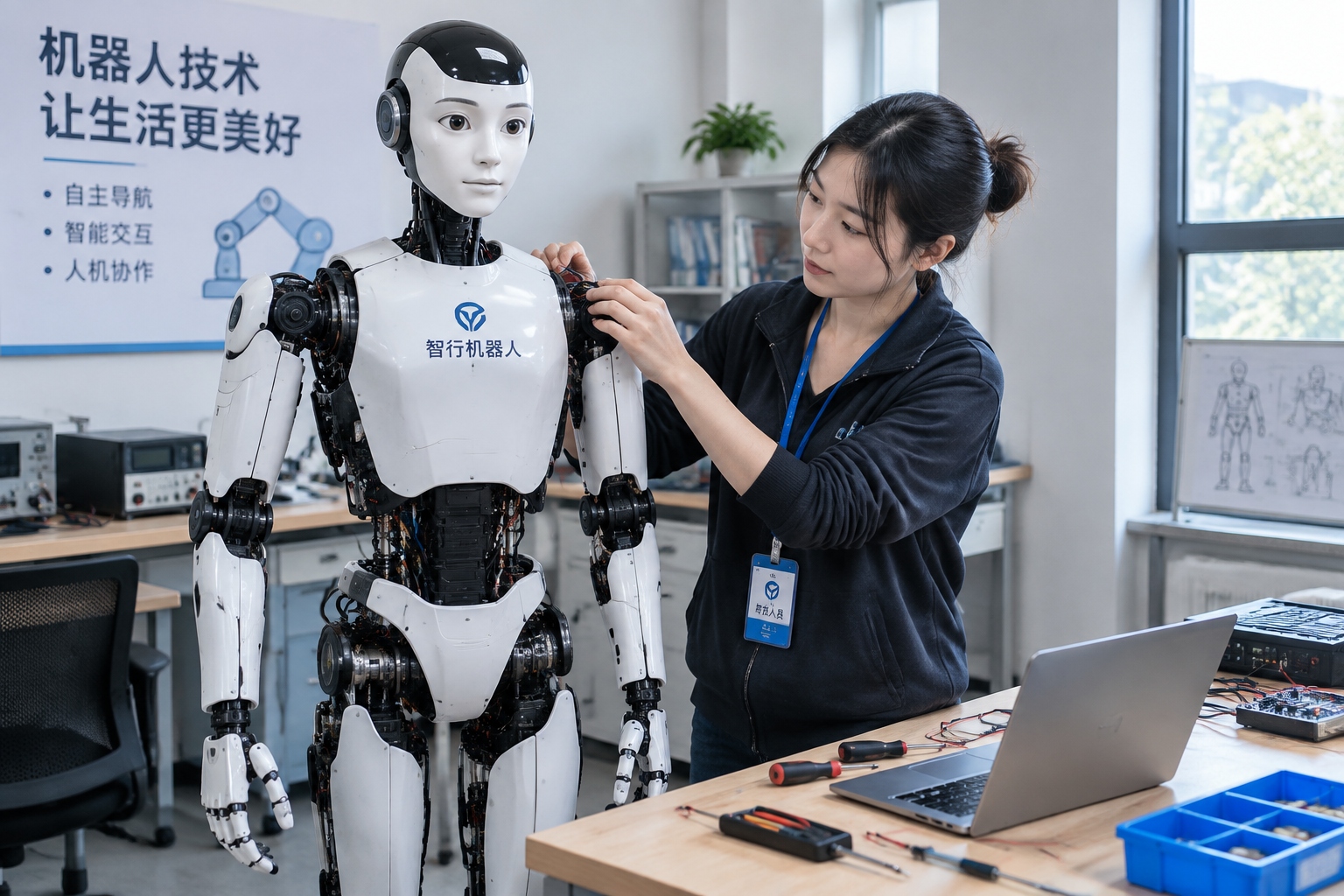
In humanoid robots, the frontier is messier but moving faster. Over the past five years, China has commercialized six humanoid robots; the US has commercialized two. In 2024 alone, Chinese companies released 34 prototypes, compared with eight in the US. China holds five times as many related patents as the US. People are moving too. OECD data shows that since 2021, the net inflow of scientists to China has exceeded the net inflow to the US. Equipment, orders and production lines attract talent. Talent follows the machines.
What this means for green factories and the next decade
This is not only a story about cars or electronics. The green transition is also a manufacturing transition. Solar panels, batteries, electric vehicles, wind turbines and heat pumps all require automated production lines. If Chinese robot makers can supply those lines and their components at a lower cost, they can speed up clean-tech factories around the world. They can also deepen global dependence on Chinese supply chains.
A battery startup in Europe or the United States that buys Chinese robots may scale faster. It may also link its expansion to parts, software and maintenance that come from China. That is the real change. China is moving from exporting goods to exporting the capacity to make goods. When you buy a phone or a car, the value is consumed over time. When you buy a robot line, you buy future efficiency that stays on your factory floor.
For ordinary workers, the effects are mixed. Dangerous welding and painting jobs can be reduced. New jobs appear for robot operators, maintenance technicians and line engineers. At the same time, older workers may see their skills lose value, and small factories that cannot automate may fall behind. There are real debates in China about youth employment, industrial overcapacity, wage growth and trade friction. The picture is not simple.
Still, the direction is measurable. A decade ago, a small metal-parts factory in Guangdong or Zhejiang could not justify a six-axis robot. Today, domestic suppliers, leasing models and cheaper components have pushed automation into smaller workshops, not just giant state-owned plants. That is what the democratization of high technology looks like: not a concept video, but a dusty factory floor where a machine arm starts doing the night shift.
The number behind the number
Read the three reports together. In 2010, Japan praised robots as a national growth industry when it led the market. In 2013, Germany defined automation as the core of an industrial revolution when it led in advanced manufacturing. In 2025, the United States writes about a robot deficit because it no longer leads. The pattern is old: whoever leads calls the technology essential. What has changed is who is standing on stage.
China’s shipbuilding orders are impressive. Its robot production is structural. The country is not only building ships, cars and batteries. It is building the machines that build them, and beginning to sell those machines to the world. That is why the shipbuilding number, as huge as it is, may not be the most important number of the year. The factory is becoming the product.
Start the discussion at forum.chinacomes.com