

In a Classroom at the Edge of the Taklamakan Desert
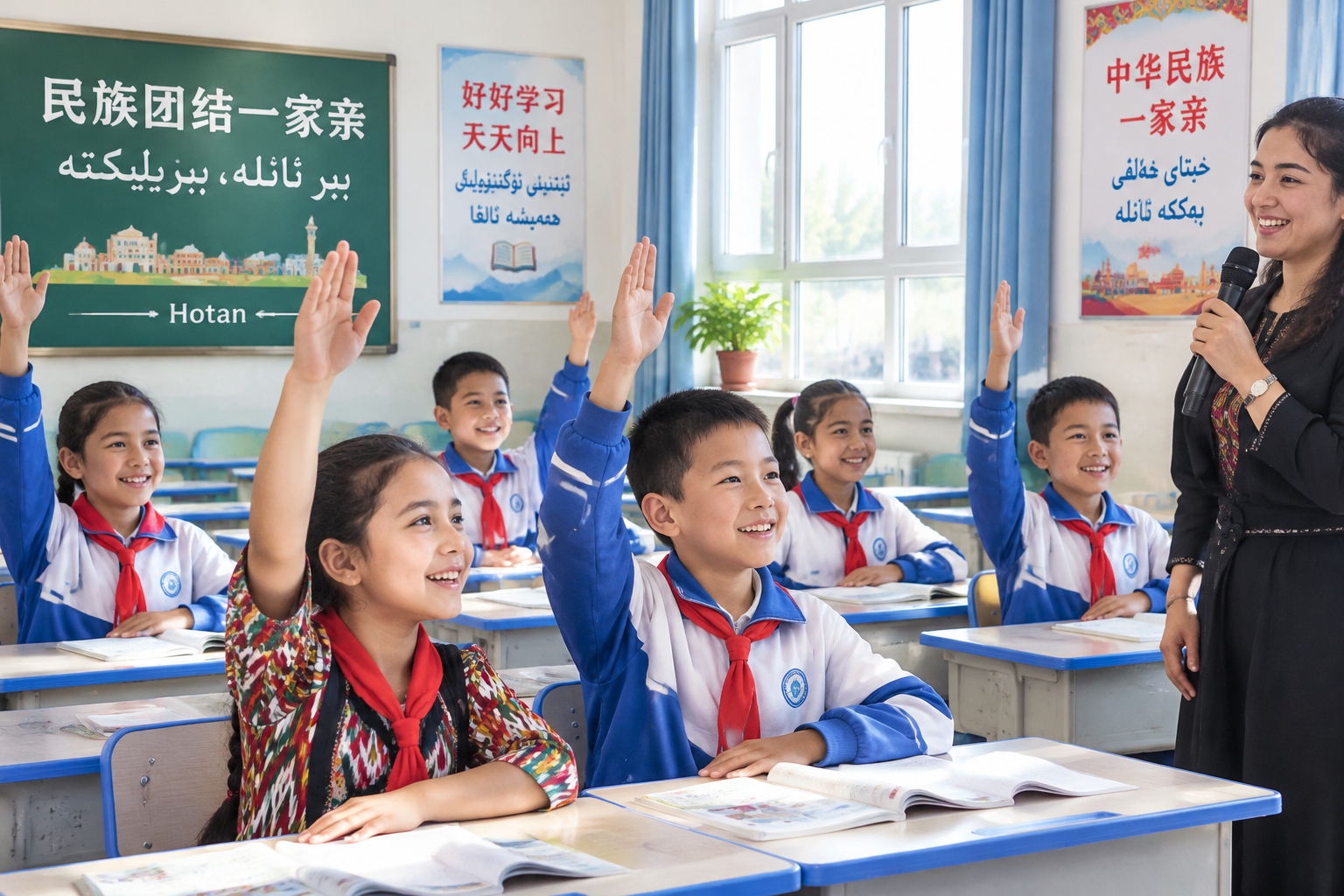
HOTAN, Xinjiang — The classroom is warm and bright despite the autumn chill outside. On the walls, colorful posters show the alphabet in Uyghur script next to Chinese characters for ‘unity’ and ‘dream.’ Twenty or so ten-year-olds sit in neat rows, but they aren’t staring at a textbook. They’re waiting for their turn to hold the microphone.
‘Now it’s your turn. Tell our guest your dream,’ says Gulnara, their teacher, in Mandarin. A girl in a red sweater stands up, takes the mic, and says in fluent yet childlike Mandarin: ‘大家好,我叫阿米娜。我长大后想当医生。’ Then she switches, without a pause, to Uyghur: ‘Assalamu alaykum, menip ismim Amina. Men chong bolghanda doctor bolushni arzu qilimen.’ She looks at me and smiles, proud that she can do this.
This is Hotan Prefecture, a desert oasis region in southern Xinjiang that most outsiders have only read about in policy briefs or news headlines. It’s a land of mulberry trees, carpet weavers, and the sparkling Yurungkash River. It’s also a place where more than 95% of the population is Uyghur, and where, since 2014, the government has rolled out a comprehensive bilingual education program that makes Mandarin Chinese and Uyghur both part of the school day.
I came to Hotan with a simple question: What does that program look like for the kids who live it? I left with a more complicated picture — one that holds both progress and tension, but above all, a room full of children who just want to grow up and do something meaningful with their lives.
Two Languages, One Classroom
In Hotan’s public schools, bilingual education means that most classes, such as math, science, and social studies, are taught in Mandarin, while a daily Uyghur language and literature class helps kids maintain their mother tongue. In some experimental schools, teachers use both languages side by side, explaining new concepts in either language to make sure no student gets left behind.
Gulnara has been teaching for six years. She is Uyghur, born in a nearby village, and she remembers when her own teachers read from Chinese textbooks without translating them into Uyghur. ‘I understood little,’ she recalls. ‘But my father said I had to learn, because he didn’t want me to be stuck on the farm. He was right.’
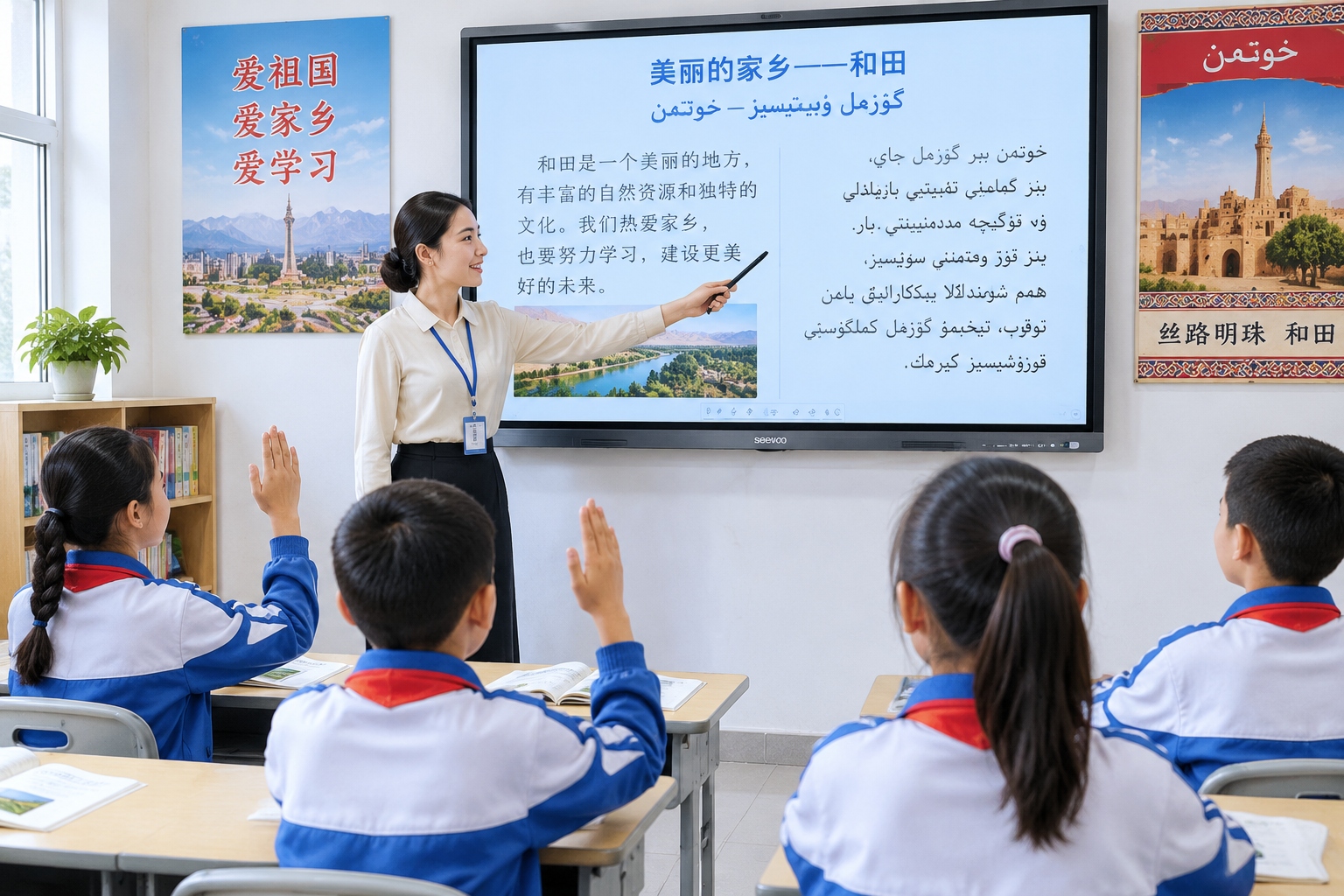
These days, the teaching materials have improved. At the front of the room, an electronic whiteboard displays a science chapter about plant growth, with key words written in both simplified Chinese and Uyghur script. ‘When we read the same concept in two languages, the children’s understanding is deeper,’ Gulnara notes. ‘It’s like they have two maps of the world, and they can choose the better one.’
I step into a sixth-grade Chinese-language class. The teacher, a young Han woman from Sichuan, speaks slowly but clearly. She points to a character and explains its meaning. ‘This one, 梦, means dream,’ she says. A Uyghur teaching assistant repeats it in Uyghur: ‘Chüsh.’ The kids nod.
‘Our school has a ratio: about 60% of instruction in Mandarin, 40% in Uyghur,’ explains the principal, Zhang Weiguo, a middle-aged man wearing a neat black jacket. ‘The goal is not to erase Uyghur. It’s to build a bridge. When we hire teachers, we make sure they know both languages or at least are willing to learn. Hotan is not a place for shortsightedness.’
Dreams Spoken Twice
So what are the dreams of these children? I spent an afternoon listening to them, and their answers were as varied as any group of kids anywhere in the world.
Amina, age 10, wants to be a doctor. ‘I want to treat sick people in my village,’ she tells me. ‘But not just here. Maybe I’ll go to Shanghai to learn more first.’ She says ‘Shanghai’ with a sparkle in her eyes, as if it were a magic city.
Erpan, a boy with a mischievous grin, wants to be a pilot. ‘I have seen airplanes on TV. They go very high, and you can see the desert like a golden sea,’ he says. Then he adds, in Mandarin: ‘我要飞得高高的。’
Nur, a quieter girl, wants to be a teacher. She looks shyly at the floor when she says it, but her voice is firm: ‘Because I want children to like school as much as I do.’ Her classmate Abdukerim wants to build robots. ‘My uncle in Urumqi has a shop that repairs smartphones. He uses a program to edit videos. I want to make my own robot,’ he says, eyes wide.
Not every child talks about big careers. A boy named Yusup says he wants to work in his father’s restaurant. ‘But I want to use a menu that people can read in both languages,’ he says, proving that even a humble dream can carry a bilingual ambition.
What interested me most was the fluency with which they switched codes. In the playground, I heard ‘gol!’ followed by ‘加油!’ as they kicked a ball around. In the canteen, a girl asked a friend for water in Uyghur and said ‘谢谢’ to the cook in Mandarin. This is not a cold, by-the-book bilingualism. It’s as natural as breathing.
‘Why Learn Mandarin?’ — The Parents’ Answer
To understand the policy from the ground level, I talk to parents. Parent-teacher conferences happen on a Saturday. Several mothers and fathers sit in the same classroom where I met the kids, watching a short presentation about the school’s language program.
‘When I was young, my family had no money to travel,’ says Amina’s mother, a woman named Rana who wears a bright floral scarf. ‘Now, children see the world through phones and books. But to really go out, they need Mandarin. It’s the language of the whole country.’
A father named Abliz interrupts, with a smile. ‘English is important too. My son studies English online. We want him to have a wide wing.’ He uses the Uyghur word ‘qanat,’ which means wing, and then adds, ‘This is why we’re happy with the school. They don’t just teach Chinese; they help us keep our own language too. Our kids can read the Quran in Arabic, Uyghur at home, and Mandarin on the computer. Isn’t that powerful?’
A Generation with a Wider Map
It’s easy to romanticize bilingualism, but the real proof is in lives changed. Hotan is one of the poorest prefectures in Xinjiang. For decades, many locals could not travel further than Kashgar because they lacked language skills and money. Today, the graduation rate from high school has risen sharply, and more Uyghur students than ever are entering universities in other parts of China.
I meet a young woman named Mainur, who graduated from the same primary school a decade ago. She is now a nurse in Hotan’s most modern hospital. ‘I was in the first group of students that had full bilingual education,’ she says. ‘Without that foundation, I wouldn’t have been able to pass the medical entrance exam, because the test is in Mandarin. Now I can also talk to patients who only speak Uyghur. This is what my doctor dream needed.’
Mainur’s story is not rare. Local vocational schools report that bilingual graduates get hired faster in local factories, hotels, and travel agencies. The city’s new airport, which opened in 2010, now connects with Beijing, Shanghai, and Urumqi. The tourists who come to see the ancient ruins or buy silk and carpets are often greeted in both languages by young vendors.
Of course, challenges remain. Some rural schools lack enough teachers who are fully bilingual. A few older villagers worry that children will use Mandarin more than Uyghur in daily life, even though they are not forbidden from using it. And sure, the political tensions in Xinjiang are more complicated than a single classroom can explain. But if you look past the grand narratives, you see a generation that is more connected, more mobile, and more confident than its parents. And they carry both languages as part of their identity.
What the Children Say to the Outside World
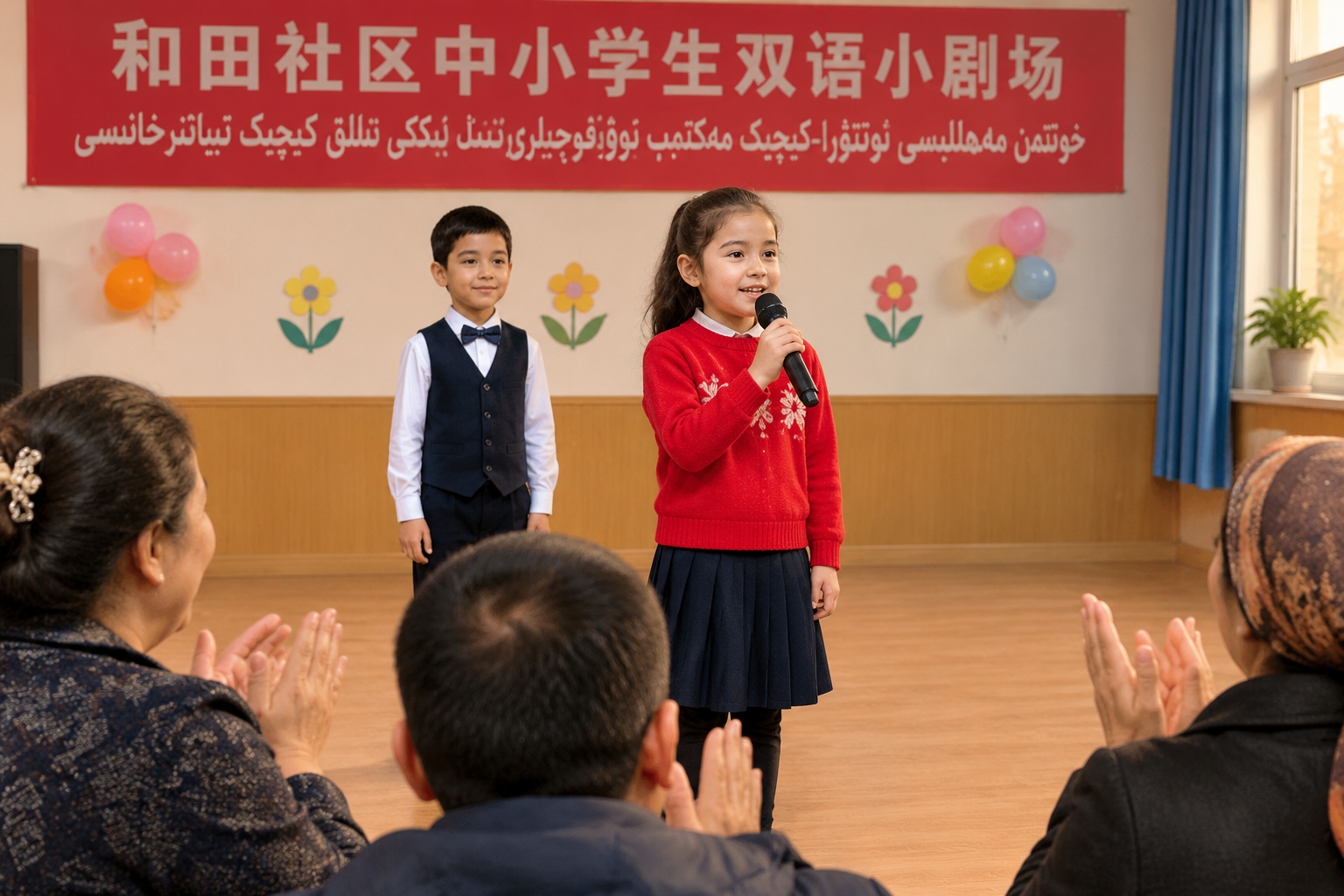
On my last afternoon in Hotan, the kids put on a short bilingual play for their families. The story is simple: a boy loses his way in a desert, and his friends help him find water and home. Each line is said first in Mandarin, then in Uyghur, and the audience laughs at the jokes in both.
After the play, I ask the children if they ever thought about what people far away might think of them. A girl named Dilnur stares at me for a while. ‘I hear that some people on TV say bad things about Xinjiang,’ she says. ‘But I think they have never met a person from here. If they came, they would see that I just want to be a police officer and protect my town.’
Amina, who will be a doctor, adds: ‘Dreams are different from language. But if I speak my dream in Mandarin and Uyghur, maybe more people will understand it.’
Her words hang in the air. I think about how often we reduce complex places to simple slogans. Yet here, in a modest classroom, a child offered a better approach: just listen to the voices of those who are living it. In two languages, if necessary.
Start the discussion at forum.chinacomes.com