

Morning, Before the First Bell
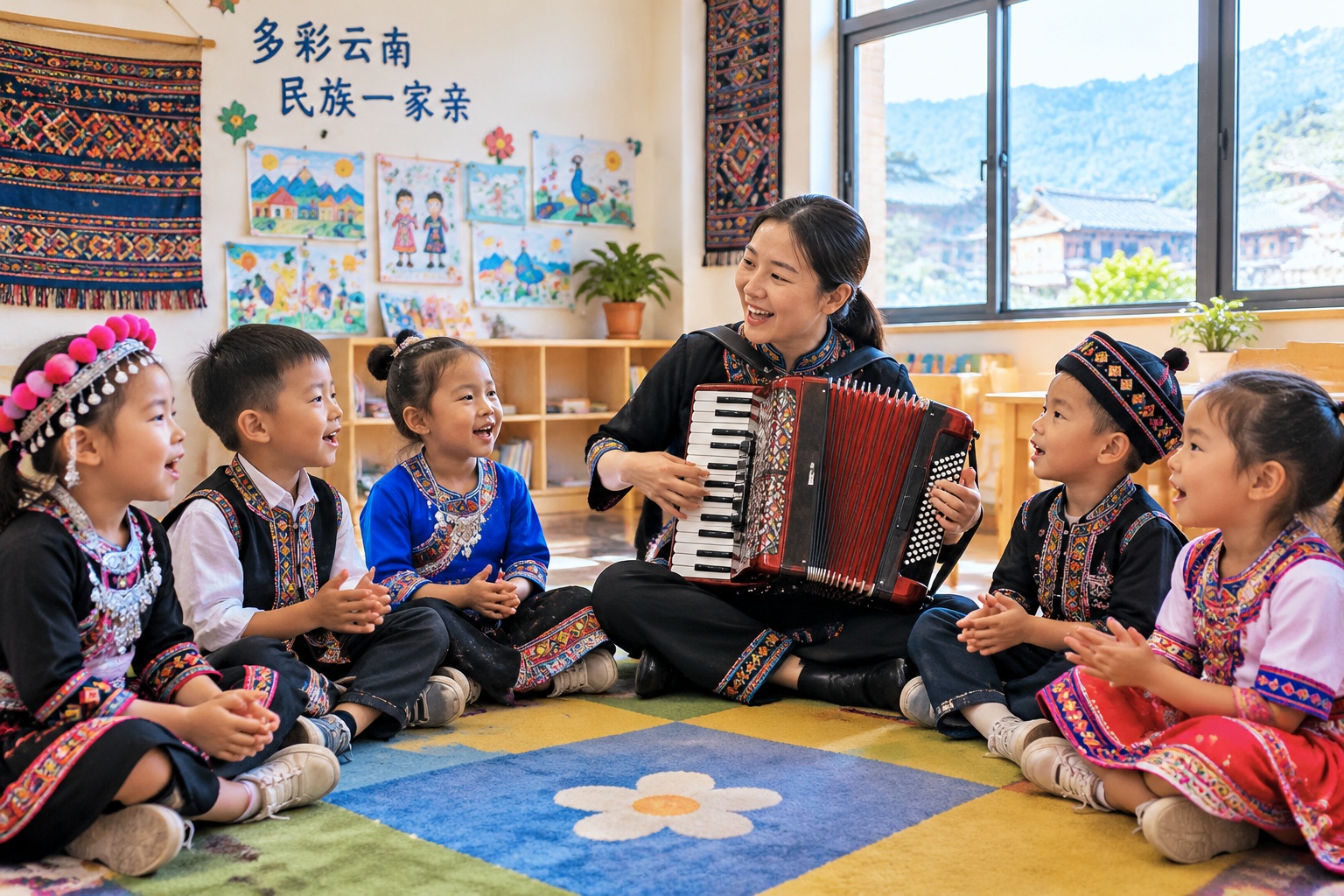
It’s just past 8 a.m. in Lvchun County, a small town tucked into the southern mountains of Yunnan Province. A girl with two braids runs across the playground, stops, and waves at her friend. They shout something in Hani, then giggle and switch to Mandarin as a teacher calls them to line up.
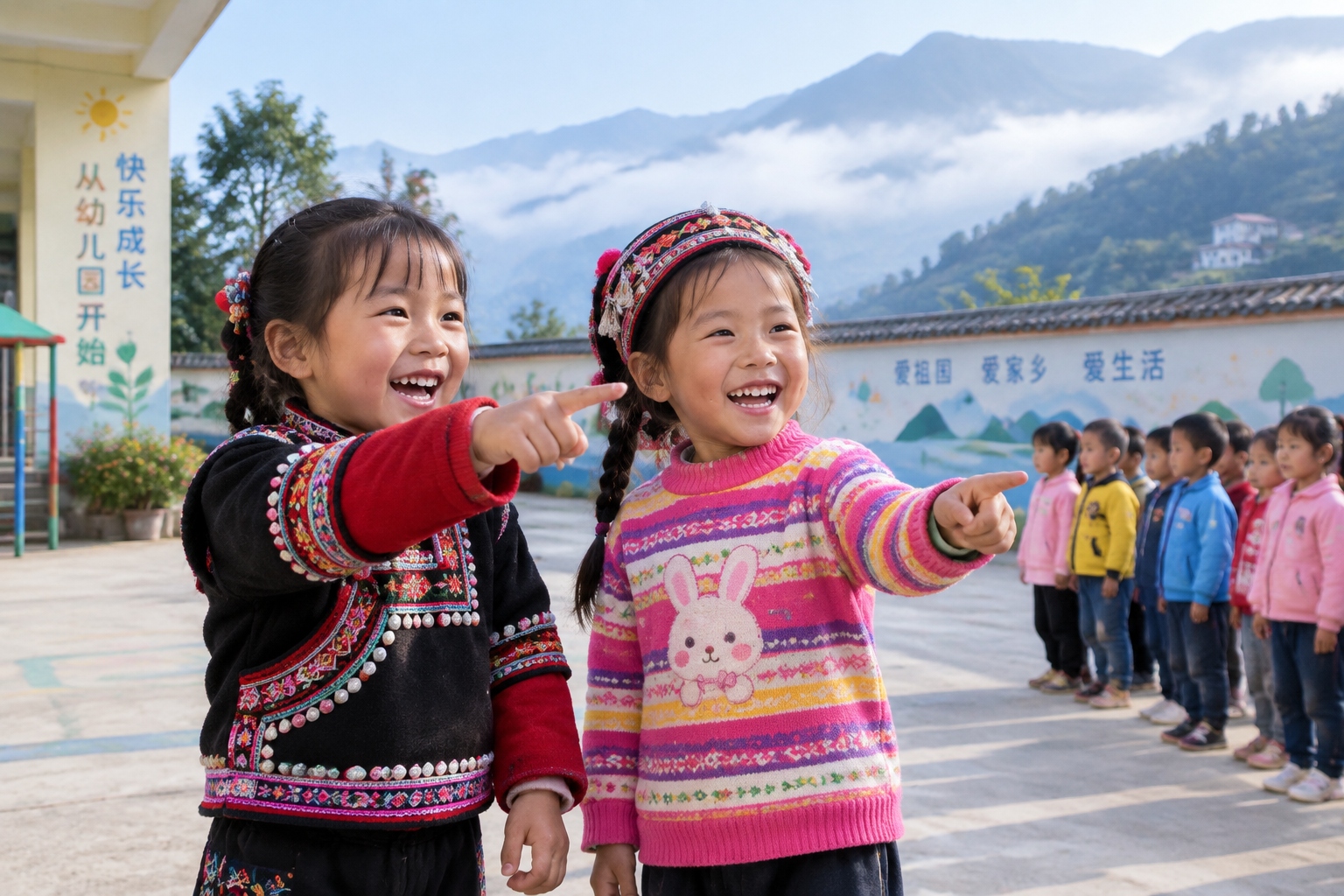
This is the Lvchun County No.1 Kindergarten, and what makes it special is not the colorful building or the new jungle gym. It’s the mix of voices. Of the 400-plus children enrolled here, roughly half come from the Hani ethnic group, a quarter from Yi, and the rest from Dai, Yao, Zhuang, and Han families. They share the same classrooms, the same meals, and the same songs — songs that are taught in three languages.
Why Three Languages?
Lvchun is one of China’s most ethnically diverse counties. Hani, Yi, Dai, Yao, and other groups have lived here for generations, often in separate villages with their own languages. Until a decade ago, many local children arrived at primary school speaking little or no Mandarin. Teachers struggled to explain basic concepts, and kids from different ethnic groups sometimes struggled to understand each other.
The kindergarten decided to flip the script. Instead of pushing children into Mandarin-only classes, it built a curriculum that treats each child’s home language as a bridge, not a barrier.
“When a kid hears the first song in Hani, his eyes light up,” says Li Xianghong, the kindergarten’s principal. “Then we sing the same melody in Yi. At first, some children look confused, then they start moving their lips. By the third round in Mandarin, everyone is singing.”
This is not just about songs. Teachers use three languages for daily instructions, stories, and games. On a typical day, a morning greeting might come in Hani, a snack-time rhyme in Yi, and a story about elephants in Dai or Mandarin. The goal is not fluency in all three, but confidence in one’s own language and openness to others’.
Inside a Three-Language Classroom
I visited one afternoon during a music lesson. Teacher Wang Mingyue, who is Hani, led the children through a song about the rainy season. She sang each line in Hani, then asked the children to echo. A little boy in the front row, from a Dai family, stumbled over a Hani word. His classmate next to him, a Hani girl, gently corrected him. Soon the whole class was laughing — not at him, but with him.
“When we started this program four years ago, some parents worried their kids’ Mandarin would suffer,” Wang says. “The opposite happened. Children who feel secure in their mother tongue actually pick up a second or third language faster. Our kids do well in primary school, and many speak two or three languages by first grade.”
Research on bilingual education backs her up. A child who builds strong foundations in a first language transfers those skills to a new language. What happens in Lvchun is a real-world example of that principle, adapted to a multilingual setting.
Teachers Learn Their Students’ Languages First
None of this would work without the teaching staff. The kindergarten has 18 teachers and assistants, representing Hani, Yi, Dai, and Han backgrounds. But being from an ethnic group doesn’t automatically mean you can teach in its language. So the school runs regular training sessions, where teachers teach each other the phrases and songs they’ll use in class.
“I’m Hani, but my Dai is terrible,” laughs teacher Zhang Suyun, who has worked here for eleven years. “The Dai teacher on our team taught me the Elephant Song. Now I can perform it with gestures, and the Dai kids join right in.”
The teachers also compile their own songbooks, with lyrics in all three languages plus Chinese characters and pinyin. It’s slow work, but principal Li sees it as essential. “If we just used ready-made materials from the city, we’d lose the local flavor. These songs come from villagers’ grandmothers. They carry memories.”
What the Parents Say
At pickup time, I talked with a Hani mother, Luo Yunfen. She works in a tea factory and sends her three-year-old son to the kindergarten. “At home we speak Hani. When he sings the Hani lullaby to me at night, I almost cry. He also teaches me Mandarin words I don’t know.” She laughs. “He’s like my little teacher.”
A Dai grandfather named Ai Zhu remembered his own school days. “When I was small, I had to sit in class not understanding a word. Teachers told my parents to speak Mandarin at home. That broke a link to our culture. Now my grandson comes home and sings in Dai, Hani, and Mandarin. It’s wonderful to hear.”
Not every parent is perfectly at ease. Some worry that with three languages in the classroom, their child might get confused. But after a few months, they see progress. “My son used to be shy,” says a Yi mother who asked not to be named. “Last week he stood up in front of the whole class and said a poem in Yi and Mandarin. I couldn’t stop smiling.”
Larger Meaning: Language as a Shared Treasure
Lvchun’s kindergarten is not a one-off experiment. In recent years, many parts of Yunnan and elsewhere in China have expanded mother-tongue education, especially in preschool. The Chinese government has put legal protections in place to allow ethnic minority languages to be used in education, and local initiatives like Lvchun’s show how those policies breathe on the ground.
Of course, challenges remain. There’s a shortage of teachers who are fluent in several local languages. Some villages have very small populations, making it hard to form a class. And there’s always the temptation to prioritize Mandarin, the language of national exams and job opportunities. The teachers here are honest about this tension.
“We want children to succeed academically, and they need Mandarin for that,” principal Li says. “But they also need to know who they are. A child who feels ashamed of his mother tongue will not become a confident learner. We help them stand firm in two or three worlds at once.”
Singing Is Just the Beginning
When I left the kindergarten, the afternoon activity was still going on. Children were acting out a Hani folk tale — a story about a clever rabbit — while switching between Hani and Mandarin. A little girl, probably five years old, raised her hand and announced in Mandarin: “In our story, the rabbit speaks Hani, but I speak Dai at home. Can the rabbit learn Dai too?”
The teacher paused, smiled, and said: “Why not? Let’s teach him.”
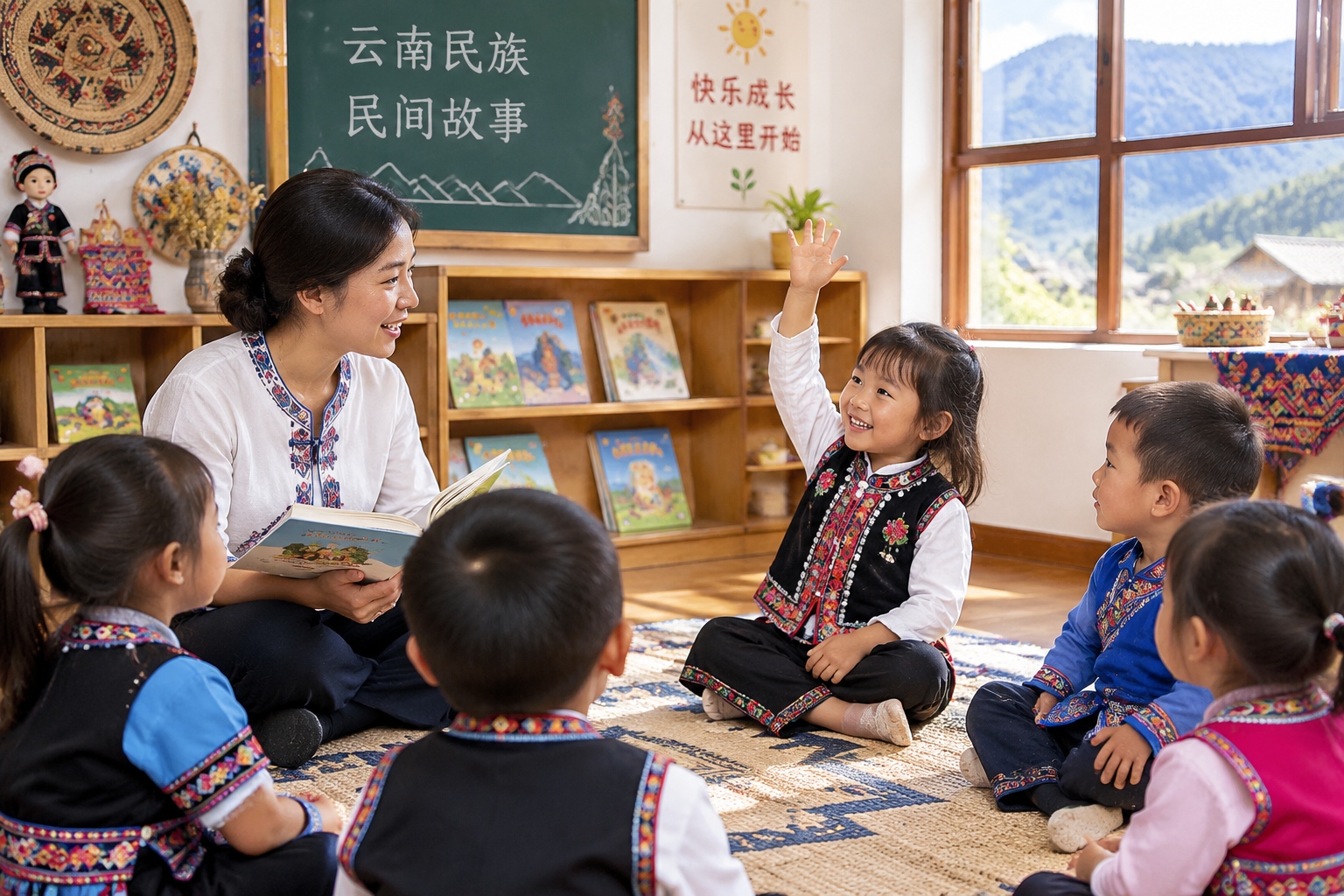
In a world where ethnic and cultural differences often become fault lines, this tiny kindergarten in the mountains of Yunnan offers another way. Children here don’t just tolerate diversity — they sing it, act it out, and make it their own. That’s an education the whole world could learn from.
Start the discussion at forum.chinacomes.com