
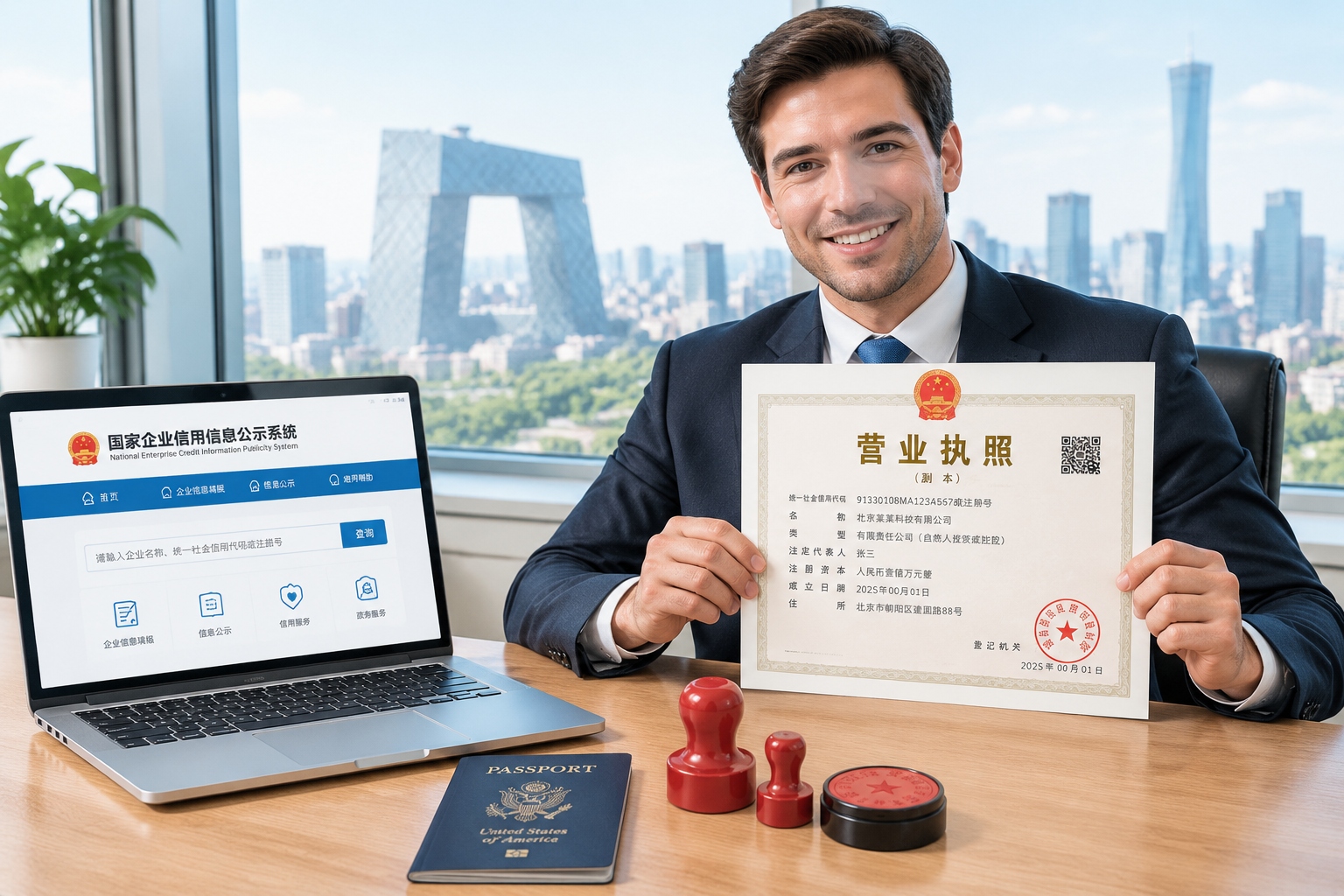

Why choose a WFOE?
When a foreigner wants to launch a real commercial operation in China, the ownership structure is the first puzzle. A joint venture often feels like the safest way to access local knowledge, but it means sharing control and dividends with a Chinese partner. A representative office is quick to set up, but it cannot sign client contracts or collect revenue in its own name. A wholly foreign-owned enterprise (WFOE) is the vehicle that gives the founder full equity and the right to hire, invoice, and litigate like any local company. Its legal status is a Chinese limited-liability company, even though 100% of its shares are held outside mainland China.
Only one restriction really matters when you pick a WFOE: the Foreign Investment Negative List, a national catalogue telling investors which industries are off-limits or subject to ownership caps. For the technology-services sector—software development, technical consulting, code auditing—most activities sit outside the negative list, which is why a British engineer called James Whitmore chose a WFOE for his new Beijing venture.

The case: a British founder’s technology-services firm
James, now 38, spent three years in Beijing as a software consultant for a German supplier of automotive electronics. During that time he noticed a persistent gap: his employer needed independent specialists to review the code of its Chinese factory software and train local staff, but the European law department refused to sign an outsourcing contract with an individual. “They needed a company with a business license, a tax registration, and a bank account in the same jurisdiction,” James recalls. “They didn’t care whether the Chinese company sat in Shanghai or Beijing.” So he decided to spin off his own consulting firm.
He chose Beijing because his co-founder and two future employees lived there, and he needed a registered office in Chaoyang District. His planned business name was Whitmore Technology Consulting (Beijing) Co., Ltd.—or, in Chinese, 惠特莫尔科技咨询(北京)有限公司.
Step 1: Name pre-approval—small screen, strict rules
Under Chinese corporate law, a company must have a Chinese-language legal name that is not already used by another same-industry company. The first name James submitted disappeared in the online queue for two days and then came back with a rejection note. The reason: 惠特莫尔 was close to the Chinese transliteration of a new domestic artificial-intelligence firm that had registered just two months earlier. The name screen may sound like a formality, but it is actually the point where many foreign founders lose the first week.
James submitted a revised name with the word Whitmore replaced by 伟姆斯, a purely phonetic variant with no pre-existing match. He used the Beijing e窗通 (One-Window) portal, which lets you check in real time whether a Chinese-style name is available. The second attempt was approved in two working days.
Step 2: Filling in the filing and business registration
The days when a WFOE founder had to visit the local commerce bureau separately are over. The Foreign Investment Law, in effect since 2020, replaced approvals with a foreign investment information report. The report now travels inside the corporate application itself through the same one-stop market-regulator portal. For James, this meant that when he applied for a business license via e窗通, his identity as a foreign investor went automatically to the relevant authorities.
His online application required four bulky items: (1) a scanned copy and Chinese translation of his UK passport, stamped by a certified translation company; (2) a proof of the registered office address—a copy of the landlord’s real-estate certificate and a lease; (3) a company constitution (“articles of association”) written in Chinese; and (4) a declaration of the beneficial owner, for anti-money-laundering purposes. “The address was the most painful part,” he says. “Until you sign the lease, you cannot get the license; once you have the license, the space is suddenly yours.” The market administration processed his documents in seven working days and issued a business license with a Unified Social Credit Code.
Step 3: After the license—seals, tax, and social insurance
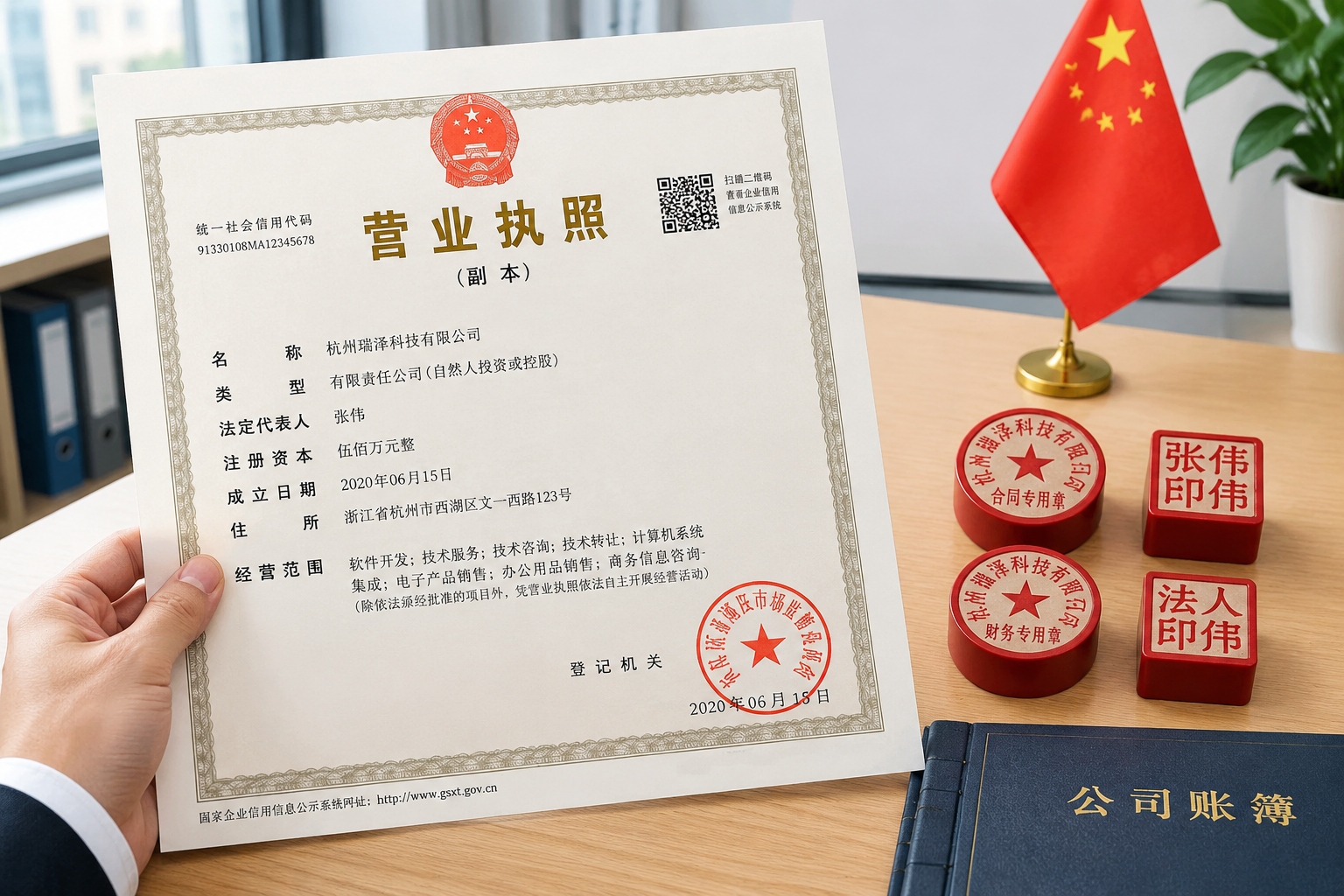
With the license in hand, James’s agency ordered four official company seals from a government-designated engraving shop: a company seal, a financial seal, an invoice seal, and a legal representative seal. The seals are still required in daily transactions—every contract, invoice, and tax declaration is stamped. The license and seals were delivered together the next afternoon, an important moment captured in the photo below.
Getting the tax and social welfare accounts is less cinematic,” James says. Because the unified social credit code is also the tax registration number, his tax clearances were created automatically when the business license was issued. But he still had to activate the tax online system, choose his tax category, and register the company’s payroll and social insurance fund for future employees. In Beijing, social insurance registration can be done through the local social security mobile app within a week after license issuance, but no penalty applies until the first salary is paid.
Step 4: Bank accounts and moving capital across the border
Two kinds of bank accounts are essential for a WFOE: a basic RMB settlement account, used for salaries, office rent, and client invoices; and a capital account, used for foreign exchange brought in as the shareholder’s investment. To open the RMB account, the legal representative must appear in person at the bank branch. “I chose Bank of China in the same building as my office,” James says. “It took about six working days and three counter visits.”
For the capital account, the bank first performed a direct-investment foreign-exchange registration and created a business registration code for the FDI. Under that registration, James wired 500,000 yuan of equity capital from his UK account (converted from GBP). The amount matched the schedule of contributions he had declared in the previous step. Once the remittance landed, James’s finance team could settle the funds into RMB and pay for office supplies and rent as long as they kept a supporting invoice and payment instruction.

The 2026 Negative List: what still applies to technology services?
James reviewed the then-current Special Administrative Measures for Foreign Investment Access (Negative List) (2026 Edition) published by the Ministry of Commerce before he incorporated. Most manufacturing and consulting categories were fully open. However, he had to make sure his listed scope stayed away from “value-added telecommunications” and “online data processing and transaction processing” services. In plain terms, that means he cannot run a cloud platform or a hosted marketplace without extra telecom licenses. But software development and technical consultation—the core of his business—does not require any special foreign investment approval. The 2026 list simply follows the trend of the past five editions: as long as you remain outside the explicitly restricted clauses, a WFOE is treated the same as a domestic enterprise.
This is the moment where founders should pause. Foreign investors eager to appear advanced often over-describe their scope with words like “big data,” “cloud,” or “telecom.” That wording can push the company into a restricted category. James’s agency forced him to keep a modest, precise list of business items in the application. It is safer to apply for narrow permits first and add them later via a business-scope change.
Timeline, costs, and the final review
From the date James submitted his first name-pre-approval attempt to the day he purchased office furniture from his own bank account took six weeks and four days. Here is a realistic breakdown for Beijing:
- Name pre-approval: 2 days (plus one day for correction)
- Business license filing and foreign-investment report: 7 business days
- Company seal production: 1 day
- Tax activation and social insurance registration: 3 days (fragmented)
- RMB basic bank account and FDI capital account: 8 working days
- Funds arrival and currency settlement: 2 days after wiring
Government registration and license fees are currently zero in Beijing. Meaningful costs are not paid to the government but to the professionals who bridge language and red tape: notarized translation and document preparation can cost between ¥2,000–¥5,000; an agency fee is typically ¥6,000–¥15,000; company seals are about ¥500; and the annual bank account service fee may be ¥200–¥800. For James, the total out-of-pocket cost, not including minimum registered capital or office rent, was less than ¥12,000.
The biggest lesson from his experience is that Chinese company registration has become much more digital than many expats assume, but the system still rewards certainty. You need to decide your Chinese name, your exact scope of business, and your contribution schedule before you open the portal. Once those three decisions are clean, the rest of the process is less about negotiation than about patience.
Today, James sends contracts from his Beijing office and pays local staff from a Chinese bank account. The WFOE was not a mystery; it was a sequence of small administrative gates, each with a clear input and output. The fastest way to reach the end is to hire a bilingual advisor who knows how to use the Beijing e窗通 platform—and to remember that a British name, no matter how well known at home, must still earn its space in the Chinese-language record.
Start the discussion at forum.chinacomes.com