

A Ladder, a Watering Can, and a Dozen Glass Tubes
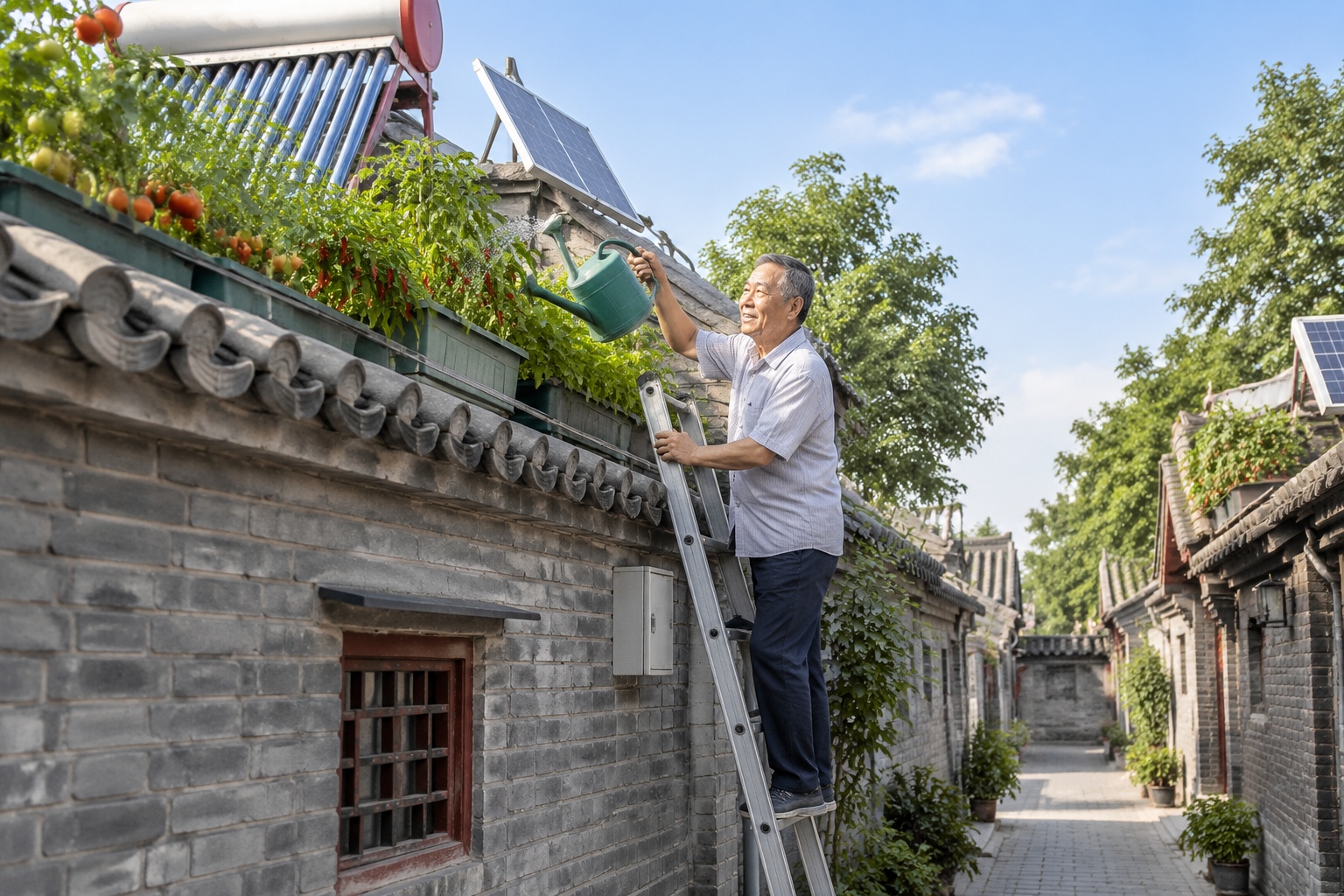
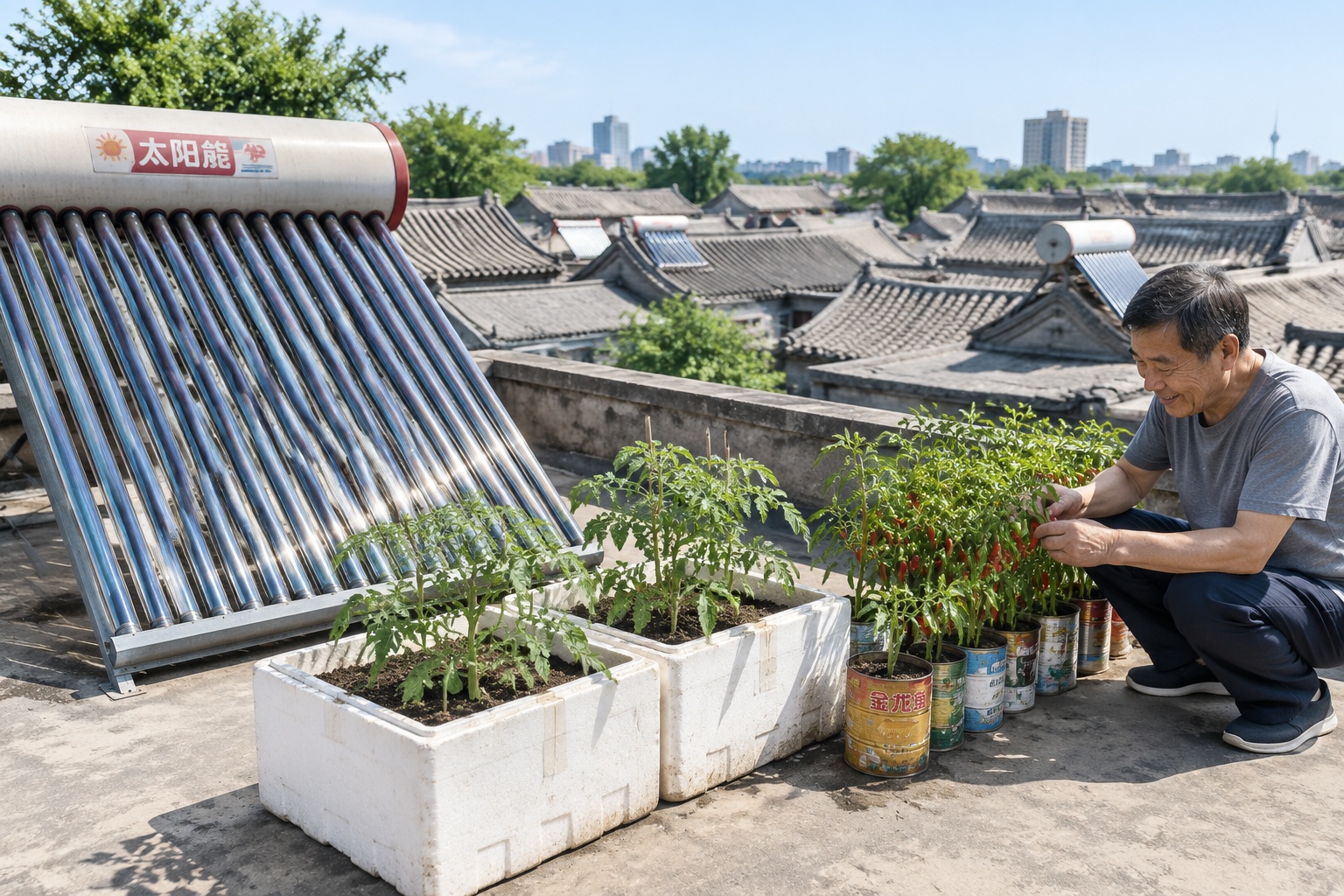
The ladder leans against a wall of gray brick. Up on the flat section of the roof: two foam boxes of tomatoes, a row of chili plants growing in old cooking-oil tins, and twelve glass vacuum tubes from a solar water heater, all tilted toward the south.
Nobody in the lane would find this remarkable. The roof belongs to an ordinary courtyard home in the Caochang area, a grid of narrow alleys about a 20-minute walk south of Tiananmen Square. On a clear summer morning you can stand in the middle of the lane and count solar water heaters on almost every rooftop in sight.
This is what the green transition looks like in a Beijing hutong. Not a showcase project. Just a lot of small decisions, repeated across thousands of roofs.
What a Hutong Actually Is
Start with the word. Hutong comes from Mongolian and refers to the narrow lanes that grew up around Beijing’s courtyard houses over the past 700 years. Inside the line of the old city walls — roughly 62 square kilometers — more than a thousand of them still exist.
A hutong is not a museum piece. It’s a dense residential neighborhood. Most courtyards that were once built for a single extended family now hold four, six, or even a dozen households. Kitchens and bathrooms are often shared. Homes face inward onto a small paved yard, which means the only outdoor space a family controls is that yard — and, if they’re lucky, the roof above it.
That shortage of space is the starting point for everything that follows.
Why Beijing’s Hutong Rooftops Became Useful
In the 2000s, the city pushed solar water heaters into low-rise neighborhoods. The pitch was straightforward economics: a rooftop unit costs a few thousand yuan, and it removes most of the household’s water-heating bill for much of the year. By the 2010s, the gray tile roofs of the old city had grown a second layer of glass tubes.
Growing food came next, for a similar reason. Courtyards are small. Flat roof sections, added over the decades for storage or as informal extensions, turned out to be useful. Residents filled them with foam boxes, plastic tubs, and repurposed oil tins. Tomatoes, chili peppers, scallions, and small cucumber vines do well in Beijing’s long, bright summers.
None of this was planned as an environmental program. It was a response to cramped space and high utility bills. The environmental results came along for the ride.
One Courtyard’s Numbers
Ms. Liu has lived in the same courtyard since the 1980s. Ask her what actually changed, and she points at the tubes first. Before the solar heater, hot water meant boiling a kettle or running an electric unit that showed up on the monthly bill. Now, from April through October, the household barely uses electricity for hot water at all. She puts the saving at a few hundred yuan a year — not life-changing, but real, and it arrives every single month.
More recent, and less visible from the street, is the photovoltaic panel. A growing number of courtyards in the area now carry small rooftop arrays, usually 3 to 5 kilowatts. That’s enough to run lights, a fridge, a washing machine, and a fan, with surplus power exported to the grid.
The arithmetic works out roughly like this. Beijing gets about 1,100 to 1,300 full-load sunshine hours a year, so a 3-kilowatt system generates somewhere near 3,500 kilowatt-hours annually. A small urban household might use 2,000 to 3,000. In other words, one modest array can cover a family’s electricity for the year.
The catch is payback time. Panels and installation run into the tens of thousands of yuan. Beijing offers a municipal feed-in subsidy on top of the national one, which shortens the payback period to somewhere between six and nine years, depending on when the system went up. For a household planning to stay put, that is a reasonable bet. For a tenant renting a single room, it isn’t a decision they get to make at all.
The Cooling Effect Nobody Expected
Beijing runs hot in summer, and the old city runs hotter than the suburbs. The urban heat island effect adds roughly 2 to 4 °C in dense low-rise districts with little greenery. Old courtyard roofs are thin. Without insulation, a south-facing upstairs room can gain several degrees over the course of an afternoon.
Plants change that. A layer of soil and foliage shades the roof surface and cools the surrounding air through evaporation. Rooftop greening projects in Chinese cities typically record surface temperature drops of 10 °C or more on planted areas, with a smaller but measurable effect on the room underneath. Solar panels do something similar from the other direction: they block direct sun from hitting the roof surface and keep the space below cooler.
Residents experience this as comfort, not as data. The upstairs room is usable in July. The air conditioner runs less. That is the version of climate adaptation people actually discuss over dinner.
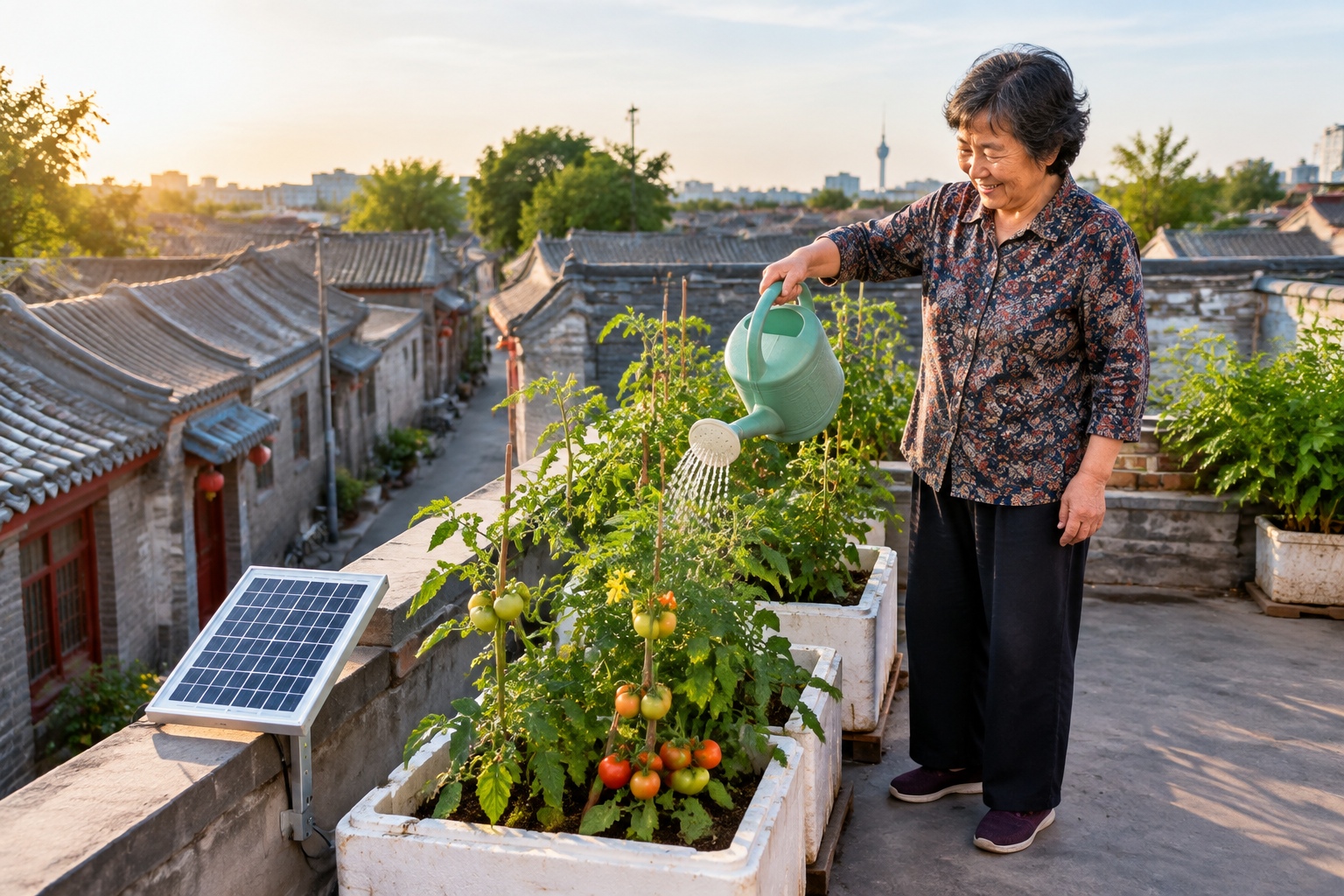
Watering the rooftop vegetable boxes is still a daily chore — and a daily pleasure — in many hutong courtyards.
Who Pays for Green Roofs in Beijing — and Who Decides
None of this happened on its own. Three things had to line up.
The first was coal. Until around 2015, many hutong households burned coal briquettes for winter heat, and the resulting air quality was bad enough to become a national issue. Beijing’s coal-to-electricity program replaced those stoves with electric heat pumps backed by a subsidized electricity rate. Once a household had a modern electrical connection and a reason to watch its power bill, rooftop solar became a much easier conversation.
The second was money. Municipal programs cover part of the cost of rooftop greening and distributed solar. The sums aren’t enormous, but they shift the math enough to matter.
The third, and least discussed, is organization. Old Beijing courtyards have no homeowner association. They have residents’ committees, courtyard-level self-management groups, and — since around 2017 — “responsible planners,” architects assigned to specific neighborhoods who work with residents on small upgrades instead of demolition.
That last detail is the real story. For decades, the standard way to improve these neighborhoods was to tear them down. That approach is now largely off the table. What replaced it is incremental: bury the overhead wires, separate sewage from stormwater, add a public toilet, put a garden on a roof, then let residents argue about what comes next. Progress is measured in courtyards, not city blocks.
What Doesn’t Work
It would be easy to oversell this. Not every roof can hold soil or panels. Many hutong roofs are pitched, tiled, and structurally marginal. Ownership is often unclear — one courtyard, several families, no single decision-maker. Fire codes complicate anything electrical. And winter sunshine in Beijing is weak, so a solar water heater needs a backup for four or five months a year.
Rooftop farming has its own limits. Watering means carrying buckets up a ladder, which gets harder every year in neighborhoods where the average resident is over 60. Some gardens are quietly abandoned after two summers.
These are real constraints. They also explain why the change looks patchy rather than uniform — and why it looks different from one lane to the next.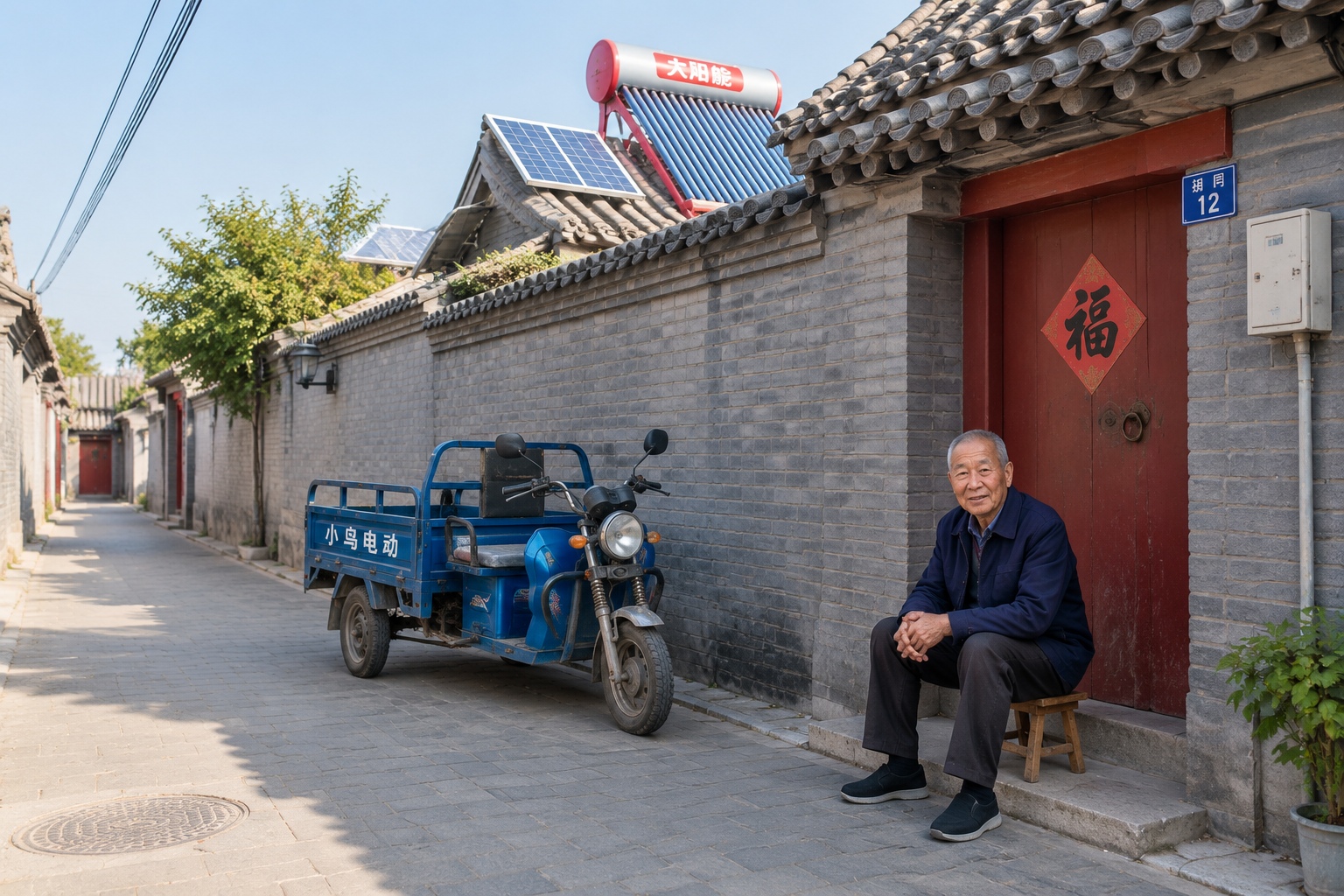
What This Says About Chinese Cities
Still, the direction is clear. Chinese cities are no longer growing mainly by pouring concrete on the edges. A rising share of the work is happening inside what already exists: retrofitting, insulating, greening, rewiring.
For a country that spent three decades tearing down and rebuilding, that is a genuine shift. It shows up not in skyline photographs but in small things — a bucket of tomatoes, a meter running backward, a room that stays cool in July.
Stand in the lane in the late afternoon and look up. The gray tiles are still there. There’s just more going on above them than there used to be.
Start the discussion at forum.chinacomes.com