
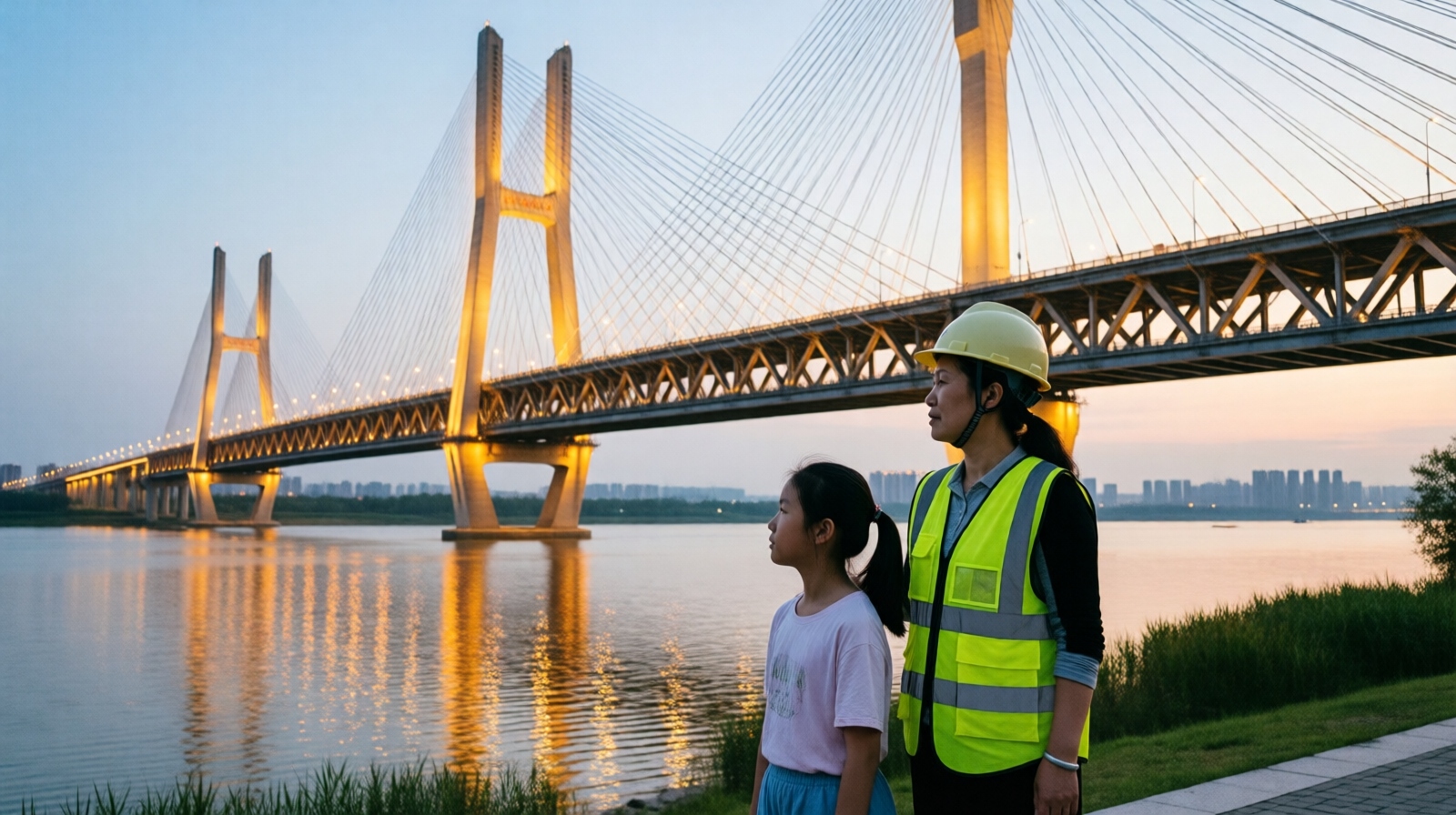

The Evening Walk That Changed Everything
It was a warm evening in late spring when I met Chen Wei at the southern end of the Qingzhou Bridge, in the city of Yangzhou. She was waiting for her 14-year-old daughter, who had just texted: “Mom, I’m walking across now. Wait for me at the tower.” Chen Wei laughed and pointed up at the 168-meter-tall concrete pylon. “She likes to count the cables as she walks. She says there are 88 of them. She’s wrong—there are 92—but I let her be.”
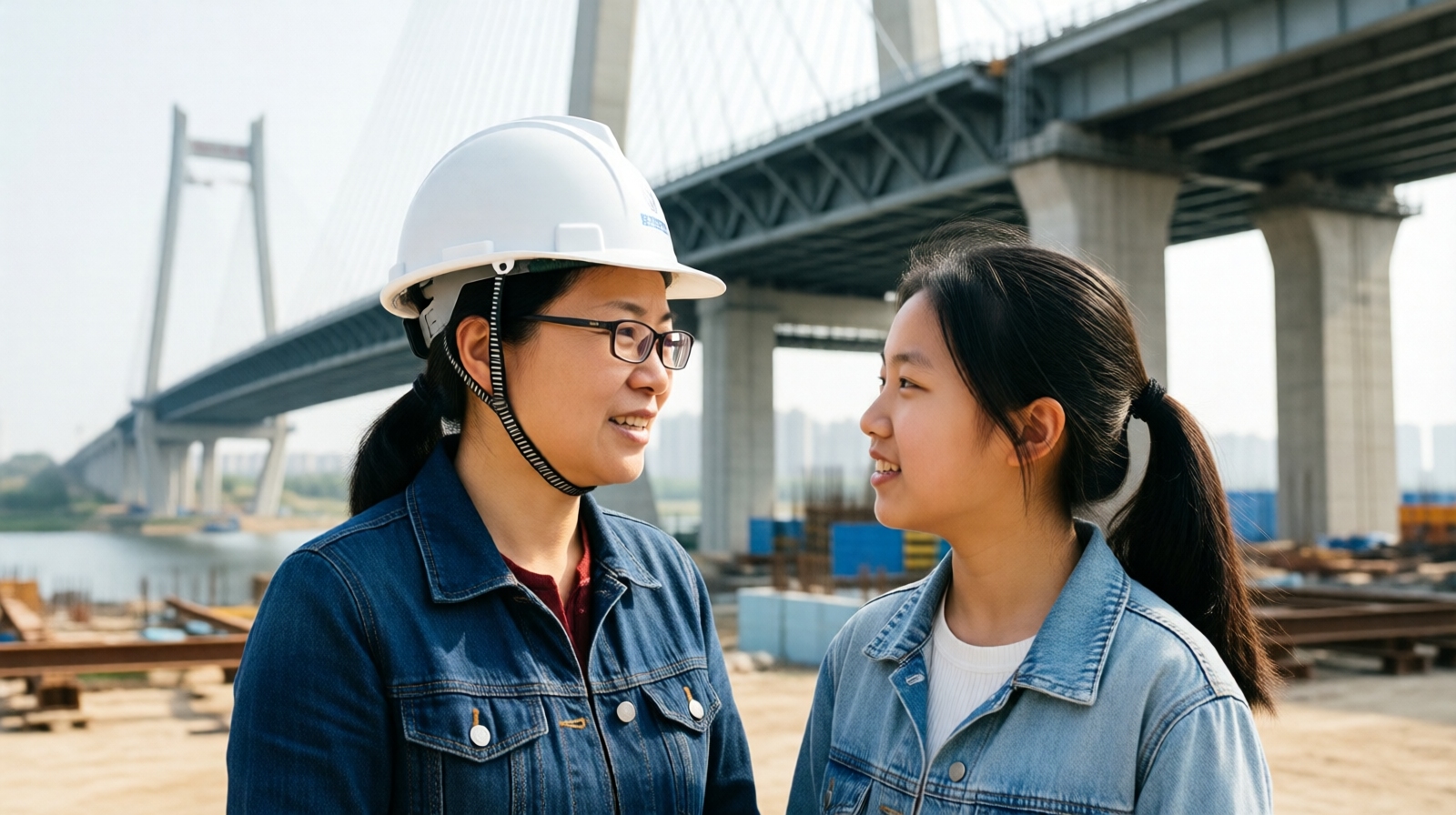
Chen Wei is a bridge engineer. For three years, she spent most of her time on construction sites, away from home, working on what is now the newest crossing over the Yangtze River between Zhenjiang and Yangzhou. The bridge opened to traffic last year. It cut the driving time between the two cities from over an hour to less than twenty minutes. But what Chen Wei didn’t expect was that the same bridge would also close a gap she had felt for years—the distance between her and her daughter.
Two Cities, One River, One Bridge
Zhenjiang and Yangzhou sit on opposite banks of the Yangtze, the longest river in China and the country’s economic spine. For decades, people crossed by ferry, which was slow and often cancelled in fog or high wind. The new bridge, with its eight lanes and a railway line underneath, finally gave the two cities a fixed link. Local officials call it a “new artery.” For the people who live here, it means something simpler: a grandmother can see her grandchildren every weekend, a factory worker can take a job across the river and still be home for dinner.
Chen Wei’s job was to ensure the bridge could stand for at least a hundred years. She was one of the lead design engineers, responsible for the structural details of the main span. She spent months running calculations, testing materials, and supervising the placement of hundreds of steel cables. “The hardest part was the foundation,” she says. “The riverbed here is soft, with deep mud. We had to sink giant caissons more than 70 meters down. Every day was a negotiation with the river.”
A Daughter’s Quiet Complaint
But the biggest challenge, she admits, had nothing to do with engineering. It was her daughter, Xiaoyu. When Chen Wei was assigned to the project, Xiaoyu was only 11 and just starting middle school. Chen Wei’s husband works in Shanghai and could only come home on weekends. So Xiaoyu was left with her grandparents in Yangzhou. “I remember one night, I called home and Xiaoyu said, ‘Mom, you helped build a bridge across the river, but you can’t even walk me to school.’ That really hurt.”
Chen Wei didn’t quit the project, but she changed the way she worked. She began taking the high-speed train home every Friday night, a two-hour ride from Zhenjiang. On Sunday evenings, she would walk Xiaoyu to the bridge site, where she could show her what was being built. “She saw the bridge rising from the water. She asked a thousand questions. She started to understand that the time I spent away from her was for something real.”
The Day the Bridge Opened
When the bridge opened, Chen Wei’s daughter was in the crowd. She had drawn a picture of the bridge on a poster and held it up as the official cars drove through. “I saw her from the platform. She saw me too. She waved so hard I was afraid she’d fall.” That evening, mother and daughter walked across the bridge together for the first time. “It was about 3 kilometers. We walked slowly. Xiaoyu said, ‘This is the longest walk we’ve ever taken together.’ I said, ‘Where do you want to go next?’ She said, ‘Anywhere, as long as you’re walking with me.’”
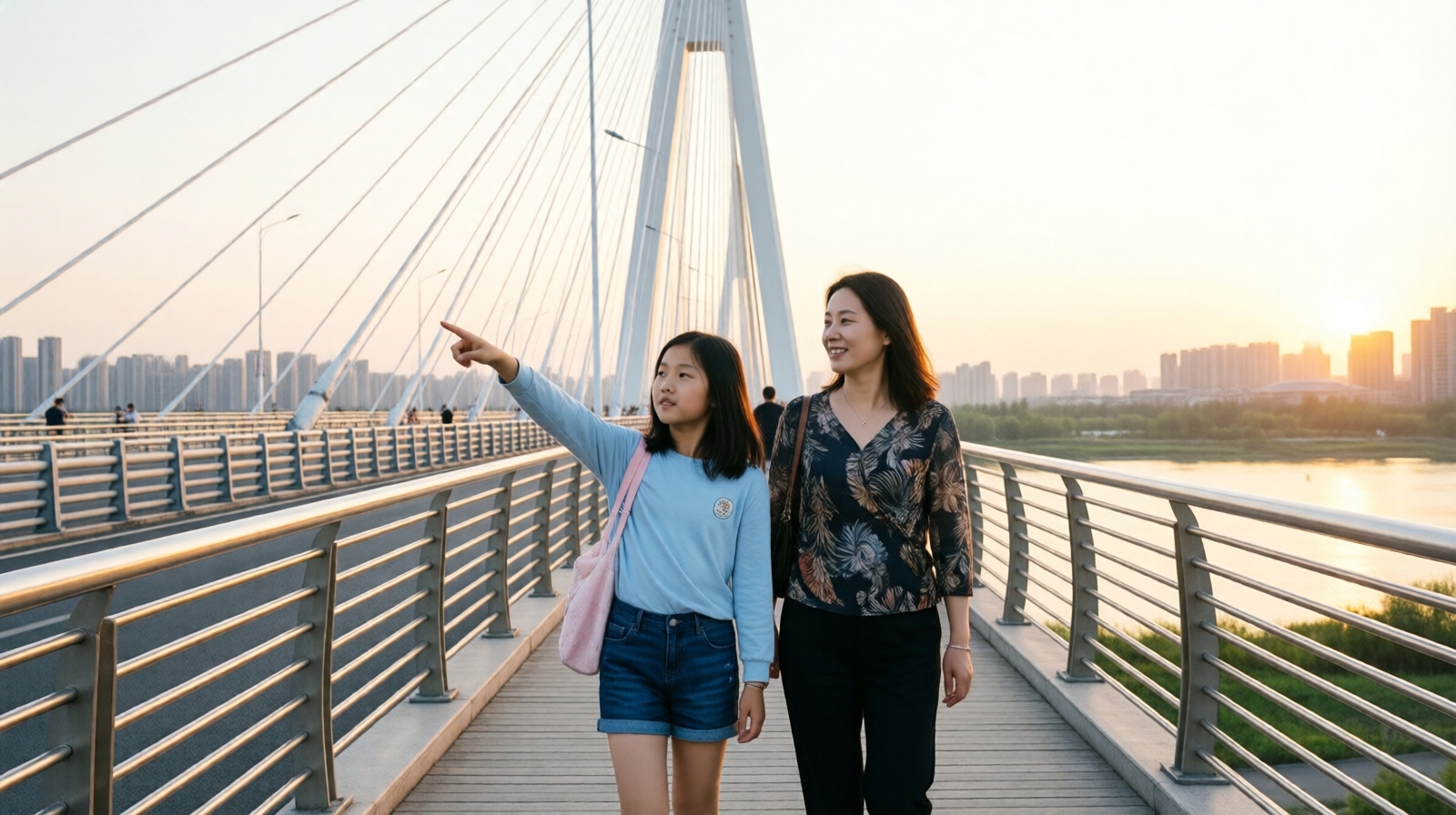
Chen Wei’s story is not unique. Across China, thousands of engineers—men and women—are working on massive infrastructure projects that are reshaping the country. Many of them have families they rarely see. But the bridge has changed Chen Wei’s relationship with Xiaoyu in a lasting way. “Now she tells her classmates, ‘My mom built that bridge.’ And she tells me, ‘When I grow up, I want to design a bridge too—only longer, and closer to home.’”
What China’s Bridges Mean for Ordinary People
For outsiders, China’s rapid bridge construction can seem like a feat of statistics. Over 2.4 million bridges span the country’s rivers and valleys, including some of the world’s longest sea-crossing and suspension bridges. But behind each one are stories like Chen Wei’s—of ambition, sacrifice, and unexpected human connection. The Qinzhou Bridge is not just a concrete and steel structure. It is a place where a mother and daughter found a way to meet in the middle.
Chen Wei now works on a new project, a railway bridge in the southwest. She still works long hours, but she and Xiaoyu have a new ritual: they video-call every evening, and Xiaoyu sometimes uses the camera on the bridge’s live feed to show her mother the weather in Yangzhou. “She found a way to check on me, actually,” Chen Wei says, laughing. “She says the bridge is her eye. She can always see where I am.”
Start the discussion at forum.chinacomes.com