
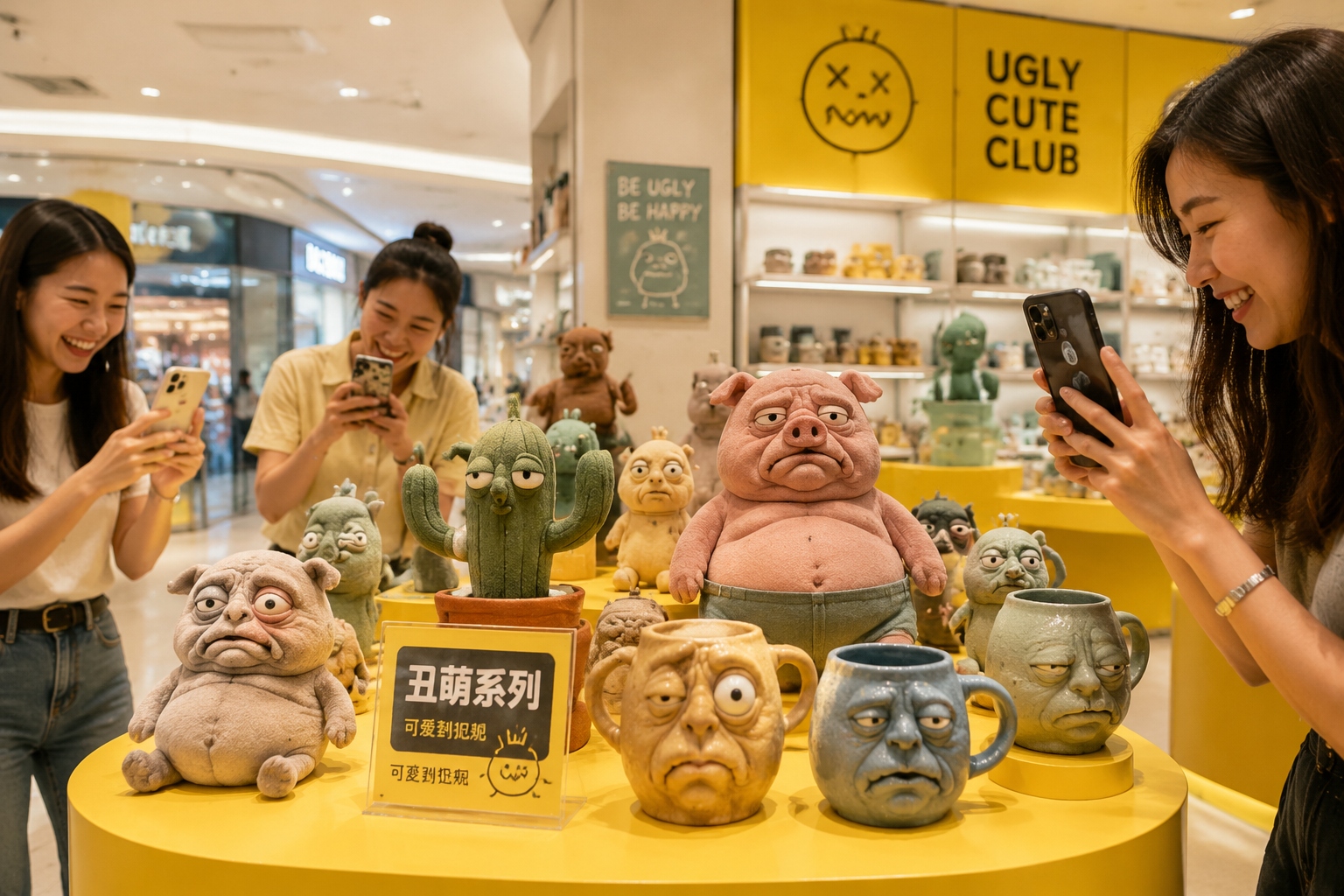

It Started With a Lopsided Cactus
I was wandering through a mall in Shanghai when I spotted it: a plush cactus with a drooping face and tiny, mismatched legs. It looked almost like it had given up on life, which made it oddly lovable. A teenager next to me picked it up, laughed, and immediately took a photo to post on Xiaohongshu—China’s answer to Instagram. Within minutes, her phone showed a flood of comments, most saying “So ugly, I want one.” This is the world of “ugly-cute” (丑萌, chǒu méng), a design language that has swept Chinese pop culture with its unabashed weirdness.
Before that encounter, I had expected Chinese youth to favor sleek, minimalist designs—think Muji-style simplicity with a high-end twist. But here was something delightfully clumsy, intentionally abject, and clearly flying off the shelves. I later learned that this object belonged to a family of “ugly-cute” products that are conquering everything from phone cases to backpacks. The more I dug in, the more I realized this trend is not just about selling strange trinkets. It mirrors a deeper shift in how young Chinese see themselves and their society.
What Exactly Is “Ugly-Cute”?
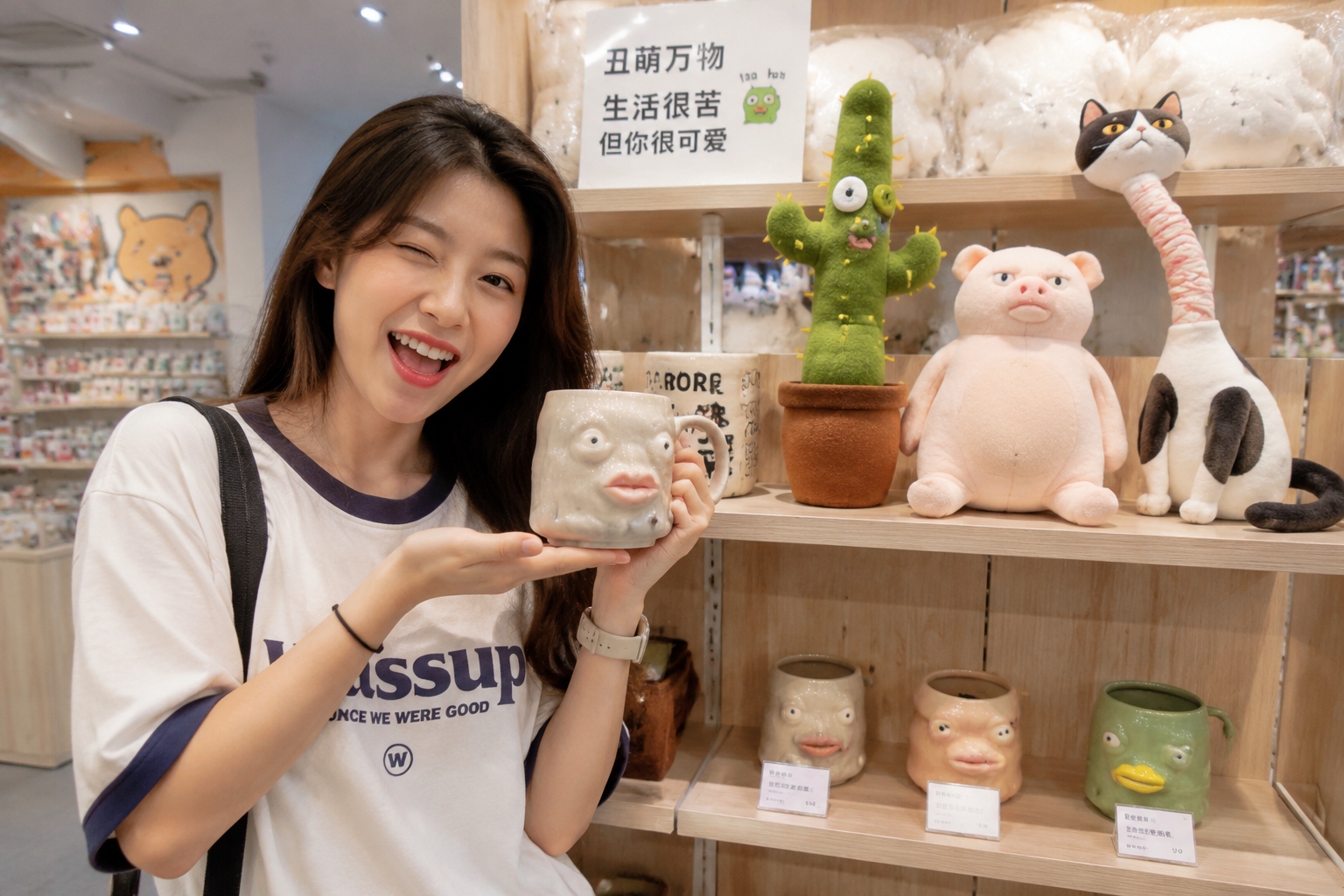
Ugly-cute isn’t about being poorly made. It’s a deliberate aesthetic that combines the awkward with the adorable. Think of a ceramic mug shaped like a lumpy potato, a keychain of a hunched-over panda with blank eyes, or a desk lamp that looks like a melting ice cream cone. These products deliberately subvert the polished, symmetrical, and often sterile design that once dominated Chinese consumer culture.
The term “chǒu méng” merges two words: “chǒu” meaning ugly, and “méng” meaning cute (borrowed from Japanese “moe”). The result is a playful paradox. Unlike Japanese “kawaii,” which tends to be sweet and soft, ugly-cute often carries a mocking, self-aware humor. A design might give a flowerpot a grumpy face or turn a teapot into a squinting, toothy creature. These objects do not beg for your approval; they simply exist in their oddity, and that is exactly why people love them.
Take the “pug mug” sold by many small studios: a handle shaped like a pug’s butt and a face that looks both sleepy and irritated. It’s not something you’d find in a traditional crafts market, yet it sells out online within days. Another success is the “sad broccoli” plush—a limp, wilted vegetable with droopy eyes that users on Xiaohongshu describe as a “mood companion.”
From #UglyThingsProtectionSociety to a Generation’s Mantra
The rise of ugly-cute is closely tied to Chinese social media, especially Xiaohongshu and Weibo. Around 2020, users began to dig out strange and hilariously ugly objects from bargain stores and share them under hashtags like #丑东西保护协会# (#UglyThingsProtectionSociety). The hashtag quickly went viral, with people competing to find the most absurd, badly proportioned, or weirdly expressive products. What started as a fun pastime soon became a collective celebration of imperfection.
One pivotal moment came in 2021, when a user posted a photo of a plush toy named “Big Belly Pig” (大肚猪). The toy, with a grotesque big belly and a grumpy face, looked like it constantly ate and passed judgment. The post sparked thousands of comments and reposts, and within weeks, the toy became a bestseller. Similar stories followed: a “twisted face” ceramic bowl, a “cross-eyed” cat magnet, and a “lopsided” jellyfish lamp. Xiaohongshu’s algorithm, which favors visual novelty, amplified these finds, creating a snowball effect.
What is striking is that many of these objects were originally mass-produced by small factories without any artistic intent. They were simply mistakes or cheap designs. But Chinese Gen-Z users, tired of the same perfect Insta-worthy filters, turned these flaws into a trend. They began to actively purchase and even commission “ugly” products, giving rise to a new cottage industry. The movement is both a joke and a genuine taste shift—one that designers quickly picked up.
Why Imperfection Wins Hearts
To understand the appeal, I spoke with Dr. Lin Xiaoyan, a cultural psychologist in Beijing. She argues that ugly-cute offers relief from the “pressure of perfection” that permeates Chinese society. “From kindergarten through our careers, we are constantly judged, ranked, and pushed to be flawless,” she says. “These grotesque yet cute objects give people a sense of acceptance. They say, ‘I am not perfect, and it’s okay.’ That is a comforting message in a society that often feels like a beauty pageant.”
The trend also mirrors a broader movement away from “exquisite poverty” (精致的穷), a term young people use to describe spending beyond their means to maintain a polished lifestyle. Ugly-cute is the opposite—it doesn’t try to impress. It downshifts the pressure to appear put-together. As a 24-year-old office worker in Shanghai told me: “I can put this weird frog mug on my desk, and when my boss sees it, he laughs. It humanizes me.”
Psychologists also point to “cute aggression,” the urge to squeeze something because it’s too cute. Ugly-cute heightens this by adding a layer of surprise. The unpredictability triggers a dopamine release—it’s funny, odd, and endearing all at once. For many, collecting ugly-cute items becomes a form of cheap thrill, a small rebellion against the sterile, pixel-perfect virtual world.
Inside the Studios Where Ugly Is Made
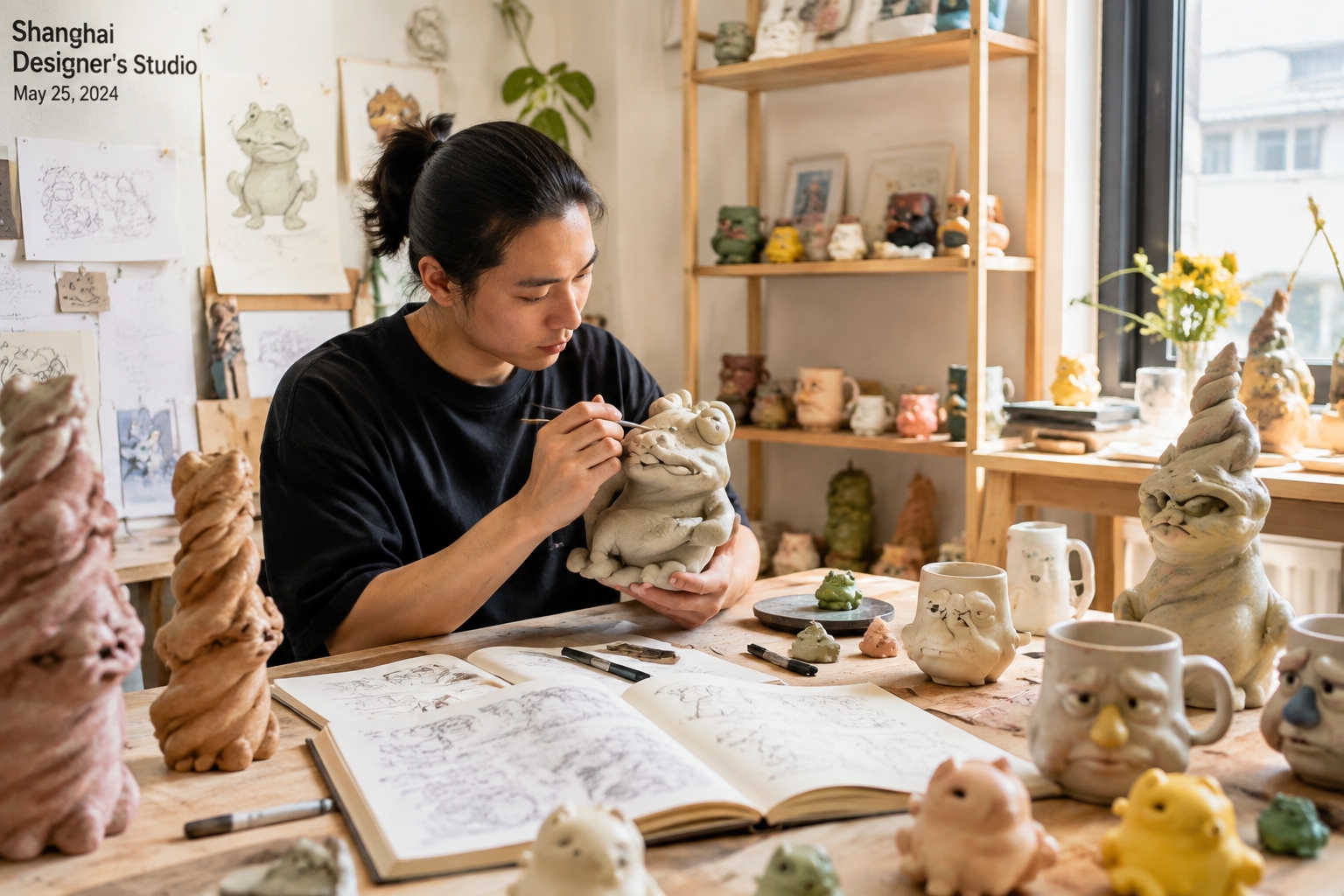
To see the creative side, I visited LOKEY, a Shanghai-based design studio known for its distorted animal sculptures. The studio looks more like a cabinet of curiosities than a design workshop. Shelves are crammed with prototypes: a giraffe with an impossibly long neck, a frog wearing a tiny crown, and a pig-shaped cup with its mouth wide open, ready to juggle your tea. Co-founder Chen Lin, 32, tells me that the creative process starts with a real emotional moment.
“We often take photos of things that make us feel awkward or laugh—like a friend’s odd posture, or a vegetable that grows in a weird shape. Then we exaggerate it until it becomes a character,” Chen explains. “The key is to give the object a personality. It doesn’t work if it’s just ugly; it has to evoke a story or a feeling.”
LOKEY’s products sell for ¥100 to ¥1,000 (roughly $15 to $150). Their most famous creation, “Dizzy Cat,” a cat with twisted neck and dizzy eyes, became a phenomenon after a video of it spinning on a turntable went viral on Douyin. Within four months, the studio sold 50,000 units. Chen says the challenge now is to keep the charm fresh as imitators copy their ideas. “We survive by constantly creating new characters and paying attention to what makes people laugh at first sight.”
The commercial path for ugly-cute products has been turbocharged by e-commerce and digital printing. Taobao and Tmall make it easy for small studios to set up shops, and social media offers free promotion. Many designers also use crowdfunding platforms like Modian to test ideas before mass production. This direct-to-consumer model allows even the weirdest creations to find an audience.
From Niche to Mainstream: How Ugly-Cute Conquered Retail
What began as an underground internet meme is now a visible presence in malls and specialty stores across China. The trendy youth brand “Baozan,” known for its “angry panda” mascot, has opened more than 80 physical stores nationwide, all filled with ugly-cute items. These stores are designed like playful laboratories, with shelves displaying lopsided ceramic figures, waddling plush toys, and oddly shaped stationery.
In 2022, the Chinese toy company Pop Mart, famous for its designer blind boxes, launched a line of “Ugly-Cute” collectibles featuring heavily bottomed and scowling creatures. They sold out in weeks, confirming that the trend had crossed over from niche internet culture to mainstream consumerism. Even fast-food chains got in on the fun: a local bubble tea brand offered a “cursed” cup with a wavy rim and a perpetual frown, and customers lined up to buy it.
Online, the trend shows no signs of slowing. Xiaohongshu now has hundreds of thousands of posts under #丑萌# (ugly-cute) and related tags. Many creators post “ugly-cute haul” videos, showing off purchases from thrift stores or Taobao, with commentary like “why is it so ugly but so right?” The hashtag #丑东西保护协会# has amassed over 1.2 billion views cumulatively.
Going Global: China’s Quirky Designs Take on the World
Ugly-cute is also becoming a cultural export, and it’s doing so not through official channels but through independent designers and e-commerce platforms. AliExpress, Alibaba’s international retail platform, reported a 300% year-on-year increase in searches for “ugly cute” products from American and European users in 2023. Items like the “sleepy blob” stress ball or the “banana-pelting” monkey enclosure have become popular among international buyers looking for something unconventional.
Chinese design collectives are also making appearances at global fairs. In 2023, LOKEY exhibited at Tokyo Design Week, and their “crooked” animals were a hot topic among Japanese and Korean visitors. Another brand, “Slow Pork” (慢肉), known for its angry pig motifs, participated in Paris’ Maison & Objet, where buyers from European boutiques placed orders. These designs are not copying Japanese kawaii or Western minimalism—they present a distinctly Chinese brand of absurdity, one that draws on local internet culture and everyday life.
What makes this trend culturally significant is that it challenges the West’s lingering perception of Chinese manufacturing as only a source of cheap copies. Ugly-cute proves that Chinese designers can produce original, emotionally resonant work—work that does not take itself too seriously. It also shows a different side of Chinese society: playful, ironic, and self-critical, a far cry from the often-portrayed image of pure discipline and pursuit of perfection.
The Fine Line Between Ugly-Cute and Just Ugly
Of course, not everyone is a fan. Critics argue that the trend encourages bad craftsmanship and celebrates laziness. Some manufacturers have jumped on the bandwagon, flooding the market with poorly made “ugly” goods that lack any creative spark. “There is a thin line between intentional imperfection and simply bad design,” says designer Chen Lin. “We always ask ourselves: does this make you smile? If it just makes you cringe, it’s a failure.”
The trend also faces the risk of saturation. As more brands jump in, the shock value wears off. Young consumers, who are adept at spotting hypocrisy, can quickly turn away from what feels forced. In 2023, some viral ugly-cute products saw a sharp drop in sales after imitators appeared. The staying power, experts say, depends on whether designers can keep finding new forms of emotional resonance.
Conclusion: The Beauty of Not Being Perfect
Ugly-cute is more than a design trend; it’s a generational statement. In a society that has made enormous economic progress but also imposed high standards on individuals, young Chinese are using these weird little objects to say: “I’m flawed, I’m tired of pretending, and I can still be loved.” It is a surprisingly tender rebellion, packaged in a lumpy, squinting, unsettling yet adorable form.
As I left that Shanghai mall, I bought the lopsided cactus. It now sits on my desk, a reminder that perfection is overrated. In a world that desperately needs authenticity, maybe a little more ugly could make things beautiful.
Start the discussion at forum.chinacomes.com