
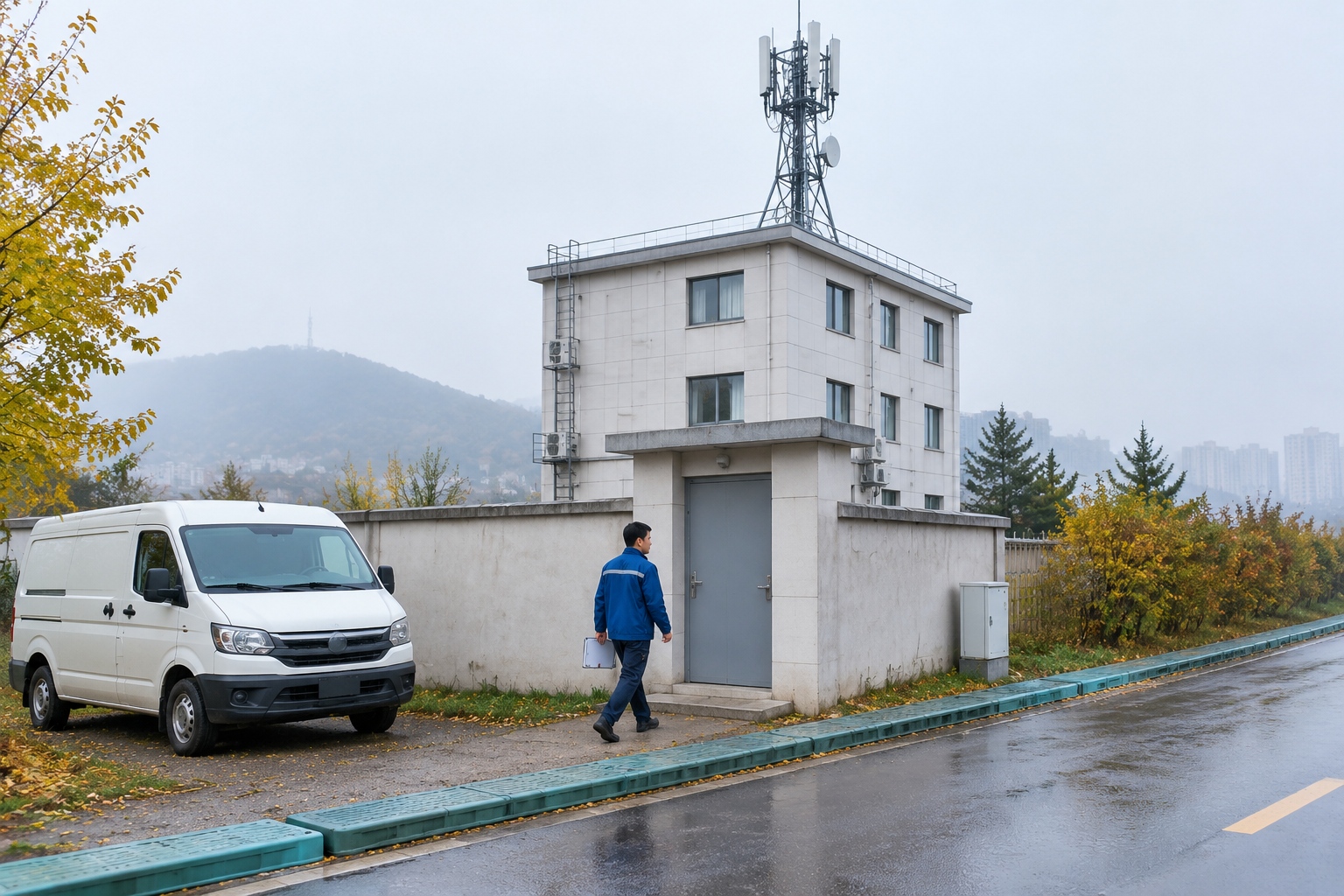

A room with no windows outside Jinan
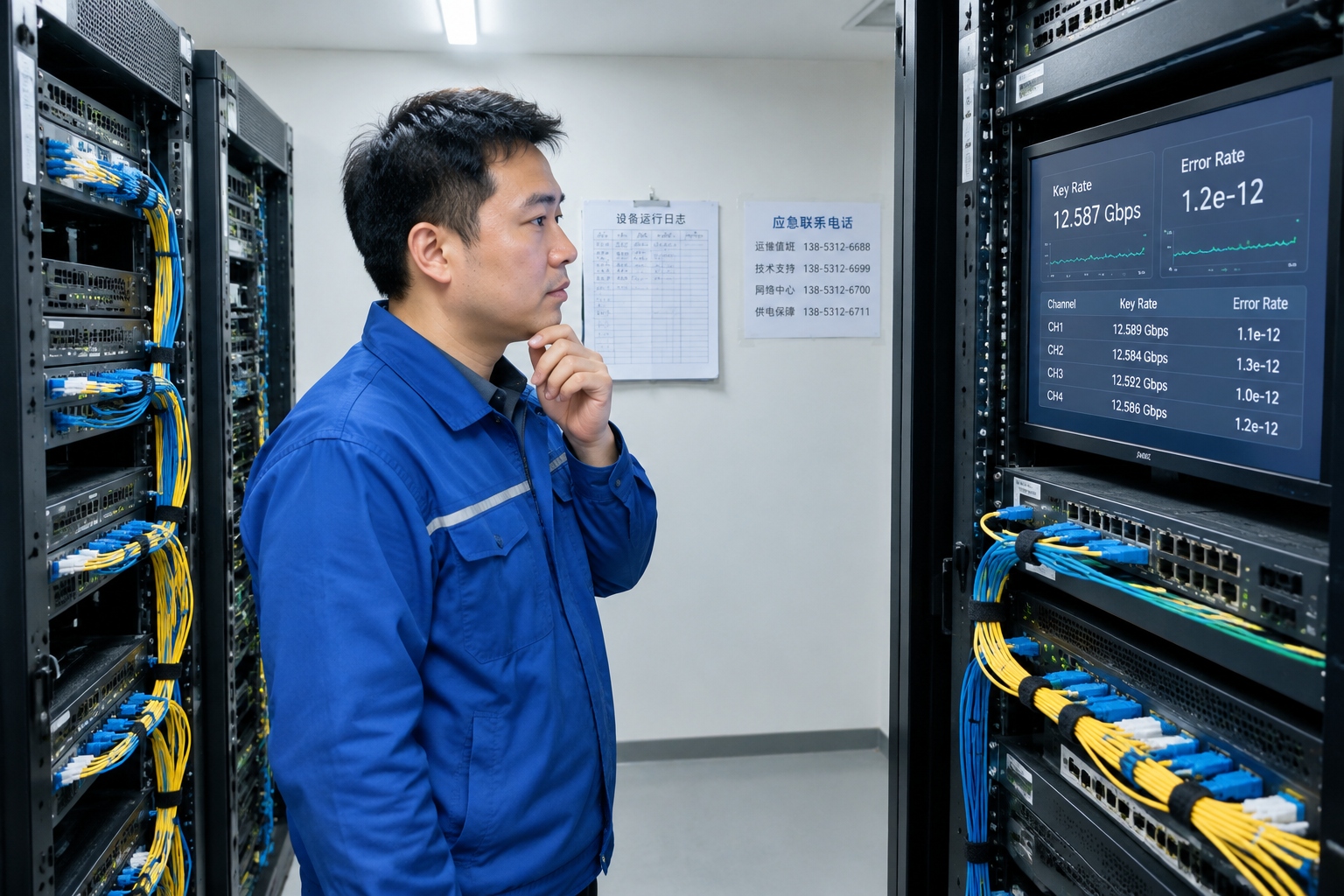
At 7:45 on a weekday morning, the technician on duty unlocks a grey steel door on the ground floor of a three-storey building on the western edge of Jinan, walks past the air-conditioning units, and writes the date in a logbook. Then he reads numbers off a screen: key generation rate, quantum bit error rate, rack temperature, humidity.
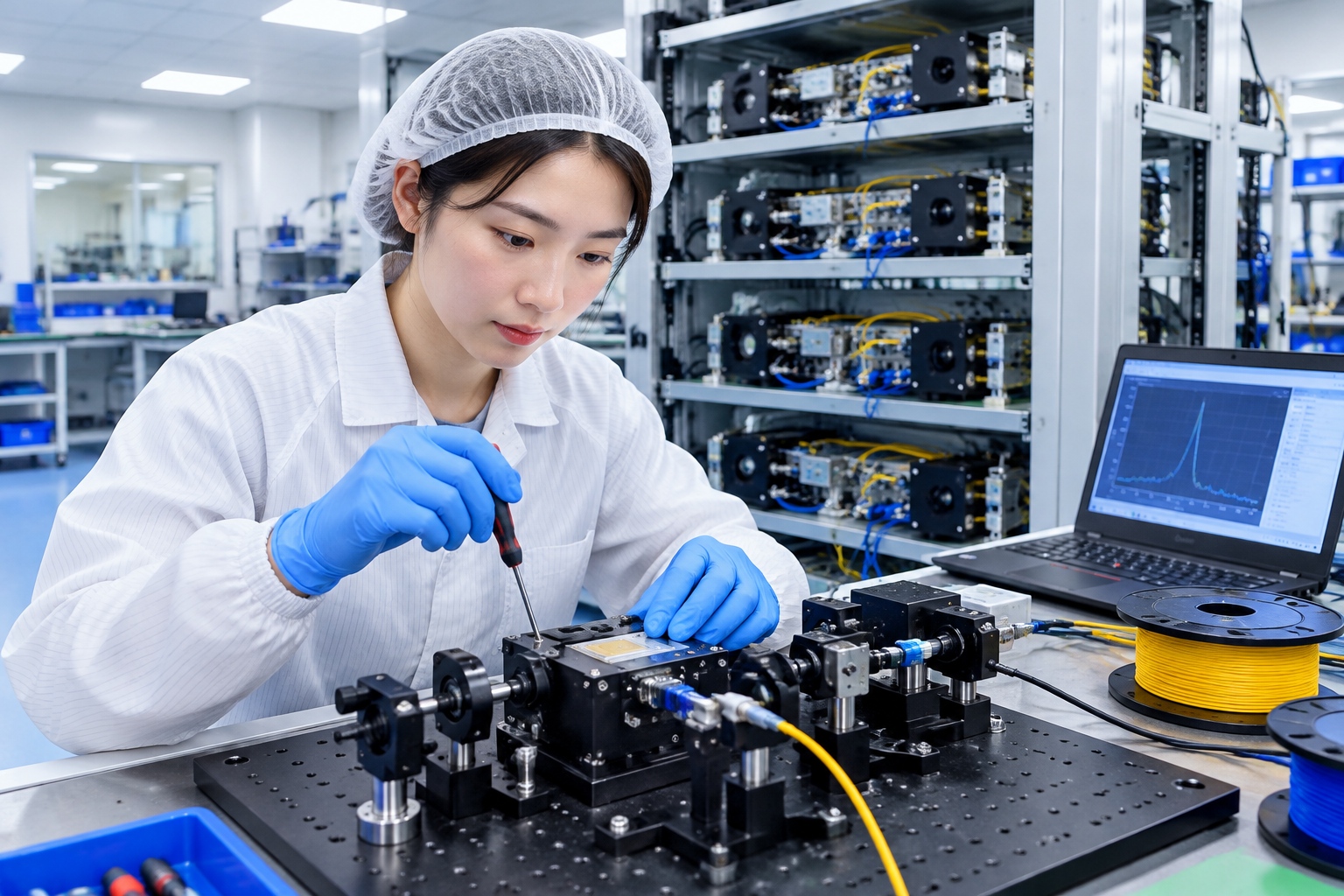
The room has no windows. Two rows of black racks hum quietly. Blue and yellow fiber patch cords loop between them, tied off with Velcro. A laminated sheet taped to the wall lists three phone numbers and one instruction: if the red light comes on, call Hefei first, then Beijing.
Nothing about the building announces that it sits on one of the more unusual pieces of infrastructure China has built. It is behind a low wall next to a repair yard. A delivery van parks outside. Under the floor, and then under the road, a fiber passes through and keeps going north.
What the Beijing-Shanghai line actually is
The line is usually called the Jing-Hu trunk — Jing for Beijing, Hu for Shanghai. It runs 2,032 kilometers, roughly following the Beijing-Shanghai corridor through Hebei, Shandong, Anhui and Jiangsu. It was approved in 2013, completed in September 2017, and is generally described as the first long-distance quantum key distribution (QKD) backbone in the world to move from a laboratory demonstration to something operated like infrastructure.
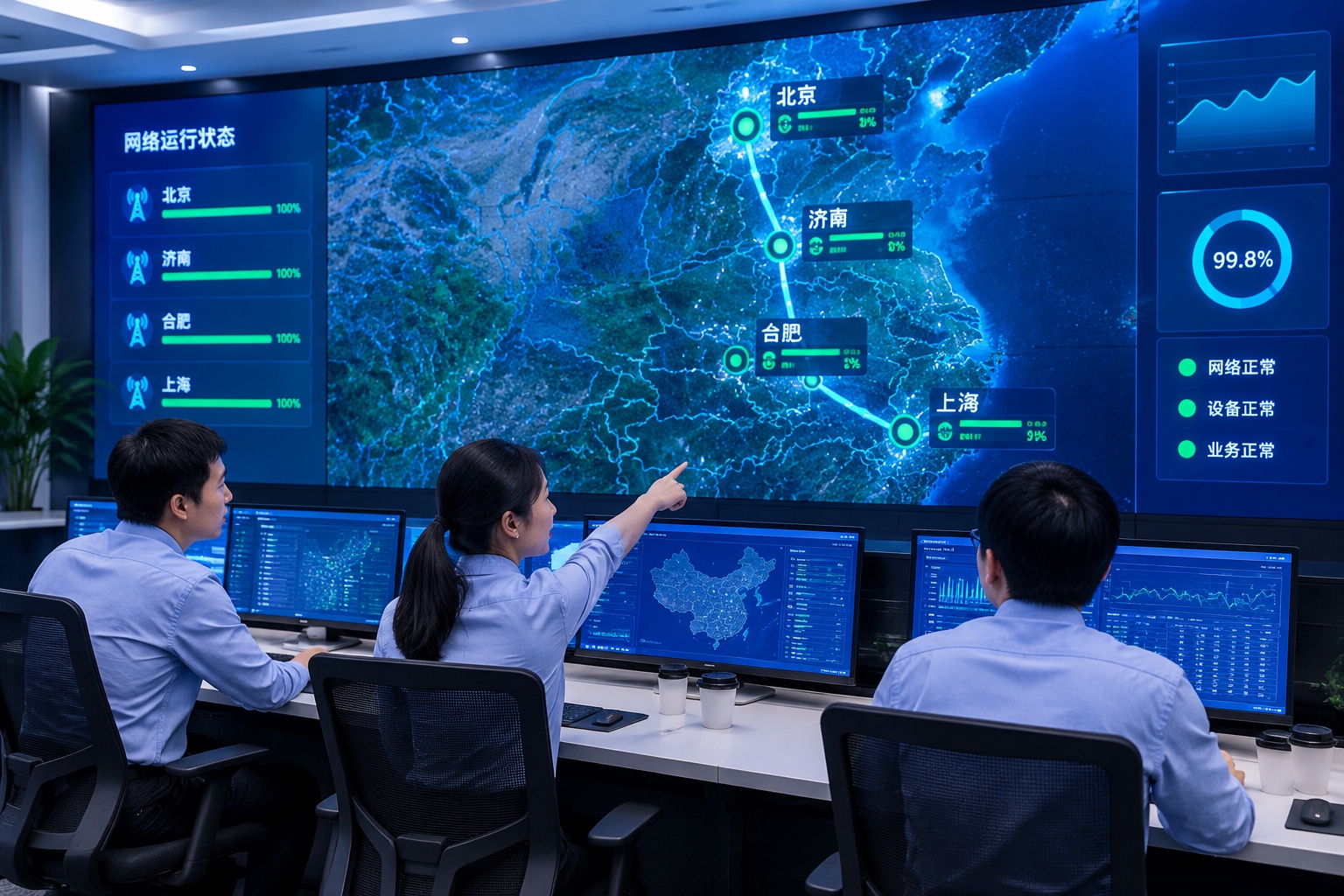
Four cities anchor it: Beijing, Jinan, Hefei and Shanghai. Between them sit 32 relay stations, small technical buildings like the one outside Jinan, spaced so that no single stretch of fiber is longer than a few dozen to around a hundred kilometers.
The fiber itself is unremarkable. Much of the route uses ducts, poles and maintenance corridors that already carried commercial telecom traffic; new cable was pulled through where capacity was missing. That detail matters more than it sounds. A quantum network is not a different kind of cable. It is ordinary glass, used in an unusual way.
Why fiber under the road, not a satellite overhead
China also has a quantum satellite, Micius, launched in August 2016 into a roughly 500-kilometer orbit. It has done real work, including a 2017 intercontinental key exchange with a ground station in Austria, and a 2020 link-up with the Beijing-Shanghai trunk itself.
But a low-orbit satellite is only overhead for a few minutes at a time. Key exchange needs a clear line of sight to a telescope, a dark sky and decent weather. Each pass yields a limited amount of key, and then the satellite is gone. For a bank in Beijing that wants to refresh keys with a branch in Shanghai every few minutes, that is not enough.
Fiber gives you a continuous connection and much higher rates. It also has a hard physical limit: light attenuates in glass. Send single photons down 2,000 kilometers of fiber and essentially nothing arrives. Signal loss grows exponentially with distance, which is why long-distance quantum links are chopped into segments — and why the relay stations exist.
The trusted relay: where the word “unconditional” stops
The physics behind QKD is genuinely elegant. A key is encoded on individual photons. Anyone who tries to measure them disturbs them, and the disturbance shows up as errors at the receiving end. Two parties can therefore detect eavesdropping on the fiber rather than simply hoping it isn’t happening.
The catch is the middle. At each relay station, the key cannot stay quantum — it is measured, converted into ordinary bits, and used to encrypt the next segment. The station stores it, briefly, in a form that a person with physical access could in principle copy. Engineers call this a trusted relay, and the word trusted is doing a lot of work.
So the correct description is: each link is protected by quantum physics, and the network as a whole is protected by quantum physics plus guards, locks, access logs, tamper detection and audits. Chinese researchers have said this plainly in published papers. The line is not advertised as immune to a compromised insider, and it should not be.
There are other honest caveats too. Real devices are imperfect, and imperfections can leak information; that is why equipment certification and side-channel testing matter as much as the mathematics. And the claim of “unconditional security” applies to the key exchange on a single span, not to the whole path from a ministry desk to a bank vault.
Who is actually on the other end
Public project descriptions and state media reports list government affairs networks, financial institutions and power utilities among the users. In Anhui, provincial and Hefei municipal government systems have been connected. Banks including the People’s Bank of China’s local branch, Industrial and Commercial Bank of China, Bank of Communications and China UnionPay have appeared in official accounts. State Grid has used quantum links for grid-related communications.
The realistic picture is less dramatic than the headlines. Most of these users run the quantum channel as a parallel or backup route for specific, sensitive traffic — cross-city data backups, archived records, some dispatch signaling — rather than pushing all their traffic through it. The trunk’s key rates sit in the kilobit-per-second range, which is perfectly adequate for keys and nowhere near enough for bulk data.
No public figures break down how much traffic the line carries on an average day, and it is fair to assume it is modest. The more visible commercial product is not the trunk at all but quantum-encrypted voice calls sold by China Telecom, which use keys generated on metropolitan networks and have found a small consumer and enterprise market.
The unglamorous part: cuts, cooling, spare parts
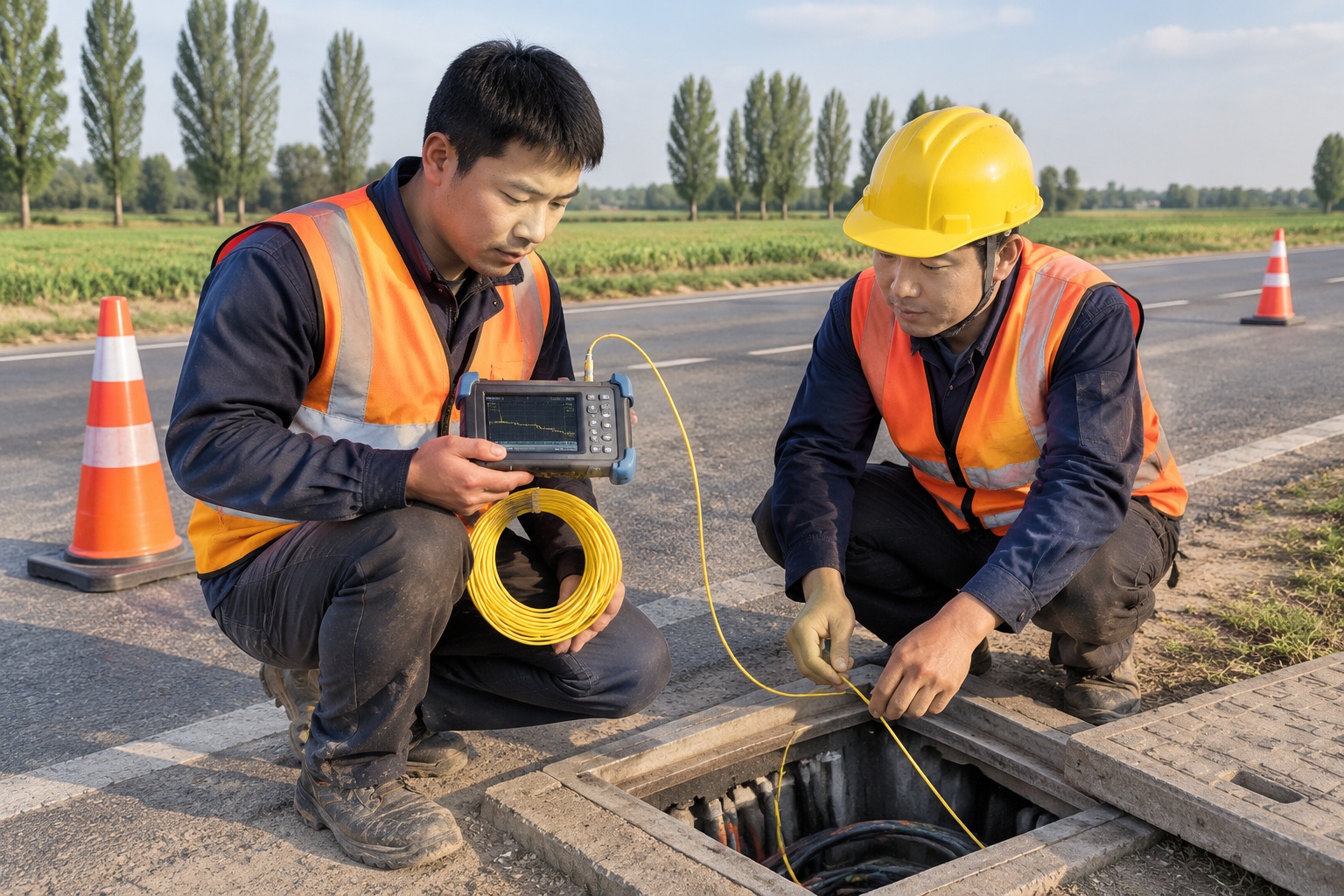
Ask the people who keep the line running what breaks, and the answer has little to do with quantum mechanics. It is backhoes. Roadworks, pipeline crews, a farmer ploughing a field — buried fiber gets cut somewhere along 2,000 kilometers with some regularity. The optical time-domain reflectometer, a device that sends a pulse down the fiber and reads the reflection to locate a break, is the most-used tool in the van.
Then there is the ordinary machinery of reliability: redundant power, air conditioning that must not fail, spare optical modules kept in stock, scheduled walk-throughs of roadside ducts, and drills for switching traffic to backup paths. Staff at the network management center watch the route on a wall screen much like any telecom operations room.
Cost is the quieter constraint. The project’s full budget has never been published in detail, and it is widely acknowledged within the industry that a QKD link costs far more per kilometer than ordinary encrypted fiber, largely because of the endpoint hardware. Each node needs specialized single-photon detectors and timing electronics. That economics, not physics, is what has limited how fast such networks spread.
From one line to a small network
Since 2017 the trunk has stopped being a solitary experiment. Hefei built a metropolitan quantum network connecting government and finance users across the city, and Jinan followed with its own. A second phase of a national wide-area backbone has extended links toward other regions, and China Telecom set up a dedicated quantum subsidiary in Hefei in 2023 to productize the technology.
Equipment has also shrunk and cheapened, though not to the point where it competes with software. Meanwhile a rival approach, post-quantum cryptography, has matured fast: the US National Institute of Standards and Technology published its first standards in 2024, and they run on ordinary computers and ordinary networks. Many security engineers now argue for hybrid systems — quantum keys where they are affordable, post-quantum algorithms everywhere else. That debate is unresolved, in China as elsewhere.
What the line does and does not prove
Back in Jinan, it is 8:20. The technician logs the morning’s error rate, checks that the standby power unit is charged, and takes a call from a colleague about a section of duct near a new housing site that will need an escort while an excavator works.
The Beijing-Shanghai line proves something fairly narrow and quite solid: that quantum key distribution can be engineered into a national-scale system, with staff, procedures, supply chains and maintenance schedules — not just a bench demonstration with a press release. It also shows the limits of that achievement. Trust still concentrates at the relay stations. Cost still decides who connects. And the most common cause of failure remains a machine digging where it shouldn’t.
That is what a real piece of the future looks like: mostly mundane, occasionally brilliant, and dependent on someone remembering to write in the logbook.
Start the discussion at forum.chinacomes.com