
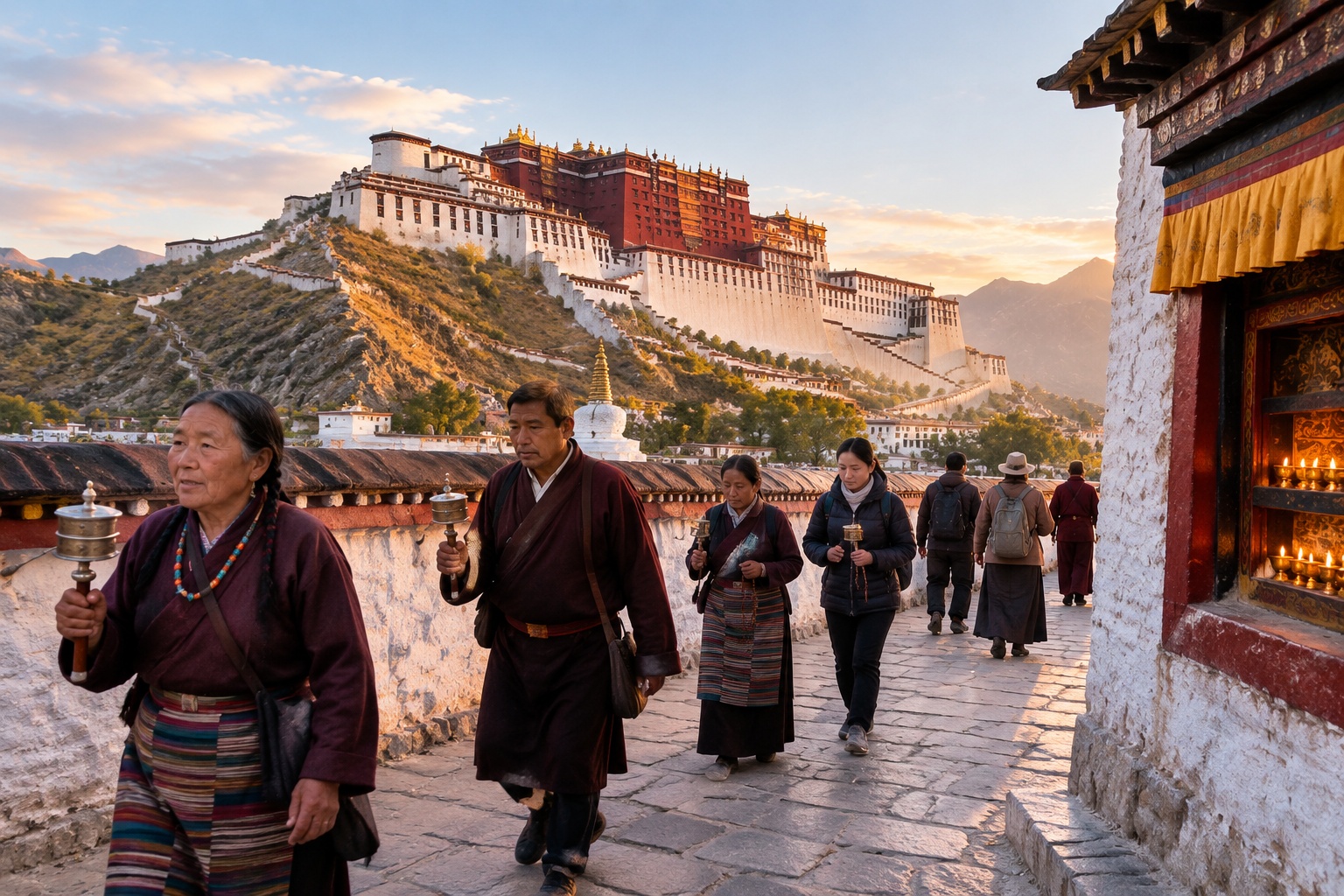

Dawn on the Kora: Where the Potala Palace Meets Its People
At 7 a.m., the air in Lhasa is still cold and thin. The sky is a pale blue, and the first rays of sunlight are just touching the golden roofs of the Potala Palace. On the kora—the circumambulation path that circles the palace—a steady stream of people is already moving. Most are Tibetans, some in traditional chuba, others in modern jackets. They walk clockwise, spinning hand-held prayer wheels, their lips moving in silent recitation. The only sounds are the soft shuffle of feet, the creak of wooden blocks hitting the ground, and the low hum of mantra. This is not a tourist attraction at opening time; it is a daily ritual that begins before the city wakes.
The Potala Palace: A Living Monument, Not Just a Postcard
The Potala Palace dominates the skyline of Lhasa, a massive structure of white and red walls built on Marpo Ri hill. For most visitors, it’s a photo opportunity, a Unesco World Heritage Site, and a symbol of Tibet. But for Tibetans, it is a living symbol of faith and history. Built in the 7th century by King Songtsen Gampo, and later expanded by the Fifth Dalai Lama in the 17th century, it served as the winter residence of the Dalai Lamas and the seat of Tibetan government until the 1950s. Today, it’s a museum, but it remains a pilgrimage destination. Every day, thousands of pilgrims climb the long stone stairs to make offerings, prostrate before the tombs of past Dalai Lamas, and receive blessings from monks. The palace has over 1,000 rooms, 10,000 shrines, and 20,000 statues. Yet its true power lies not in its architecture, but in the continuous stream of people who come to pray.
The Pilgrim’s Path: Devotion in Motion
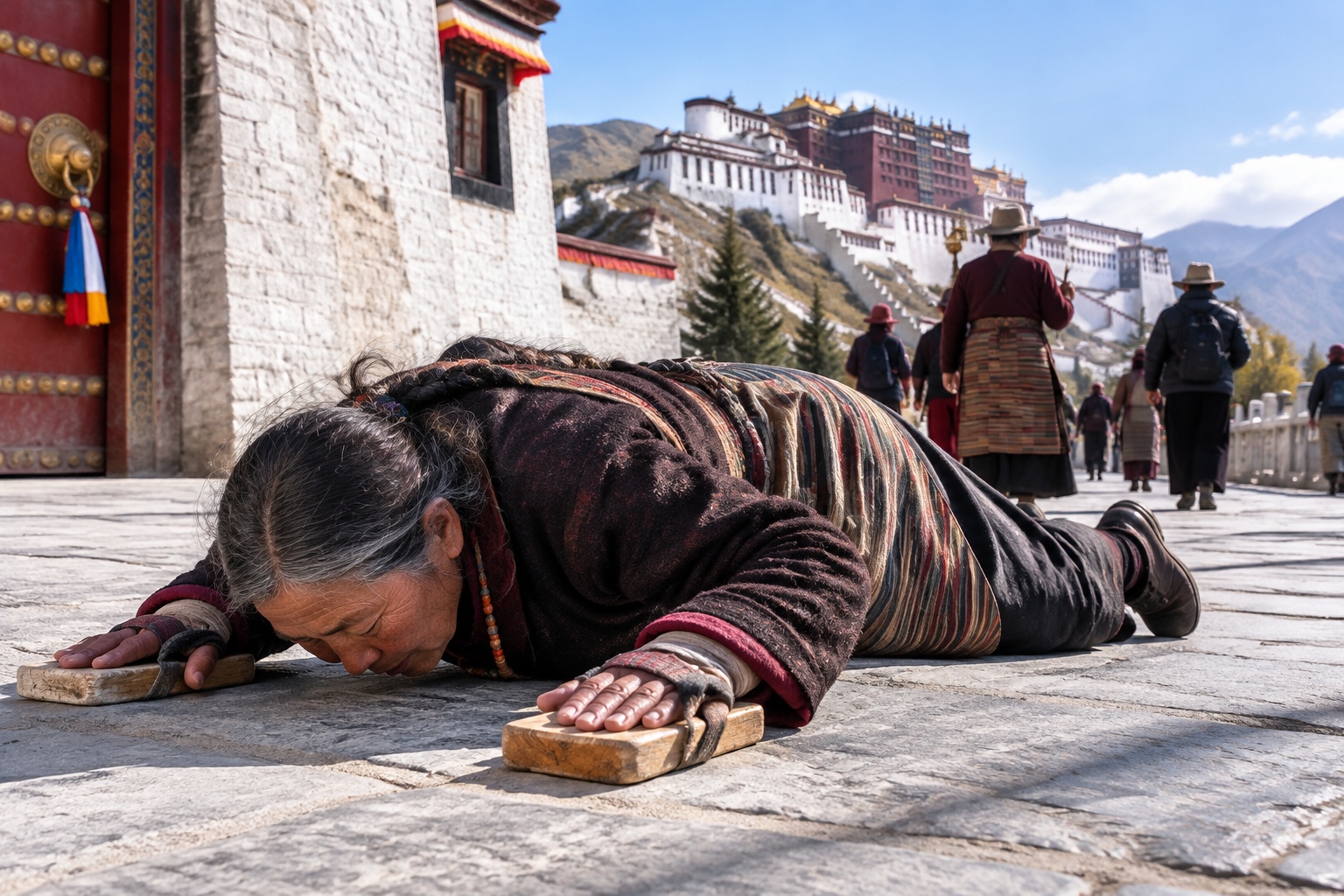
On the ground below the palace, near the western gate, a woman in her sixties is doing prostrations. She wears a thick apron to protect her clothes and wooden blocks on her hands. She stands, presses her palms together above her head, then touches her forehead, mouth, and chest. Then she kneels, slides her hands forward along the ground, and lies flat, forehead touching the stone. She repeats this motion, over and over, for hours. Her face is weathered, her eyes focused inward. When I ask her why she does this, she says simply, “To pray for all beings.” This is kowtow—a physical expression of humility and devotion. For Tibetan Buddhists, prostrating is a way to purify negative karma, accumulate merit, and show reverence for the Three Jewels: Buddha, Dharma, and Sangha. It’s not about reaching a destination; it’s about the journey itself. Each movement is a prayer. Some pilgrims perform hundreds of prostrations a day, their bodies calloused, their clothes worn thin. They are not performing for an audience; they are engaged in a private conversation with the divine.
Beyond the Palace: The Barkhor and Jokhang Temple
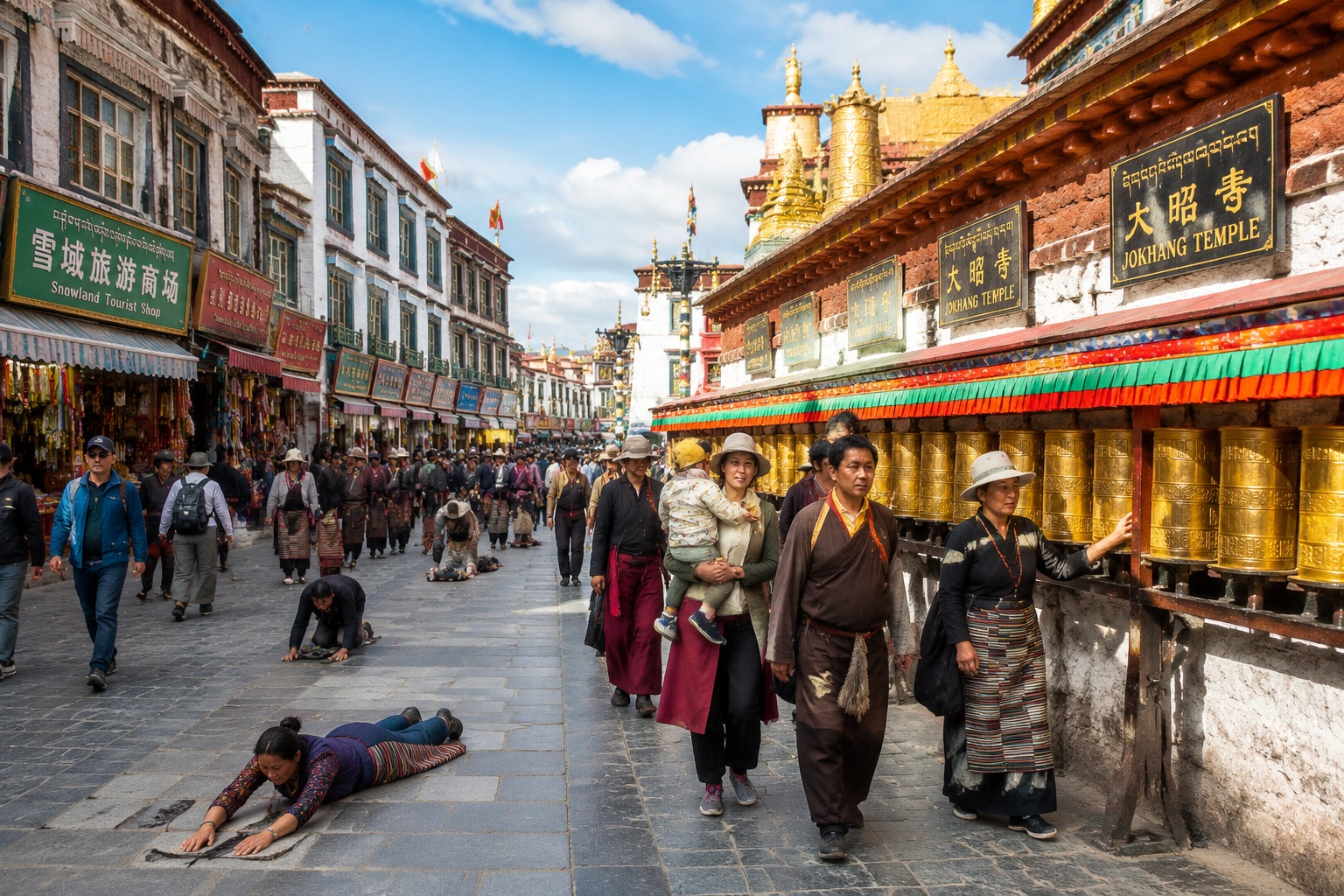
While the Potala Palace is the iconic image of Lhasa, the spiritual heart of the city is the Jokhang Temple, located in the old town. The temple was built in the 7th century to house the Jowo Shakyamuni, a sacred statue of Buddha. Around it runs the Barkhor, a circular street that is both a marketplace and a pilgrimage route. Here, the rhythm of devotion is even more intense. Pilgrims walk clockwise, spinning prayer wheels, chanting mantras, and prostrating on the stone pavement. The air is thick with the smell of butter lamps, incense, and fried bread. Shops sell prayer flags, rosaries, and traditional medicines. Monks in red robes mingle with nomads from the grasslands and tourists from around the world. It’s a place where the sacred and the mundane are inseparable. For many Tibetans, a pilgrimage to Lhasa is not complete without a visit to the Jokhang. Some travel for weeks, even months, from distant villages, prostrating every few steps. Their journey is a testament to the depth of their faith.
Inside the Jokhang: Where Faith Feels Tangible
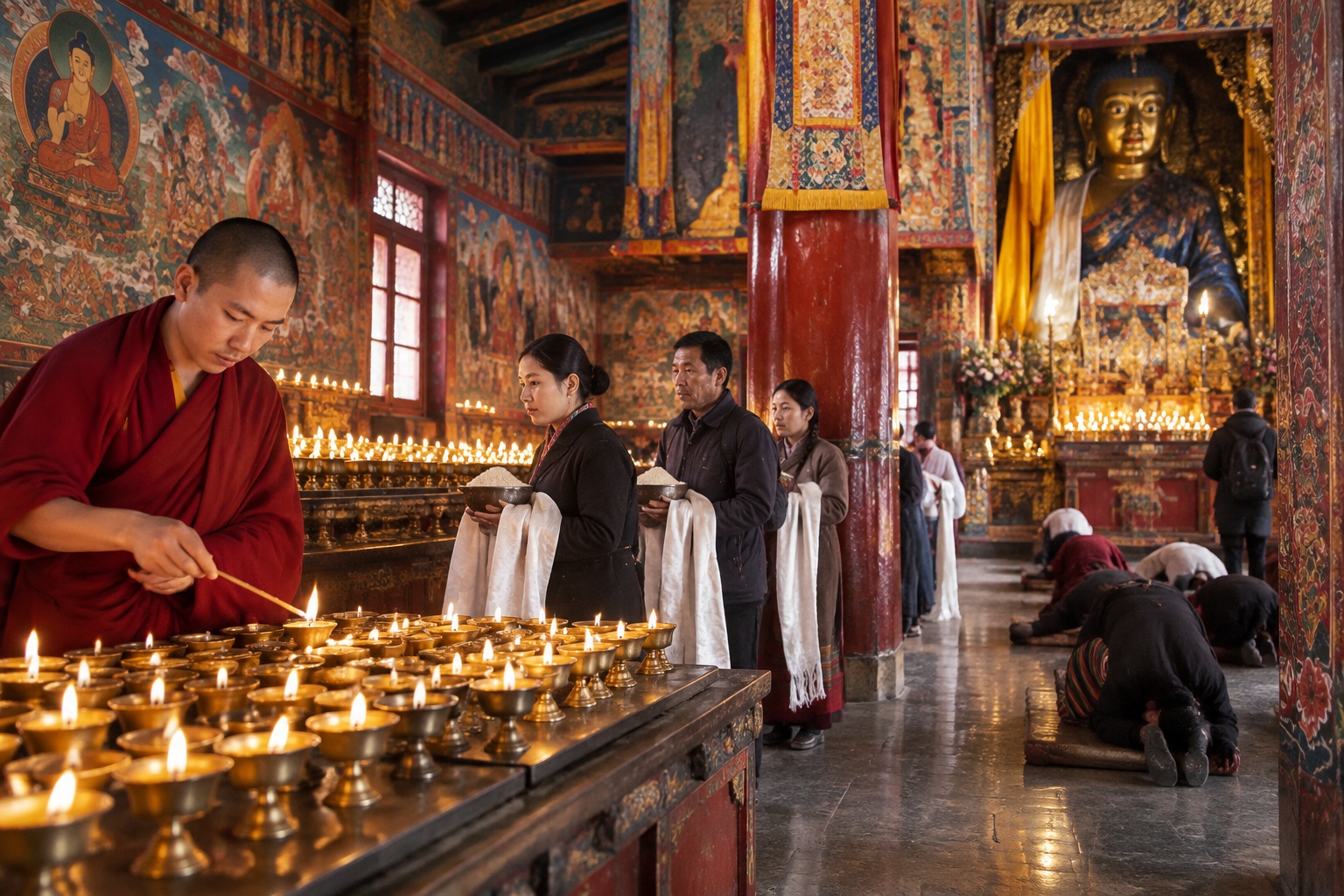
Stepping into the Jokhang Temple is like entering another world. The interior is dimly lit, illuminated by hundreds of butter lamps that flicker and cast shadows on ancient murals. The smell of melted butter and juniper incense is overwhelming. Pilgrims line up to offer barley flour, money, and silk scarves. Some prostrate before the central statue of Jowo Shakyamuni, believed to be the most sacred statue in Tibet. Monks sit in rows, chanting sutras, their voices a low drone that vibrates through the wooden floor. In a corner, an old woman is turning a large prayer wheel, her lips moving silently. The atmosphere is heavy with reverence, and even non-believers might feel a sense of awe. This is not a museum; it’s a living temple, where faith is practiced every day. The Jokhang is the spiritual center of Lhasa, and for many, the most important place in their lives.
What This Ancient Practice Says About Modern Life
In our fast-paced, digital world, the idea of spending hours—or days—walking, prostrating, and praying seems almost incomprehensible. We are used to efficiency, instant gratification, and constant stimulation. But the pilgrims of Lhasa offer a different model: one of patience, repetition, and presence. They remind us that some things cannot be rushed. That devotion—whether to a religion, a cause, or a person—requires time and effort. And that community matters: the kora is a collective act, with people from all walks of life moving together. For ordinary people, even those who are not religious, there is something to learn from this rhythm. It’s a quiet protest against the tyranny of the urgent. It’s a reminder that life is not just about the destination, but about the steps we take. In a society that often values speed over depth, the pilgrims of Lhasa show us another way. They are not escaping modernity; they are finding meaning within it, one step at a time.
Conclusion: The Endless Circle
As evening falls, the Potala Palace is lit up, its white walls glowing against the dark sky. On the kora, the pilgrims are still walking. Some have been there since morning. A young mother carries a baby on her back; an old man leans on a cane. They are not rushing. They are part of a tradition that stretches back centuries, and they are not alone. In a world that often feels fragmented, this continuous stream of people walking together, praying together, offers a glimpse of something larger than the self. It’s a spiritual route that leads not just to a palace, but to the human heart. And it is a journey that anyone, regardless of belief, can witness and perhaps learn from.
Start the discussion at forum.chinacomes.com