
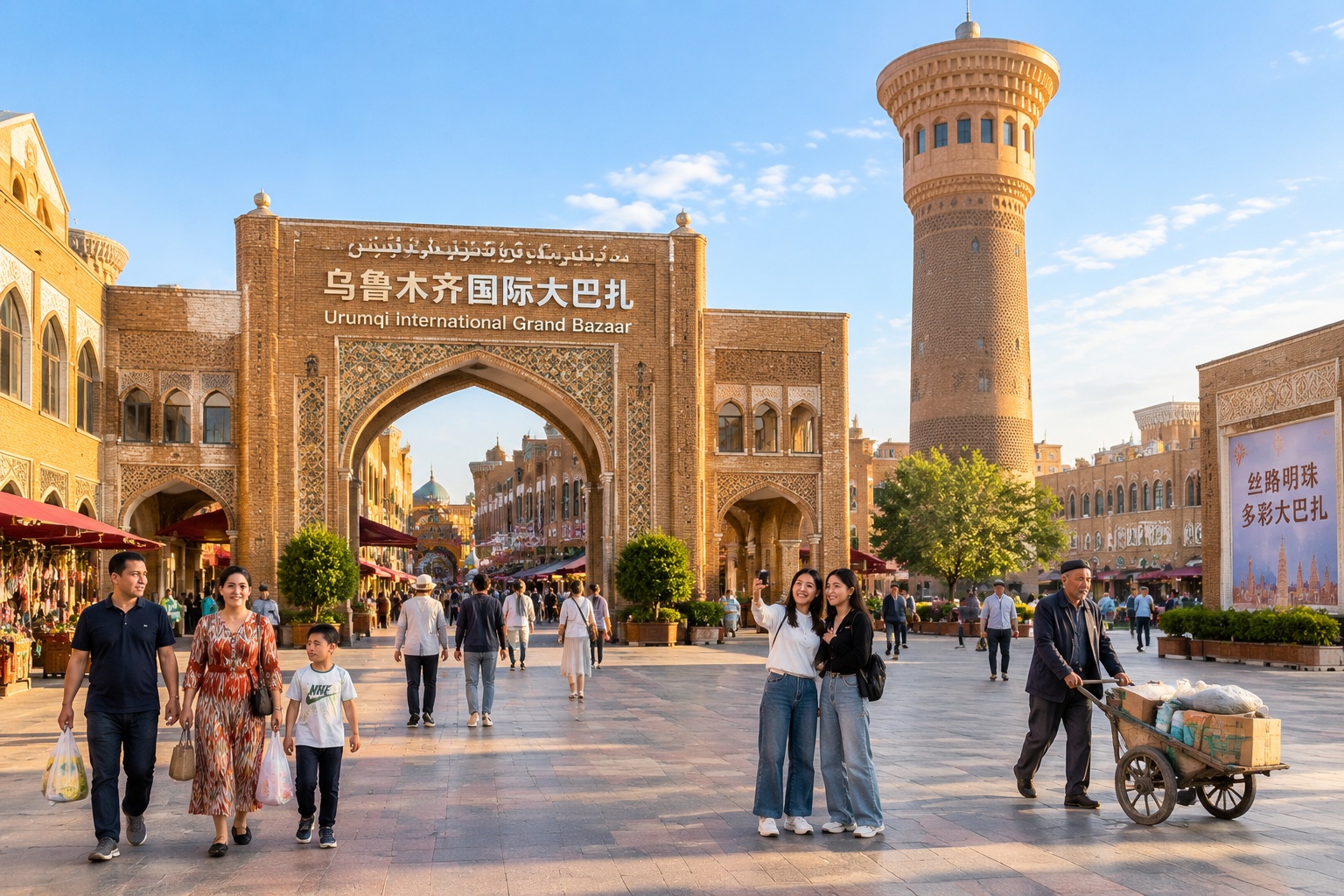

The Market Wakes Up Before the Tourists Do
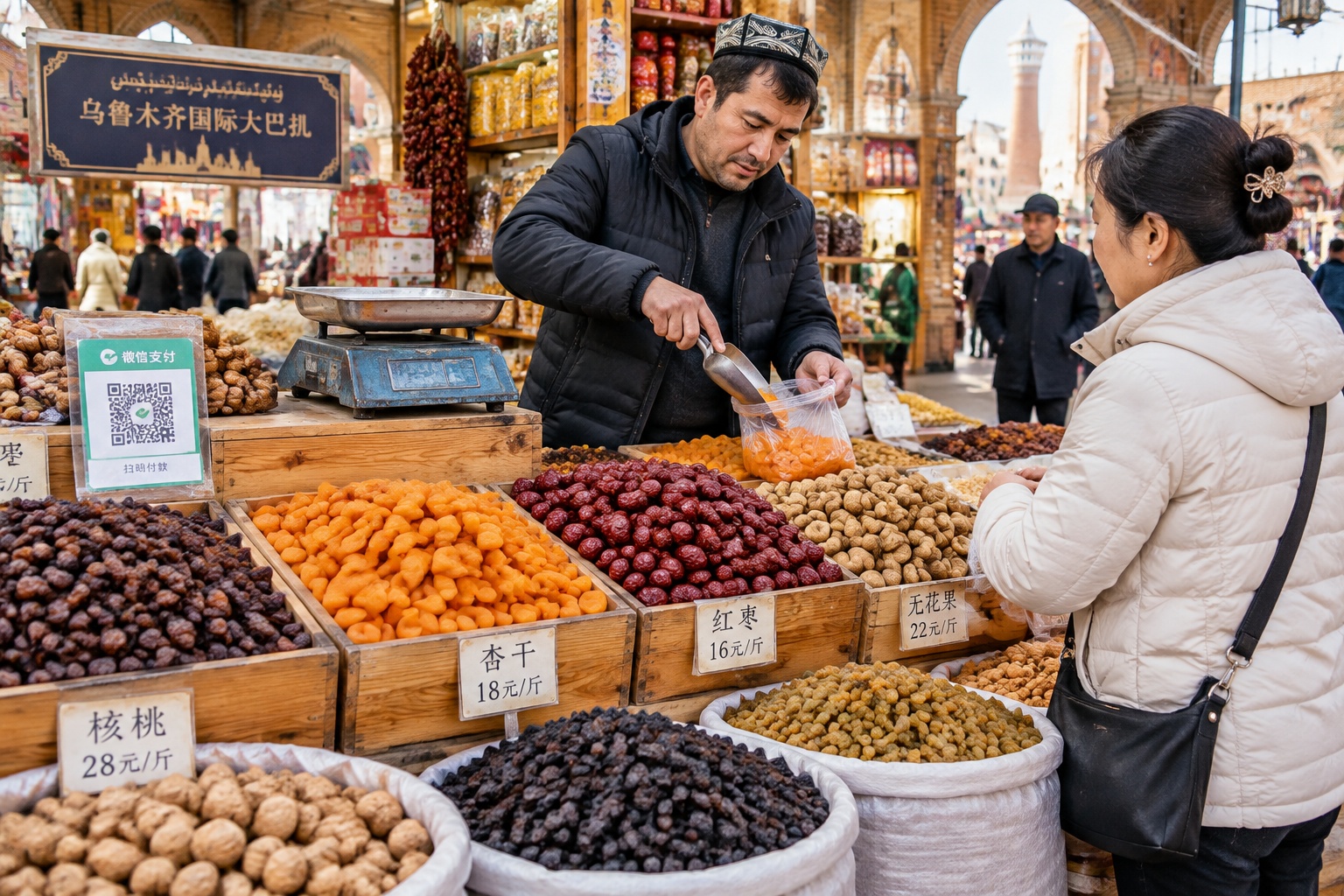
At 9:30 on a weekday morning, the outdoor half of Urumqi’s Grand Bazaar is still yawning. Metal shutters rattle up one at a time. A man in a padded jacket squats on the paving, unfolds a plastic sheet and tips a sack of dried apricots onto it — orange, sticky, stacked into a low pyramid. He weighs them on a battered scale, gives a price per jin, and waits.
That is roughly how a fruit seller opens up in Barcelona’s Boqueria, or how a spice stall off Istanbul’s Grand Bazaar starts its day. The differences between those markets matter. But the first useful thing to say about Urumqi’s International Grand Bazaar — 乌鲁木齐国际大巴扎 in Chinese, usually shortened to simply da bazar — is that it is a working market that happens to be famous, not a museum that happens to sell things.
Where Urumqi’s Grand Bazaar Actually Is
The bazaar sits in the Erdaoqiao (二道桥) area of Tianshan District, about three kilometres south of central Urumqi, the capital of the Xinjiang Uyghur Autonomous Region. Urumqi Metro Line 1 has a station named Erdaoqiao, which puts you a two-minute walk from the main entrance. A taxi from the city centre is short and cheap.
The complex opened in 2003 and covers roughly 100,000 square metres: an indoor hall, a covered pedestrian street, an open-air food lane and a plaza. The architecture borrows from Central Asian and Islamic building traditions — pointed arches, patterned brickwork, domes and towers. Its landmark is the sightseeing tower at one end, around 80 metres tall, with an observation deck near the top. You can see it from several blocks away, which makes it genuinely useful when you get turned around.
Walking through the market is free. The tower needs a ticket. The whole compound holds a national 4A rating in China’s tourist-attraction system, which roughly means a large, well-managed visitor site with signage and facilities.
What Is Actually on the Stalls
Dried fruit, nuts, and the 500-gram jin
Dried fruit is the volume business here. Raisins in several shades, red dates from Xinjiang, figs, apricots, walnuts, almonds, melon seeds, safflower and honey. Most of it comes from orchards and drying yards a few hours away by road, which is why the prices can be startlingly low by European standards.
One thing trips up visitors from metric countries: prices are usually quoted per jin, which is 500 grams, not a kilo. A sign reading 38 means 38 yuan for half a kilo. Vendors will happily weigh smaller amounts, and they will push a handful at you to taste before you buy. That is salesmanship, not a trap — you are not obliged to purchase after tasting.
Bargaining is normal but gentler than in Istanbul’s tourist bazaar. Margins are thinner, and vendors would rather add an extra scoop to your bag than cut the price by a third. Ask for a small discount, smile, and if the answer is no, buying anyway is perfectly acceptable.
Copper, silk, and a room full of instruments
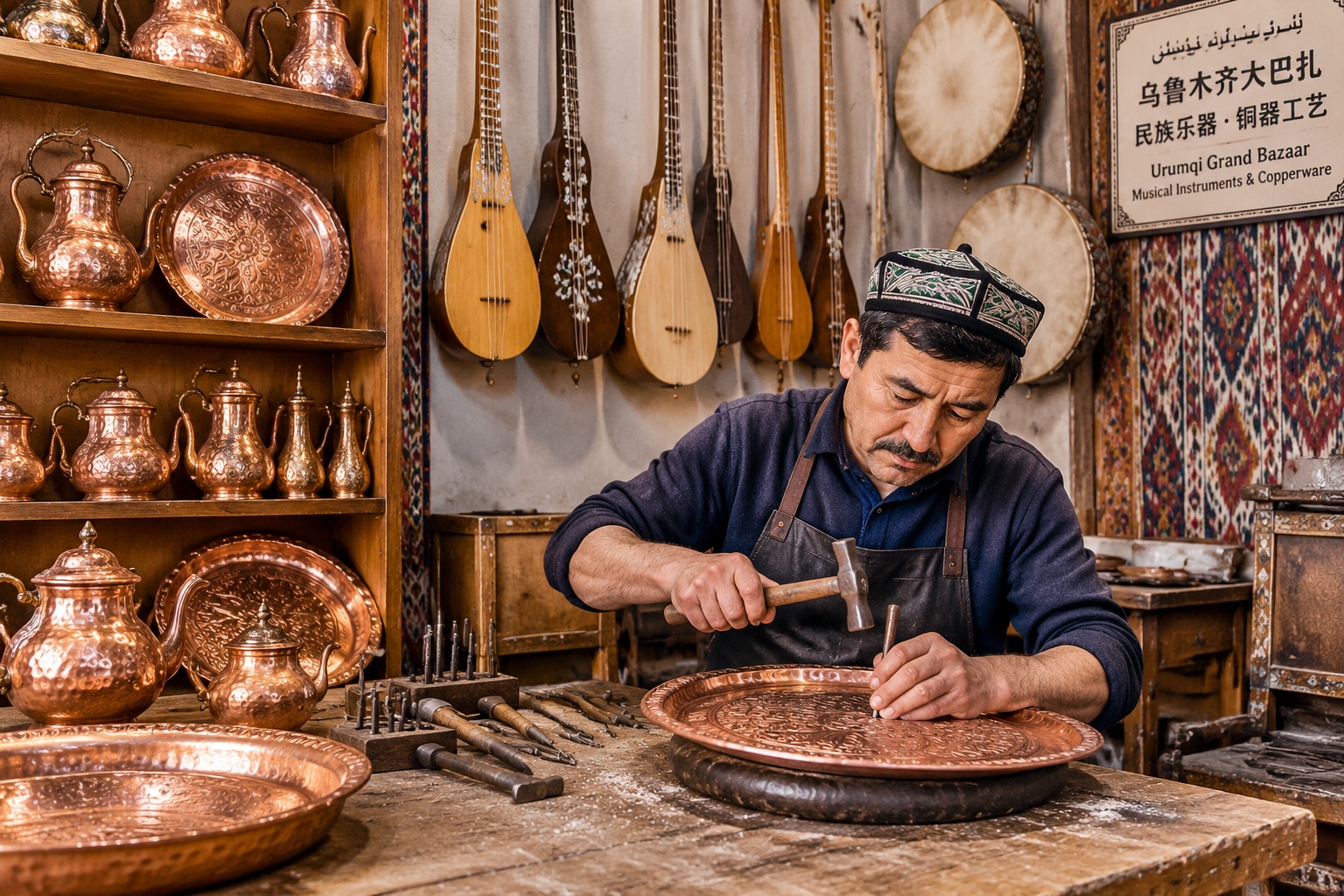
Further in, you hear the trade before you see it. Somebody is hammering a copper teapot or a tray into shape, the tap of metal on metal carrying down the corridor. Hand-hammered copperware, samovars and trays are sold alongside mass-produced versions, and the price gap tells you which is which if you look closely at the seams.
Textiles run from factory-printed Atlas silk — the bold, ikat-like patterns that appear on Uyghur dresses — to hand-woven pieces that cost many times more. Embroidered four-sided doppa hats are stacked by colour. There are carpets, and there is jade, much of it treated or imitation; if you are serious about stone, buy from a shop that will give you a certificate, and treat the cheap tables as souvenirs.
Then there are the instruments: long-necked rawap, two-stringed dutar, and frame drums. In a good shop, the owner will play a phrase without being asked. Older guidebooks list Yengisar knives as a classic souvenir; today, carrying a knife in public or flying with one is restricted in China, so treat them as display pieces rather than something to take home.
The Sound and the Smell
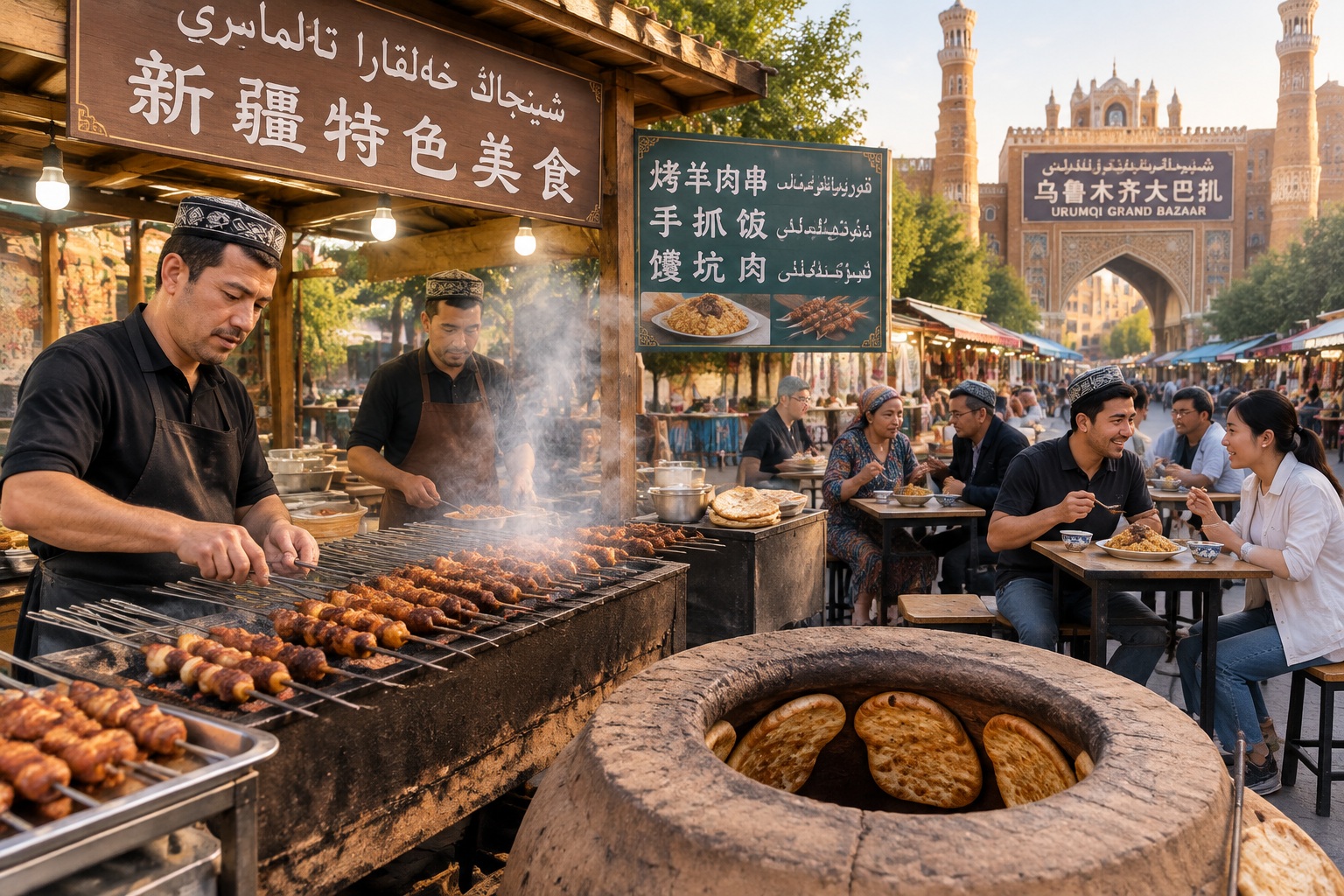
The outdoor food lane is the loudest part of the bazaar and the easiest place to understand Xinjiang cooking. Cumin hits you first, then charcoal smoke and lamb fat. Naan is slapped onto the inside wall of a clay tandoor and hooked out a few minutes later, blistering and hot. Samsa — baked buns stuffed with lamb and onion — come out of the same ovens. There is pilaf with yellow carrots, hand-pulled noodles, thick yogurt, and pots of tea that people refill all afternoon.
Listen to the languages. Uyghur and Mandarin dominate, with Kazakh, Russian and the occasional English sentence mixed in. Shop signs carry Chinese characters and Uyghur script side by side. When numbers get complicated, a vendor will turn a calculator or a phone screen toward you instead of repeating the price, which is a system that works in every market on earth.
Five times a day, the call to prayer from the nearby Erdaoqiao Mosque carries over the rooftops. It is part of the neighbourhood’s ordinary sound, not a performance for visitors.
Morning, Noon and Evening Are Three Different Markets
Xinjiang runs on Beijing time officially, but many residents live two hours behind it. Shops that open at 10 a.m. on the clock are opening at what feels like 8 a.m. to the people behind the counter. So the bazaar feels quiet later than a European visitor would expect, and busy later too.
Morning, from around 10 to 12, is the best time for photographs and for actual shopping. Locals are buying in quantity, deliveries are being unpacked, and nobody is in a hurry. The light in the covered street is soft.
Early afternoon belongs to tour groups and school trips. It is hot, crowded and the least interesting version of the place, unless you enjoy crowds as a subject.
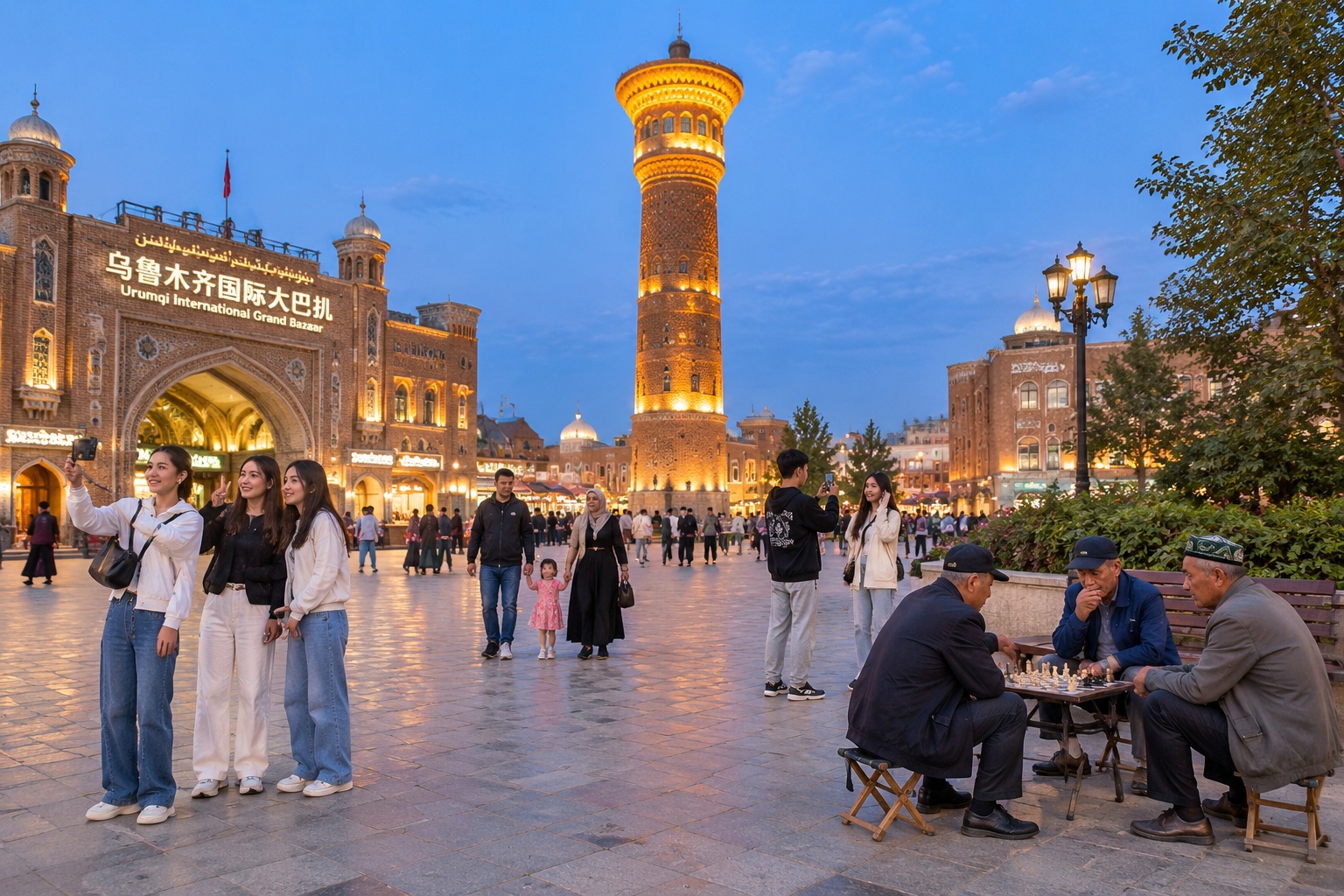
Evening is the surprise. In summer, the sun in Urumqi does not set until close to 10 p.m. on the clock, and the plaza fills with families, teenagers filming short videos, and men playing chess on low stools. The tower lights up. The food lane reaches its peak around 9 p.m., and the whole compound stops feeling like a tourist site and starts feeling like a neighbourhood.
Getting In, Paying, Taking Photos, Saying Hello
Getting there. Metro Line 1 to Erdaoqiao station is the simplest route. Buses and taxis are cheap. The area is walkable, and the surrounding streets — not just the bazaar itself — are where you find cheaper food and everyday shops.
Paying. Almost every stall takes WeChat Pay and Alipay, with a laminated QR code taped to the counter. Foreign visitors can often link an international card to either app now; otherwise bring cash, which is still accepted but can slow things down while someone hunts for change.
Photographing people. Ask first. A raised camera and a questioning look is enough, and a surprising number of people will say yes. Some women will decline, and that answer is final. Do not photograph worshippers or the interior of the mosque, and avoid photographing security personnel and checkpoints. Expect bag scans at metro stations and some public buildings — that is routine across Chinese cities, not a signal that anything unusual is happening to you.
Saying hello. Mandarin works everywhere. The Uyghur word for thank you, rahmat, is appreciated and easy to pronounce. A few numbers, a calculator and a smile will carry you further than a translation app.
It Is a Market, Not a Curiosity
If you have been to Istanbul’s Grand Bazaar, Barcelona’s Boqueria, Seattle’s Pike Place or London’s Borough Market, you already know this place’s logic. Wholesale meets retail. Families do their weekly shopping next to tourists buying gifts. Prices move with the season. The same vendor has stood behind the same counter for a decade and knows which customers will come back.
What is particular to Urumqi is not the structure but the ingredients: orchards a few hours away, a tandoor built into the pavement, instrument shops that tune what they sell, Atlas silk in colours you will not find in a European market, and signage in two scripts. That is a real difference, and it is a difference in content, not in kind.
Go in the morning, buy something, taste before you decide, and let the place be what it mostly is — a market where people work. The part that feels exotic is a byproduct, not the point.
Start the discussion at forum.chinacomes.com