

Introduction: A blue-stained pair of hands in Zhoucheng
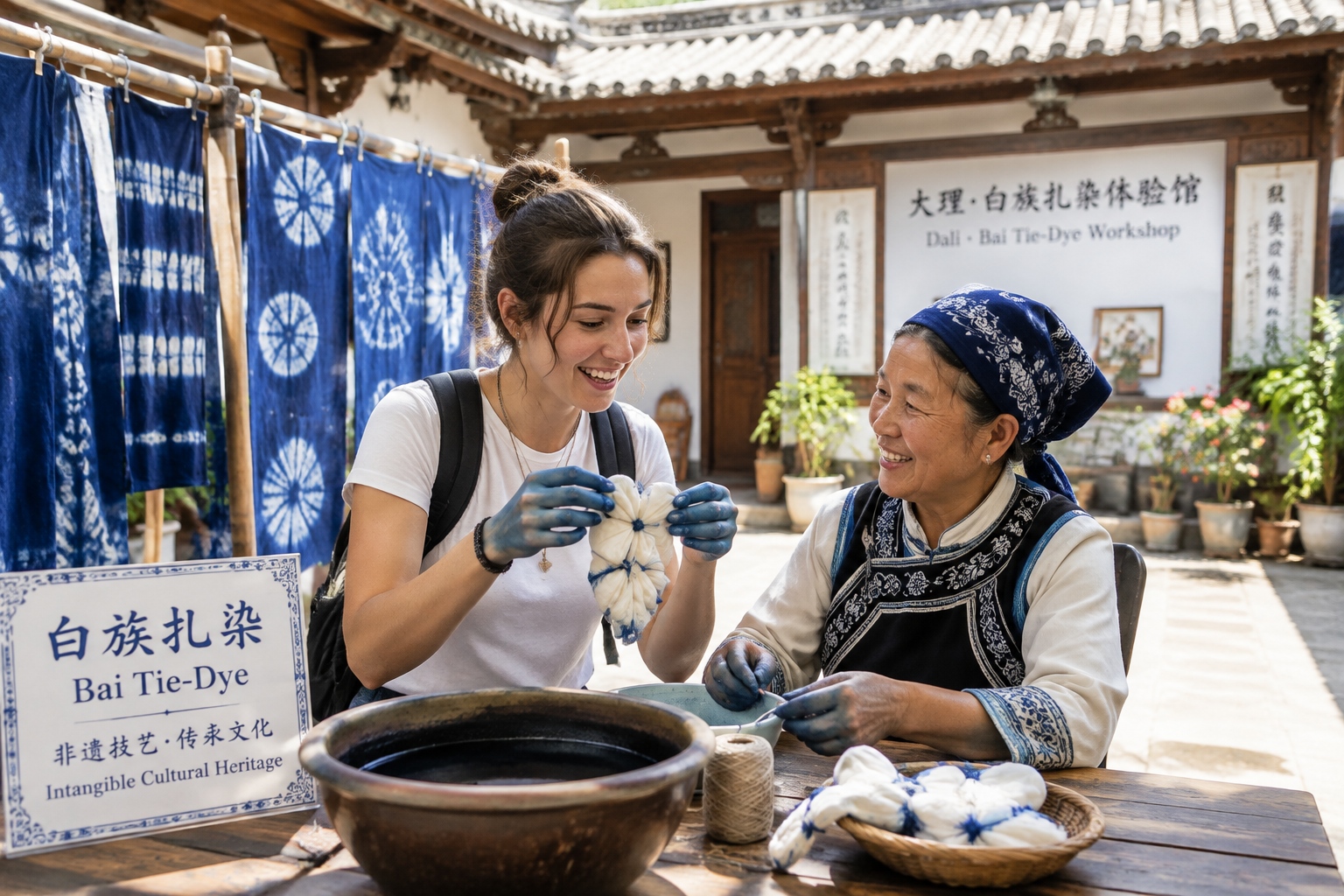
At 9 a.m. on a Tuesday in Zhoucheng, a village about 30 kilometers from Dali’s old town, Marta Ricci from Milan was trying to keep a white square of cotton flat on a wooden table. She had already turned it into something that looked like a small, twisted parcel. The Bai woman beside her, a local artisan named Li, watched for a moment and then reached over to adjust one of the threads. A young Chinese translator said, “She says you don’t need it to be perfect. The indigo will make it yours.”
Marta is part of a growing wave of foreign travelers who come to Yunnan not only to see snow-capped mountains and rice terraces, but to learn a craft with roots deep in this region: Bai tie-dye, or zazhang, in Chinese. In the last few years, Dali has turned into an informal global classroom for this traditional dyeing technique, attracting students from Europe, North America, Australia and Southeast Asia.
A craft born from indigo and patience
Bai tie-dye is exactly what the name says. The maker converts a piece of plain white cloth into a fabric with white patterns, many of them inspired by butterflies, flowers, waves, or the lunar calendar. The process begins by folding, pinching and tightly tying the cloth with thread. Only then is the fabric dipped into a vat of deep-blue dye, traditionally made from the indigo plant. Once dry, the threads are removed, unveiling white designs against a blue background. Because each piece is tied by hand, no two are identical.
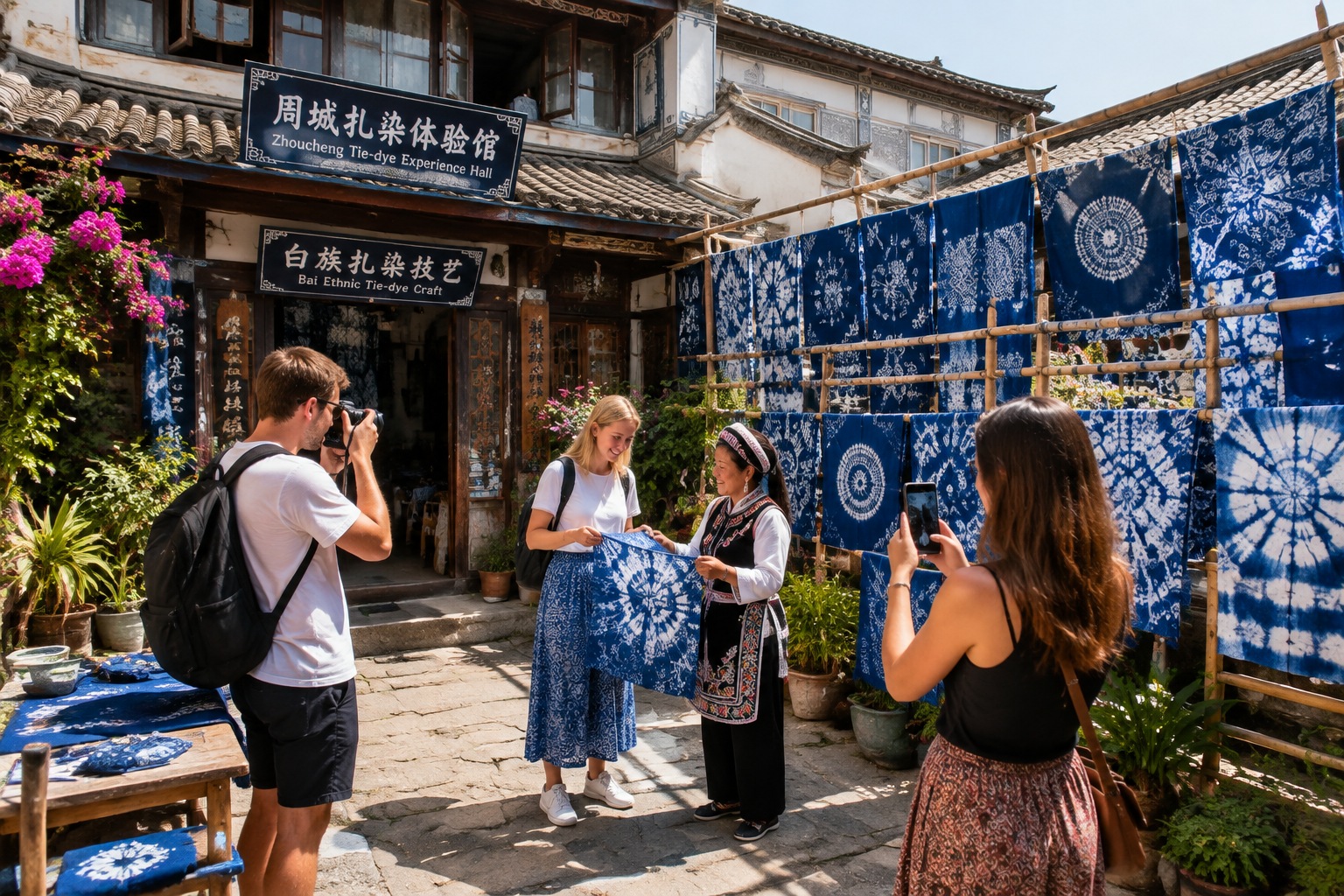
For the Bai ethnic group, the largest minority community in the Dali area, this craft is not a tourist invention. Women have been making tie-dye at home for centuries, using it for baby wrappings, headscarves, clothing and bedding. In 2006, China included Bai tie-dye on its national list of intangible cultural heritage. But in Dali today, heritage does not sit behind glass. It hangs from bamboo poles in courtyards, drips off workshop walls, and, increasingly, stains the hands of visitors from other countries.
From market stalls to hands-on courses
Dali has been a bucket-list destination in China for decades. But the local craft economy used to be simpler. Shops sold ready-made scarves and tablecloths; tourists bought them as souvenirs. The problem was that many objects ended up in drawers, not in people’s lives.
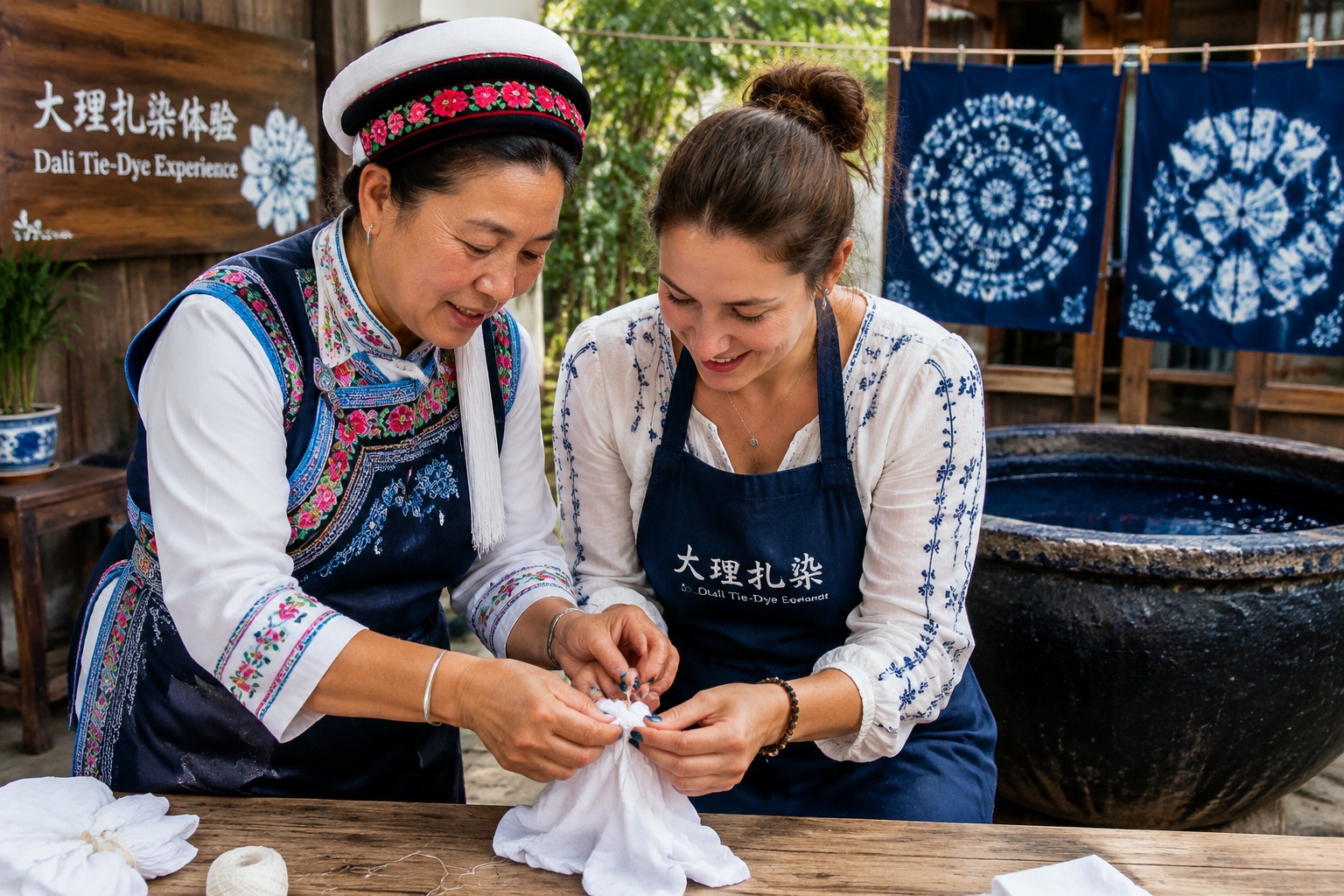
Around the mid-2010s, workshops began to change their model. Instead of only selling products, they started teaching the process. In Zhoucheng and other nearby villages like Xizhou, travelers are invited to pick a piece of fabric, sit down with a local artisan, and spend an hour or two tying and dipping. Some workshops now have English schedules, printed instruction cards with images, and even bilingual staff. A few offer one-week courses that cover natural dyeing with plants, pattern design, and finishing techniques.
This shift reflects a broader pattern across China: younger consumers and international visitors are less interested in buying things than in experiencing how they are made. A half-day class costs roughly between 100 and 300 yuan, depending on the size of the fabric and the complexity of the design. For many travelers, that feels more valuable than a mass-produced scarf bought from a stall.
What a tie-dye class actually feels like
Most beginners do the same first steps. They choose a white cotton square or a t-shirt, lay it on a flat surface, and try to imitate the artisan’s folding. Then comes the slow part: wrapping rubber bands or thread around the folded cloth to prevent the dye from reaching certain pockets of fabric. For those accustomed to screens and instant feedback, this is surprisingly challenging. There is no way to speed up the tying phase.
Next comes the dipping. The cloth is lowered into a dark, near-black vat that smells earthy and slightly metallic. After a few minutes, it is pulled out and left in the air. Oxygen works its magic, and the cloth slowly turns from greenish-yellow to a deep, permanent blue. This color transformation is so visually satisfying that almost every student pulls out a phone to record it. That is also why tie-dye videos have become a reliable source of likes and shares on social media.
The numbers point to a genuine shift
Exact statistics on foreign students in Dali’s tie-dye workshops are hard to find, but the direction is clear. Several workshop owners in Zhoucheng told local media that international visitors now account for around 10 to 15 percent of their students, up from almost zero a decade ago. Travel platforms in China have also reported a steady rise in searches for “Dali tie-dye experience” and related keywords, especially in spring and summer.
On Chinese short-video platforms like Douyin, videos tagged with the Chinese characters for Bai tie-dye have drawn tens of millions of views. Some of the most popular videos are posted by foreign visitors, explaining the process to their own audiences in English, French, or German. This creates a loop: a visitor comes, makes a video, his or her friends see it, and a few months later they book a trip to Dali.
Who are the new learners?
When you walk into a workshop in Dali, you will see an interesting mix. There are backpackers who discovered tie-dye while exploring Yunnan, design students from Seoul and Tokyo who came to study traditional textile techniques, and even retired couples who want a hands-on lesson in Chinese craftsmanship. Some foreign students stay for a day; a smaller number stay for weeks, picking up enough skill to start their own small dyeing projects at home.
One common thread is that these visitors are looking for something slower. They have come to Dali not to check off landmarks, but to spend time with local people and to understand how a cultural tradition is being carried into the future. That does not mean they avoid the cherry blossom photos or the lakeside cafes. But many say the dye workshop is the part of the trip that stays with them, because it turned them from spectators into participants.
Dali itself does some of the teaching
It would be a mistake to talk about tie-dye without mentioning the setting. Dali has a lake, Erhai, that mirrors the sky, a mountain range, Cangshan, that shelters the plain, and a mild climate that suits outdoor activity nearly year-round. The region has also developed a reputation as a place for expats, digital nomads and artists. There are yoga retreats, craft breweries, organic farms and co-working spaces scattered around the old town.
This modern creative ecosystem is part of the reason why foreign learners feel comfortable staying longer. After a morning of dyeing, they can walk to a café run by a foreigner from France, attend a sound-healing session near the lake, or meet other travelers in one of Dali’s many hostels. The village workshops are not isolated lesson rooms; they are part of a larger environment that encourages slow living and cross-cultural conversation.
Not everything about the boom is perfect
With popularity comes commercialization. Some shops put out small dye buckets so visitors can take a quick photo without really learning the craft. Some “experience courses” last twenty minutes and use chemical dyes that imitate indigo. In better workshops, you might spend hours learning the logic of pattern-making; in others, you are simply asked to dip a shirt into a bucket and then pay. The quality of teaching varies, and it is not always clear which workshops are serious and which are just photo opportunities.
For a foreign traveler without Chinese language skills, finding a good class takes a bit of research. Reading recent reviews on travel apps, looking for images of actual workbenches rather than stylish living rooms, and asking the workshop how long their class lasts are reasonable first steps. Some of the most authentic experiences are still organized by elderly women who have done tie-dye all their lives; they may not speak English, but they can make you understand a great deal through gestures and shared laughter.
There is also a quieter concern. As more outsiders come to learn, some local traditions are being distilled to their most visual elements. The blue-and-white cloth becomes a symbol of “Dali culture” even though the actual Bai culture is far more complex. Those who take the time to listen will notice that the artisans themselves are thinking about these questions. They are proud that more people care about their craft, and at the same time they want to keep control over what it represents.
What this says about culture and change
The rise of Bai tie-dye as an international learning opportunity is part of a larger story about cultural preservation in China. When a younger generation drifts toward cities, traditional crafts often lose their successors. But Dali shows that cultural confidence can be rebuilt in surprising ways. Foreign interest is helping to create economic value, which in turn encourages young Bai people to learn the craft from their elders and to experiment with new designs.
Some workshops in Dali are now run by young Bai designers who combine classic patterns with modern colors and materials. They sell not only in China but also through online platforms to customers around the world. The presence of foreign learners gives these young artisans a sense that what they are doing is not just about nostalgia. It is about a living culture that can evolve without losing its roots.
How to learn tie-dye in Dali yourself
If you are planning a trip and want to try Bai tie-dye, Dali is easy to reach. You can fly directly to Dali from major Chinese cities like Beijing, Shanghai, Guangzhou, and Chengdu. Many international travelers fly into Kunming, the capital of Yunnan, and then take a high-speed train that reaches Dali in about two hours.
Once in Dali, Zhoucheng village is the most convenient destination. It is about an hour by bus or taxi from Dali’s old town. Numerous workshops line the village streets. Prices, as mentioned, usually range from 100 to 300 yuan for a basic session. For those who want more depth, some workshops offer multi-day courses covering indigo farming, natural dyes made from plants like walnut bark and tamarind, and advanced stitching techniques. Even without a word of Chinese, you can join a class with translation support or simply rely on demonstration. Many visitors say the best reward is not the finished scarf but the amount of time they spent doing something with their hands.
Conclusion: Blue threads across borders
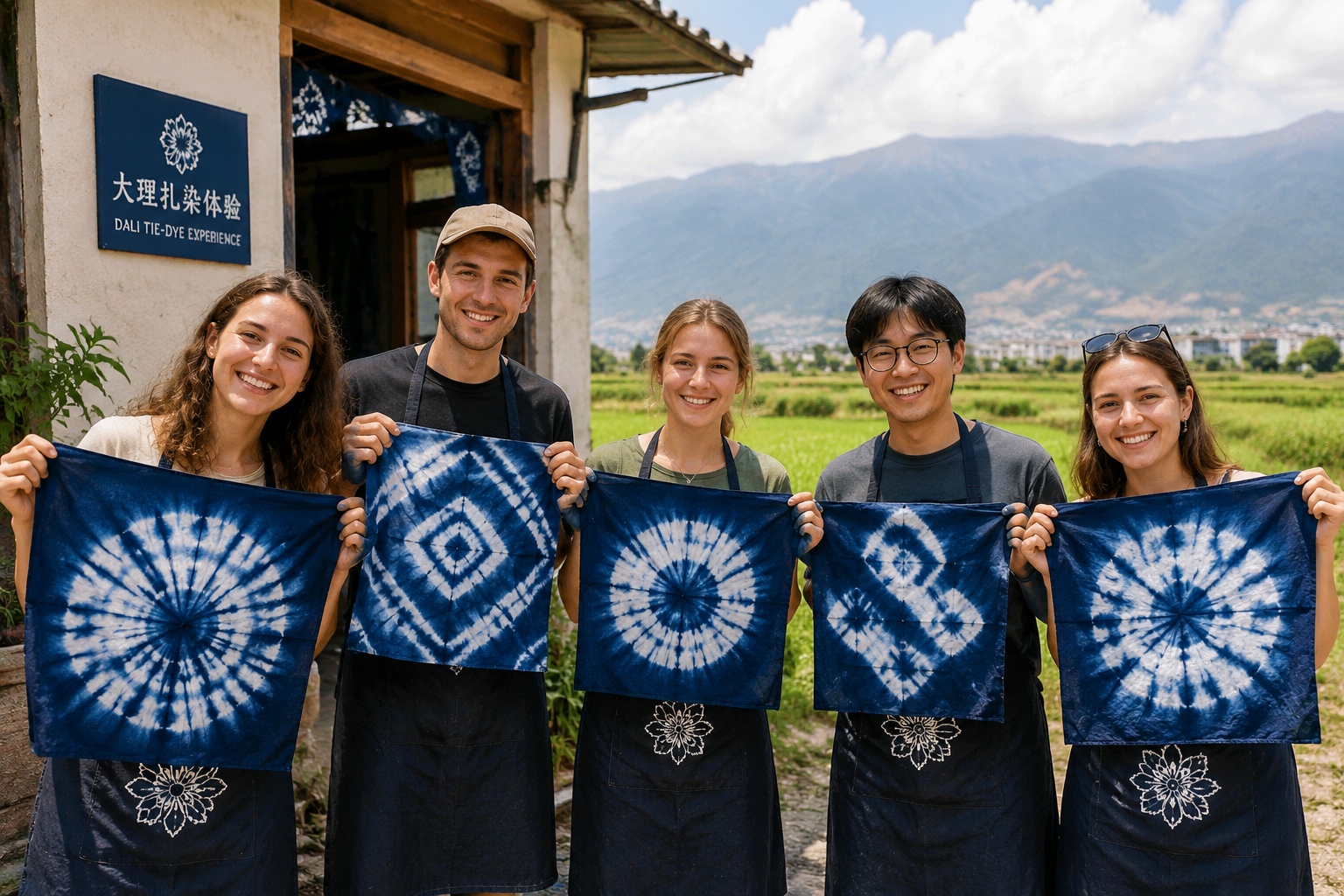
Marta stayed in Dali for six days and took three classes. Before leaving, she bought a hand-stitched tie-dye apron as a gift for her mother. Now back in Milan, she has started experimenting with leftovers of indigo dye in her tiny studio. “It makes me feel like I brought a piece of Dali’s patience home,” she said.
The image is a fitting one. A traditional craft that once belonged to one village in Yunnan is now teaching foreigners how to slow down, look closely and make something by hand. That cannot be exported entirely, but its threads are already crossing borders.
Start the discussion at forum.chinacomes.com