
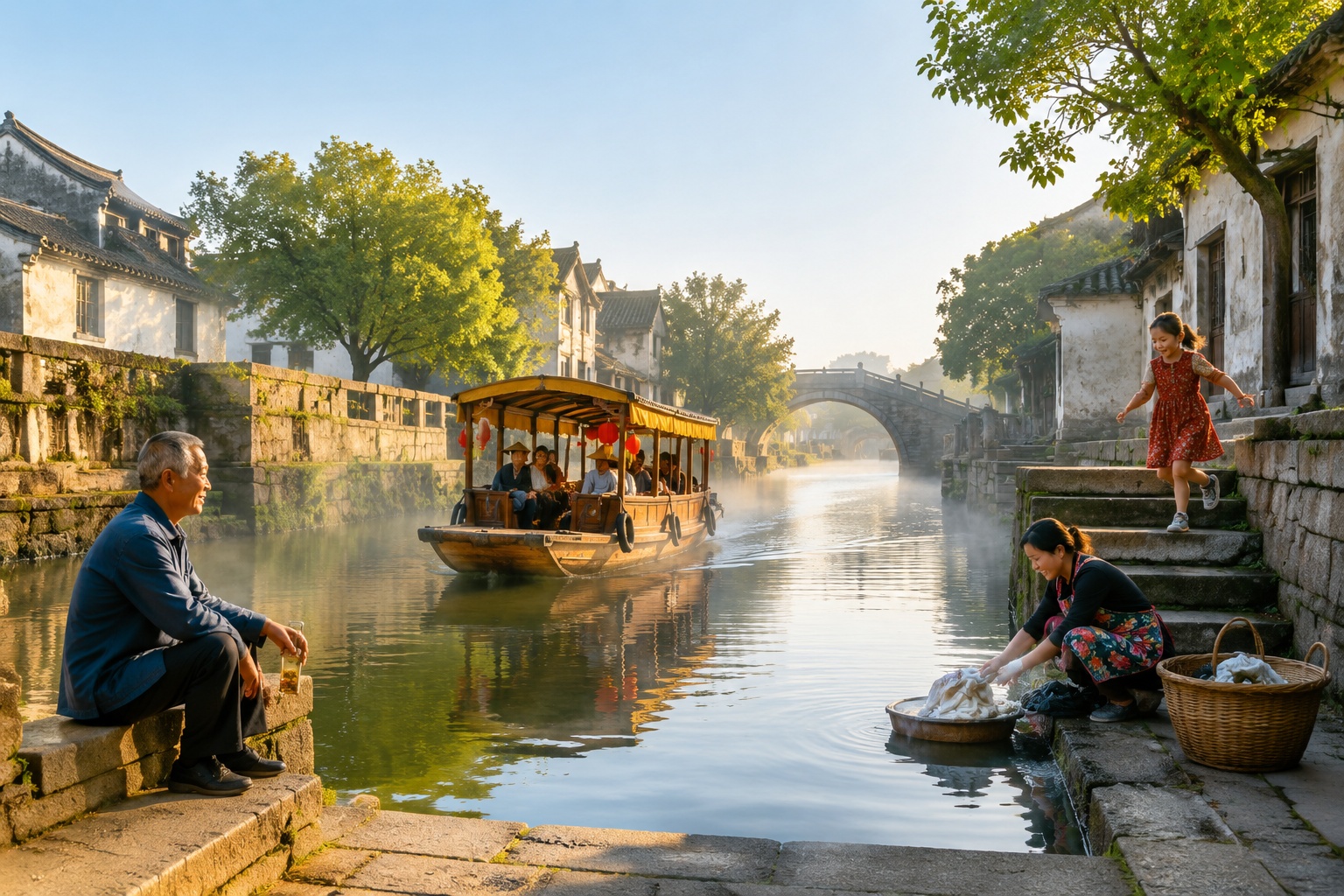

The Canal at Dawn
A few minutes past seven, the air over the little canal town is cool and smells of frying oil and river silt. Old Zhang, 68, settles onto a stone step by the lock, his thermos of jasmine tea steaming in the morning light. A tour boat slides in from the south, horn low and unhurried. On the opposite bank, a mother in a floral apron squats at the water’s edge, scrubbing a plastic basin full of clothes. Her daughter, a schoolgirl in a red jumper, runs up the stone steps and calls out: “The boat is here!” Nobody turns to look at the boat with surprise. The canal is not a museum here. It is simply the neighborhood’s wide, muddy living room.
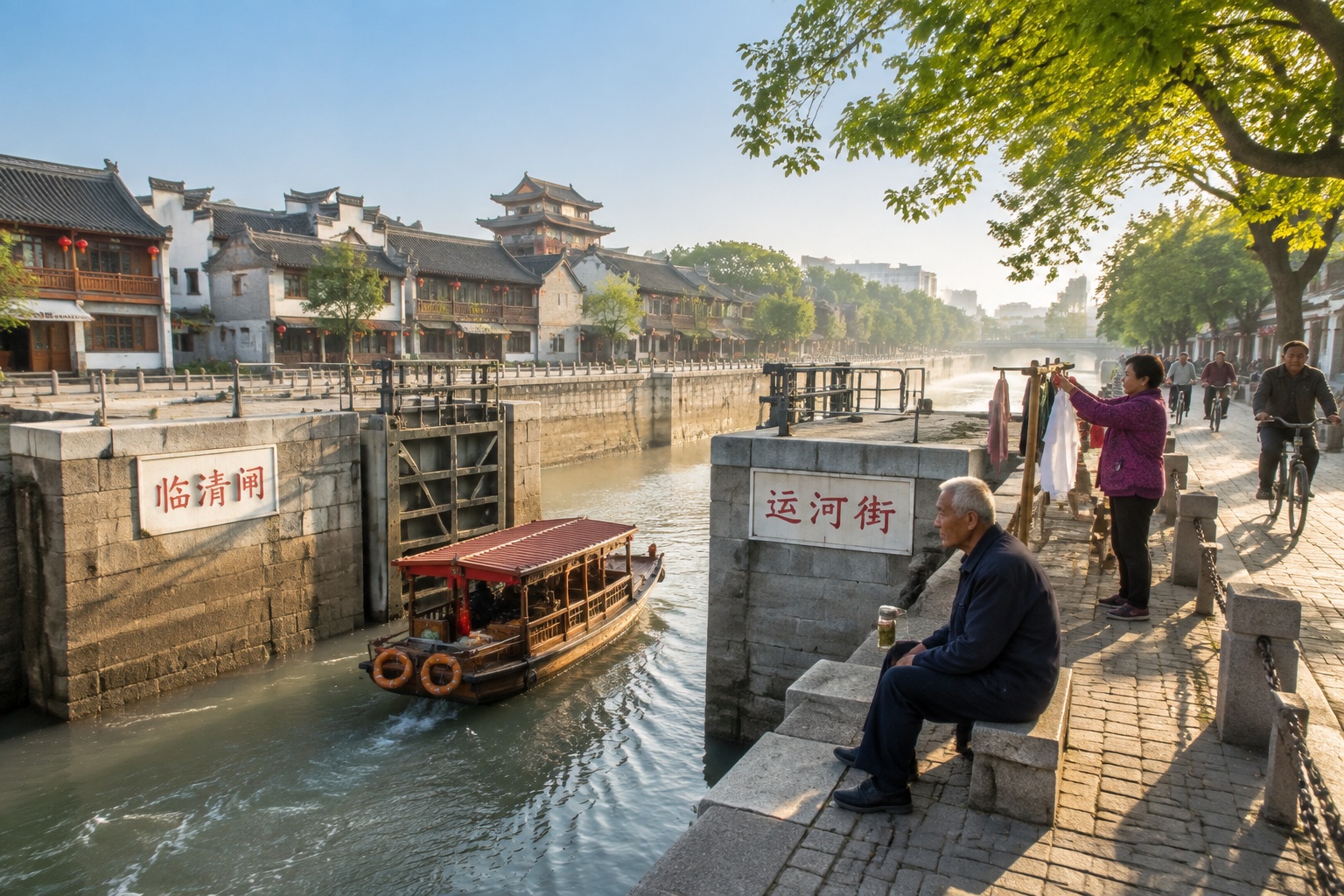
This is Linqing, a small county-level city in the northwest of Shandong Province, China, with a population of about 760,000. It is not on the usual list of must-see stops for overseas travelers. Yet for more than 600 years, it was one of the most important cities in the country, a warehouse and a water gate on the Grand Canal, the longest artificial waterway in the world.
The canal is two thousand years old — the earliest sections were dug in the 5th century BC, and the full system linking the Yellow and Yangtze rivers was completed under the Sui emperor in the 7th century AD. For most of that long life, Linqing sat at its heart. Boats loaded with grain, salt, timber, bricks and tea had to stop here to wait for the lock to exchange the level between two stretches of water. Those waits turned into trade. Trade turned into tall houses, guild halls, and temple roofs. Then, in the late 19th century, railways and the rise of coastal shipping made the slow canal almost painless to abandon. The ships stopped. The warehouses emptied. Linqing became a quiet town with an oversized old quarter.
A Short History of Water Moving Grain
The Grand Canal was an emperor’s solution to moving grain from the fertile south to the political capitals in the north. At its peak during the Ming and Qing dynasties, more than 10,000 boats carried tens of millions of stones of rice and wheat every year. In Shandong, the canal was more than a highway; it was a water lifeline that determined which towns would grow and which would fade.
Linqing profited because it had two things: a deep-draught channel for large boats and a lock system that paused every ship for hours. While ships waited, crews came ashore for food, minor repairs, gambling and a bath. Goods were repacked, taxed and re-sailed. The town built a string of docks along the canal, some of which are still visible today.
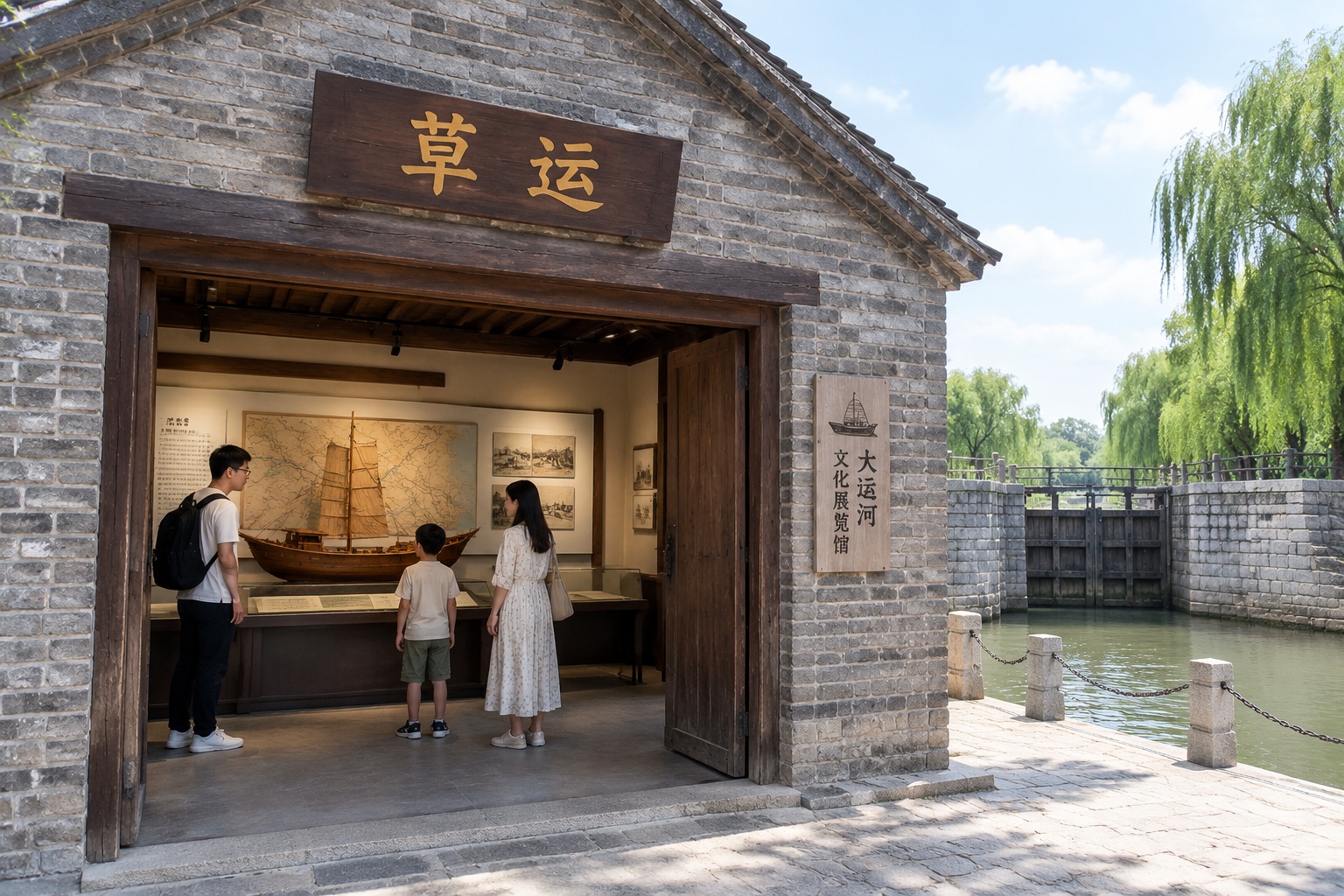
Walk along the restored riverfront, and you pass an old brick warehouse with a plaque reading “Caoyun — grain transport under imperial supervision.” The building is now a gallery showing historical maps and boat models. The original lock, built of granite blocks, is now part of a quiet park. In the early morning, locals practice tai chi on the lower platform, and a few children fish with string and bread balls. The water level changes slightly when rainfall is high, but the mechanism that once lifted and lowered huge wooden boats has been dead for more than a hundred years.
Old Streets, New Lives
The old quarter behind the canal has been slowly restored over the past decade. The strategy was not to turn every building into a shop, but to keep the people already living there and help them adapt. Wang Lan, 54, runs a small snack shop in a Qing-dynasty courtyard. Through the open wooden screen, you can see her making sticky rice cakes in a bamboo steamer, the same shape her grandmother made. Prices are written in chalk on a half-black wall: two yuan for one piece. Kids from the nearby elementary school run in with their satchels jangling. She also sells the northern sesame flatbread, crispy and golden, made from wheat flour mixed with a little lard, then baked against the inside walls of a brick oven. The mix of southern rice snacks and northern wheat bread is itself a heritage of the canal.
Some old craft workshops have returned as part of a heritage scheme. A bamboo weaver, his fingers scarred from decades of handle- and basket-making, teaches anyone who stops by for a short lesson. A woodcarver who makes canal boat miniatures sells them to collectors in Beijing. None of these people are museum staff pretending to work; they live there, and their doors are open.
The riverfront promenade, rebuilt with new stone and LED lights, is used beyond the tourist season. On a cool mid-week afternoon, you will find middle-aged women in shorts doing stretches on the benches, a man playing erhu (a two-stringed fiddle), and teenagers practicing archery on a temporary range set up by a local college club. The canal is woven into their routines, not as scenery but as a stage for the ordinary.
Boating on a Living Waterway
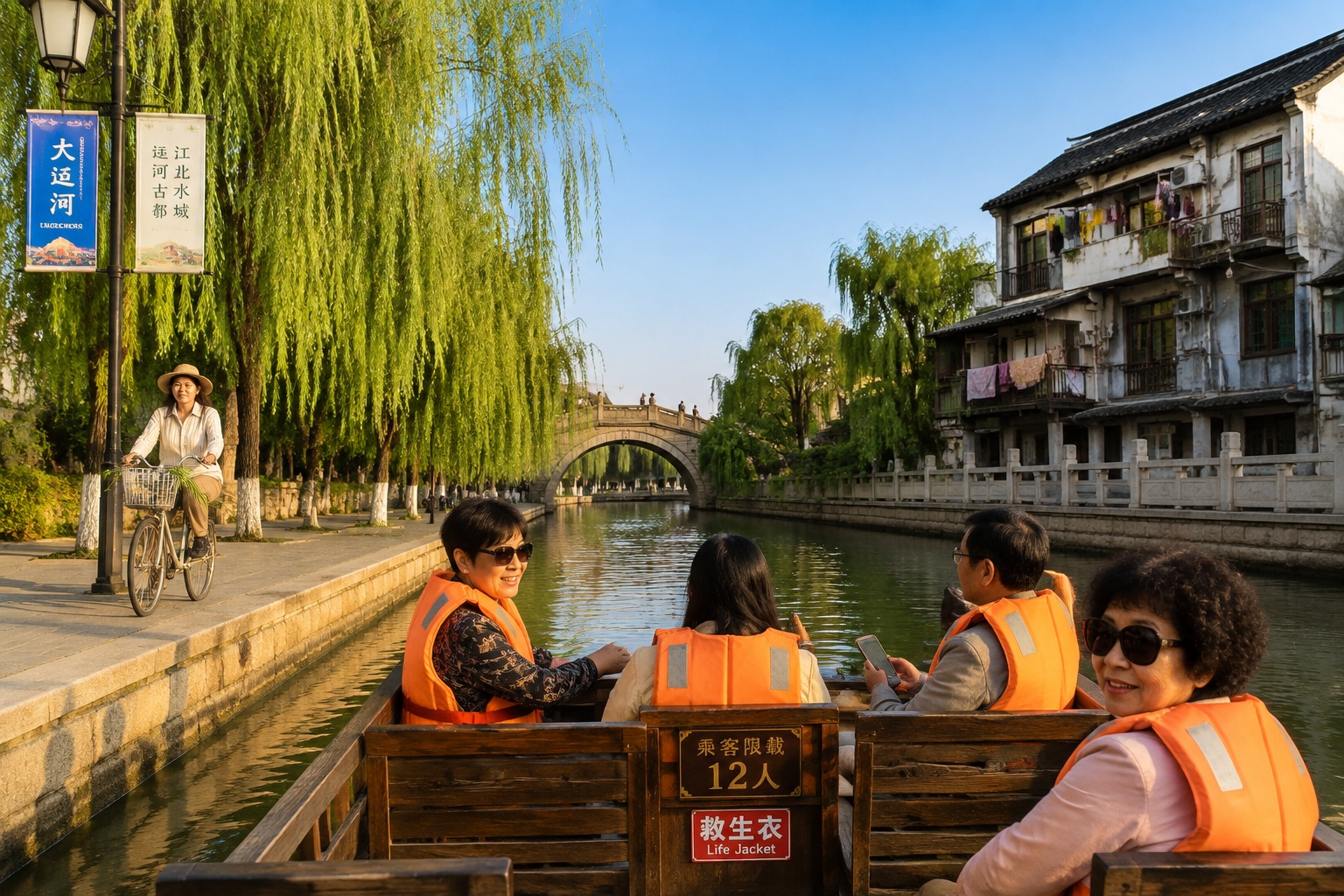
The best way to understand is to sit low in a boat. Several companies offer sightseeing boats along the restored canal, climbing through a preserved lock chamber and gliding under stone bridges. Tickets cost about 60 yuan (about 8 US dollars) for a 40-minute ride. Locals often buy the monthly pass, which is slightly cheaper than a gym subscription, and ride just to clear their heads.
I boarded one on a Saturday morning with a mix of passengers: three retired men with folding stools and fishing rods, a young couple who wanted to compare the canal with the canals in Venice (they had just been there on their honeymoon), and a grandmother with her granddaughter.
The boat hums along at the pace of a brisk walker. On both banks, the months of late spring have painted the willow trees lime green. A woman in a straw hat cycles with a fresh bag of vegetables hanging from the handlebar. A man in sweatpants reads a newspaper on a park bench. The channel narrows past an old residential quarter; laundry hangs across internal courtyards, and a television flashes through an open window. A long metal barge loaded with sand comes from the opposite direction, moving slower than the willows sway. This is not a tourist-only water. It is a working river, but smaller and gentler than before.
New Energy on the Waterfront
In the last two years, the youth cafes have started appearing in restored buildings along the north bank. In one, the owner, 27-year-old Qin Fei, learned to make cold brew and also offers a local twist: jasmine tea soaked overnight with roasted rice and a little osmanthus. During the day, he works as a graphic designer for clients in Jinan, the provincial capital, on a laptop while watching the boats go by.
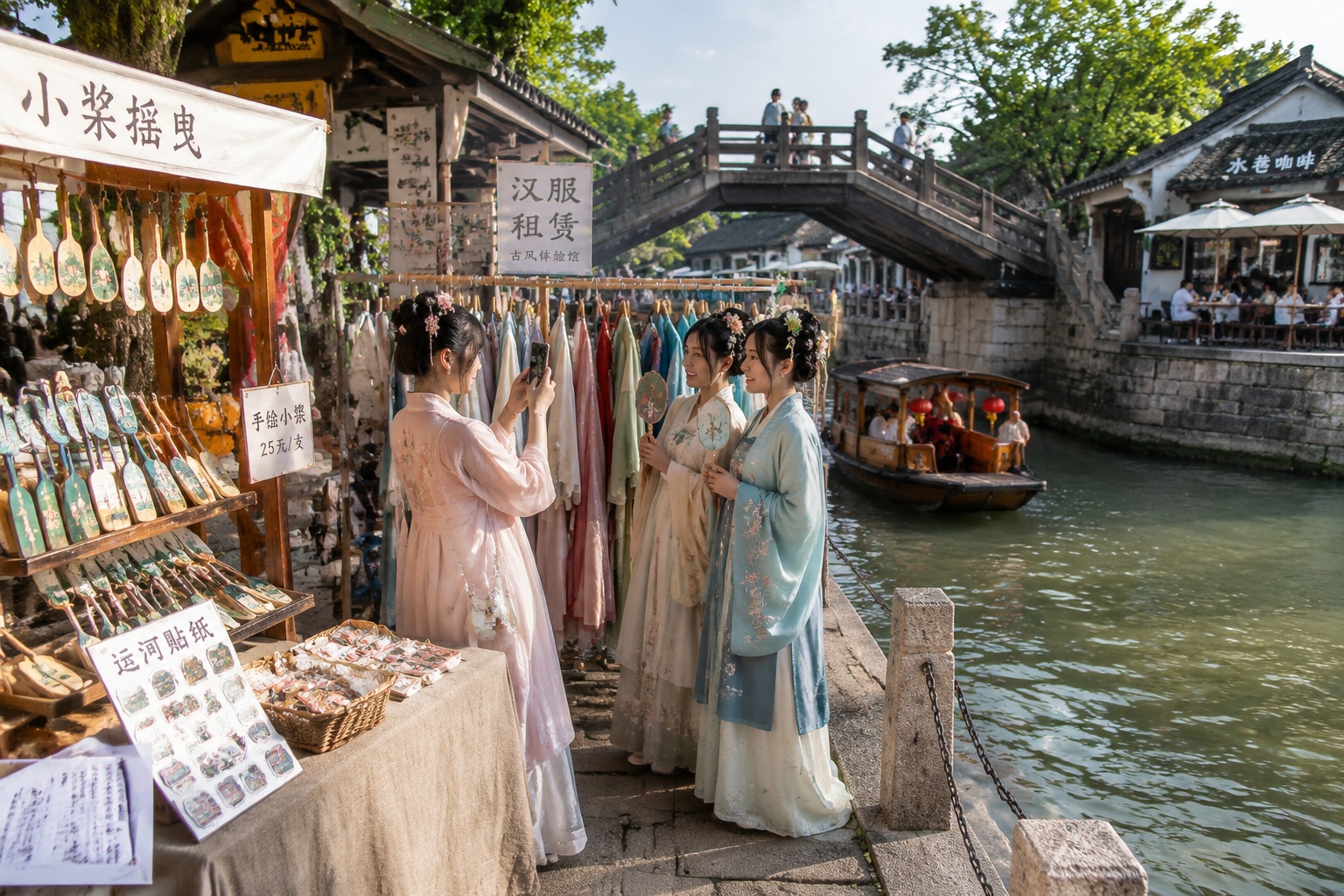
On weekends, the promenade becomes a market. Stalls sell hand-painted mini-oars, canal-themed stickers, Hanfu (traditional Chinese dress) rentals and small instruments for children. A local university student group runs a game station where visitors can try to “barge through” a model lock with water pumped from the creek. Such activities treat the canal’s old technology as entertainment, not just information.
Hanfu photo shoots have become a surprisingly common sight: young women in flowing Tang and Ming-dynasty robes, holding paper fans, while a friend photographs them at the corner of a wooden bridge. This mix of ancient costume and smartphone photography is often what people mean when they talk about “living heritage.” It is not a historical theme park performance; it is young people claiming the city’s history as their own backdrop.
Balancing Protection and Visitors
There are tensions beneath the peaceful surface. The canal is a UNESCO World Heritage Site (the Grand Canal was inscribed in 2014), but that status comes with demanding conservation standards. Local officials, who once pushed for a series of modern riverfront apartments, were asked to scale back the plan, keeping the building heights low and the materials traditional.
Residents also worry about pollution. The canal receives water from the Yellow River system under an ongoing water-transfer arrangement; when the city floods, the water quality can decline. A volunteer group formed by retired teachers and middle school students monitors the water’s clarity and reports to the local environment bureau every month. Their data remains modest, but they have successfully pushed for a wetland park at the town’s northern edge, which filters some agricultural runoff before it reaches the old channel.
Tourism is, for now, moderate. Hotel owners say summer weekends are busy, but weekdays are calm. Local planners are cautious about courting only large numbers; their more ambitious aim is to make the canal trail part of a longer, slower route that connects several small canal cities and offers walking and cycling paths for both tourists and residents.
Conclusion: A River That Keeps Time
The canal in this small Shandong town is not a monument to be visited once and remembered forever. It is a place where grandparents sit on benches, children skip stones, and a veteran canal worker repairs a wooden dock with nails that came by train, not by boat.
Two thousand years ago, the water was carrying weapons, grain and officials. Today it carries tour boats, fishing boats and the occasional sand barge. In a hundred years, perhaps it will carry something else. But as long as there is a woman squatting by the bank to wash clothes, a baker folding rice cakes, and a child asking “which boat is ours?”, the canal will keep its second life: not as a relic, but as a home.
Start the discussion at forum.chinacomes.com