

A Tuesday Morning in Baoding, 12 Yuan
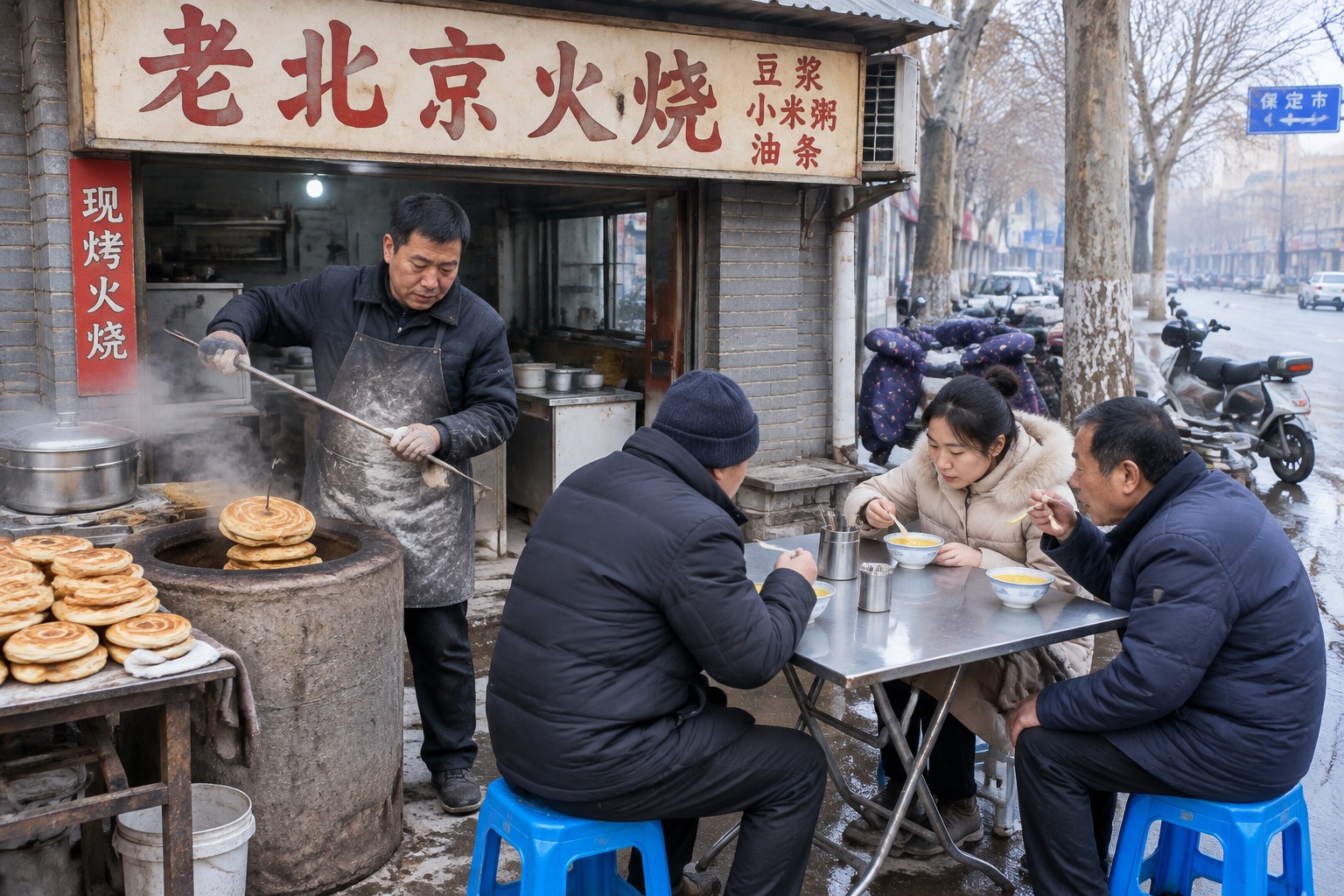
6:40 a.m., a side street off Yuhua Road. A woman in a padded jacket leans her electric scooter onto its kickstand and orders without looking at the menu on the wall: “Two huoshao — one lean, one with a bit of fat. And soup.”
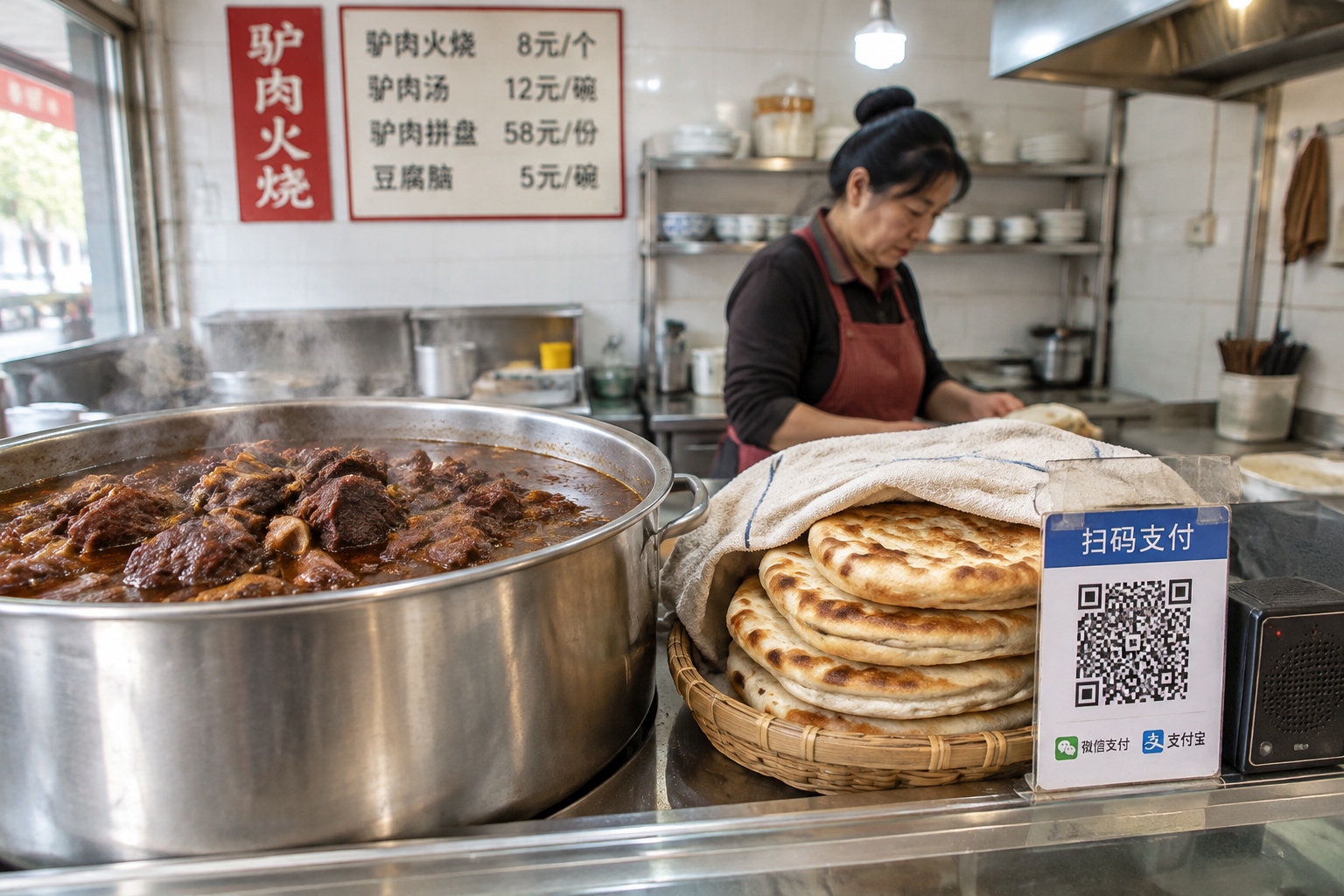
The cook hooks two round flatbreads out of a drum-shaped oven, splits them with a knife, and fills them with thin slices of braised donkey meat from a pot that has been simmering since before dawn. The whole thing takes about forty seconds. Total: 12 yuan, roughly $1.70. The bowl of corn porridge comes free.
This is 驴肉火烧 — lǘròu huǒshāo, donkey meat huoshao. In Baoding, a city of about nine million people in central Hebei province, 140 kilometers southwest of Beijing, it is not a delicacy or a specialty. It’s a Tuesday.
Start With a Burger, Then Take It Apart
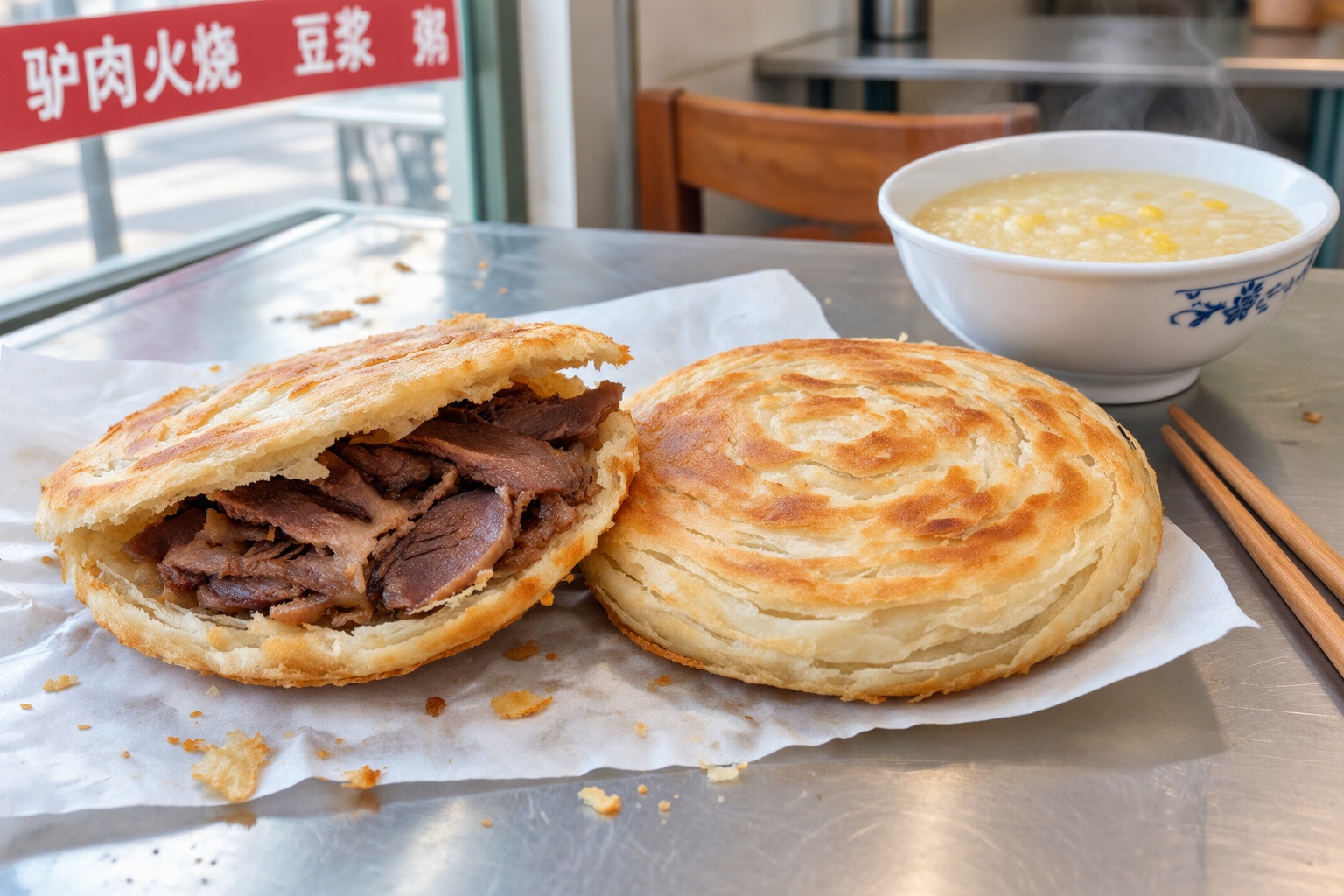
If you’re from the US or Europe, your brain reaches for the nearest word: sandwich. Fine. But the comparison breaks down in useful ways.
A burger’s texture comes from the patty, a hot disk of ground meat. Huoshao’s texture comes from the bread. The dough is rolled, brushed with lard and a dry flour-and-oil paste, folded, rolled again — sometimes a dozen passes — so that it bakes into dozens of thin, separate flakes. It’s seared on a griddle first to set the crust, then finished standing upright inside an oven until the layers puff apart. Bite into a good one and it shatters. A burger bun is soft and forgiving. Huoshao is crisp and demanding.
The meat is braised, not grilled. Donkey is lean, dark red, faintly sweet — closer to beef shank than anything else on a Western menu — and it goes in cold or warm depending on which city you’re standing in.
Which city matters more than you’d think.
Two Styles, One Name
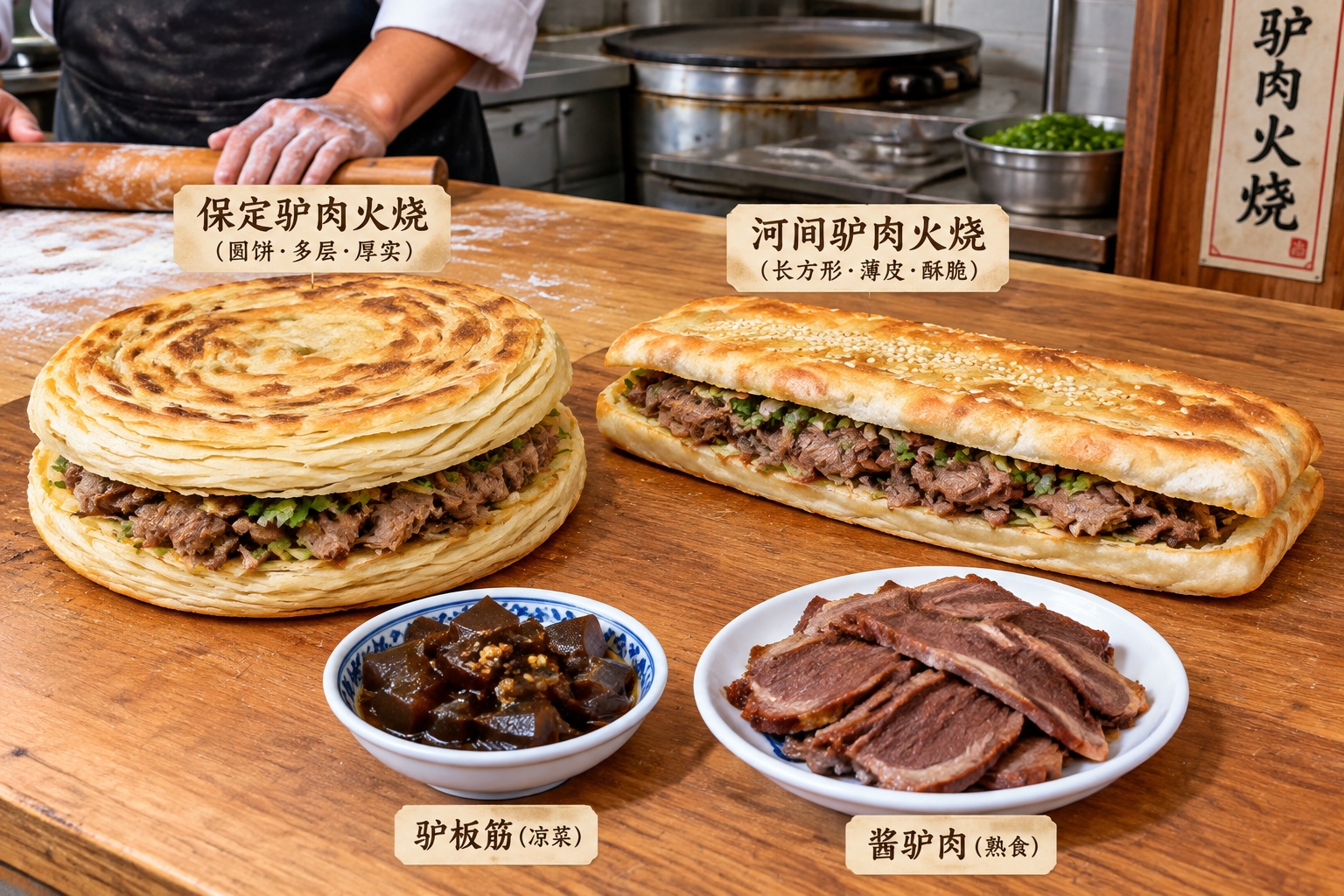
Baoding huoshao are round, and the meat goes in warm. Hejian huoshao — from Hejian, a county about 100 kilometers east — are rectangular, longer, and usually filled with cool sliced meat plus 焖子 (mènzi), a firm gelatinous block made from meat broth and starch. People from Hejian will tell you their version is the original. People from Baoding respond by taking another bite.
Prices run roughly 8 to 15 yuan depending on the shop and how much meat you ask for. A double-meat version, or one with 驴板肠 (donkey intestine), can push past 20.
The Real Reason It Stays in Hebei
The question “why hasn’t this gone national?” has a dull answer that turns out to be interesting: donkeys.
In the mid-1990s, China had more than 11 million donkeys. They pulled carts, turned millstones, carried loads up hills. Then tractors and three-wheeled trucks arrived and the animals became economically pointless on farms. Around the same time, demand for 阿胶 (ējiāo), a traditional gelatin made from donkey hide and produced mainly in Shandong, took off as household incomes rose. Hide prices climbed several-fold within a decade.
A donkey is not a chicken. A mare carries a foal for about twelve months and produces one at a time. You cannot scale donkey supply the way you scale pigs or broilers. By the early 2020s, China’s donkey herd was down to roughly two million animals — a fall of more than 80 percent in under thirty years. A growing share of the donkey meat sold in China today is imported frozen, from Africa, South America and Central Asia.
That scarcity shows up on the price tag. A jin — 500 grams — of cooked donkey meat costs a shop owner 40 to 60 yuan, several times what pork or chicken would cost for the same weight. A huoshao shop runs on volume, thin margins and family labor, and it can’t switch to a cheaper cut, because there isn’t one.
Compare that with the Chinese foods that did conquer the country — Lanzhou beef noodles, Fujian’s Shaxian snacks, braised chicken with rice. All of them are built on cheap, industrially scalable proteins: beef bones, chicken, pork. Huoshao is built on an animal China is running out of.
It Also Refuses to Travel Well
There’s a second reason, and it’s about the bread.
A proper huoshao has a shelf life measured in minutes. The lard layers that make it flake also make it soften; ten minutes in a plastic bag and you’re holding a chewy, greasy disc. Every chain that has tried to expand has hit the same wall: the food peaks about ninety seconds after it leaves the oven, and no amount of packaging engineering gets it to a shopping mall food court in Shanghai intact.
So huoshao spreads the way regional food in China actually spreads — through people. You find shops in Beijing, Tianjin, Shijiazhuang and the Hebei towns people moved to for work. Estimates of the national total run into the tens of thousands, but almost all of them sit in the north, and almost all are single-owner shops rather than franchises.
What a Breakfast Like This Says About China
For a visitor from Europe or North America, three things tend to land at once.
The price
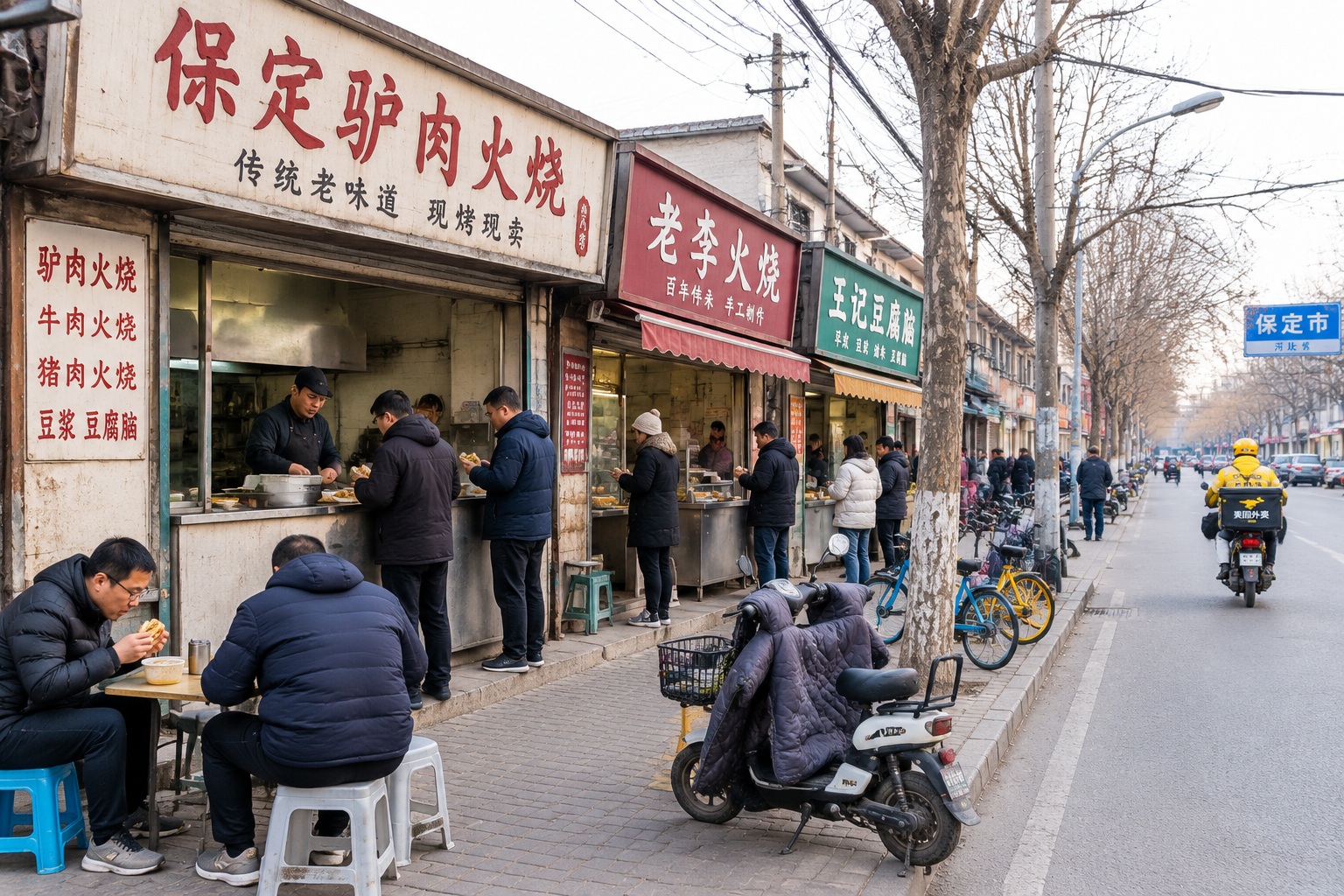
Twelve yuan for a hot, made-to-order breakfast, with as much porridge as you want, is roughly what a coffee costs in a Western city. Even allowing for lower Chinese wages, the ratio is striking: food made by hand, from scratch, in front of you, sold at a price that only works with enormous daily volume. A busy shop moves 500 to 1,000 huoshao before 10 a.m.
The rhythm
Breakfast is eaten out. Not grabbed from a supermarket shelf, not assembled at home. Between six and nine in the morning, the streets of Baoding are full of people standing at counters or sitting on low plastic stools, eating something hot before work. That’s true across most of China, and it may be the single biggest difference in daily food life between China and, say, Germany or the United States.
The payment
You order, then scan a QR code taped to the counter. Nobody hands over cash. The owner’s phone chirps. This isn’t a big-city tech thing — it’s a provincial breakfast stall in a city most foreigners have never heard of.
And one more, less visible: nobody is there to serve you. You fetch your own porridge, your own chopsticks, and you bus your own bowl. The transaction is faster and more functional than in a Western café, and also less lonely — you’re shoulder to shoulder with twenty people doing exactly the same thing.
How to Order One
Ask for 驴肉火烧 (lǘròu huǒshāo). In Baoding you’ll be handed the round one. Say 瘦一点 (shòu yīdiǎn) if you want leaner meat, or 肥瘦 (féishòu) for a mix. Add 驴肉汤 (donkey meat soup) or 鸡蛋汤 (egg soup) for a few yuan, or take the free corn porridge. The adventurous should ask for 焖子 or 驴板肠.
Eat it in the shop. Standing up if that’s the only space left.
Local Food That Stays Local
There’s a habit among outsiders — and honestly among Chinese food writers too — of treating regional food as a product waiting to be scaled. If it hasn’t gone global, something must be wrong with it: bad marketing, no capital, weak branding.
Huoshao suggests the opposite reading. It stayed in Hebei because it’s tied to a specific animal supply, a specific way of baking bread, and a specific morning. It doesn’t travel because it is, genuinely, better where it comes from. That isn’t a failure of ambition. That’s what a food culture looks like before it gets flattened.
Twelve yuan. Two bites. Sit down before it goes cold.
Start the discussion at forum.chinacomes.com