

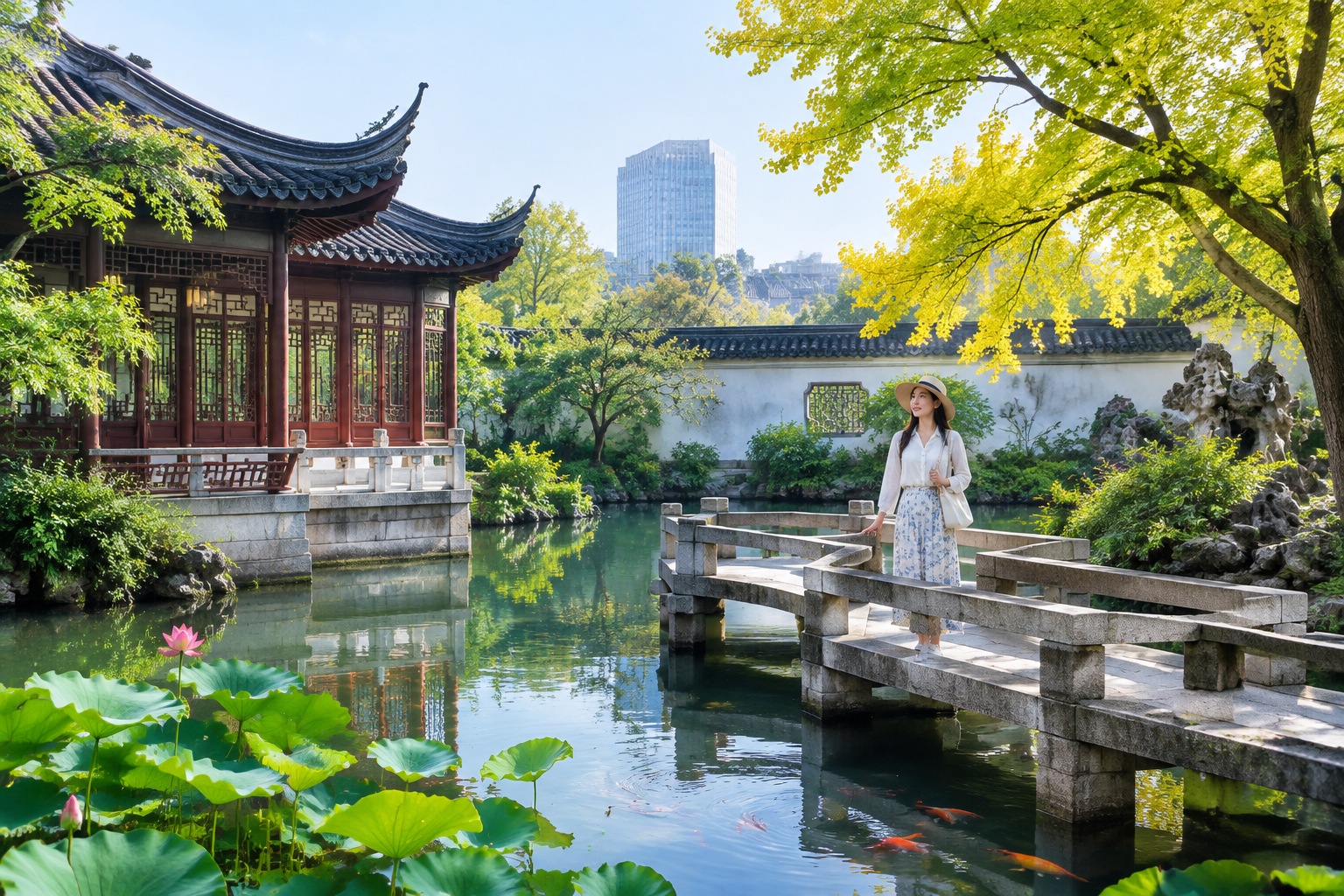
The view from the Mandarin Duck Hall in Suzhou’s Humble Administrator’s Garden was designed for a different era: lotus leaves in the foreground, a painted bridge beyond, a vertical rockery set against a white wall. On a clear morning, though, a glass office tower rises over the plane trees, reflecting a cloud and reminding you that this city no longer lives inside its postcards.
That double exposure is the reason to visit Suzhou. For more than 2,500 years, this city on the lower Yangtze River was the place where Chinese scholars built dream houses out of water, stone and borrowed views. In the last three decades, it also became one of China’s most productive manufacturing centers. The transition did not happen overnight; it shaped the Yangtze River Delta we see today. This short guide is written for business travelers who have half a day, a full day, or maybe one weekend to understand a city that is both a world heritage site and a factory town.
Why Suzhou matters beyond the garden wall
Located 100 km inland from Shanghai, Suzhou functions like a dense engine room for the delta. Its GDP crossed 2 trillion yuan in 2020, surpassing many mid-size national economies, but the city does not feel like a capital. Instead, it looks like a long chain of industrial towns connected by clean metro lines, elevated highways, and high-speed rail.
The factories you pass between old-town gates and hotels make far more than garden furniture. Around Suzhou, companies produce semiconductors, integrated circuits, biomedical drugs, medical devices, electric motors and precision components. A solid share of the world’s laptops, network equipment, and consumer electronics passes through or near this city. For a foreign visitor, the most reliable way to open a factory door is to attend a trade fair or join an official delegation. We will come back to practical routes in the final section.
Morning: Read space in the classical gardens
Start in the walled old town. Buy a ticket for the Humble Administrator’s Garden, but do not walk through it in twenty minutes. Chinese literati designed these gardens as poems in three dimensions; every corridor, window, tree branch and stone is placed to shift as you move. The most understandable technique is called borrowed scenery: you take a view that lies outside the garden, from nearby fields or even distant mountains, and turn it into a painting when you look through a moon gate. The Humble Administrator’s Garden is the archetype of that style; the Lingering Garden, a fifteen-minute walk away, is smaller but no less skillful, with carved walls and a famous grey limestone called Cloud-Capped Peak.
The practical part: arrive before 9 a.m. on weekdays if you can. Both gardens have ticket offices that accept passports, and audio guide machines with Chinese, English, Japanese and Korean versions. A full visit takes between one and two hours. Take water and move slowly, because the best moments come when sunlight hits a blank white wall and turns shadow into a brush painting.
Late morning: Slow down on a canal in Tongli
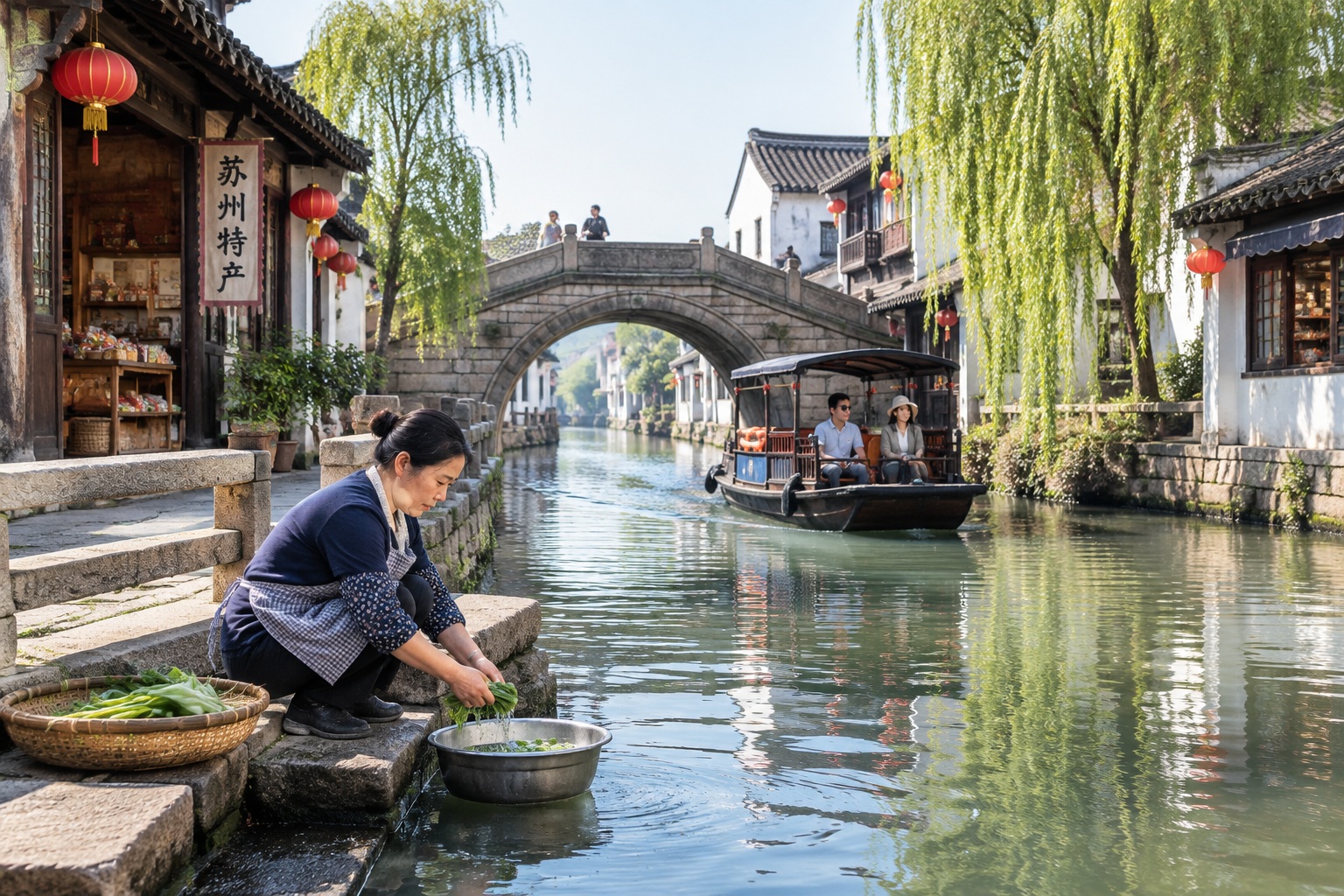
Tongli is about forty minutes from the old town by taxi and almost in line with the Suzhou Industrial Park. Together with Zhouzhuang, another twenty minutes further south, it represents a time when canals were the region’s highways. Tongli is quieter; old houses face the water, and locals still wash vegetables at stone steps, although tourism has arrived around the edges. If you only have time for one water town, choose Tongli: it is close to the industrial park and gives you the same experience of arched bridges, boat songs and rice snacks.
A useful hint: most canal bridges are narrow and there is not much shade. Go before the midday sun or after 4 p.m. On weekend afternoons the walkways can be crowded, so an early visit rewards you with more authentic rhythm.
Afternoon: Suzhou Industrial Park and the modern garden city
Begin the modern chapter at Jinji Lake. Suzhou Industrial Park (SIP), founded in 1994, was the first large-scale Chinese collaboration with Singapore on urban planning. It was not only an industrial zone; it was a test bed for Singaporean-style planning: roads first, utilities buried underground, lakes kept as public space, industrial zones separated but not distant from residential areas. The result feels less crowded than Shanghai and surprisingly green.
You can take Metro Line 1 or Line 5 from the old town to the lake area. Walk along the shore and you will see why people call Suzhou a garden city in a second sense: one side has office towers, the other side has walking paths and public art. At the western end of Jinji Lake, the Suzhou Centre is a good place for lunch, with options from Japanese ramen to local noodle shops. The Suzhou Industrial Park Exhibition Hall tells the story of Singapore and Suzhou’s cooperation; hotel concierges and business partners can help arrange a visit.
Clean rooms and lab coats: Biotech and advanced manufacturing
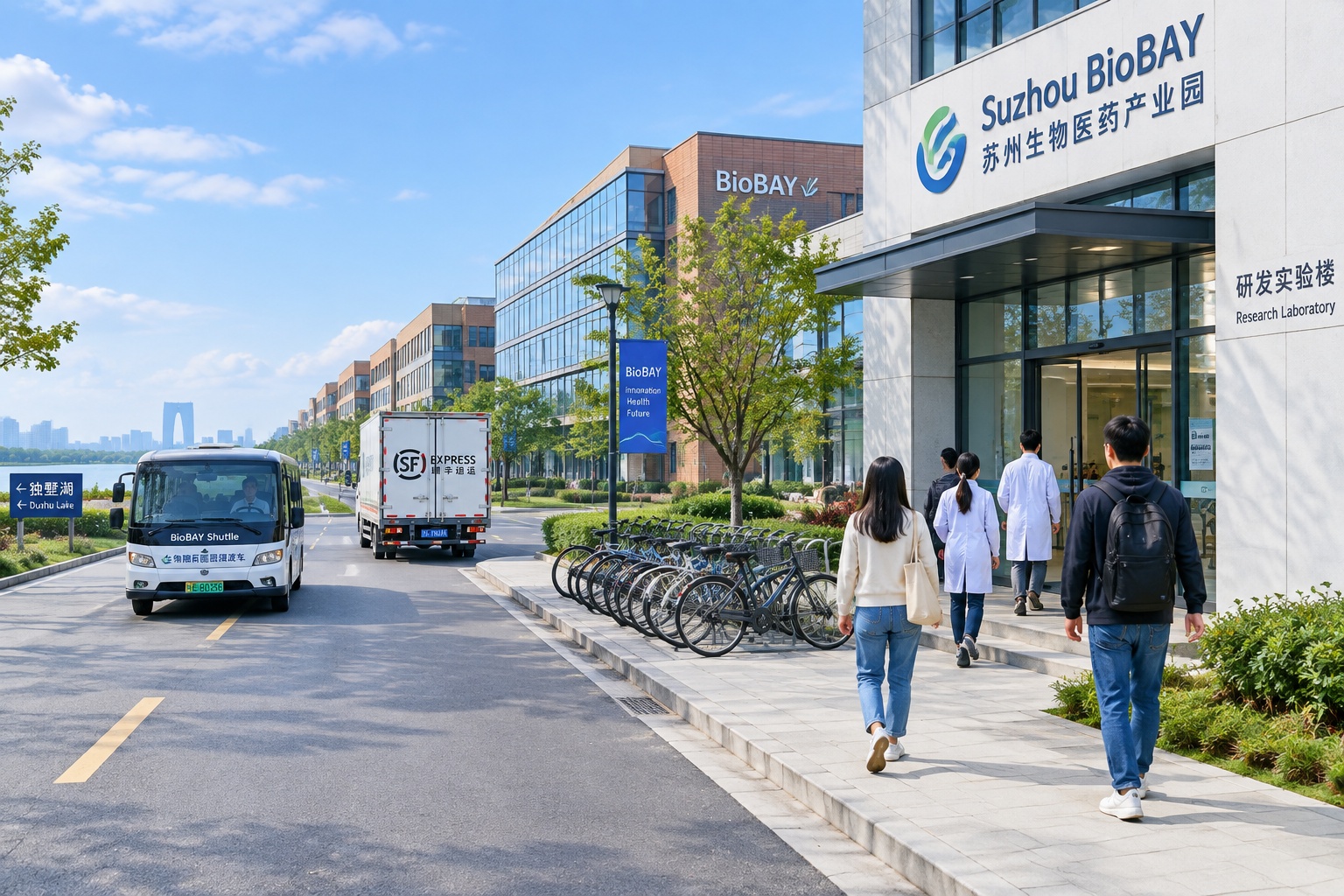
A few stops south of Jinji Lake, near Dushu Lake, you will find Suzhou BioBAY, short for Suzhou Biomedical Industry Park. Walking around its campus is less like visiting a factory than a modern university: white-walled laboratory buildings, coffee shops, bicycle racks and lake breeze. Inside, scientists develop antibody drugs, gene treatments and medical devices. BioBAY grew out of the region’s shift from low-cost assembly to knowledge-intensive industry. Today, hundreds of companies operate there, and many products have reached clinical trials in China and other countries.
Not far away, Suzhou Nano City and the surrounding science district bring together researchers in semiconductors, nanomaterials and artificial intelligence. For an outsider, the physical sensation matters: every building has security gates, delivery drivers and trucks. The supply chain is deep behind those anonymous walls. That is where Made in Suzhou stops being a sticker and becomes a regional system connecting lab bench, pilot line, and factory.
If your schedule allows, ask a Chinese business partner to arrange a visit in advance. Factories and research parks are not shopping malls; you cannot walk in with a passport and a curious mind. Industry expos and partner delegations are the standard path. If you are not part of a formal delegation, BioBAY’s outer streets are open, and combining a short walk around the campus with a coffee by Dushu Lake still gives you a sense of the ecosystem.
Between Shanghai and Suzhou: 25 minutes that shrink a region
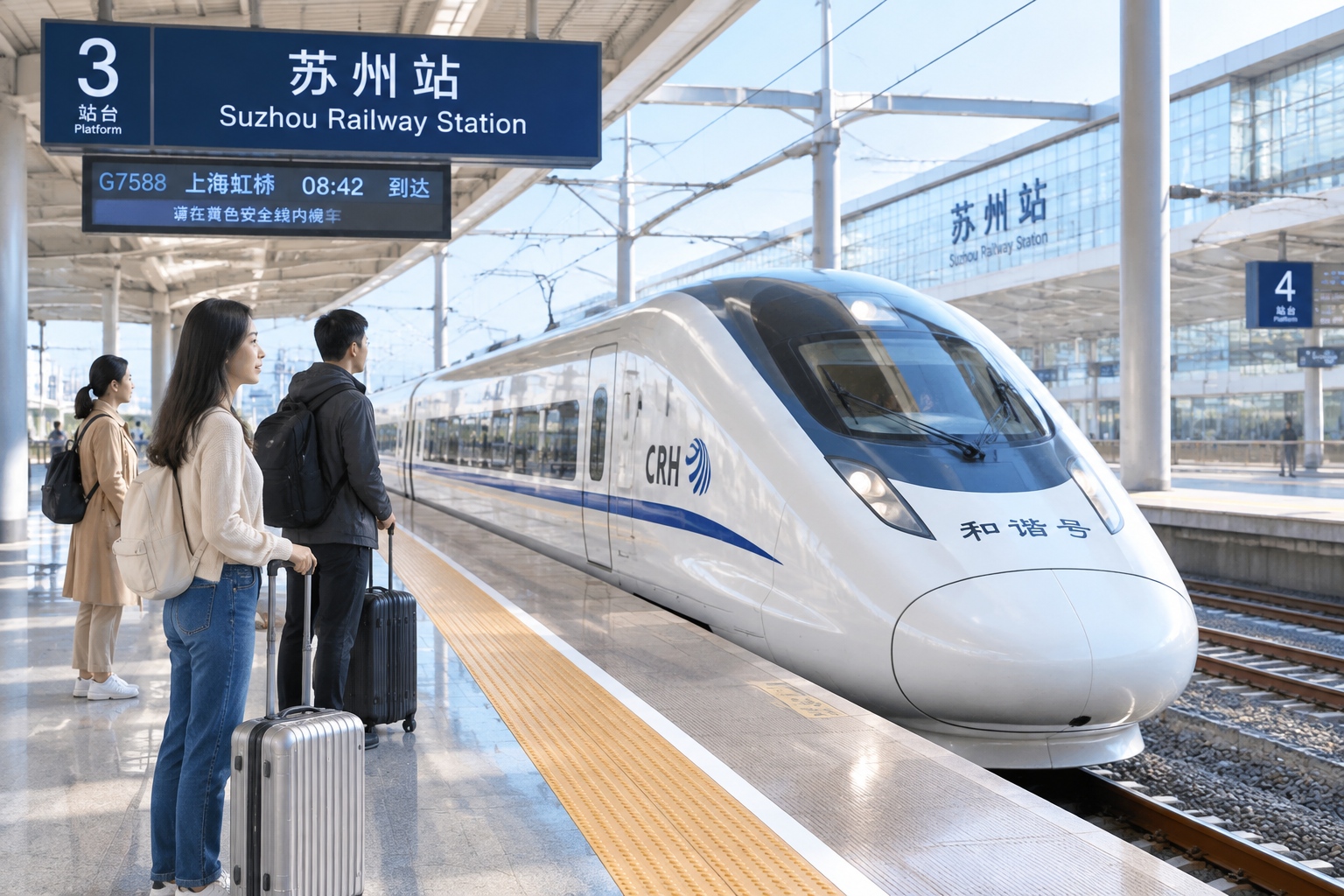
Late afternoon is when the delta feels least like a country and most like one continuous metropolitan area. Suzhou Railway Station, Suzhou North Station, and Suzhou Industrial Park Railway Station all link to Shanghai’s main stations. On the Shanghai–Suzhou section, high-speed trains leave every ten to fifteen minutes during peak hours, and a non-stop G train takes about 25 minutes from Shanghai Hongqiao to Suzhou Railway Station. The second-class fare is around 40 yuan, less than 6 US dollars. Many executives treat the two cities as one office: sleep in Shanghai, spend the day in Suzhou, and return for dinner. This is not convenience marketing; it is a direct result of the Yangtze River Delta integration strategy that has built high-speed corridors across the region.
Practical railway tips: buy tickets through the official Railway 12306 app or major travel platforms, but both require a real-name account and sometimes a seat reservation. If that feels complicated, ask your hotel concierge to buy paper tickets with your passport. On weekends, book your return ticket as early as possible, because the Shanghai–Suzhou corridor is full of day-trippers.
Putting it together: a one-day Suzhou itinerary
If you are based in Shanghai, a simple plan looks like this:
8:00 – Take a morning high-speed train from Shanghai Hongqiao Railway Station to Suzhou Railway Station.
8:30–10:30 – Walk through the Humble Administrator’s Garden or the Lingering Garden in the old town.
10:30–11:30 – Take a taxi or metro through the old town toward Jinji Lake. Watch the city change density as you move east.
12:00–13:00 – Lunch around Jinji Lake or Suzhou Centre.
13:30–15:30 – Company visit, or a self-guided walk near BioBAY and Dushu Lake.
16:00–17:00 – Head to Suzhou Railway Station or Suzhou Industrial Park Railway Station.
17:30 onward – Take a fast train back to Shanghai for evening meetings or dinner.
If you prefer to stay overnight, international hotel chains cluster around Jinji Lake, and the morning light on the lake is worth the extra night. The old town also has boutique courtyard hotels, but commuting to the industrial park from there takes about thirty minutes by taxi; that is still faster than many cross-city commutes in London or New York.
Conclusion: Suzhou as the delta’s clearest mirror
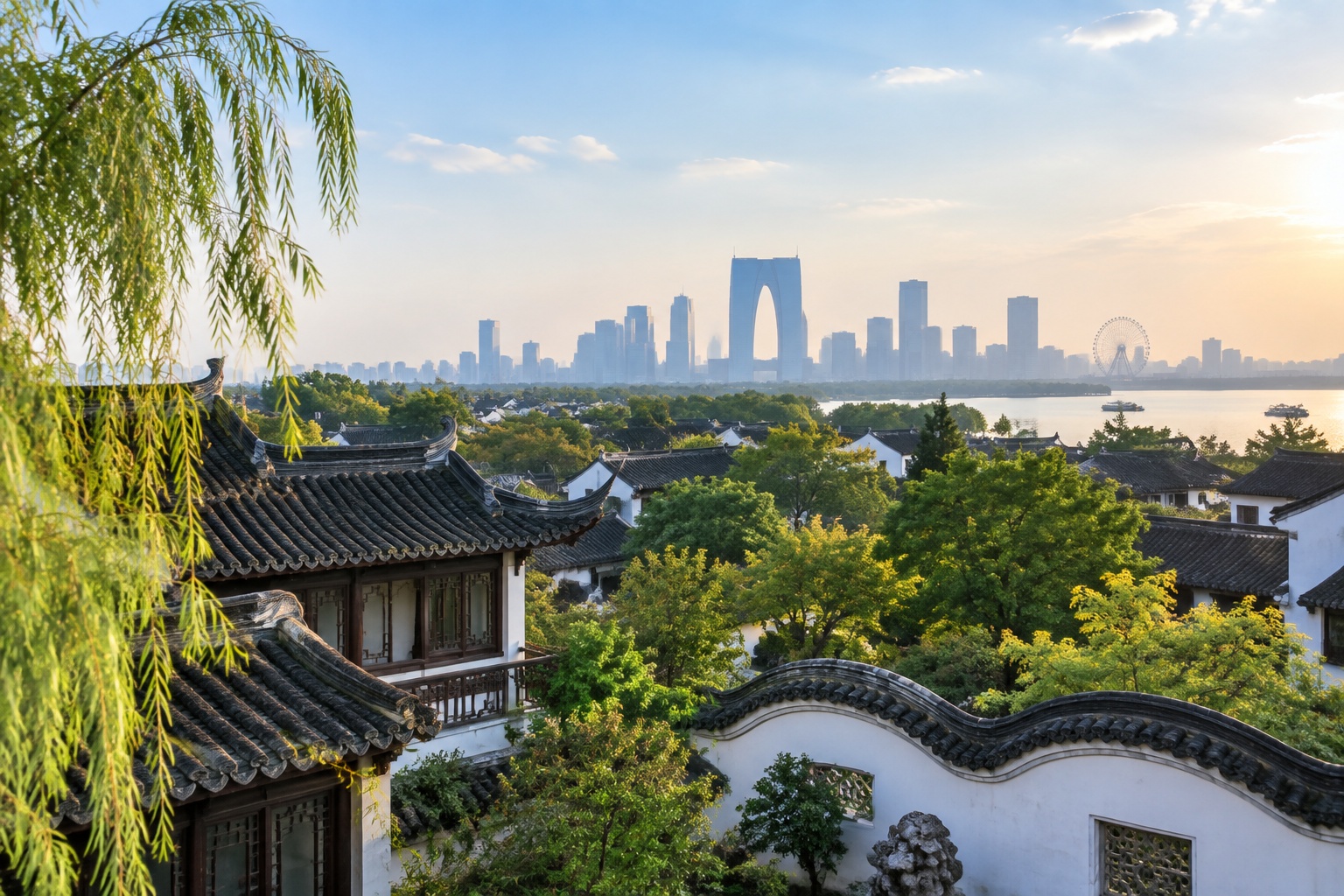
In Suzhou, classical gardens and clean-room factories are not rivals. The same culture that appreciated a stone placed near water has spent decades engineering a building-sized logistics system. When you look through a moon gate and see a glass tower across the street, that image is not a contradiction; it is a summary of what the Yangtze River Delta is becoming. The region no longer moves at the pace of canal boats or even the first generation of fast trains. It moves at the pace of thirty-minute links between finance, research and production. Suzhou is the clearest place to observe that pulse.
Start the discussion at forum.chinacomes.com