
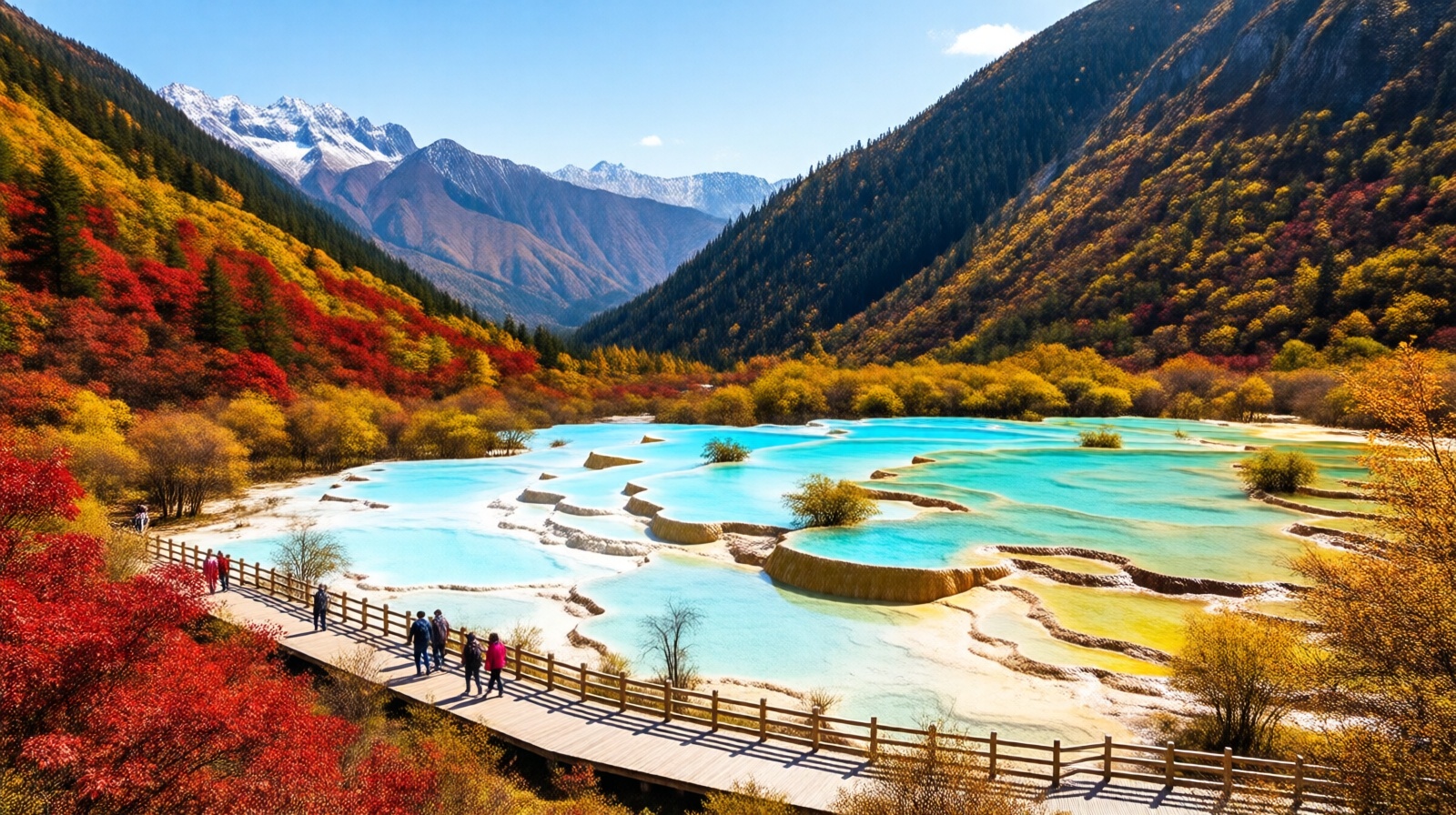

On a crisp October morning, the viewing platform at Five Flower Sea is already packed. A woman from Shanghai leans toward her friend and asks, "Did they dye the water?" A man with a drone sets it hovering just over the lake, then looks at the screen and sighs. "The camera still doesn’t catch that exact blue." It’s a question almost every visitor asks at least once: why is the water so impossibly blue?
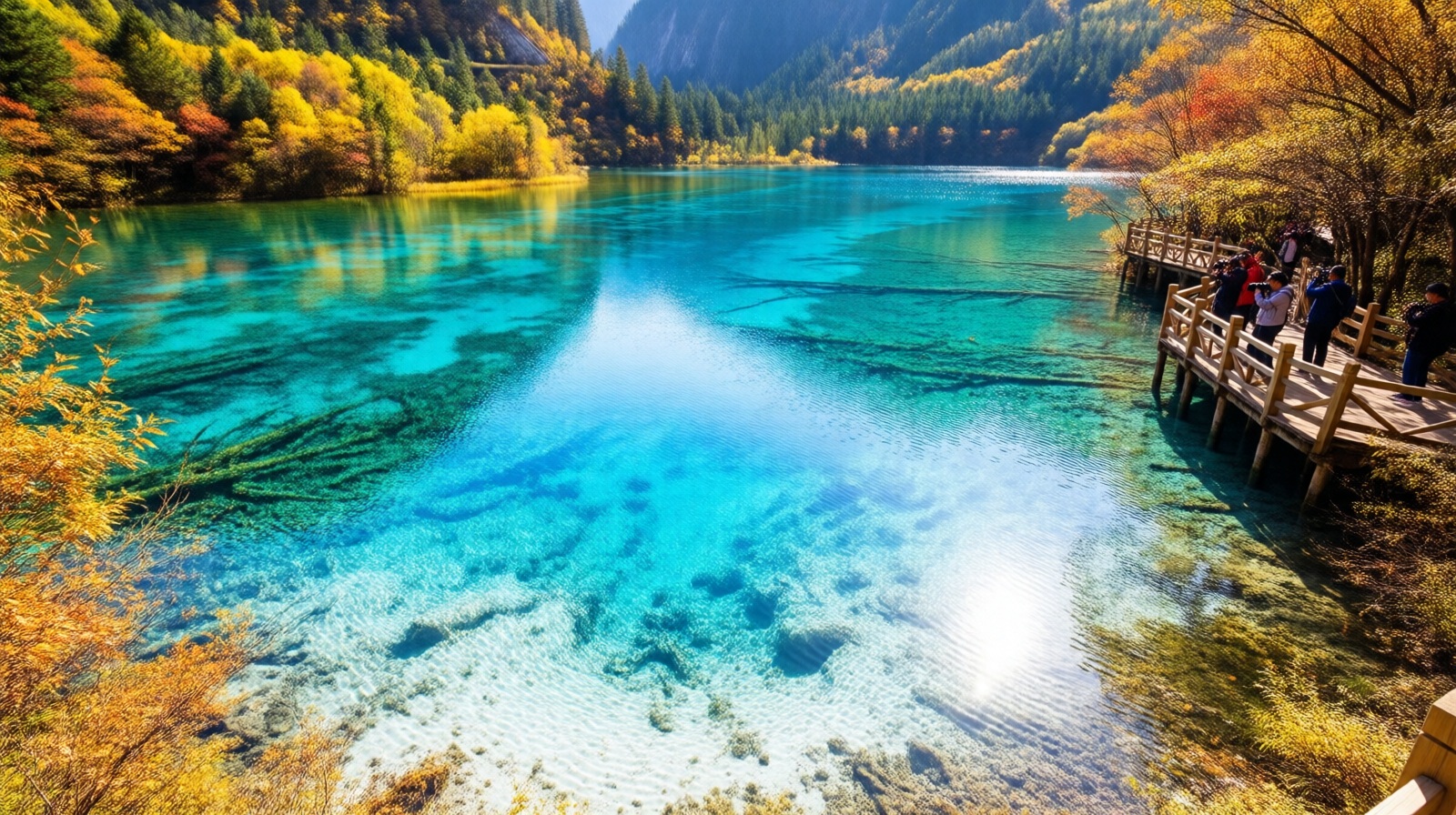
Jiuzhaigou (九寨沟) is a nature reserve in southwest China’s Sichuan Province. Its name means "Nine Villages Valley," after the Tibetan settlements that have been here for centuries. The park is a UNESCO World Heritage Site, famous for over a hundred colourful lakes, waterfalls, and dramatic forests. But the thing that people remember best is the water: clear, reflective, and every shade of teal and blue you can imagine.
What is Jiuzhaigou, anyway?
Geologically, Jiuzhaigou sits in a high-altitude valley that was shaped by glaciers and earthquakes millions of years ago. Elevations range from about 2,000 meters at the valley entrance to almost 4,600 meters at the highest peaks. The lakes you see today are not ancient seas — most of them are relatively young, formed by landslides and mineral dams that slowed the flow of glacial streams.
But the story of the blue color begins with the rocks themselves. Jiuzhaigou is a karst landscape, meaning that its mountains are made largely of soluble limestone. Rainwater and melting snow pick up carbon dioxide as they fall through the atmosphere and soak into the soil. That mild acidity allows them to slowly dissolve calcium carbonate from the limestone.
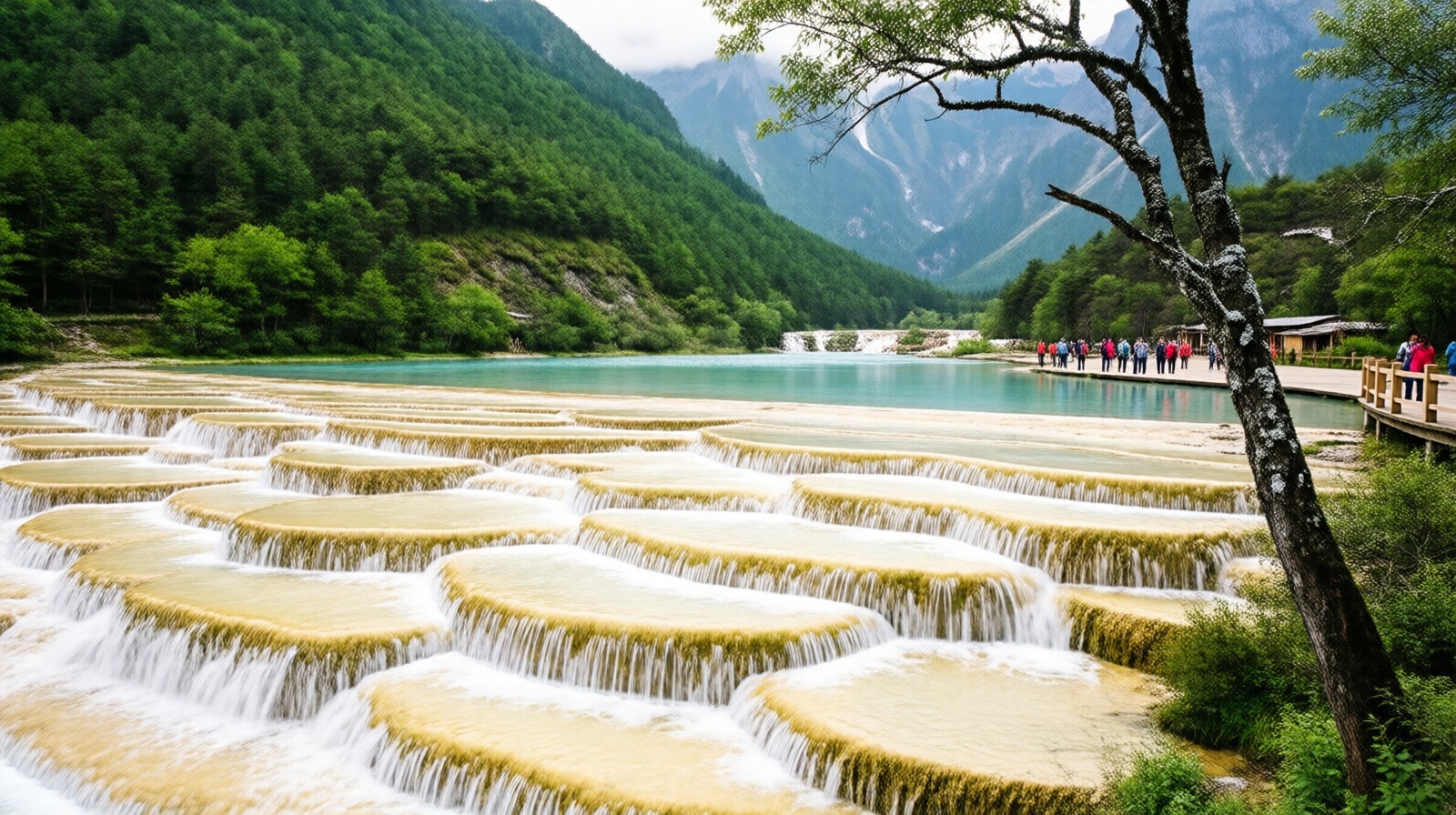
This dissolved mineral is then carried down into the valley by creeks and underwater springs. When it reaches a lake or a waterfall, a chemical reaction causes the calcium carbonate to settle out of solution, forming a fine white-to-pale-yellow sediment known as travertine or calcareous sinter.
The pale, chalky bottom layer
This may sound technical, but you can actually see the travertine with your own eyes. In many places, a hard white crust coats the banks and the branches that have fallen into the water. Over time, these mineral deposits build up into natural terraces and dams. At the famous Nuorilang and Pearl Shoal waterfalls, whole cliffs seem to be made of pale honey-colored rock.
The effect on water color is tremendous. First, the travertine at the bottom of the lake makes the water look bright, because it reflects sunlight like an underwater mirror. Second, because the mineral settles into a solid layer rather than floating around, it keeps the water clear. Many lakes in Jiuzhaigou have visibility of 10 meters or more, which is rare in most freshwater lakes.
The physics of blue water
Now for the light show. Water molecules absorb light at wavelengths that we see as red, orange, and yellow much more strongly than they absorb blue and green. In a glass, this effect is invisible, but once you have a body of water that is more than a few meters deep, the warm colors start to disappear, and the cooler colors are mainly what get scattered back to your eyes. This is why the ocean looks blue, and why shallower tropical waters often look turquoise when white sand is beneath them.
Jiuzhaigou stacks several factors on top of each other to push this effect toward the extreme:
- Clean, clear water. The lakes are low in plankton, mud, and pollution, so light can travel deep without being scattered by particles. Clear water means the sunlight can travel down to the white mineral floor and bounce back almost unchanged.
- A giant white reflector. As we just covered, travertine covers much of the lake bottom. The bright floor sends the light back upward, effectively making the whole lake glow from the bottom.
- High altitude. At 2,000 to 3,000 meters, the atmosphere above you is thinner, which allows more blue and ultraviolet light in direct sunlight to reach both the water and your eyes. The same water at sea level would look visibly less saturated.
If you’re standing above the lake and the sun is shining, the blue you see is actually a combination of blue light reflected from the lake surface and blue-green light that has been scattered by water molecules, then enhanced by the white floor below.
Depth, algae, and changing clouds
Not every lake does the same blue. Long Lake, which is more than 60 meters deep in places, looks dark navy because most of the light is absorbed before it hits the bottom. Five Flower Sea, with its shallow bays and white travertine floor, shimmers in pale aqua. Zones with more aquatic weeds take on a greener cast, because chlorophyll absorbs red and blue light but reflects green light.
You can also watch the color change as weather moves through the valley. A passing cloud can turn a bright turquoise lake into a deeper blue, and after a summer rain, fine sediment may give the water a milky pale-blue tint for a day or two before it settles.
Why autumn makes the color pop
If you’ve seen photos of Jiuzhaigou in autumn, you know the landscapes look almost intentionally painted. Most photographers agree that October is the best time to visit, for several reasons:
- The summer monsoon leaves behind clear, dry skies. The atmosphere is cleaner, and the sunlight is stronger and sharper.
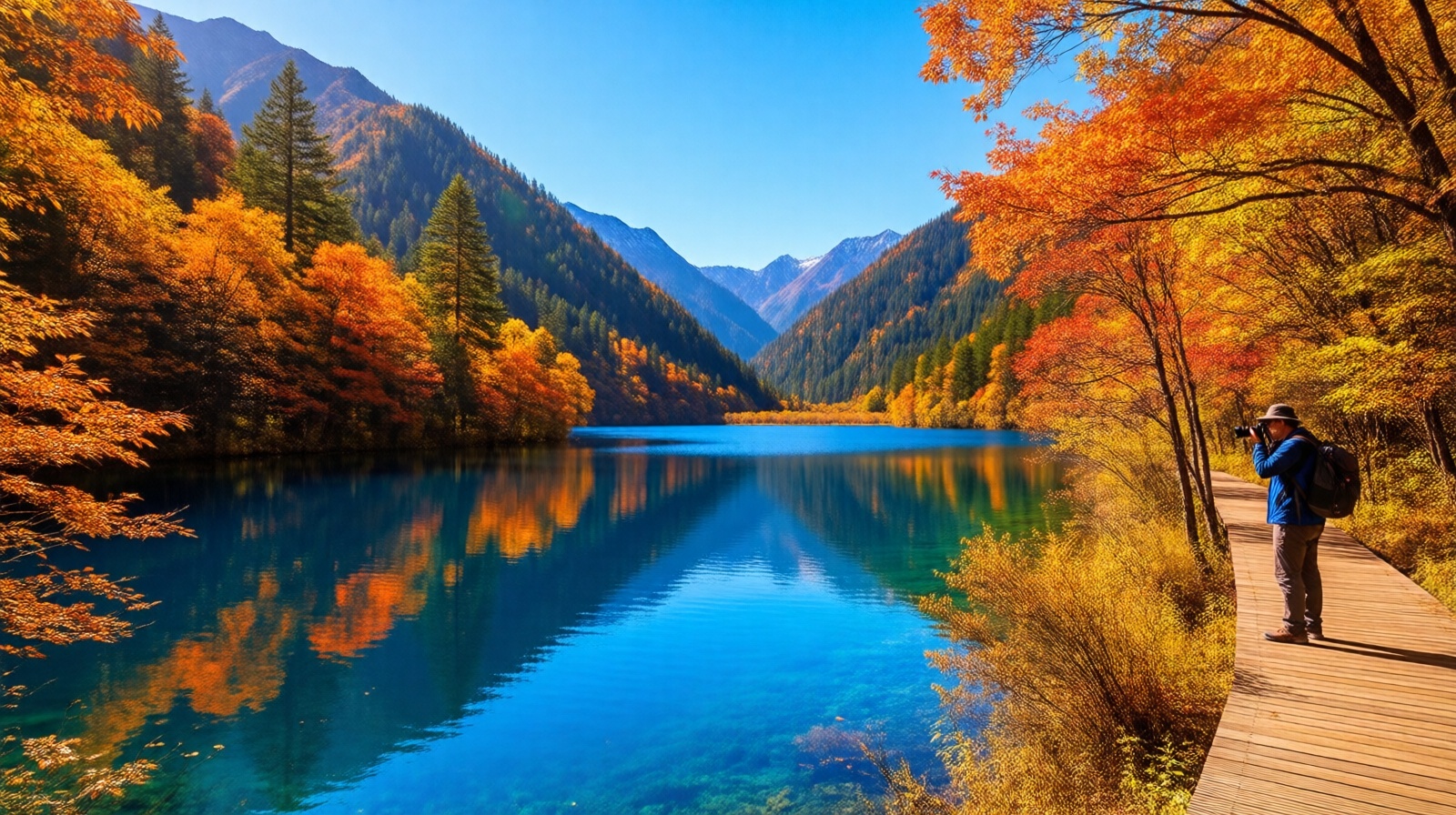
- The leaves of birch, maple, and rhododendron turn red, orange, and bright yellow. These warm colors reflect onto the blue water, intensifying the contrast.
- The water level drops a bit after the rainy season, which exposes more of the white mineral terraces around the shorelines. With shallower water, the light bounces off the bottom more efficiently, making the color more vivid.
A fragile beauty
Jiuzhaigou’s incredible color isn’t something that can be reproduced in a swimming pool. It depends on a slow, delicate geological process. Travertine takes years to accumulate, and a single human step on the mineral crust can destroy a shelf that has been growing for decades. That is why park management has built kilometers of raised wooden pathways to keep visitors off the travertine. Swimming, fishing, and clipping plants are all prohibited.
The fragility was made clear in 2017 when a magnitude 7 earthquake struck the area. Some of the natural mineral dams were damaged, causing water levels in certain lakes to drop. Chinese engineers worked carefully to stabilize the structures without radically changing their appearance, so the mineral-building process could continue. Even now, scientists keep monitoring the water chemistry, because these lakes are still evolving.
So, is it really "no filter"?
The next time you see a photo of Jiuzhaigou that looks too blue, it might not have a filter at all. The color is produced by water, light, and minerals interacting in an ordinary but rare combination. It’s less a magic trick and more like a natural light show that has been running for tens of thousands of years.
Of course, seeing it in person is another experience altogether. The lakes change color as clouds pass over the sun, and the same scene can feel completely different between morning and afternoon. So take a photo, but also put your phone away for a while. Watch the water go from deep navy to pale cyan and back again. Almost nothing in nature delivers such an effortless display of color, and now you know exactly why it happens.
Start the discussion at forum.chinacomes.com