


An Accident in Dongguan: Am I Covered as an Expat Worker?
When Daniel, an Australian-born equipment technician, landed in Dongguan, Guangdong Province in 2024, his goal was to upgrade a production line. He never expected to slip on a pooled oil spot and fracture two fingers. After the emergency treatment, he discovered that the monthly contributions his employer made to China’s work injury insurance system covered expats just like any Chinese worker. If you hold a lawful work permit in mainland China, you are usually enrolled in the same statutory workers’ compensation system. But real-life claims require immediate reporting, careful documentation, and accurate knowledge of the timelines.

Coverage: Not Citizenship, but a Valid Work Relationship
Since the 2011 revision of the Chinese Social Insurance Law and the Work Injury Insurance Regulations, all legally employed foreign employees in China are required to participate in social insurance, including work injury insurance. The premium on this work-injury segment is fully paid by your employer — usually a few tenths of a percent of the social insurance base, depending on the hazard rate of the industry. If your employer pays you through China payroll and deducts individual income tax in China, you have almost certainly fallen into the coverage.
Do not confuse this with a commercial accident policy. The state-run work injury scheme is not a private policy that can choose to exclude foreigners. It is an administrative benefit. If your employer has not registered you for social insurance, you can still request coverage, and the law may hold them solely responsible for reimbursing every compensation item.
From Injury to Claim: Three Deadlines You Must Know
There is no national rule requiring you to report within 48 hours. But well-managed expat employers instruct employees to use their internal incident reporting system within the working shift or within 24 hours. Why? Because your employer is then obliged to apply for work injury confirmation to the local social insurance administration within 30 calendar days from the date of injury. If the company drags its feet and fails to file, you as the employee can submit an application yourself within one year.
Note About the “48-Hour Rule” and Sudden Death
The only 48-hour rule usually cited is in Article 15 of the Work Injury Insurance Regulations. If an employee has a sudden collapse at work and passes away within 48 hours after the first medical diagnosis, the death is accepted as work-related. If the death takes place after 48 hours, the case is generally not treated as work-related unless another occupational factor is proven. This is a painful point for many expat families but also a practical calculation.
After You Report
The local HRSSB agency typically issues a work injury confirmation decision within 60 working days from when the application is accepted, but a notice to supplement can be issued. Once that decision has been issued, the gate opens for expenses to be reimbursed. Medical institutions will usually collect treatment fees, and the insurance fund will transfer the cost if the accident has already been accepted by competent reviewers.
What You Can Claim: Wage, Medical Costs and Cash Subsidies
In China’s system, the injured employee receives several distinct benefits. A first key benefit is “stop work with full wages” (停工留薪期). During the period of medical treatment and until your condition reaches a degree of stability, the employer must keep paying your normal monthly salary just as before. No sick pay rate is deducted. That period can last for up to 12 months, extendable for another 12 months in special situations approved by the social insurance agency.
Your medical expenses, including hospitalisation, drugs and surgery in designated hospitals, are covered by the work injury insurance fund. If an emergency forces you to go to a non-designated hospital, notify HR and ask them to go through the proper reimbursement procedure later.
After your recovery evaluation, a disability level (1–10) is assigned by a local Labor Ability Appraisal Committee. The district and provincial standards use a uniform national list, but the payment rates are defined in central documents.
- One-time disability subsidy: grade 1 (27 months wage), grade 2 (25 months), grade 3 (23), grade 4 (21), grade 5 (18), grade 6 (16), grade 7 (13), grade 8 (11), grade 9 (9), grade 10 (7).
- If your labour contract is terminated later, you receive a one-time medical subsidy from the fund and a one-time employment subsidy from the employer. Those amounts are set by provincial regulations and vary dramatically between regions.
- For grades 1 to 6, you may also be entitled to a monthly disability pension or living subsidy.
How Much Money Can You Actually Get?
Back to Daniel. His Dongguan employer paid him a monthly wage of RMB 15,000. His accident occurred on 17 March 2024. The company applied on 3 April 2024, well within the threshold. On June 10, the labor ability appraisal gave him a Grade 9. The insurance payout was calculated as follows:
One-time disability subsidy: 9 × RMB 15,000 = RMB 135,000 paid to his bank account within the statutory schedule. When his fixed-term contract ended in September because the production line moved back, he became entitled to two additional provincial benefits: a one-time medical subsidy from the fund and a one-time employment subsidy from the employer. In Guangdong, the combined calculation in his district added roughly RMB 50,000 in Daniel’s pocket, because the three sources are linked to the city’s monthly average social wage—not to Daniel’s personal high salary.
Many foreign workers misread the calculation. The second-stage subsidies do not necessarily use your actual salary; they commonly use the local social average wage. That is why two employees with identical salary may receive different amounts after relocation.

Building Your Evidence File as an Expat
You need to organize the following if you want a smooth claim:
- Eligibility documents: passport pages with current work permit and visa, foreigner’s work permit, residence permit, and signed labour contract.
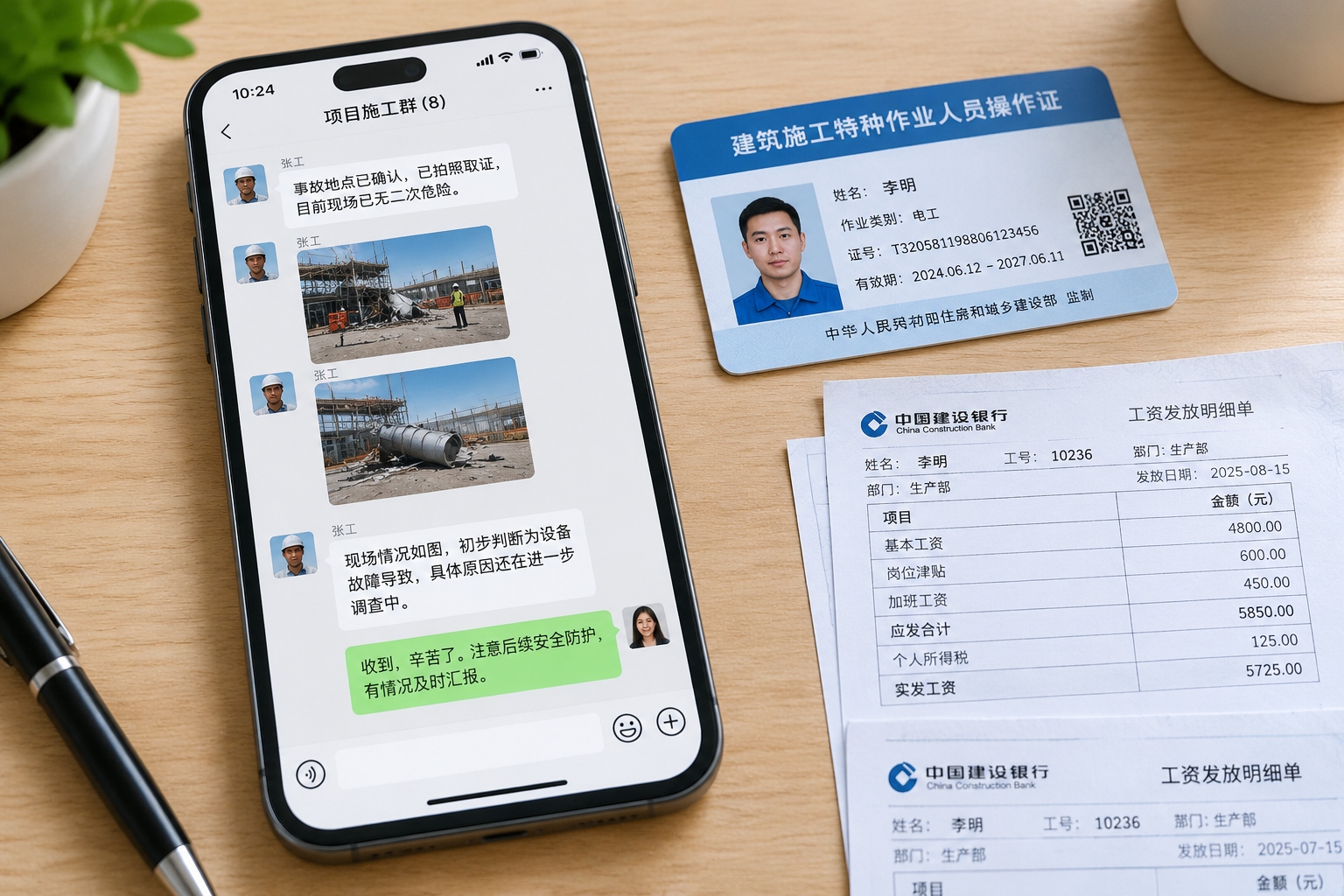
- Incident record: time, location, task; a diary screenshot; a WeChat report to HR; factory floor video footage; witness names and contact numbers.
- Medical record: admission notes, X-ray / CT reports, prescriptions, diagnostic certificate. Keep original or have HR sign scanned copies.
- Attendance/timekeeping: system records proving you were on duty at the place of injury.
- Wage materials: social insurance contribution certificate, payslips or bank records for prior 12 months.
Keep all original copies in a physical file. The application form, signed by the employer, helps speed things up, but you don’t need the employer’s “permission” to submit it yourself from the social insurance counter. Ask the receiving officer to stamp a receipt with the date on the copy.
Where to Look for Help: Legal Routes and the Language Hazard
If your employer opposes your claim or does not submit within thirty days, contact the district HRSSB and file a complaint. The national hotline is 12333, with most interaction in Chinese; however, big cities often staff a foreigner service window. Labour arbitration in China is not prohibitively expensive, and a local employment lawyer can charge a percentage of recovered benefits. Keep in mind that all official proceedings take place in Chinese; foreign-language documents normally need a notarised translation.
You can also seek advice through local official foreign affairs offices and expat legal aid clinics, which pro bono providers run in Shanghai, Guangzhou and Shenzhen.
Bottom Line: Know Your Calendar, Protect Your Rights
China’s work injury compensation is comprehensive and nationality-neutral. But the system does not act as your personal accident lawyer. The entire claim is built on written evidence and rigorous deadlines. A failure to ask your HR for a signed copy of the incident report can hurt you months later. If an industrial accident happens to you in China, remember three numbers: 30 days, 1 year, and 48 hours. The first is the employer’s application window, the second is your own window, and the third defines a narrow category of occupational death. Treat every folder as if it were your passport—then the compensation will be almost inevitable.
Start the discussion at forum.chinacomes.com