
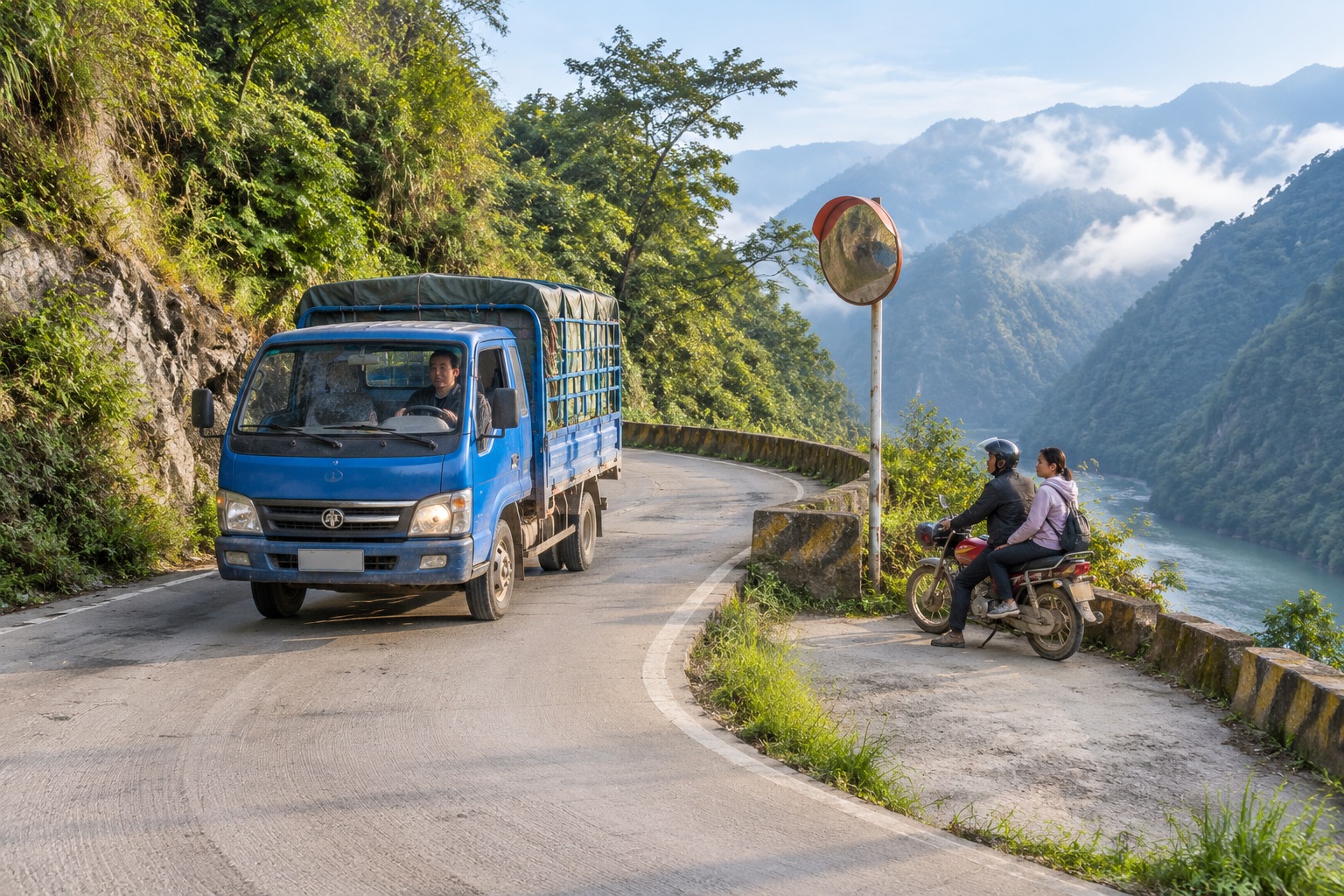

At the third hairpin, the truck stops
Ten forty on a Tuesday morning, and A-Deng is already sweating. He has driven the 288-kilometer highway along the Nujiang River more than a hundred times — cement, fertilizer, cooking oil, once a piano for the township school. This is his first run on the village road, and it has taken him forty minutes to cover three kilometers.
He stops at the third hairpin because he cannot see around it. A convex mirror is bolted to a pole on the outer edge, gray with dust; below it the ground falls away some 400 meters to the river. He honks twice. Nothing answers. He reverses fifteen meters into a passing bay the length of his truck and waits.
A motorcycle comes down, a woman with two crates of eggs strapped behind her and a live chicken in a mesh bag hung from the handlebars. She lifts her chin at him as she squeezes past. First gear. Up again.
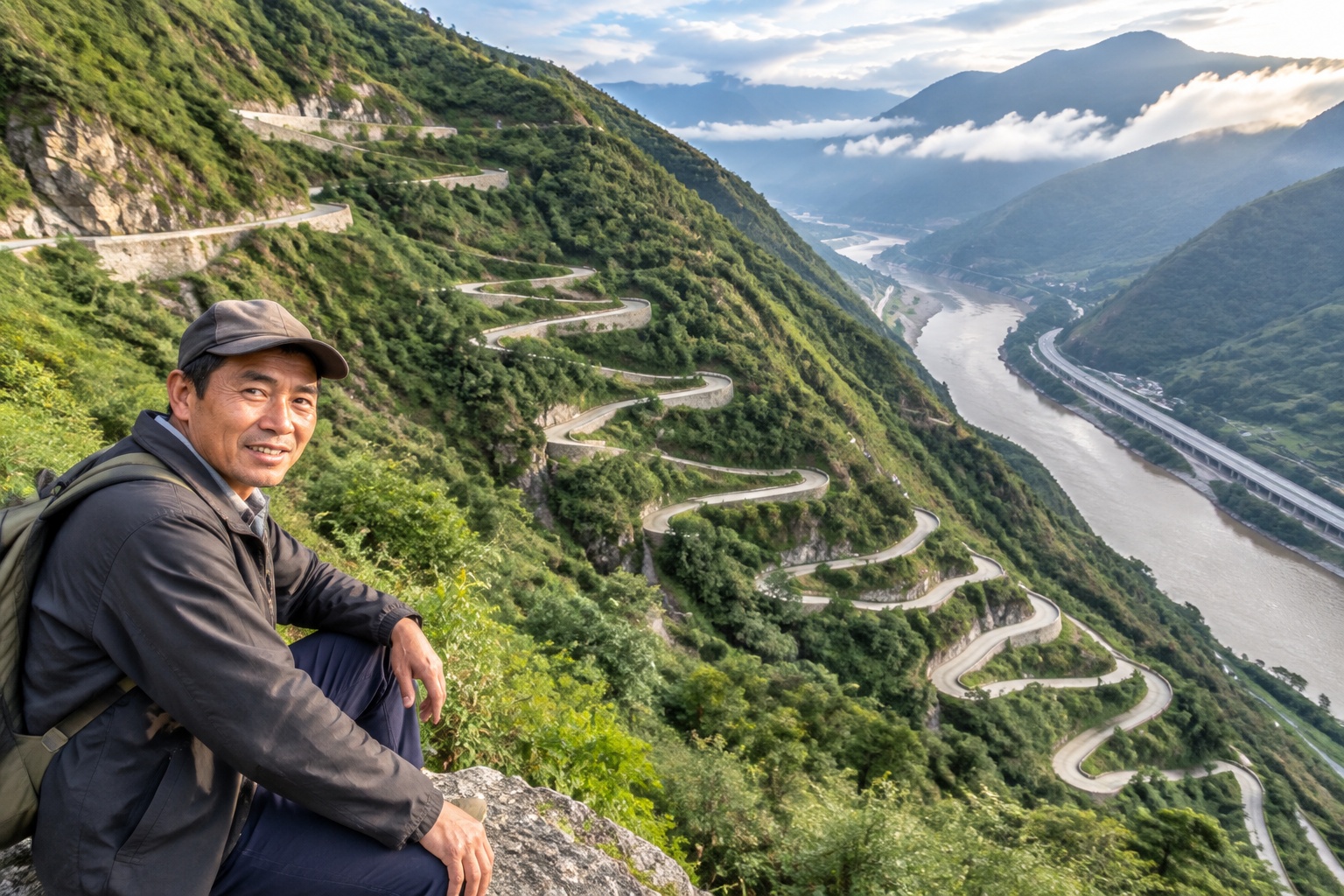
From the driver’s seat, three years of construction looks like this: 6.8 kilometers of concrete, 4.5 meters wide, twenty-seven bends, climbing 1,050 meters from the river to a ridge-top village of 41 Lisu households. Nine months ago, no truck had ever made the climb. This load — three tonnes of bagged fertilizer and a refrigerator in a cardboard box — is the eleventh truck to come up this year, and the fourth this month.
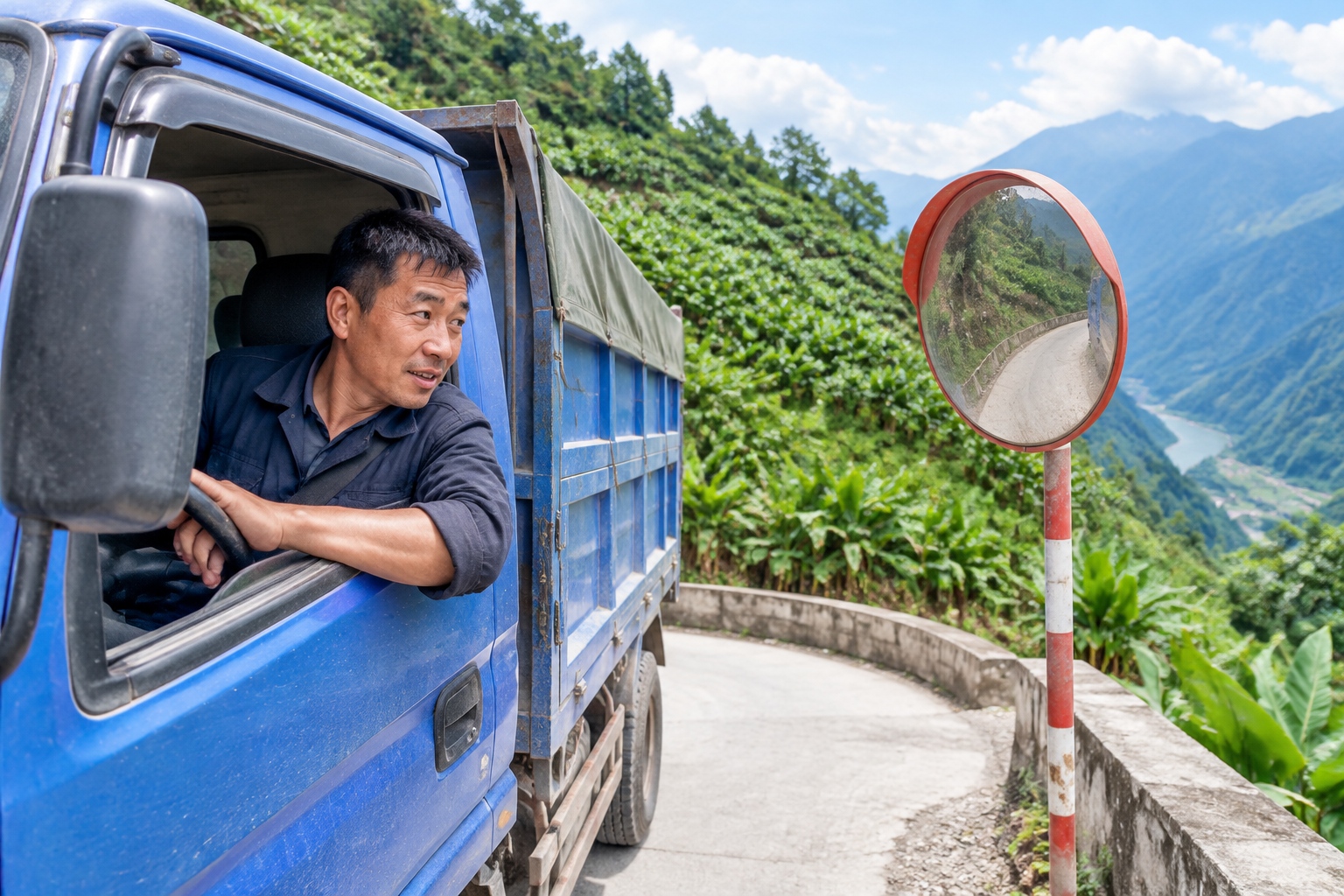
Before the road, everything went up on someone’s back
Until 2023, the last link in this village’s supply chain was human.
Goods came off the highway at the river. From there it was a three-hour climb for a strong man and ninety minutes down. Mules took what mules could take, usually 80 kilos a trip, and they hated the final pitch as much as the people did. Bringing a 50-kilo sack of fertilizer up on your back cost 25 yuan. Getting a refrigerator to a doorway cost about the price of the refrigerator, which is why, a few years ago, most houses here had a television and none had a fridge.
A-Ying is 51 and grows cardamom on four mu of shaded slope — the smoky, camphor-scented pod that flavors Chinese braised dishes and, increasingly, foreign gin. Cardamom has to be dried within about a day of picking or it molds. On the mountain there was nowhere flat to spread it and no fast way down, so brokers set the price. In 2019 her harvest went for 24 yuan a kilo, and she had no way to check whether that was fair.
The road was a medical problem before it was an economic one. In 2016, a man with a burst appendix was carried down in a chair slung from two bamboo poles; the county hospital in Fugong was three and a half hours away, and he lived. Older people here will tell you the names of the two who did not.
Three years, most of it spent waiting for the rain to stop
Surveyors came in 2019. The first excavator arrived in March 2020; the last concrete was poured in April 2023. Three calendar years, but closer to eighteen working months.
The rainy season in the Nujiang valley runs from May to October, and on a slope this steep, rain means rockfall. Crews from Zhaotong and Sichuan lived in container huts at a bend for three seasons. Their foreman kept a tally on a whiteboard: in one four-month stretch, eleven slides on road they had just cut, and a 60-meter section they had to build three times. They blasted the hillside rather than tunneling — a tunnel would have cost several times more — and pinned the outer edge with gabion baskets packed with river stone.
Total cost: roughly 14 million yuan, about $2 million, for 6.8 kilometers, mostly county money with a provincial subsidy. For scale, China has around 4.5 million kilometers of rural road, a network largely built or rebuilt since a national push began in 2014. From a bus window those roads look like nothing — gray threads on green slopes. Walking one is the only way to see how much of it is retaining wall.
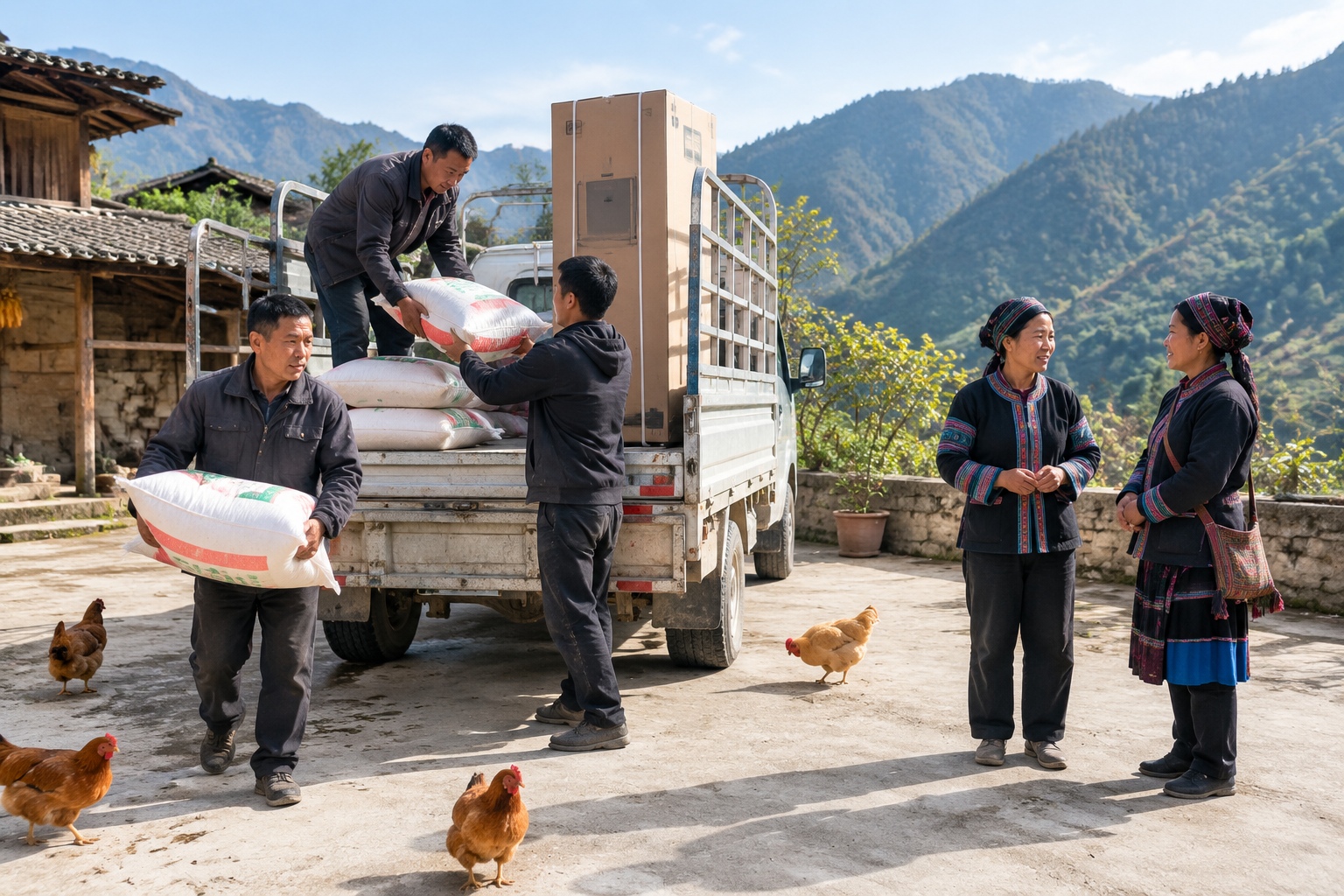
What actually arrives on a truck
The first truck up, on a Monday in May 2023, carried eight tonnes of cement, and about thirty people came out to watch it turn around in the drying yard. Since then the loads have become ordinary, which is the whole point. A washing machine. Two hundred chicks in cardboard boxes. Twenty sacks of pig feed. Bottled water and beer for a November wedding. Vitamins for the health worker’s monthly visit.
Going down, trucks carry cardamom, walnuts, honey, dried chilies, and in one bad potato year, four tonnes sold cheap to a buyer in Liuku. In the 2023 harvest, A-Ying sold her cardamom at 44 yuan a kilo after drying it properly on a new concrete pad — built with cement from that first truck. That is the road, stated as a price.
The truck carries people too. A-Deng’s cab seats three, and the grandmothers of the village use it as a bus: down to the Thursday market in the township, back in the afternoon, 10 yuan a head, free over eighty. Children who board at the township school ride home on Friday afternoons the same way. They still board during the week — three hours of mountain path on a Sunday evening is not something a nine-year-old should do in the dark.
What the road does not fix
Roughly three weeks a year, the road is closed. Twice last summer: a slide near the fifth bend, cleared by a county loader in eleven hours, and the second time in three days. Between June and September, A-Deng won’t drive up after five in the afternoon, and he won’t drive it at all after two days of hard rain. There is now one small shop in a front room, and a WeChat group where the village head posts road conditions.
There is still no clinic. A health worker comes once a month and stays four hours. The primary school closed in 2016 for lack of children, not lack of road, and the village is still shrinking — a little over 160 people, about twenty of them working in Guangdong and Zhejiang, sending money home and returning for Spring Festival along this same road.
The price of cardamom is volatile, too: it more than doubled between 2019 and 2021, then slid back. The road took away the mule tax and the broker’s leverage. It did not take away the market.
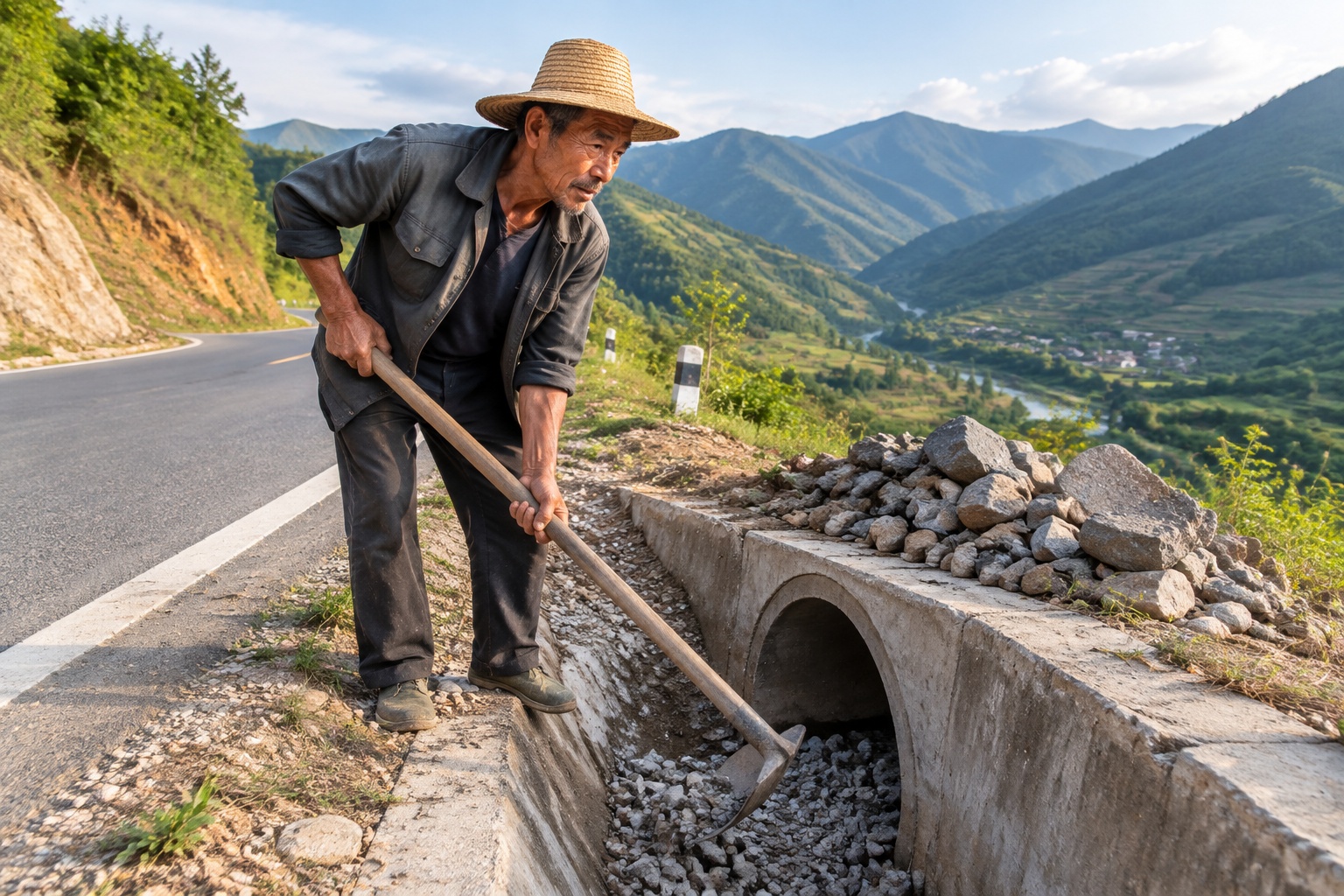
Someone still has to keep the ditches clear. A-Pu is 62 and the village’s paid road keeper — 800 yuan a month, a public-welfare job the county gives to a household that needs it. Twice a week he walks the 6.8 kilometers with a hoe, scraping gravel out of the culverts and stacking small rockfalls where the loader can reach them.
If you go
Villages like this one sit above Fugong County, in Nujiang Lisu Autonomous Prefecture — the far northwest corner of Yunnan, along the valley of the Nujiang (Salween) River. The road joins the riverside highway between Liuku and Bingzhongluo, rebuilt in 2019 and known locally as the Beautiful Highway.
Getting there: fly to Baoshan or Dali, then take a bus to Liuku, the prefecture seat, about 3.5 hours from Baoshan. County buses run north along the river to Fugong, three hours or so. There is no public transport up the village road itself — ask at the township, where a local driver with a 4×4 will go up for 100 to 150 yuan. Walking it takes about three hours uphill, and there is nowhere to buy water.
Best time: late October to early December, when the cardamom harvest is drying on the concrete pads, the skies are clear and the road is dry. Avoid June to August — rain, slides, leeches, and the occasional multi-day closure.
Sleeping: simple guesthouses in Fugong county town, 100 to 200 yuan a night; a handful of small homestays have opened along the highway. Eating: lacquer-oil chicken, buckwheat cakes, cardamom-braised pork, river fish.
Etiquette and practicalities: ask before photographing anyone. On a bend, the vehicle going uphill has priority and the one coming down reverses — it looks aggressive, and it is simply the rule. Carry cash for village shops; mobile payment works, but signal on the road is patchy. Don’t walk the road at night or in rain. Don’t hand money to children; buy something from the shop instead.
From the highway below, the road up to this village looks like a scratch on a green wall. A-Deng drove past it for six years without turning. Now he turns off it eleven or twelve times a year.
Start the discussion at forum.chinacomes.com