

A Three-Person WeChat Group That Sealed a Deal
On a Tuesday evening in Hangzhou, Lina Chen, 29, needs a factory. She runs a small packaging design studio, and a client is waiting for 3,000 custom gift boxes — too small for the big printers she knows, too urgent to spend three weeks cold-calling.
So she doesn’t cold-call. She sends a WeChat message to a former colleague. Within an hour there’s a group chat of three: Lina, the colleague, and a production manager at a factory in Ningbo. The colleague types six characters: 这是我朋友,靠谱 — “This is my friend, reliable.”
Samples ship two days later. No contract yet. No procurement department. A deal moved forward because one person put her own standing on the line for another.
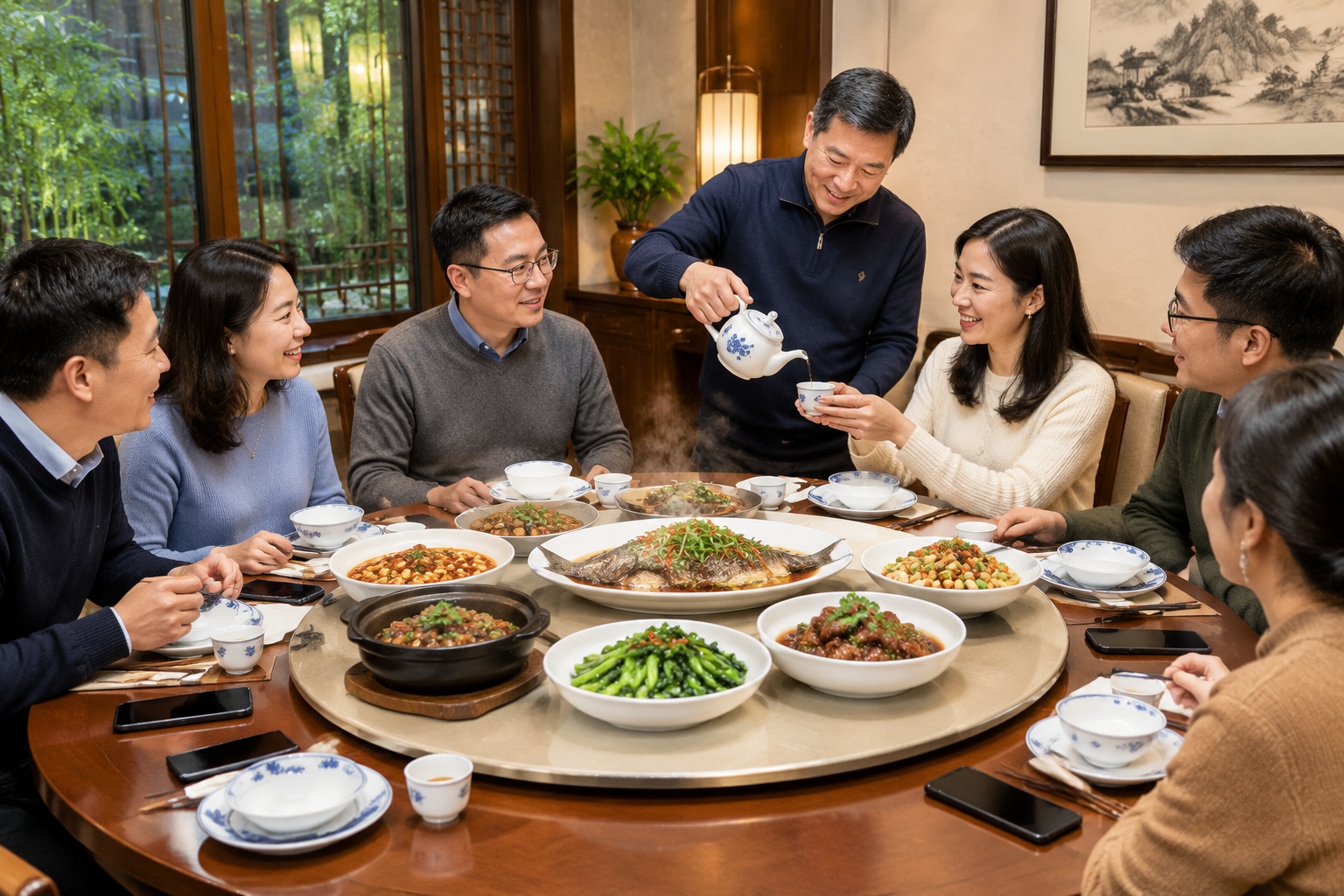
Anyone who has lived in China finds that scene unremarkable. For many outside observers, it is exactly the kind of thing that feeds a stubborn stereotype: that business here runs on “face” and “guanxi” — backroom favors, banquet tables, obligations you can never quite discharge. The reality in 2025 is more interesting, and far more useful to understand.
First, a Plain-Language Translation
Two words get used constantly and explained badly.
Face (面子, miànzi)
Face isn’t vanity, and it isn’t the same as reputation. It’s closer to the standing you hold in one specific room at one specific moment — and unlike reputation, it can be given, borrowed, and lost in public. Praising a colleague in front of her boss is 给面子, “giving face.” Contradicting someone in a meeting takes it away. Chinese working life is full of small, deliberate moves that acknowledge other people’s standing, and foreigners who notice them tend to find that meetings go better.
Guanxi (关系, guānxi)
Literally “relationship” or “connection.” It describes a network of people who can call on one another, plus the running ledger of favors between them — known as 人情 (rénqíng). Western readers already know versions of this: the alumni network, the warm introduction from a former boss, the friend-of-a-friend who gets your résumé read. The difference is density and weight. In China, when you introduce someone, you are lending them your own face. If they behave badly, you’re the one who looks foolish.

The Misconception: Is This Just Feudal Corruption?
The most common Western framing is that face and guanxi are leftovers from an older, more corrupt China — a system where the well-connected get the contracts and everyone else queues. It’s a fair question. It’s also about fifteen years out of date.
For one thing, the rules changed hard. Since the anti-corruption campaign that began in 2012, government and state-enterprise officials operate under gift and banquet restrictions that would surprise most foreigners who last visited before then. Lavish official dinners largely disappeared. A supplier who sends a 2,000-yuan hamper to a procurement officer at a state-owned company isn’t building guanxi — he may be creating a problem for both of them. Anyone who arrived in China with a mental image of bribery at a banquet table is working from a picture that Chinese companies themselves have largely retired.
For another, relational trust isn’t the opposite of formal trust. It fills the gap when formal systems are slow. Think about how hiring actually works in the United States: an internal referral moves a candidate to the top of the pile, not because the hiring manager is corrupt, but because someone credible has absorbed part of the risk. China works the same way, with more of the risk landing on the introducer.
The system has real costs. Calling someone a 关系户 — a person hired because of connections — is an insult, and Chinese employees complain about it as loudly as anyone in London or Chicago. The interesting story isn’t that the practice exists. It’s that it’s being pushed in two directions at once: formalized wherever rules can be written down, personalized wherever trust is expensive to verify.
WeChat Didn’t Kill Guanxi. It Rewrote the Rules.
The old version of relationship-building required time and alcohol: banquets, karaoke rooms, weekend trips, a decade of accumulated favors inside one industry. That version still exists in parts of manufacturing, state-owned enterprises and local government circles. It is no longer the whole picture.
WeChat, which reports more than 1.3 billion monthly users, has become the operating system for social capital. Group chats hold up to 500 people and often run for years: university alumni, former colleagues, parents at the same school, neighbors in the same apartment compound, suppliers in the same industrial cluster. A “group of three” — you, a mutual contact, and the person you want to reach — is now the standard warm introduction, the digital equivalent of being walked over to someone’s table at a banquet.
It also produces new etiquette. Adding someone on WeChat is itself a signal, since the app sits closer to a personal phonebook than to LinkedIn. Lunar New Year red packets (红包) sent through a chat are calibrated: an amount that’s too large embarrasses the recipient, while the right amount says “I remember you.” Replying within a few hours matters. Being quietly visible — a like on someone’s Moments feed, a congratulations on a new job — is low-cost face-giving that keeps a weak tie alive for the day you need it.

There are concrete examples of how far this reaches. During the Shanghai lockdown in 2022, residents who had never spoken to each other organized neighborhood group buys for vegetables through building-level WeChat groups within days. Nobody was paid. No law required it. Trust was the only currency that worked.
Where It Still Decides the Outcome — and Where It Doesn’t
The mistake foreigners make is applying one rule everywhere. In practice, relational logic has a strong pull in some rooms and almost none in others.
It matters when supply is tight or judgment is subjective: securing a production slot in peak season, getting a first meeting with a fund, making a senior hire at a family-owned business, seeing a specialist doctor at a crowded hospital. It matters far less wherever rules have been automated — train tickets, government permits, school admissions in many cities, online registration for almost anything. When a process is transparent, asking for a favor is both unnecessary and faintly embarrassing.
It also matters less in casual friendship than outsiders assume. For younger urban Chinese, having dinner with someone creates goodwill, not debt. Western visitors sometimes read a long, generous evening as induction into a network; often it just means the food was good.
The sharpest contrast with Western business norms is about sequence rather than substance. A German or American buyer typically wants the specification, the price and the contract first, and the relationship can follow. A Chinese counterpart often wants to know whether you’re the kind of person who will answer the phone in a crisis — before the numbers make sense. Contracts still get signed, and Chinese companies increasingly insist on detailed ones, especially with foreign partners. The dinner doesn’t replace the contract. It comes first.

Gen Z: Same Instinct, New Terms
China’s Gen Z — roughly 260 million people born between 1995 and 2010 — is often described abroad as the generation that will finally kill guanxi. They change jobs more often, drink less, and are famously allergic to performative hierarchy. The evidence points to something subtler: they kept the mechanism and dropped the theatre.
Internal referral (内推) is the standard route into most large Chinese tech and consumer companies — a friend submits your résumé through the company’s own system and often earns a bonus if you’re hired. That is guanxi with a dashboard and a payout schedule. What younger workers resist is the open-ended version: three hours of baijiu toasting with a client, or a favor whose size nobody defined in advance. Their preference is a bounded exchange — a clear ask, a clear thank-you, a clear ending.
Alcohol culture is one place where you can watch the shift. Baijiu toasting remains a fixture in state-owned enterprises and traditional manufacturing, but in technology, media and startup circles, tea in place of liquor (以茶代酒) is completely normal, and nobody loses face over it.

A Practical Playbook for Visitors
If you’re visiting, working with, or selling to Chinese partners, these are the habits that actually change outcomes.
- Get an introduction. A cold email from a stranger is weak almost everywhere; here it’s weaker. Ask for a WeChat group of three.
- Treat WeChat as your handshake. Set up the app before you arrive, add the people you meet, and send a short message with your name and context within a day.
- Don’t pitch at the first meal. Ask about their city, their team, their commute. Curiosity is a form of giving face.
- Reciprocate, but not instantly. Repaying a favor within the same week can read as refusing the relationship. Return it at the next natural moment.
- Read the soft no. “This is a bit difficult” or “let me think about it” usually means no. Pushing costs you standing.
- Keep gifts modest. Regional food, a good book, a box of tea. Expensive gifts to officials or state-enterprise staff are a liability, not a strategy.
- Be direct with younger colleagues. “Would you introduce me to X?” is a perfectly normal WeChat message. Clarity isn’t rude.
- Remember whose face is on the line. If someone vouches for you and you deliver badly, they pay part of the price. That’s why introductions here are given carefully — and why they mean so much when they are.
The Bottom Line
Face and guanxi are not fading relics of an older China. They’re adapting, the way they always have — compressed into group chats, shortened into referrals, and increasingly bounded by clear expectations rather than indefinite obligation.
Read them as a trust technology: a way of making decisions quickly when the paperwork is incomplete and personal judgment matters more than a résumé. That’s why a six-character WeChat message — 这是我朋友,靠谱 — still moves goods out of a factory faster than a purchase order. The instinct behind it isn’t ancient. It’s efficient.
Start the discussion at forum.chinacomes.com