
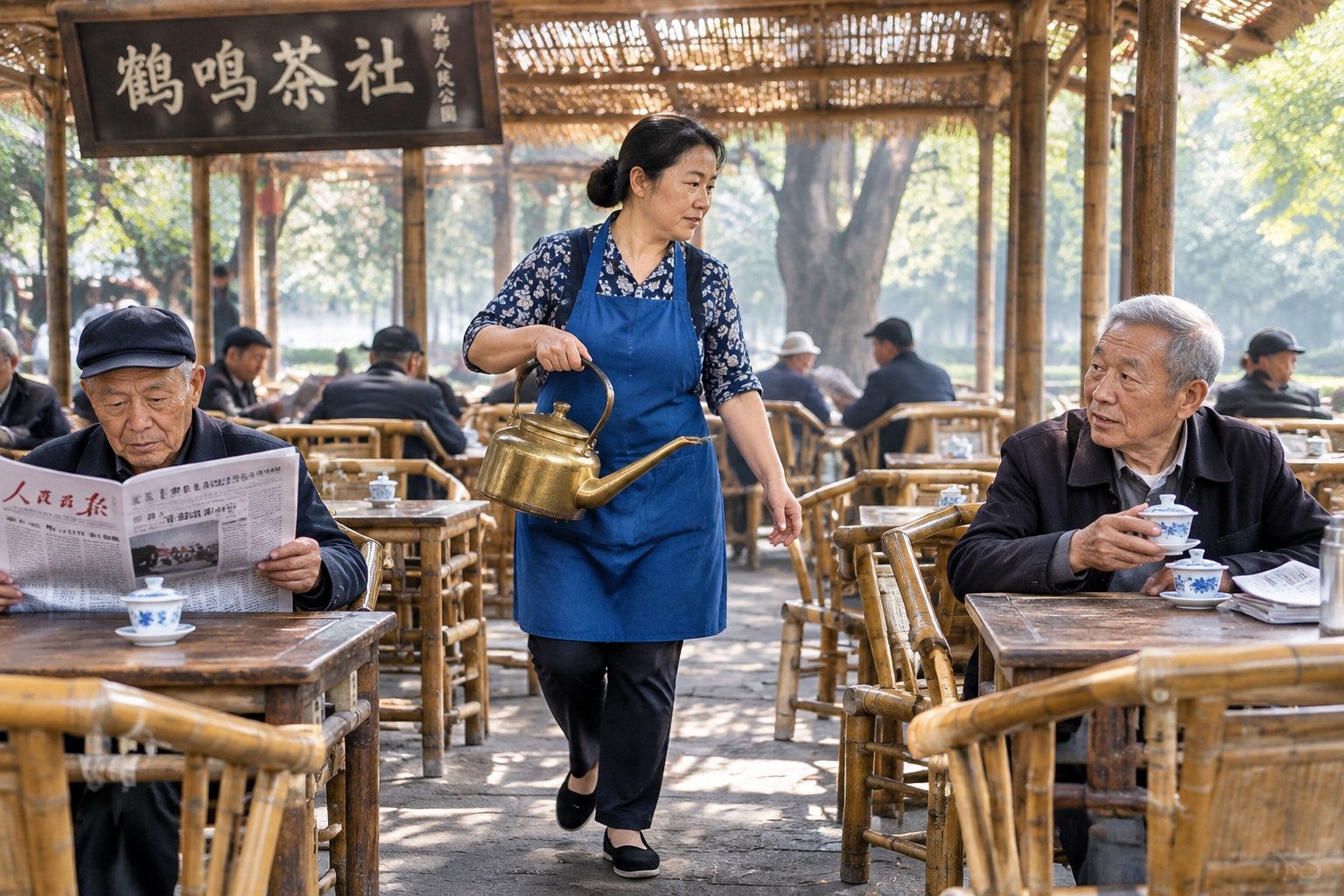

Chengdu, 7:40 a.m. The lake in People’s Park still carries a grey-white fog, but inside Heming Tea House things are already moving: bamboo chairs dragging across stone, stacks of lidded cups clinking into plastic basins, and the low hum of maybe twenty people talking at once without anyone actually raising their voice.
“Sit anywhere.”
The woman in the blue apron is carrying two brass kettles and does not stop walking. She swings one spout in a shallow arc toward the cheapest row of tables. An old man in a grey jacket nods. Three fingers tap the wood twice. She is gone. Both of them got exactly what they wanted, and neither said a full sentence.
That is the secret language of the Chinese tea house. Not the tea — the unspoken system around it: who pours, who pays, when a refill is free, and how you signal that you are finished without saying a word. Outsiders walk in confused. Ten minutes of watching, and the room starts to make sense.
Heming Tea House at 7:40 a.m.: one roof, two rooms
Heming has been in this park since around 1923. Bamboo roof, low square tables, a few hundred worn bamboo chairs. The first impression is noise — genuine noise, closer to a small gymnasium than a café.
But the noise sits at ceiling level. At table level, the room is quiet.
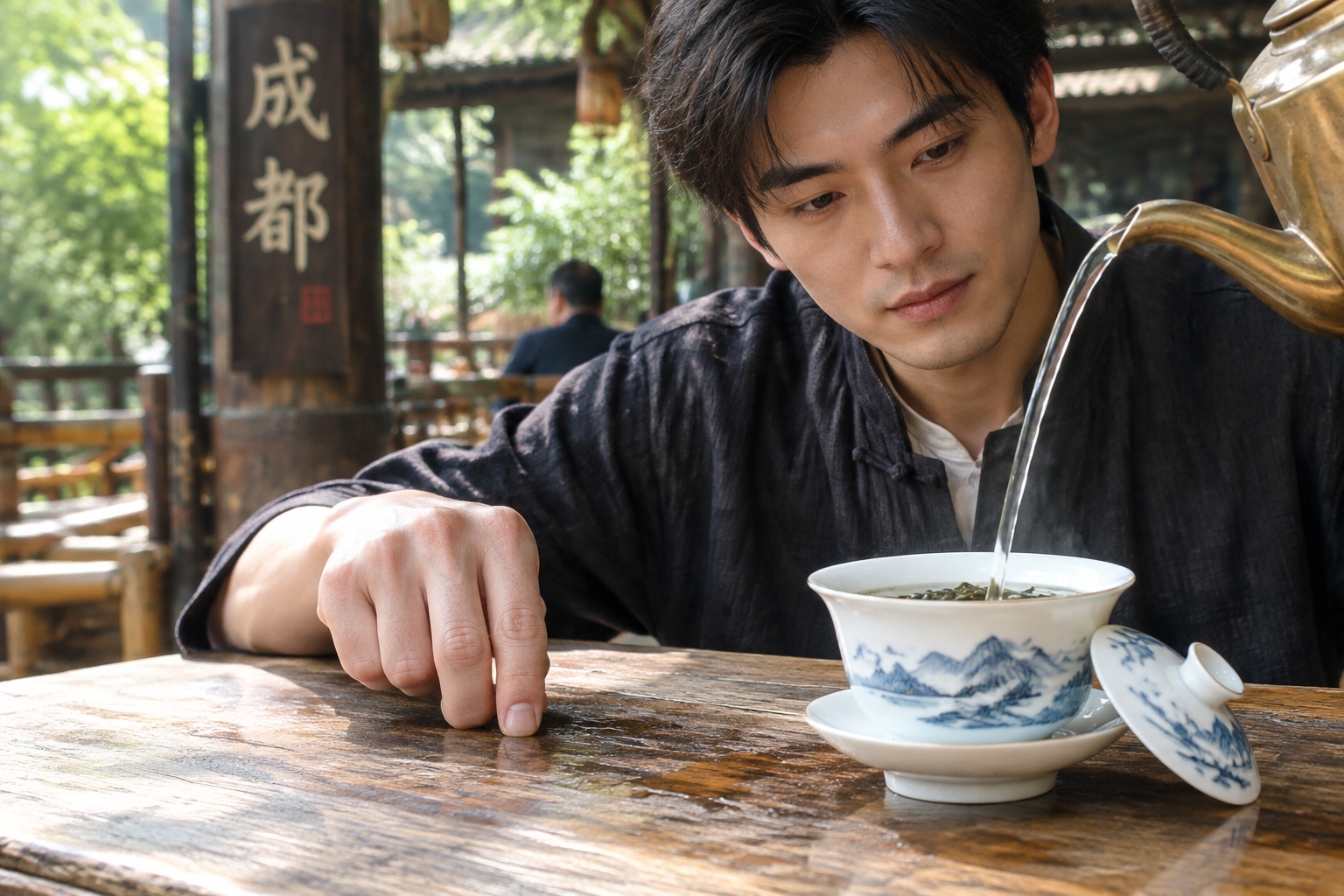
Nobody waves for a server. They watch for eye contact and let it arrive. Nobody empties a cup; there is always a thumb’s width of tea left at the bottom. Nobody stands up to fetch hot water, unless it is one of the old halls where a thermos sits at the end of the table and everyone helps themselves.
The request for more water is a small thing. You tilt the lid of your gaiwan — the lidded cup the tea is brewed in — so it rests at an angle against the rim, leaving a gap. Someone will be over within a minute. Put the lid back flat and the message is: none for now.
Paying works the same way. You do not shout for the bill. You find the person who poured your last cup, hand over cash or scan the QR code taped to the table, and leave. The money changes hands before you stand up, as if the whole thing had been agreed in advance.
Finger kowtow: two taps on the table instead of a bow
You probably know how to say thank you. Here you say it with your knuckles.
When someone pours tea for you, curl your index and middle finger and tap the table two or three times with the second joint. This is the kouzhi li, the “finger kowtow.” If the pourer is an elder, some people close the hand into a loose fist and tap with that instead. The habit travels: you will see it in Guangdong and Hong Kong tea restaurants too, though it is more formal there.
The story behind it goes like this. The Qianlong Emperor was travelling in disguise and stopped at a tea house. He poured tea for his attendants. They could not kneel in public without blowing his cover, so they bent their fingers and tapped the table — the hand’s version of a bow. The tale is almost certainly invented. The gesture is real, and it tells you something about how this culture handles rank: quietly, with the smallest possible movement.
There is a second gesture worth knowing because it saves you from a lot of awkward waving. When the server comes around with the kettle and you genuinely do not want more, lay one hand flat and light over the top of your cup. That is the universal “enough.” No hand up, no noise, no explanation needed.
And one non-signal: do not drum your fingers impatiently, and do not tap the table to call a server over. The taps mean gratitude here, not attention.
The tea list is half code
Read a Chinese tea menu without the key and you miss half of what it is telling you.
Mingqian means picked before the Qingming festival in early April, when the weather is still cold and the buds are small. Yuqian means picked after it. Mingqian costs more — often double — for tea from the same hillside harvested two weeks apart. Regulars scan the list for those two characters first.
Bitan Piaoxue, “green pool, drifting snow,” is Chengdu’s own jasmine blend: green tea with jasmine petals floating on the surface. It is a cup of jasmine tea with a poem attached. In an old park tea house it might cost you the equivalent of two or three dollars. In a new tea space downtown, the same leaf under a different name and a better chair can run eight or ten.
Then there are the regional flags. Zhuyeqing is a flat, bright green tea from Mount Emei. Tieguanyin is a roasted oolong from Fujian. Dancong comes from Chaozhou in Guangdong and can be brewed eight or ten times before it fades. Pu’er is from Yunnan, pressed into cakes, and priced by age — some of it by decade.
When a neighbour orders and their voice lifts slightly on the name, that is not a question. It means the tea is expensive, rare, or both.
What a tea house actually sells is the table
Spend an hour and you notice the real product is not the tea. It is the table.
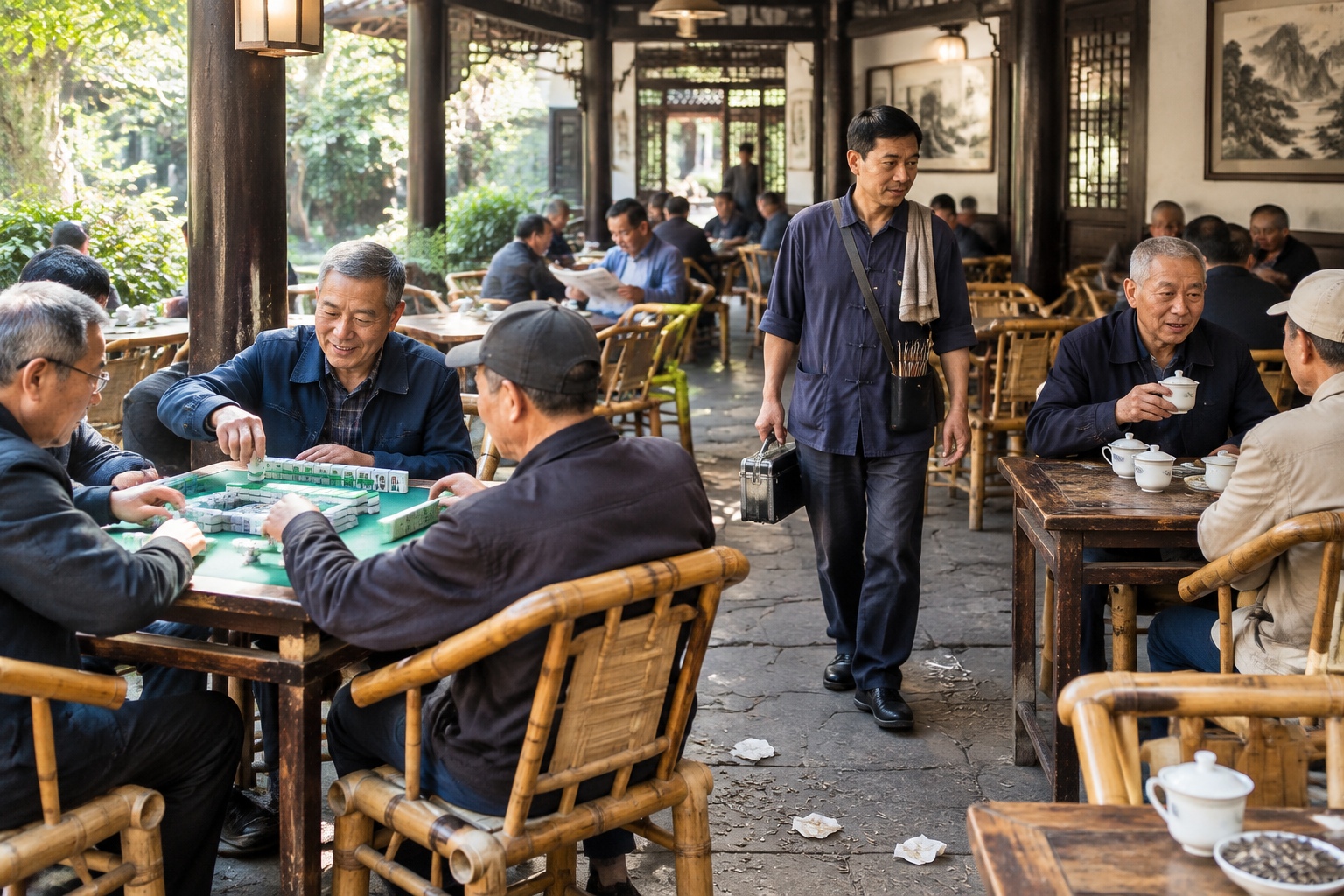
Tea houses are information exchanges. People use them to meet a matchmaker, close a small deal, settle a family argument, or simply keep a standing appointment with three friends they have seen every Tuesday for twenty years. Retired men arrive at nine and stay until lunch. Mahjong tiles clack a few tables over. An ear cleaner walks between rows with a gleaming metal case — a Chengdu speciality, and a job that exists nowhere else quite like this. A shoeshine man crosses the same floor, then a palm reader, then someone selling newspapers.
The economics matter here. Twenty yuan buys you a seat for three hours. You are not expected to order anything else. In most cities that is a rare commodity — a public living room where the only entry requirement is one cheap cup of tea.
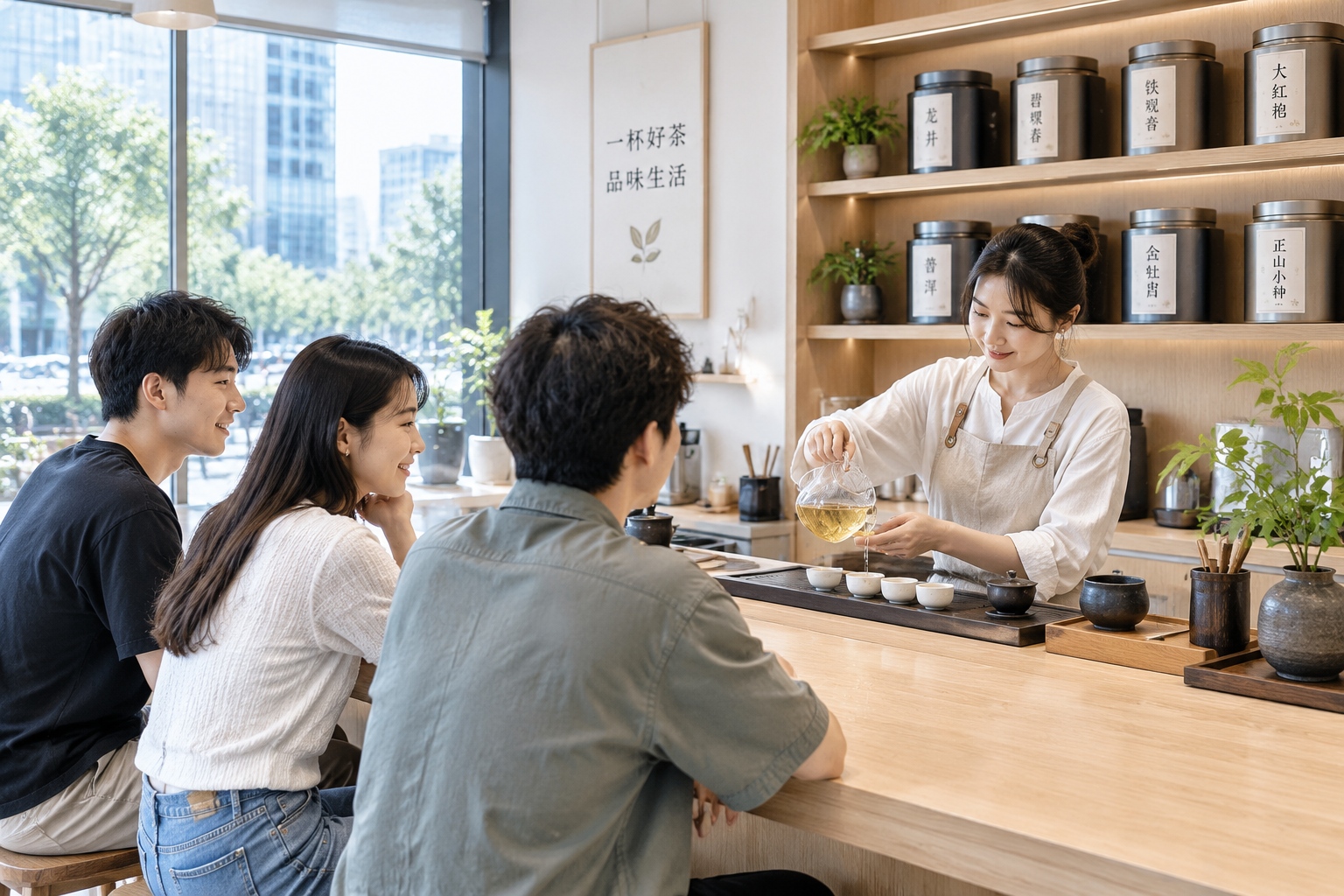
The newer version of this is showing up in Shenzhen and central Chengdu: tea bars with clean wood counters and young staff who pour with both hands, closer in feel to a specialty coffee shop. The prices are higher, the chairs are better, and the refills are still free. The grammar of the room, in other words, survived the renovation.
What to order, and what to watch, on your first visit
Practical notes, if you have never done this before.
Start with something that cannot go wrong. Jasmine tea, chrysanthemum tea (technically a flower, not a tea), or any green tea served light. Once you like the taste of the room, move toward tieguanyin or dancong.
In Chengdu, order gaiwan tea. The leaves brew directly in the lidded cup. Drink by tilting the lid slightly to hold the leaves back, then sipping from the cup. Never lift the lid off entirely and set it aside — that is the giveaway that you are new. Rest it on the rim, or tilt it against the rim if you want a refill.
Never drain your cup. Leave a small amount. That thin layer of tea is what makes a refill possible, and refills are usually free.
Watch what old women do. They are the most fluent speakers of this language in any room. They tap twice when tea is poured, they nod once to acknowledge it, and they leave when they are ready without anyone needing to be told.
Do not rush the exit. No one is waiting for your table. Sitting for two hours over one cup is normal, not rude.
Prices. Fifteen to forty yuan for a cup in an old park tea house in Chengdu. Thirty to eighty yuan in a newer tea space. In Cantonese yum cha restaurants, expect a small per-person seat charge called chawei fei on top of the tea.
Why the secret language is worth learning
The hand signals matter less as etiquette than as evidence. A great deal of Chinese social life runs on picking up what has not been said out loud — the tea lid at an angle, the hand flat over a cup, two knuckles on wood.
So when you walk into a tea house and the noise hits you like an old television set, resist the urge to talk louder. Wait a minute. Watch how people order, how they call someone over without calling, how they settle a bill.\p>
Within ten minutes you will be reading the room. After that, the tea tends to arrive on its own.
Start the discussion at forum.chinacomes.com