

A Stone Bridge That Still Carries Footsteps
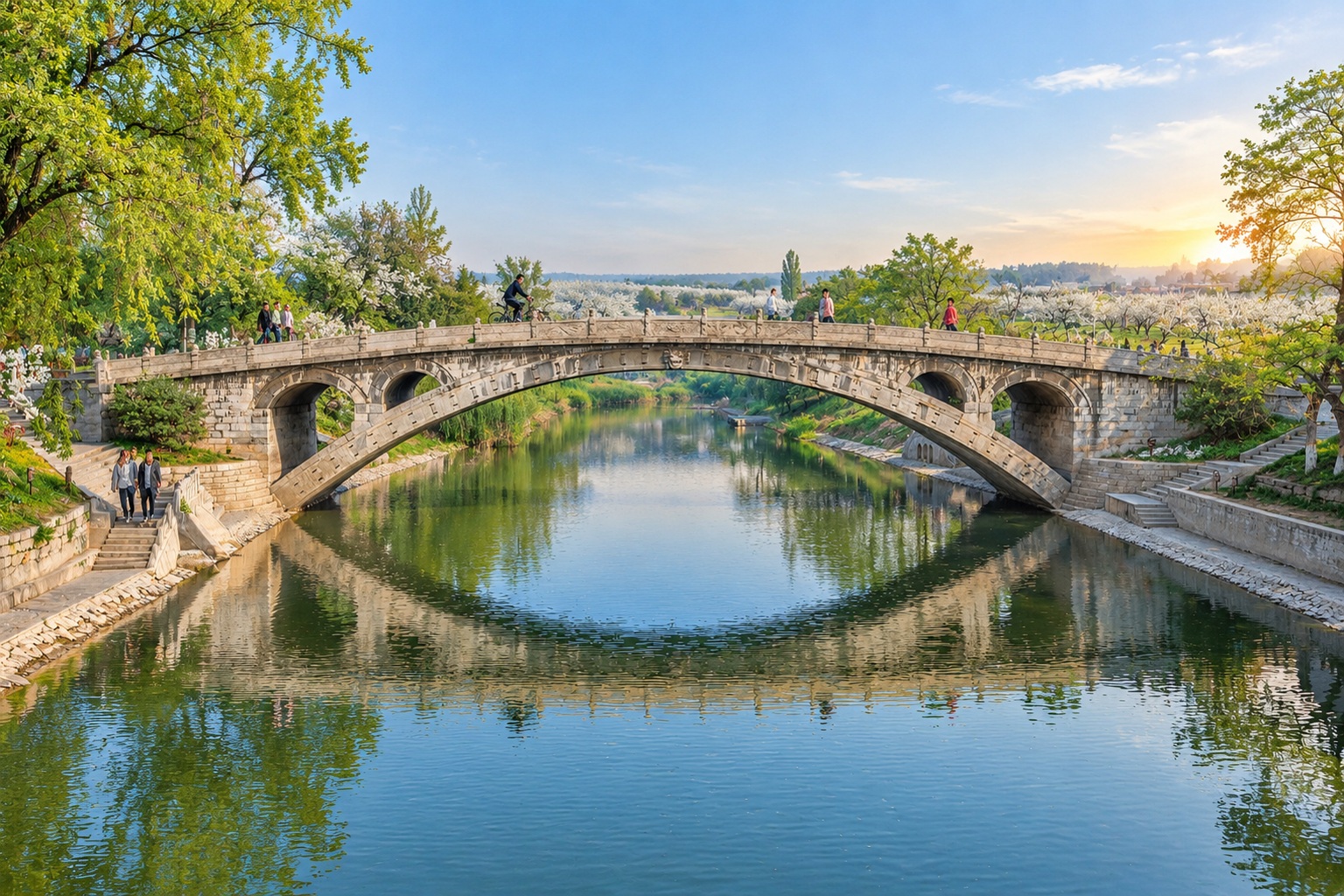
On a winter morning in Zhao County, about 40 kilometers southeast of Shijiazhuang, a woman in a padded jacket walks her bicycle across a low stone bridge. Below her, the Xiao River moves slowly through fields of pear trees. The bridge does not look like a ruin behind glass. It looks like a piece of infrastructure that has simply refused to retire. This is the Zhaozhou Bridge, also known as the Anji Bridge. It was built between roughly 595 and 605 AD during the Sui Dynasty, making it about 1,400 years old. It is the oldest surviving open-spandrel stone arch bridge in the world, and for many engineers it is one of the most important structures in civil engineering history.
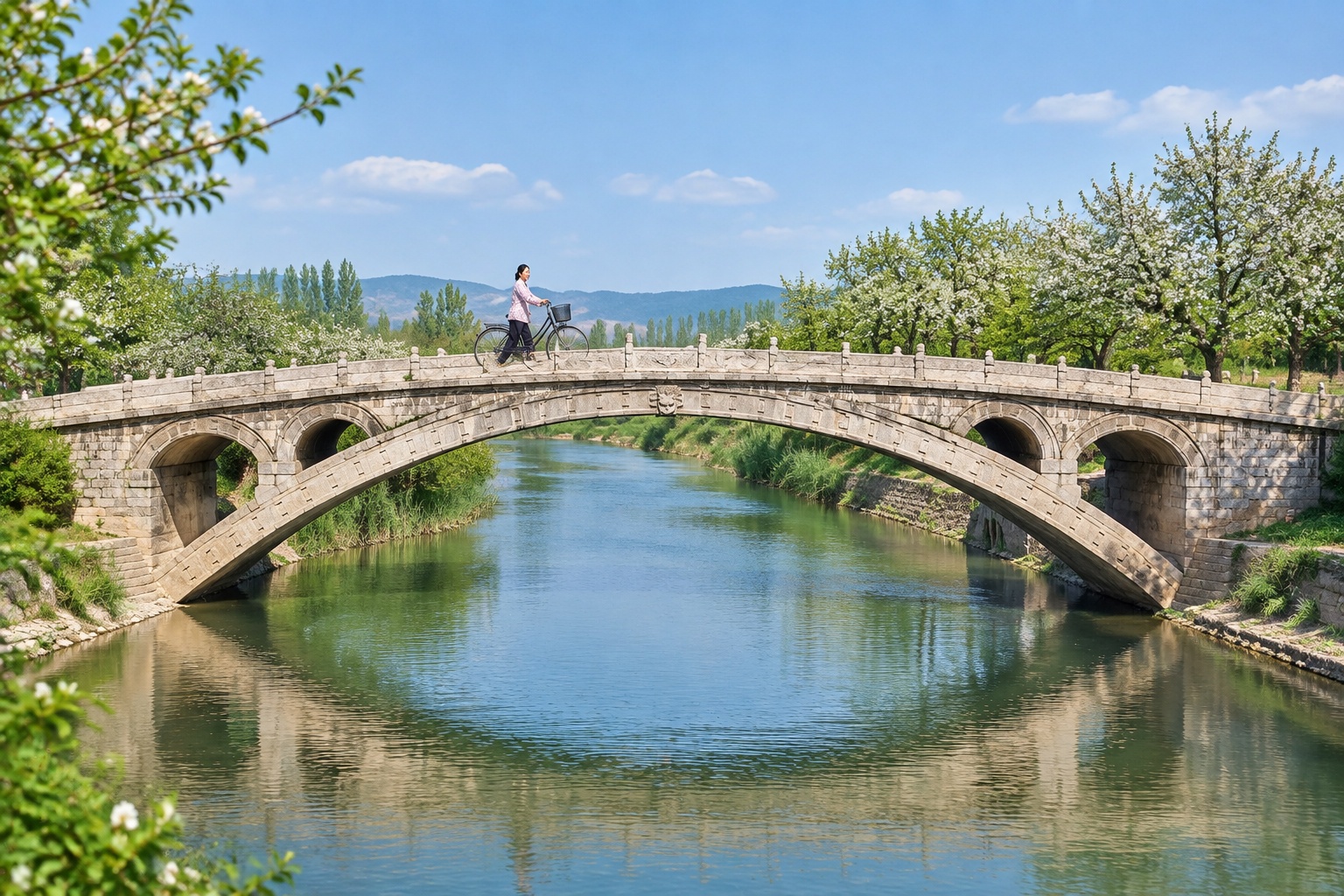
Shijiazhuang is not usually described as a tourist city. It is a railway and industrial hub in Hebei Province, about an hour from Beijing by high-speed train. Zhao County, where the bridge stands, is quieter: orchards, low houses, a river plain. The bridge is the reason many outsiders come. It is not a theme park version of history. It is a working heritage site, pedestrian-only now, with stone carvings close enough to touch and a river that still rises after summer storms.
The Engineering Idea That Made It Famous
To understand why the Zhaozhou Bridge matters, compare it with an ordinary stone arch bridge. A traditional semicircular arch rises high above the water. That shape is strong, but it also needs massive stone abutments on both sides and a steep roadway. The Zhaozhou Bridge uses a segmental arch: a shallow arc rather than a half-circle. The main span is about 37.02 meters, and the rise from the springing line to the crown is only about 7.23 meters. The ratio is roughly 1 to 5. In the early seventh century, that was a bold choice. A flatter arch pushes more horizontal thrust into the abutments, so the foundations must be stable and the whole structure must work together.
The bridge is also an open-spandrel arch. On each side of the main arch, there are two smaller arches in the spandrels, the triangular spaces between the main arch and the roadway. Four small arches in total. These openings are not decoration. They reduce the bridge’s weight, save stone, allow floodwater to pass through, and lower the pressure on the structure when the Xiao River swells. In heavy floods, water can move through the smaller arches instead of being blocked by solid walls. The design also reduces the amount of material that has to be supported by the main arch.
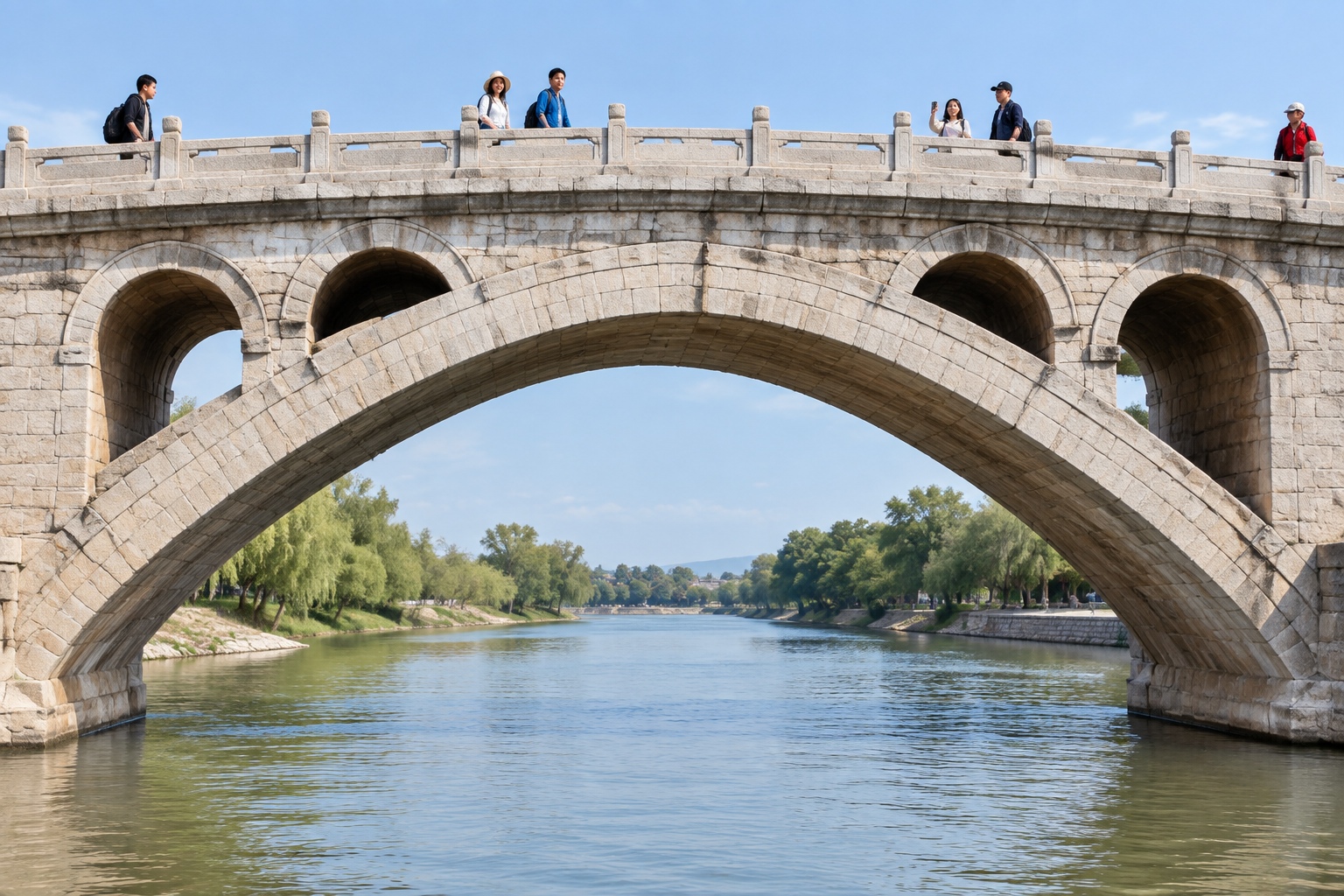
The bridge is about 50.82 meters long and 9 meters wide. Its main arch is made of parallel stone rings, with iron dovetail joints and stone blocks fitted together. The exact construction sequence is still studied, but the logic is clear: flexibility, drainage, and weight reduction. The bridge has survived at least eight major earthquakes, numerous floods, and more than a millennium of traffic. In 1966, when a strong earthquake struck the Xingtai area, about 40 kilometers away, the bridge remained standing. That is not luck alone. It is a system of decisions.
What the Numbers Do Not Show
Numbers explain the structure, but they do not explain the experience. Up close, the bridge is low and wide. The stone is gray, patched in places, with visible tool marks and carvings of dragons, lions, and floral patterns. The roadway is worn smooth in the center. From the riverbank, you can see how the small arches frame the fields behind. On quiet weekdays, the loudest sound is often a bicycle bell or wind in the pear trees. The scale is human. You do not feel dwarfed by a monument. You feel invited to cross it.
A Visit to Zhao County
The bridge sits in a park-like area with paths, signage, and a small exhibition hall. The site is managed as a national key cultural relic, and visitors are asked to stay on designated routes. That is a change from earlier centuries, when carts, animals, and people shared the roadway. The bridge is now pedestrian-only. Conservation teams watch for stone movement, water damage, and the effects of tourism. Some stones have been replaced during modern restorations, especially after the 1950s repair campaign. That fact can disappoint travelers who want an untouched relic. But it also shows how heritage works in practice: a bridge that is still standing is usually a bridge that has been maintained.
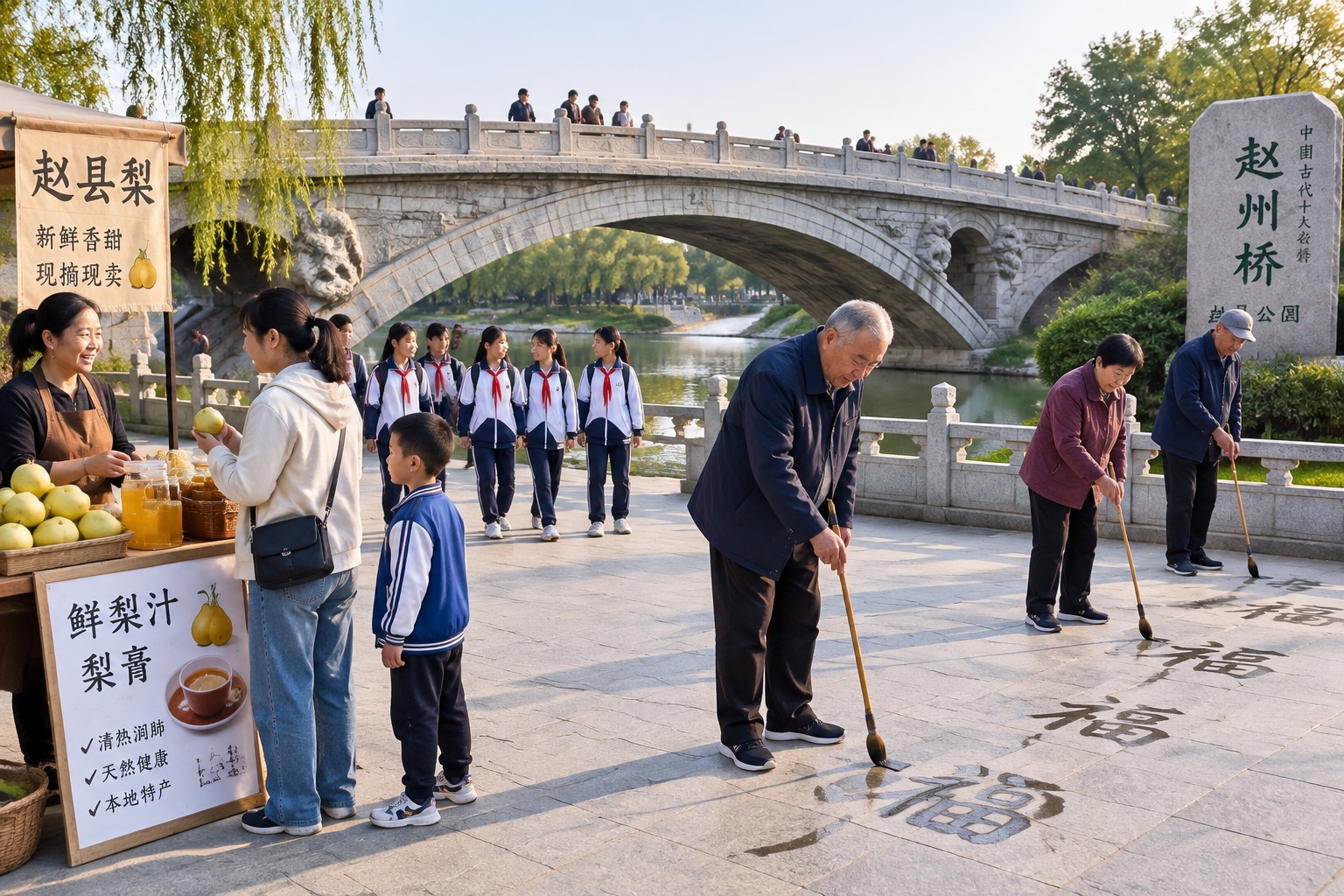
Zhao County itself is known for snowflake pears, and in autumn the orchards around the bridge turn gold. Local vendors sell pear syrup and dried fruit near the entrance. School groups come on field trips. Retired men practice calligraphy on the pavement with water brushes. The bridge is not isolated from daily life. It is part of it. That is one reason the site feels different from a museum. The past is not sealed off; it is next to a parking lot, a tea shop, and a road bridge carrying trucks.
From Sui Dynasty Engineering to Modern Shijiazhuang
The contrast between old and new is easy to see. Within a short drive, you can be on a modern expressway or a high-speed rail line. Shijiazhuang has grown into a city of millions, with a subway, biotech parks, and logistics centers. Hebei is also part of the Beijing-Tianjin-Hebei region, a national plan to integrate transport, industry, and public services. The Zhaozhou Bridge is not a symbol of a frozen past. It is a reminder that engineering capacity in this region has deep roots. The same county that produced a seventh-century open-spandrel arch now sits near some of the world’s longest high-speed rail networks.
For overseas readers, the bridge also answers a common question: what does China’s ancient heritage mean in a country that is changing so fast? The answer is not simple. Some heritage sites become theme parks. Some are neglected. The Zhaozhou Bridge is somewhere in between: protected, studied, visited, and still part of local identity. It is not the Great Wall or the Forbidden City. It is an unseen landmark, which may be why it feels more revealing.
Why It Still Matters
Engineers remember the Zhaozhou Bridge because it changed what a stone arch could be. The open-spandrel segmental arch was later used around the world, from European bridges to modern concrete structures. The bridge shows that good engineering is not about adding more material. It is about understanding forces and letting them move through a structure efficiently. It also shows that durability is a form of sustainability. A bridge that lasts 1,400 years avoids the cost, carbon, and disruption of repeated replacement.
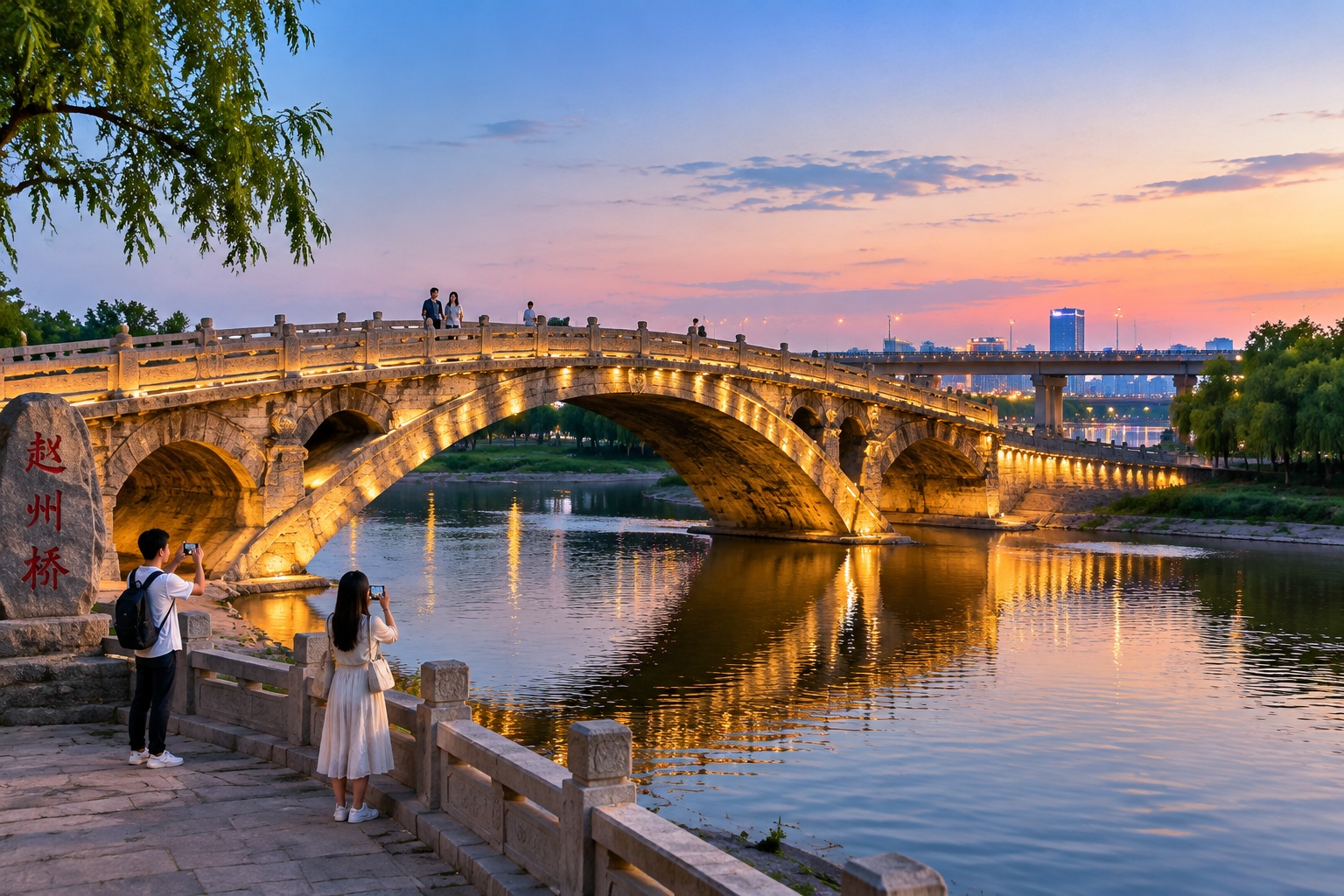
At dusk, the stone turns a soft yellow. The Xiao River keeps moving. A few visitors take photos, then leave for the bus back to Shijiazhuang. The bridge stays. It has outlasted dynasties, wars, floods, and the invention of the automobile. It will probably outlast many things being built today. That is not a mystical claim. It is a conclusion you can reach by standing on the bridge, looking at the small arches, and counting the centuries.
Start the discussion at forum.chinacomes.com