

Six lanes of bridge, water on both sides
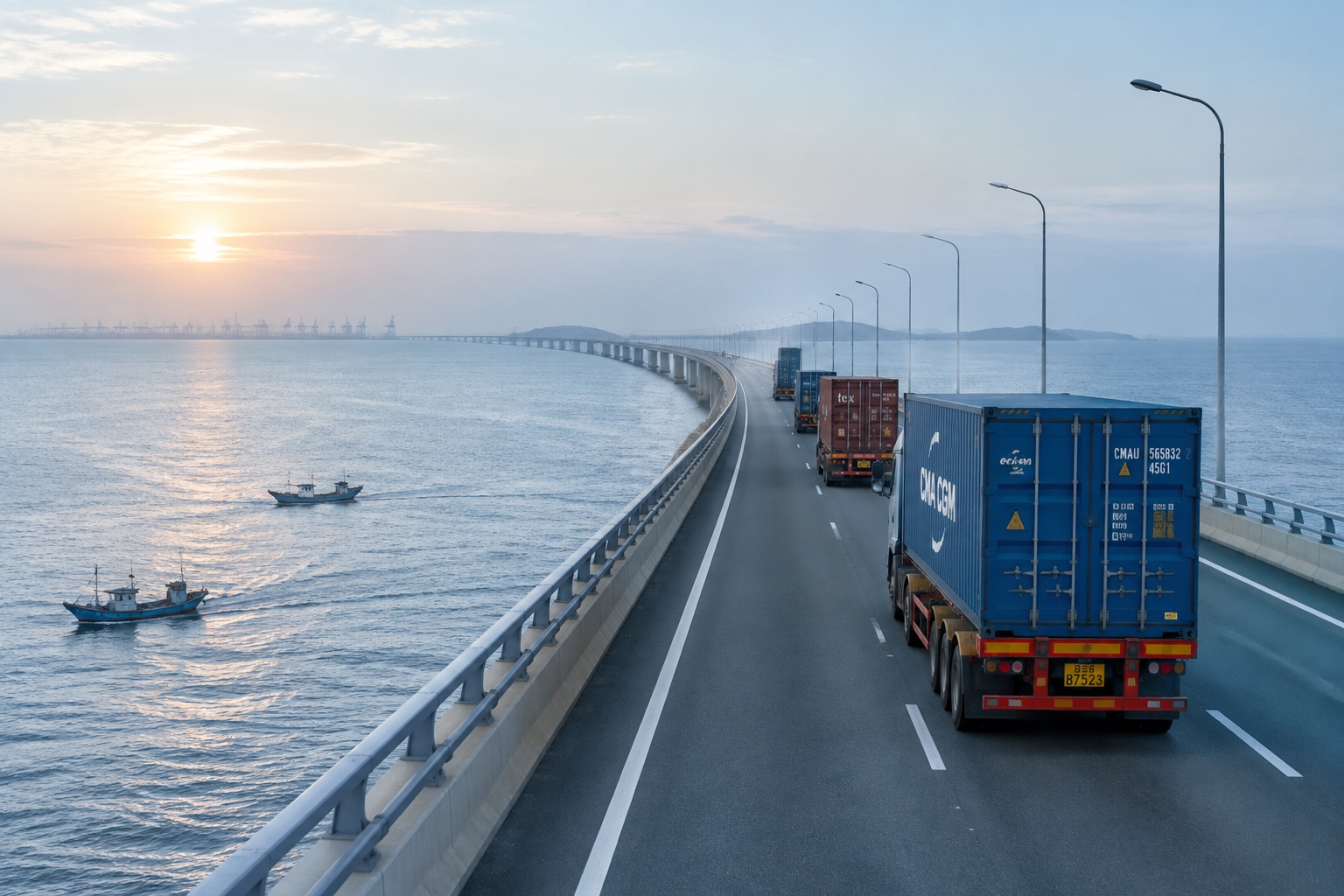
At 6:40 on a Tuesday morning, the Donghai Bridge is still grey. Thirty-two and a half kilometres of asphalt run dead straight, six lanes wide, with nothing on either side but water. A line of container trucks is already heading east, toward two small islands most maps barely mark: Xiaoyangshan and Dayangshan.
There is no city at the far end. There is a port — Yangshan Deep-Water Port, the offshore half of Shanghai’s port complex, and the place where a very large share of the world’s manufactured goods enter and leave China. A laptop, a pair of running shoes, a bag of Chilean cherries bought in January: any of them may have passed through here.
Why Shanghai built its port on an island
In the 1990s, container ships began growing faster than the channels that served them. Shanghai’s docks sat up the Yangtze and Huangpu rivers, where the water ran 8 to 10 metres deep. Even after the Yangtze estuary channel was dredged to 12.5 metres, the newest vessels — drawing 14 metres or more when loaded — could not get in. Their cargo was transshipped through Busan, Kaohsiung and Singapore instead.
The answer was to stop fighting the river. Thirty kilometres offshore in Hangzhou Bay, the Xiaoyangshan and Dayangshan islands sit in water 15 to 17 metres deep, close to the open-sea lanes. Construction began in 2002 on land reclaimed from the sea, and on the 32.5-kilometre bridge that would connect it to the mainland. The Donghai Bridge opened in December 2005 with six lanes and, running through its belly, pipes carrying fresh water and cables carrying power and telecoms. Fresh water mattered: the islands had none.
One detail puzzles most visitors. The islands belong to Zhejiang province, but the port is developed and run by the Shanghai International Port Group. Shanghai builds and operates; Zhejiang collects rent and tax revenue. The arrangement is unusual anywhere in the world, and without it the port would not exist.
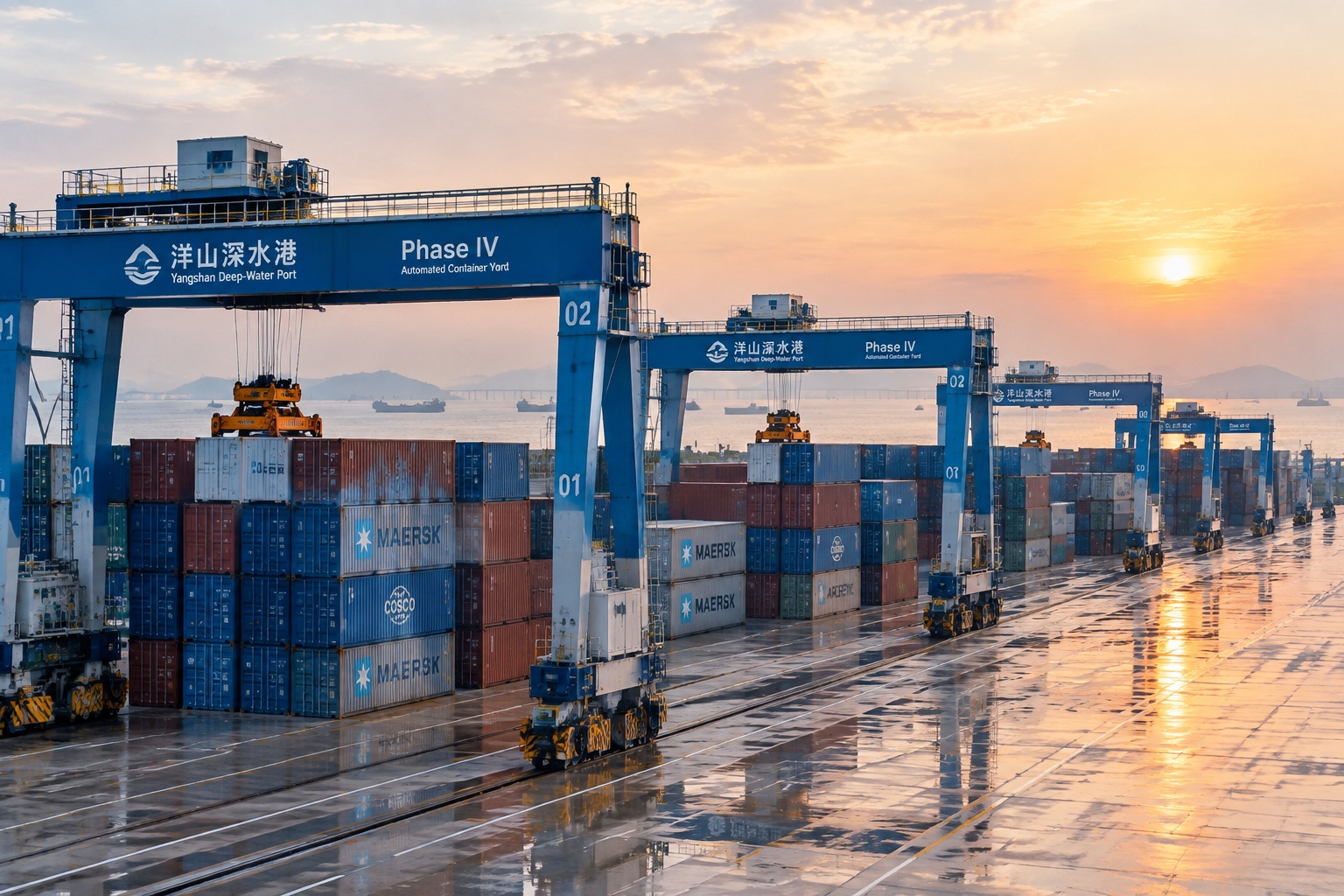
Inside Phase IV: a quay with almost nobody on it
The automated terminal, known as Phase IV, opened on 10 December 2017. Its quay runs 2,350 metres and holds seven berths. On a normal night it looks half abandoned, which is the point.
Nothing human moves in the yard. Container handling rests on three machines. Twin-trolley ship-to-shore cranes lift boxes off the vessels. Flat, battery-powered automated guided vehicles — AGVs, with no cab and no driver — carry them from the quay to the stack. Automated rail-mounted gantry cranes lift and place them, five or six high.
Above all of it sits the terminal operating system, the software that decides which box goes where, in what order, on which machine, and when. For decades, large ports around the world licensed this layer from European and American vendors. Yangshan’s was written in-house by the port group together with the Chinese crane maker ZPMC — the scheduling brain of a Chinese terminal is no longer bought from abroad.
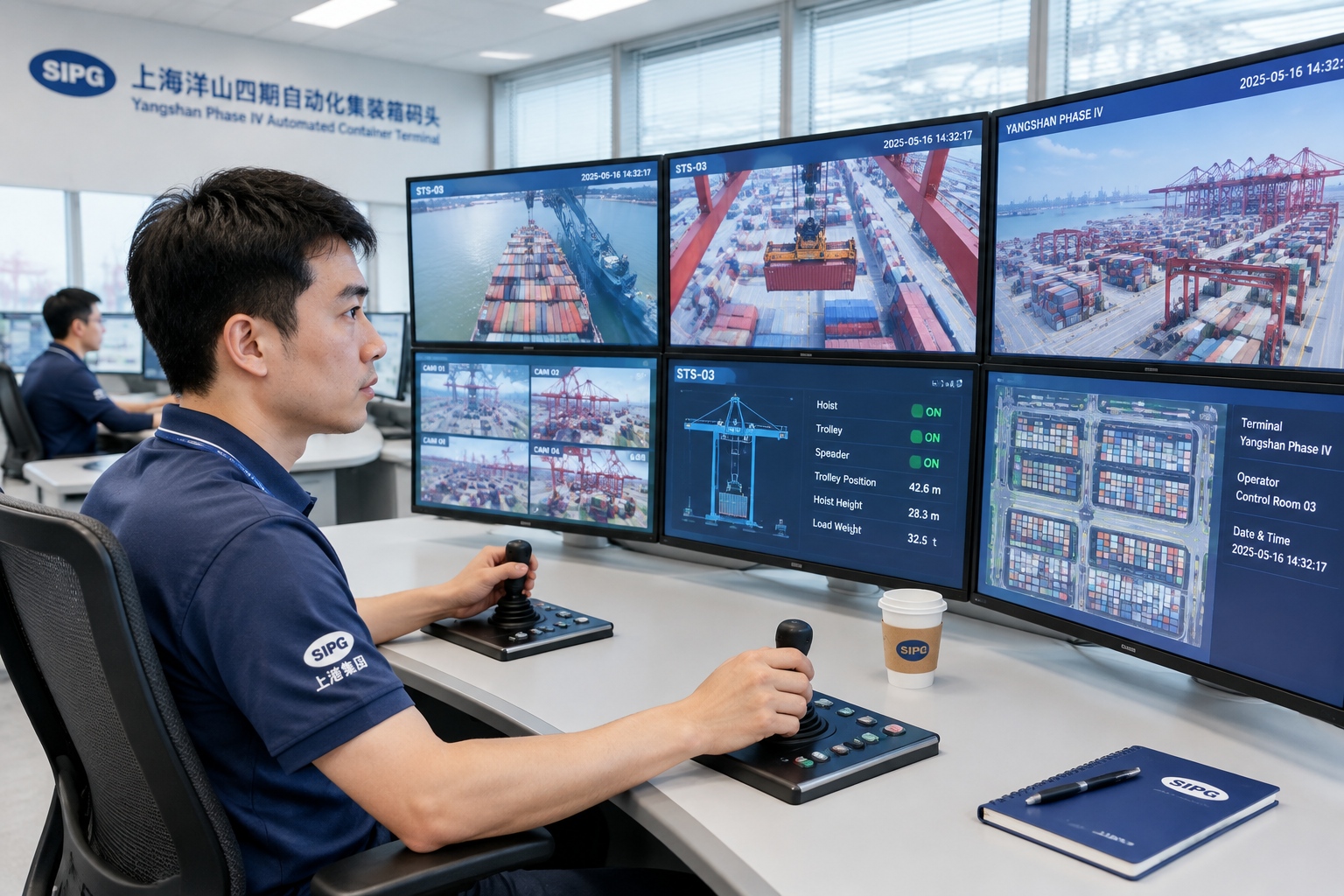
The crane operators are still here. They are just not on the cranes. In the control room, an operator sits in front of a wall of monitors with both hands on two joysticks, moving a container two kilometres away. The chair is padded; the room is air-conditioned. Some of these jobs have since moved again, off the island entirely into offices in Shanghai, with the cranes reached by fibre and 5G.
The numbers behind the world’s busiest container port
Shanghai moved 51.51 million TEU in 2024 — twenty-foot equivalent units, the standard measure of container traffic — the largest total of any port for the fifteenth year running. Yangshan accounts for close to half of it.
- Berth depth: 15 to 17 metres, enough for ships carrying more than 20,000 TEU.
- Phase IV: seven berths, 2,350 metres of quay, a design capacity of about 4 million TEU a year, 26 ship-to-shore cranes and more than 100 automated guided vehicles.
- The bridge: 32.5 kilometres, six lanes, built in under four years.
It is still growing. Since 2022, crews have been building an entire new terminal on the north side of Xiaoyangshan, on land that did not exist a few years ago — berths for the biggest ocean-going ships and for smaller feeders, with designed annual capacity of more than 10 million TEU.
The bridge carries driverless trucks now, too. Since the early 2020s, a fleet of autonomous container trucks has run boxes between the logistics park at Luchao, on the mainland, and the port. By 2024 the operators said the fleet had moved more than 200,000 TEU.
What is inside the boxes
In January, refrigerated containers of cherries leave Chile and arrive at Yangshan roughly three weeks later. They clear customs within hours, are trucked to cold-chain markets around Shanghai, and turn up in neighbourhood fruit shops a day or two after that — usually just before Lunar New Year, when they are a common gift.
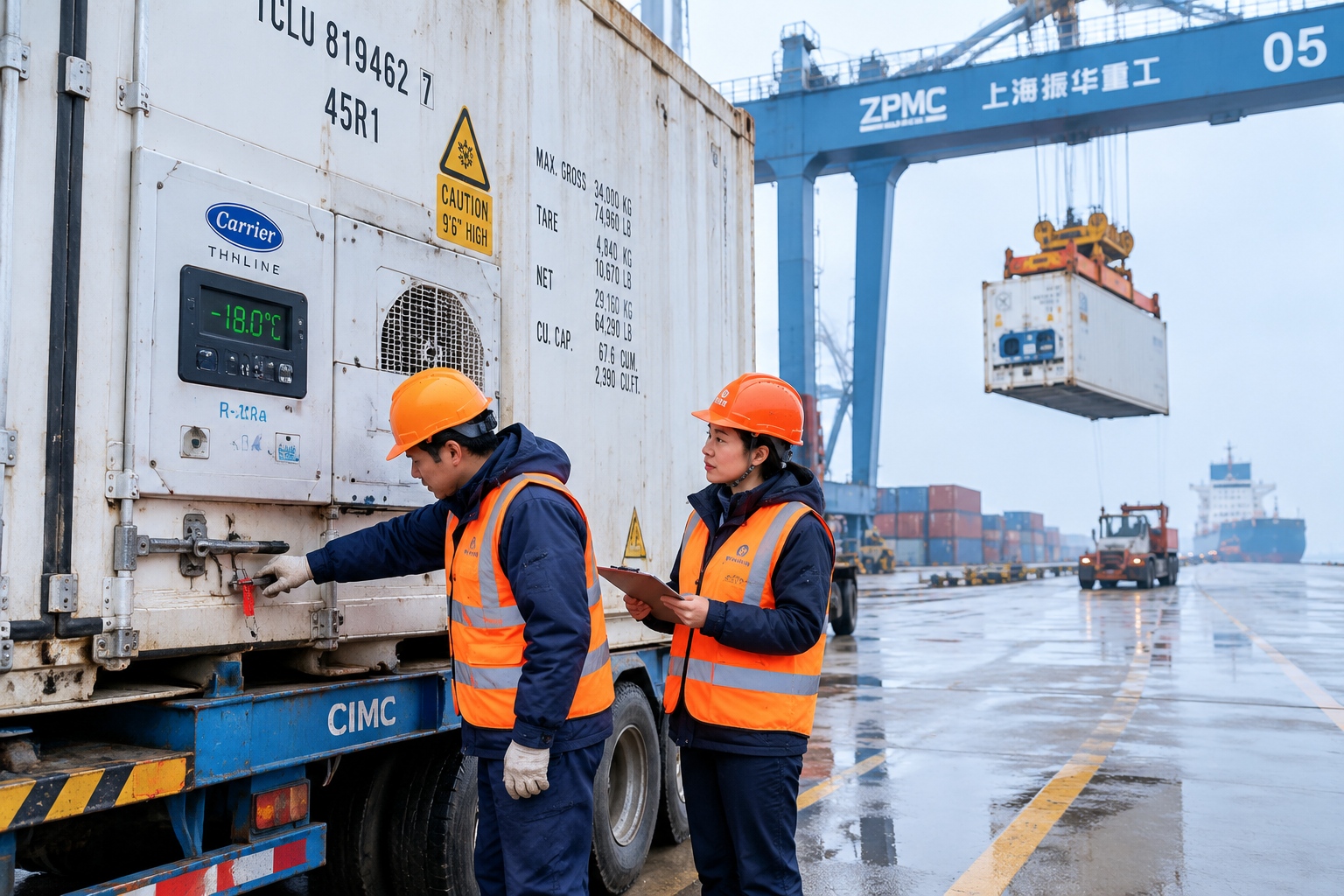
Containers leave the other way as well: washing machines, e-bikes, solar panels, air conditioners, furniture. A standard 40-foot box holds roughly 200 front-loading washing machines, or about 7,000 pairs of sneakers, or 67 cubic metres of almost anything else. Multiply that by 51 million boxes a year and you have some sense of what one stretch of Chinese coastline moves.
Not all of it is China’s own trade. A large share of the volume arrives by barge from ports along the Yangtze — Jiangsu, Anhui, Zhejiang — or transfers from other Asian ports before heading to Europe and North America. Yangshan is a switching yard for the western Pacific as much as it is a gate into China.
What automation did to the work
At an older terminal, a crane driver’s job is physical in a way that surprises visitors. You climb 40 metres or more into a cab above the quay and spend eight hours looking down through a window at a container the size of a garage, guiding it by feel while the ship shifts beneath you. Toilet breaks take planning. Knees and necks take the damage.
Port groups say automation has cut on-site labour by roughly 70 percent at terminals of comparable size. That number is real, and it means fewer drivers and almost nobody walking in the yard. It does not mean an empty port. Technicians service the AGVs and swap their batteries. Lashing crews still tie containers down on deck, though part of that work has been mechanised. Inspectors, electricians, network engineers and software teams have grown.
Safety is the clearest gain: no one walks among stacked containers and moving machines. The new vulnerabilities are less visible — a software fault, a severed fibre line, an attack on the system that decides where forty-tonne boxes travel.
The parts machines cannot fix
Hangzhou Bay carries heavy sediment, so dredgers work continuously to hold the channels at depth. Typhoons close the port several times a year; in September 2024, Typhoon Bebinca shut Shanghai’s terminals and ships waited offshore or diverted to Ningbo and Busan. Salt air corrodes steel and eats maintenance budgets, and the bridge is inspected and repaired on a rolling schedule.
The system also depends on people willing to work shifts 30 kilometres out at sea on reclaimed land. Free shuttle buses run from Shanghai, but the commute is long, and the jobs people want are the ones in the control room.
What a port actually sells
By evening the bridge lights come on and the water goes dark. A ship that arrived in the morning is loaded and gone. Somewhere in Shanghai, a shop assistant weighs a bag of cherries for a customer who will never think about Yangshan.

That is the product a port really sells — not boxes, but predictability. A factory in Zhejiang, a farm in Chile and a supermarket in Europe all plan around the assumption that a container moves when they were told it would. Keeping that promise, fifty million times a year, is what an almost-empty quay is built to do.
Start the discussion at forum.chinacomes.com