

Five minutes that used to take half a day
The D-class train out of Fuzhou South is an ordinary Chinese intercity service: rows of seats, a trolley with bottled water, air conditioning humming, a screen showing 35 minutes to Pingtan.
Then, about five minutes before the station, the land disappears. On both sides of the window there is nothing but grey-green water, ridged and moving fast. Regulars stand up in the aisle to look.
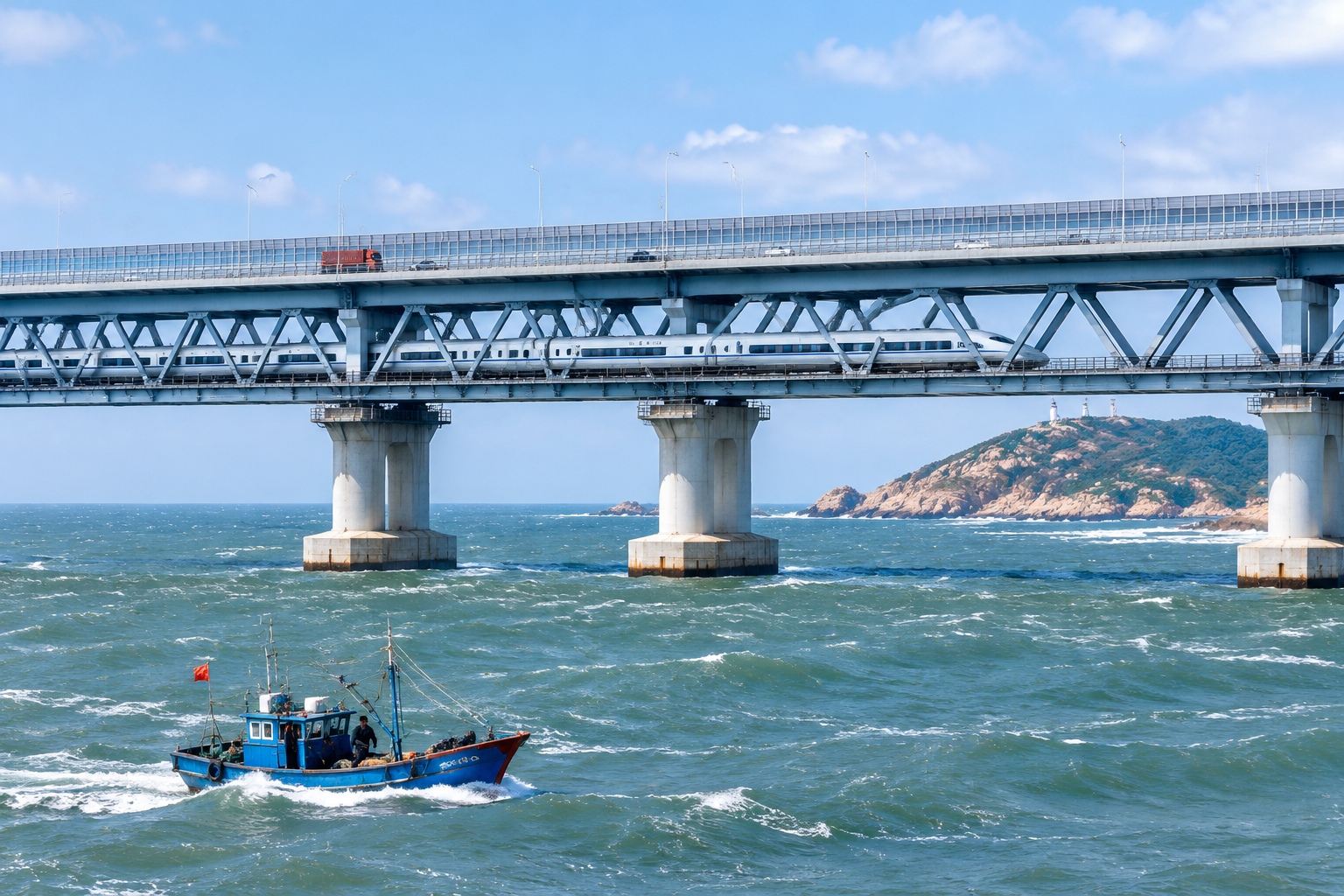
They are crossing the Pingtan Strait Road–Rail Bridge — 16.34 kilometres of steel truss carrying a six-lane expressway on its upper deck and a double-track railway underneath, linking the Fujian mainland to Pingtan Island. It is the longest sea crossing in the world built for both road and rail, and it opened to traffic in late 2020.
What “road–rail” actually means
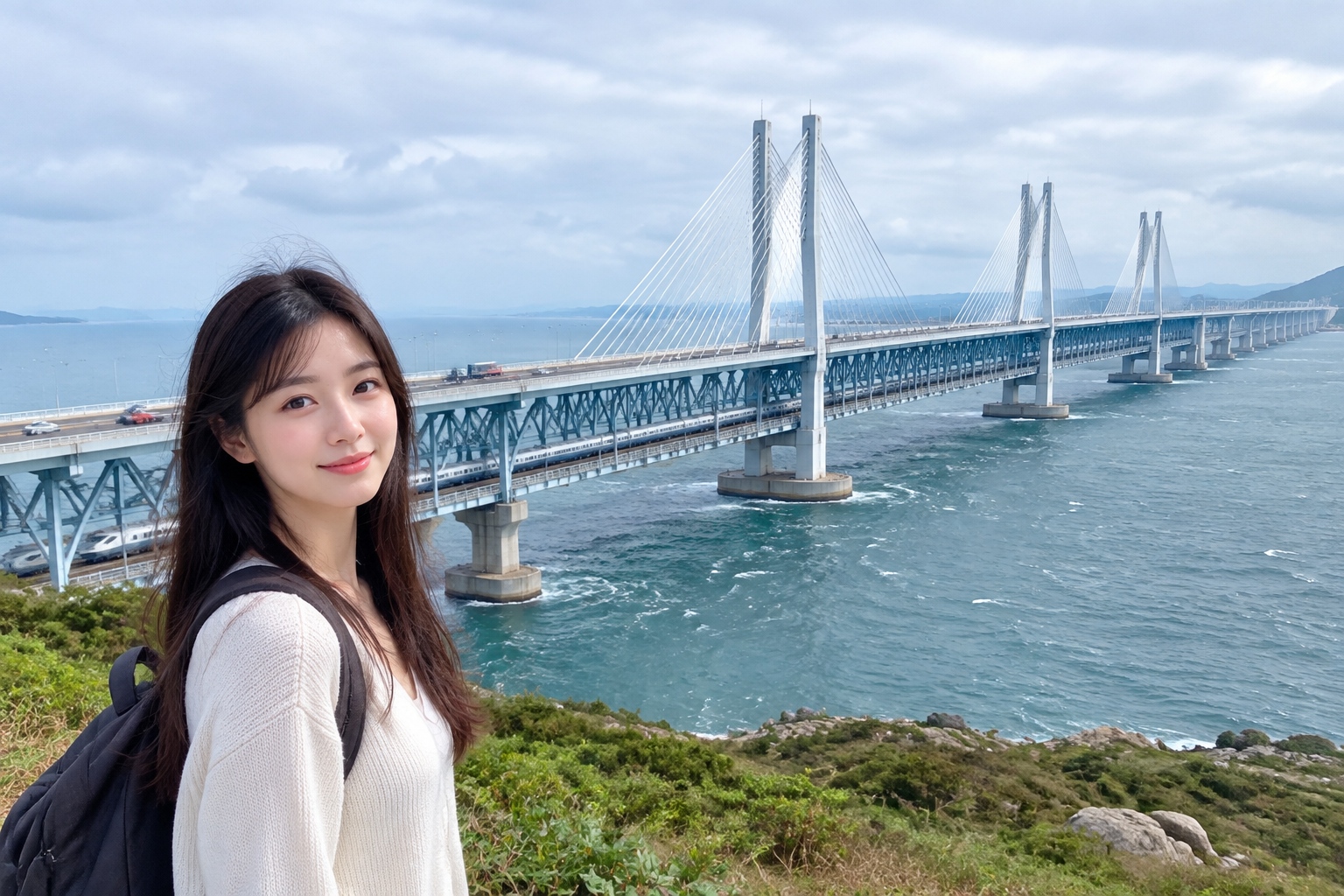
In China the term gongtie liangyong qiao — a bridge for both public road and railway — describes a specific engineering choice: one set of piers in the seabed, two decks stacked on top of it. Land is scarce, shipping channels are fixed, and budgets are finite, so the two modes share a structure instead of building two bridges side by side.
The upper deck of the Pingtan bridge is a six-lane expressway limited to 100 km/h. The lower deck holds two railway tracks designed for 200 km/h. Three times across the strait, the structure becomes a cable-stayed bridge so that ships can pass underneath; the largest of those main spans is 532 metres.
The bridge is the saltwater section of the 88.4-kilometre Fuping Railway, and it also forms the road link to Pingtan’s new high-speed railway station. Pingtan itself is small — just under 400,000 residents — but it is the closest piece of Chinese territory to Taiwan, roughly 68 nautical miles from Hsinchu.
A strait that spends most of the year saying no
Before anything else, engineers had to design for wind. At the bridge site, gusts reach force 6 on the Beaufort scale on more than 300 days a year — enough to make walking uncomfortable and to stop a crane lifting. On more than 200 days they reach force 7. Pingtan sits in what Chinese engineers call one of the country’s three great wind corridors: the gap where the northeast monsoon is squeezed through the Taiwan Strait.
Then add the rest of the site. Waves that can run close to 10 metres. Water up to about 40 metres deep. A seabed of hard granite under soft sediment, unforgiving to drive piles into and difficult to seal.
The blunt arithmetic of construction: crews had fewer than 120 workable days a year, roughly a third of the calendar. The other two thirds went into waiting, tying down equipment and replanning.
How you build a bridge that survives this
Five decisions explain most of the result.
A structure that lets wind through
The superstructure is a steel truss rather than a concrete box girder. Steel is lighter for the same strength, and an open lattice gives the wind somewhere to go instead of presenting it with a solid wall. That matters when lateral load is the governing design case.
Cable-stayed spans where ships need room
Three navigation-channel bridges use cable-stayed steel trusses, the largest with a main span of 532 metres. Cable stays pull the deck up toward the towers, keeping the spans long and the piers few.
Wind tunnel testing, not guesswork
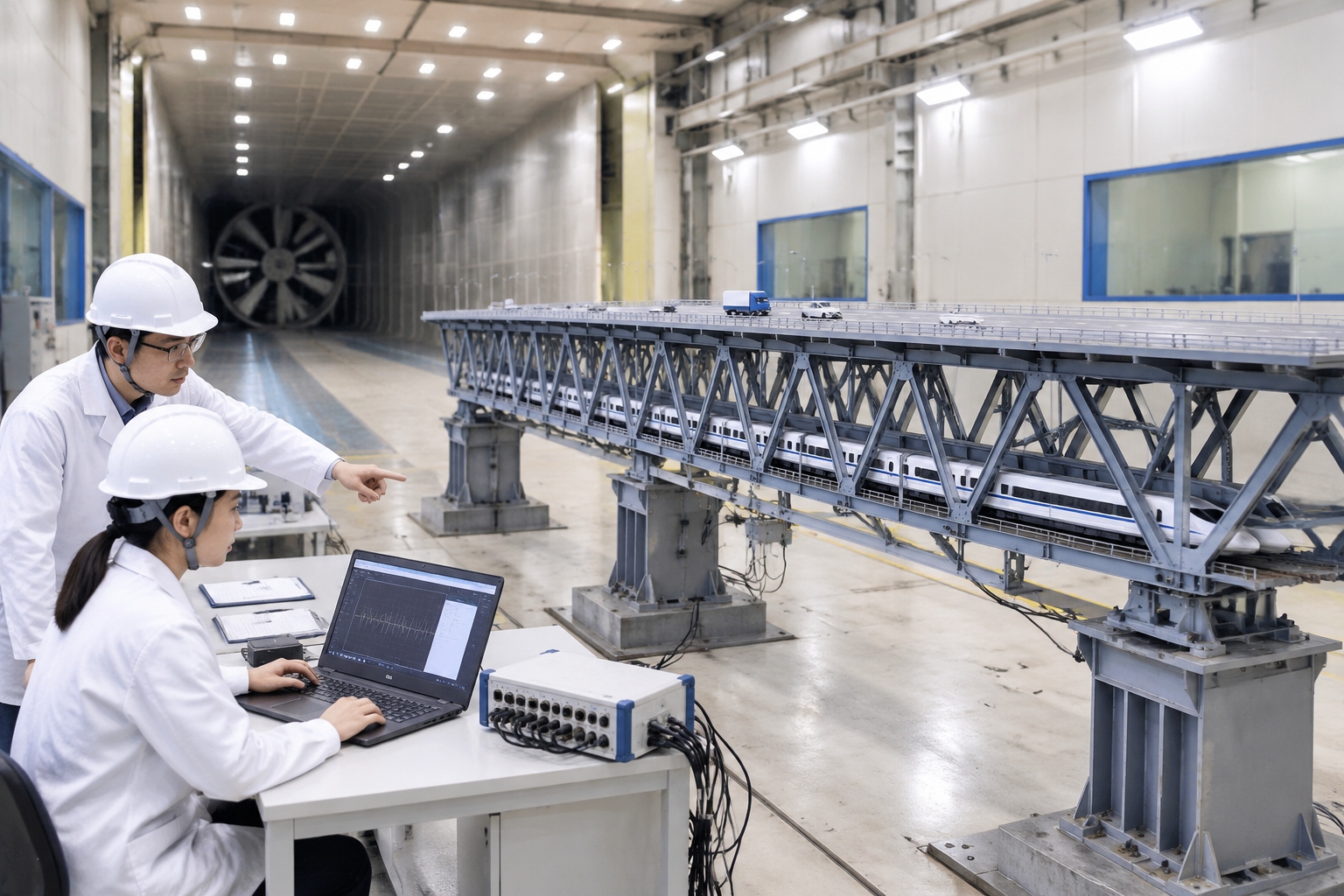
Scaled section models went into wind tunnels before construction, and the project ran wind–vehicle–bridge coupling analyses: at what crosswind speed does a truck, or a train, start to become unsafe on this particular deck? Those numbers, not intuition, set the operating rules.
Wind barriers on both decks
Tall wind barriers line the highway deck, breaking up the crosswind before it reaches a car or a container truck. The railway deck has its own shielding. The practical effect is that the bridge stays open at wind speeds that would otherwise force closures.
Foundations that can take the load
The project used bored piles 4.9 metres in diameter, reported at the time as the largest used on any bridge in the world, sunk into granite with double-wall steel cofferdams protecting the work. A 3,600-tonne floating crane, the Da Qiao Hai Ou, lifted prefabricated truss sections into place during the narrow weather windows.
What the crossing feels like — and what it replaced
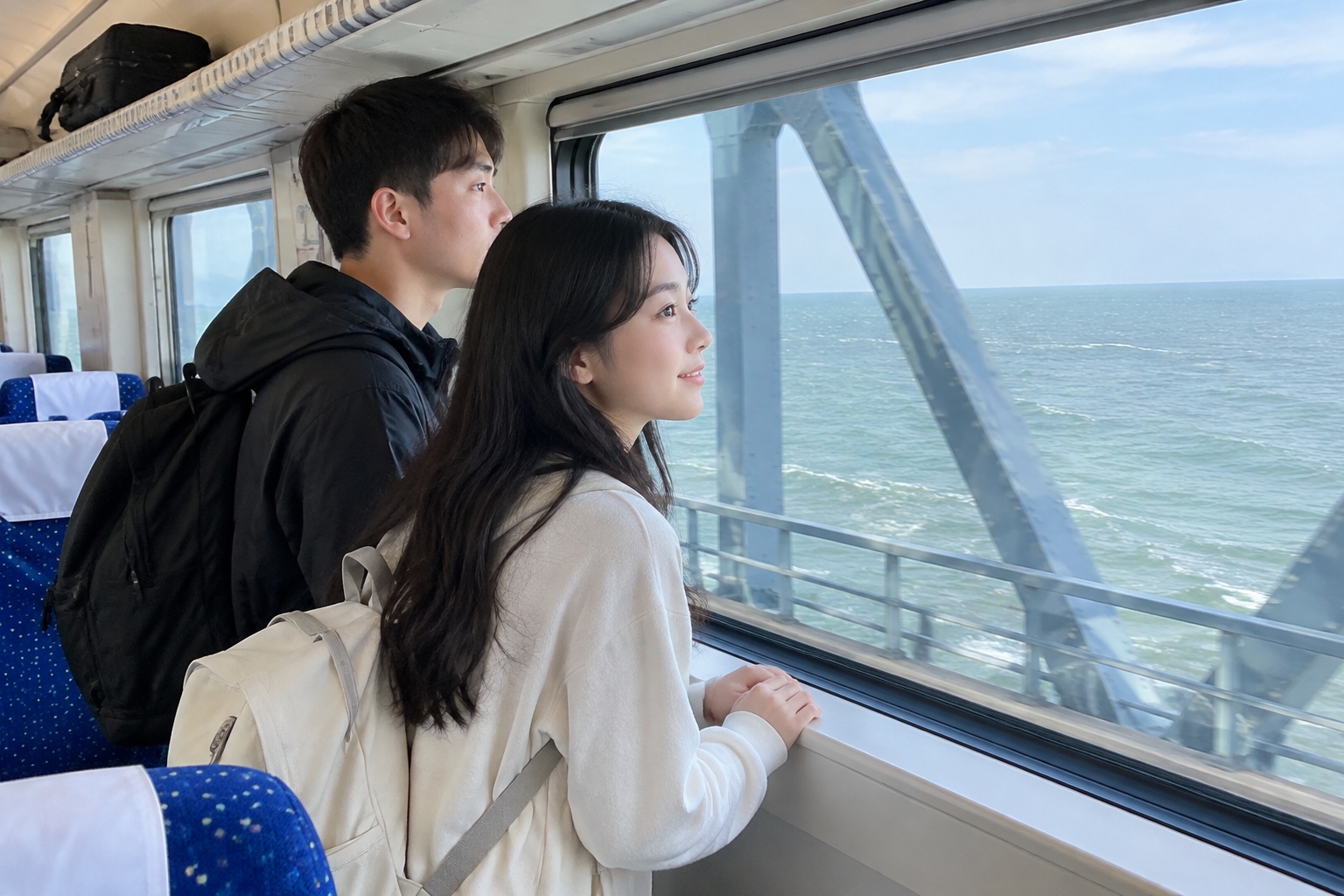
Because the railway runs on the lower deck, you cannot see the road above you. From the window there is water, the edge of the truss, and, higher up, the guardrails and container trucks of the expressway running in parallel. In rough weather the surface of the strait looks like it is being combed. A few minutes later the train slides into Pingtan station, and the announcement is over before most passengers have sat back down.
Twenty years ago the same journey was an unpredictable half-day. Until the first highway bridge opened in 2010, reaching Pingtan meant a ferry; strong wind cancelled sailings, and the island simply waited. Even after 2010 there was one road link and no railway at all. The railway arrived with this bridge in 2020.
What changed on the island
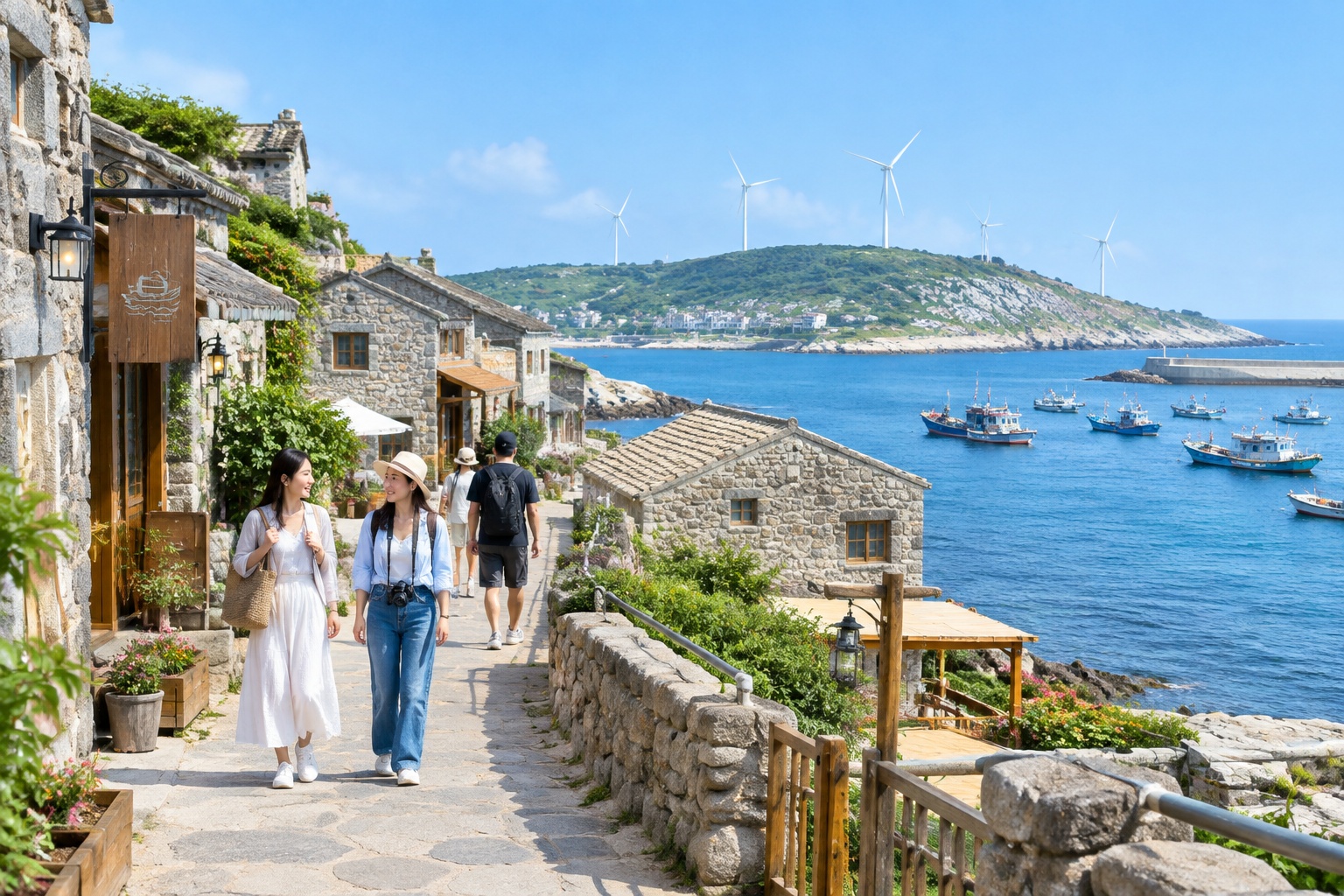
The most visible change is tourism. Pingtan has become a spring destination for “blue tears” — bioluminescent plankton that light up the surf from roughly April to June — and guesthouses have spread through fishing villages such as Beigang. Fuzhou residents now treat the island as a weekend trip rather than an expedition; visitors also come from Xiamen, Zhejiang and Guangdong.
Less visible is the commuting. A 35-minute train makes it possible to work in Fuzhou and sleep on the island, which was not realistic when the only options were a bus, a car, or a ferry plus a car. Seafood and kelp leave faster and cheaper, and the freight cost of everything coming in has fallen.
It would be wrong to describe the bridge as having turned Pingtan into a boom town. Winters are still windy and quiet, the resident population is under 400,000, and the local economy leans on fishing, tourism and cross-strait policy. The bridge removed isolation; it did not manufacture prosperity.
Different bridges, different problems
Three comparisons help place the Pingtan bridge. The Hong Kong–Zhuhai–Macao Bridge, opened in 2018, is far longer at 55 kilometres, but carries road traffic only and solves its hardest problem with a 6.7-kilometre immersed tube tunnel. The Husutong bridge over the Yangtze, opened in July 2020, carries road and rail on a 1,092-metre cable-stayed main span — the first such span over a kilometre — but it crosses a river, with far less wind exposure. The Quanzhou Bay bridge on the Fuzhou–Xiamen high-speed line, opened in 2023, is 20.3 kilometres and designed for 350 km/h, but carries rail alone.
The Pingtan bridge is the only one in that group that combines length, two transport modes and open-sea wind.
The wind still gets a vote
On typhoon days the expressway deck is closed and trains are slowed or rescheduled. The bridge does not defeat the strait. What it did was turn a crossing that depended on the weather into one that depends on a timetable — and anyone who has waited at a ferry terminal in a stiff northeast wind knows the difference between those two things.
Underneath the piers, fishing boats still work the same water. Above them, the traffic keeps moving.
Start the discussion at forum.chinacomes.com