
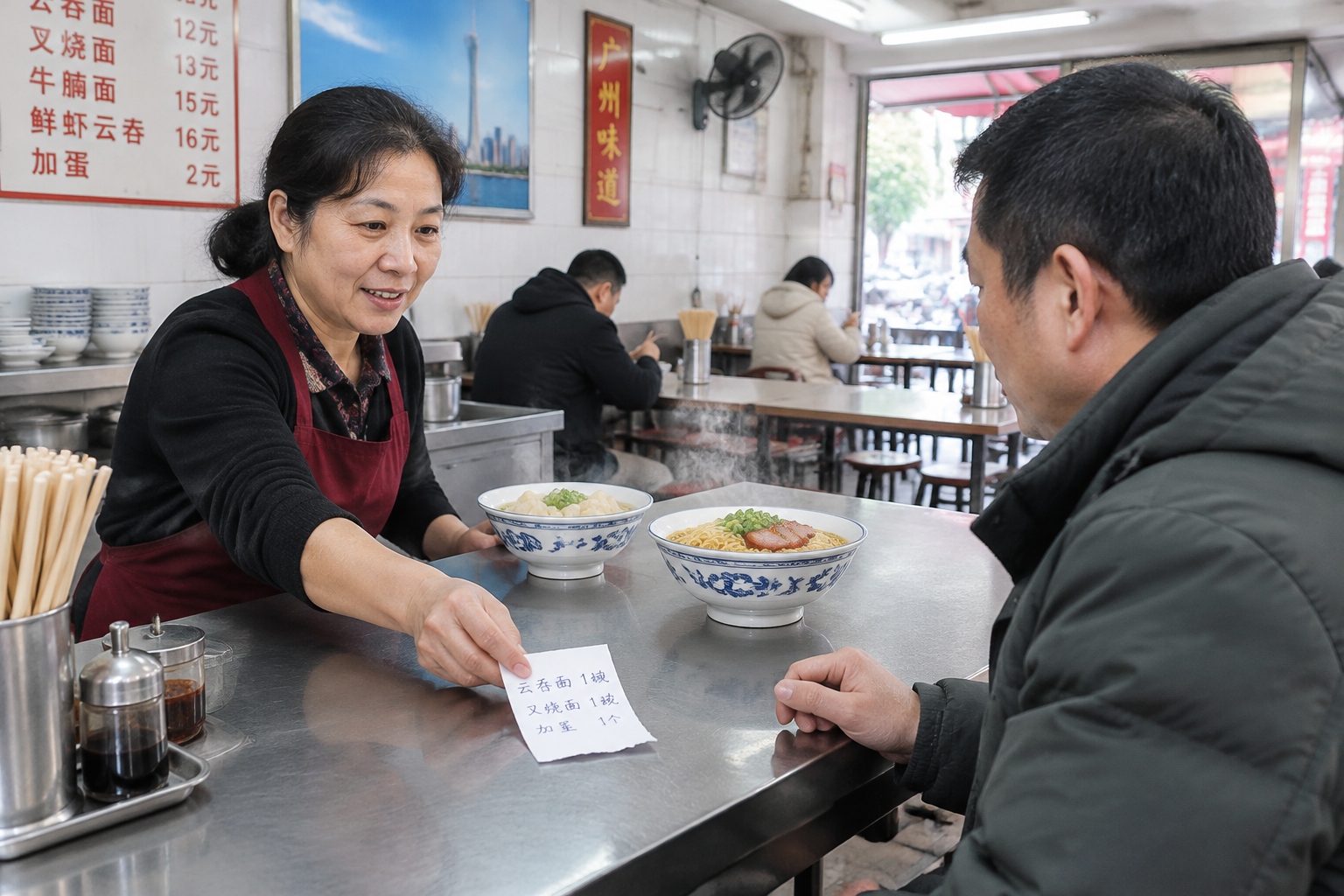

A Tear of Paper in a Guangzhou Noodle Shop
The customer is from Harbin, in China’s far northeast, and he wants to know whether the soup has pork in it. The woman behind the counter answers in Cantonese. Both of them are speaking Chinese. Neither understands the other.
After two failed attempts she tears a corner off the order pad, writes four characters, and slides it across the counter. He reads it, nods, and sits down. Nobody around them finds this remarkable. It happens every day in noodle shops, train stations and hospital waiting rooms across the country.
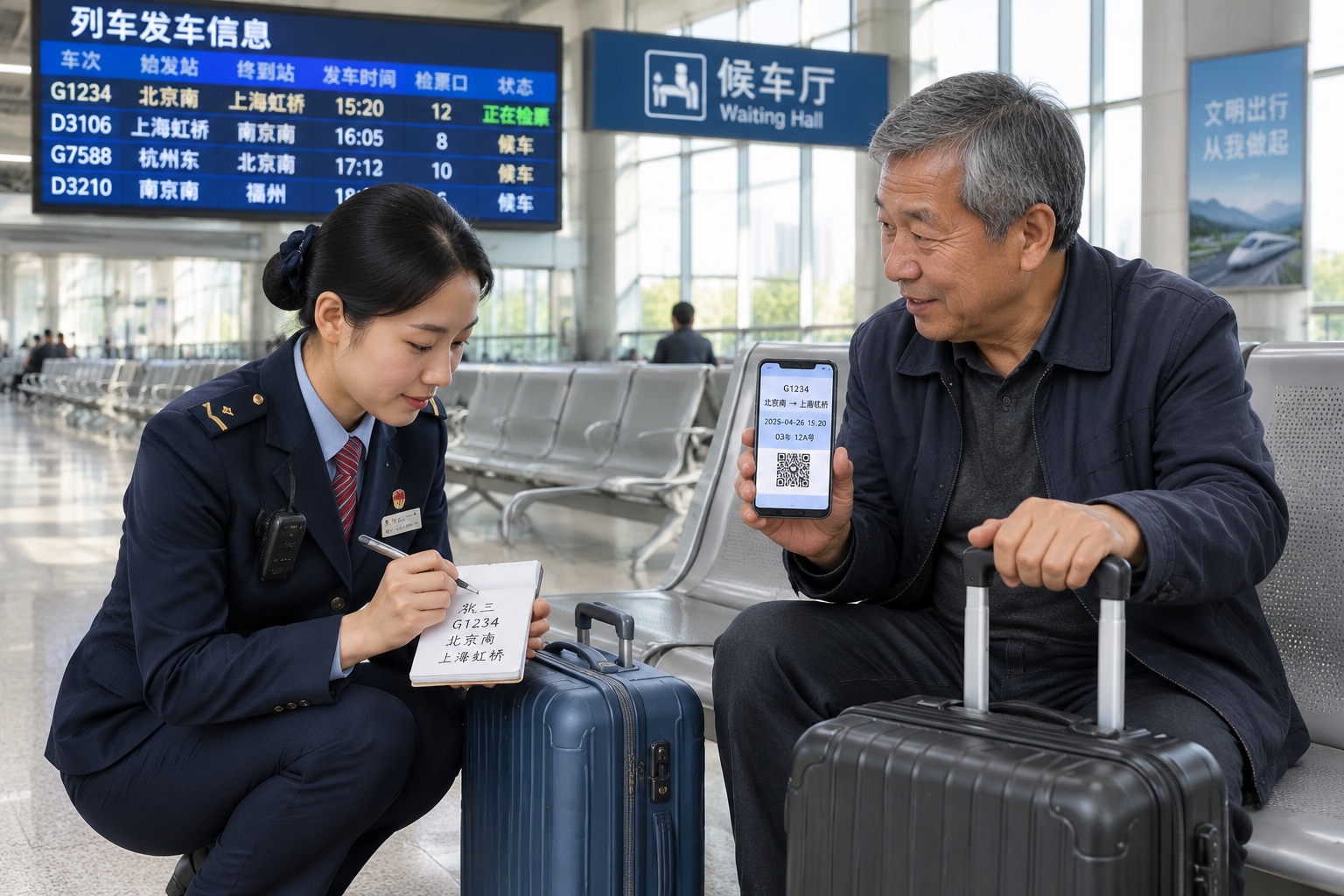
The trick works because written Chinese does not record sound. It records meaning, and lets every reader bring their own pronunciation to the page. A man from Harbin and a woman from Guangzhou cannot hold a conversation, but they can read the same four characters and agree on what they say.
Almost Every Other Living Script Starts With Sound
Read the English word “knight” and you can say it out loud, even though the letters no longer match how it sounds — the spelling is a fossil of how it used to be pronounced. That is the normal arrangement. Latin letters, Cyrillic, Arabic, Devanagari, Korean hangul, Japanese kana: at heart, all of them are instructions for the mouth. When a language’s pronunciation drifts, its spelling eventually drifts with it.
That is exactly how one language turns into several. As spoken Latin came apart across Europe, French, Spanish, Italian, Portuguese and Romanian each ended up with its own spelling system and its own literature. A reader in Lisbon cannot casually pick up a novel printed in Bucharest.
Chinese took the other road. The written form stayed shared while the spoken language split into dozens — by some counts hundreds — of mutually unintelligible varieties: Mandarin, Cantonese, Hokkien, Hakka, Shanghainese, Teochew. Beijing and Hong Kong cannot hold a phone call. They can read each other’s newspapers.
Part of this was deliberate. For more than a thousand years, China’s imperial examinations required officials from every corner of the empire to write in the same formal register, which made a shared written standard a career necessity. Part of it was simply how the script works. Either way, the outcome is odd: a country where reading travels much further than speaking.
The characters also travelled outward. Japan borrowed kanji, Korea used hanja for centuries, Vietnam wrote with chữ Nôm. None of those readers were pronouncing Chinese out loud. They were reading Chinese characters in their own languages.
Where the Simple Version Breaks Down
It would be tidy to say Chinese characters are pictures of meaning. They are not. Roughly 80 percent of characters combine a meaning hint with a sound hint. 妈 (mā, mother) is built from 女 (woman) plus 马 (mǎ, horse) — the horse is there for its sound, not the animal.
So Chinese is a mixed system. The difference is that sound plays a supporting role instead of the lead. A character can survive a shift in pronunciation without anyone rewriting it, which is why a Tang-dynasty poem from twelve centuries ago is still memorised by schoolchildren, while an English speaker needs a translation to read Beowulf.
Four Scripts Were Invented From Scratch. Three Are Museum Pieces.
Scholars broadly agree that writing was invented independently a small number of times: Sumerian cuneiform, Egyptian hieroglyphs, Maya glyphs and Chinese oracle bone script.
The first three are read today mainly by specialists, from stone and pottery. The fourth is the one you would use to order lunch.
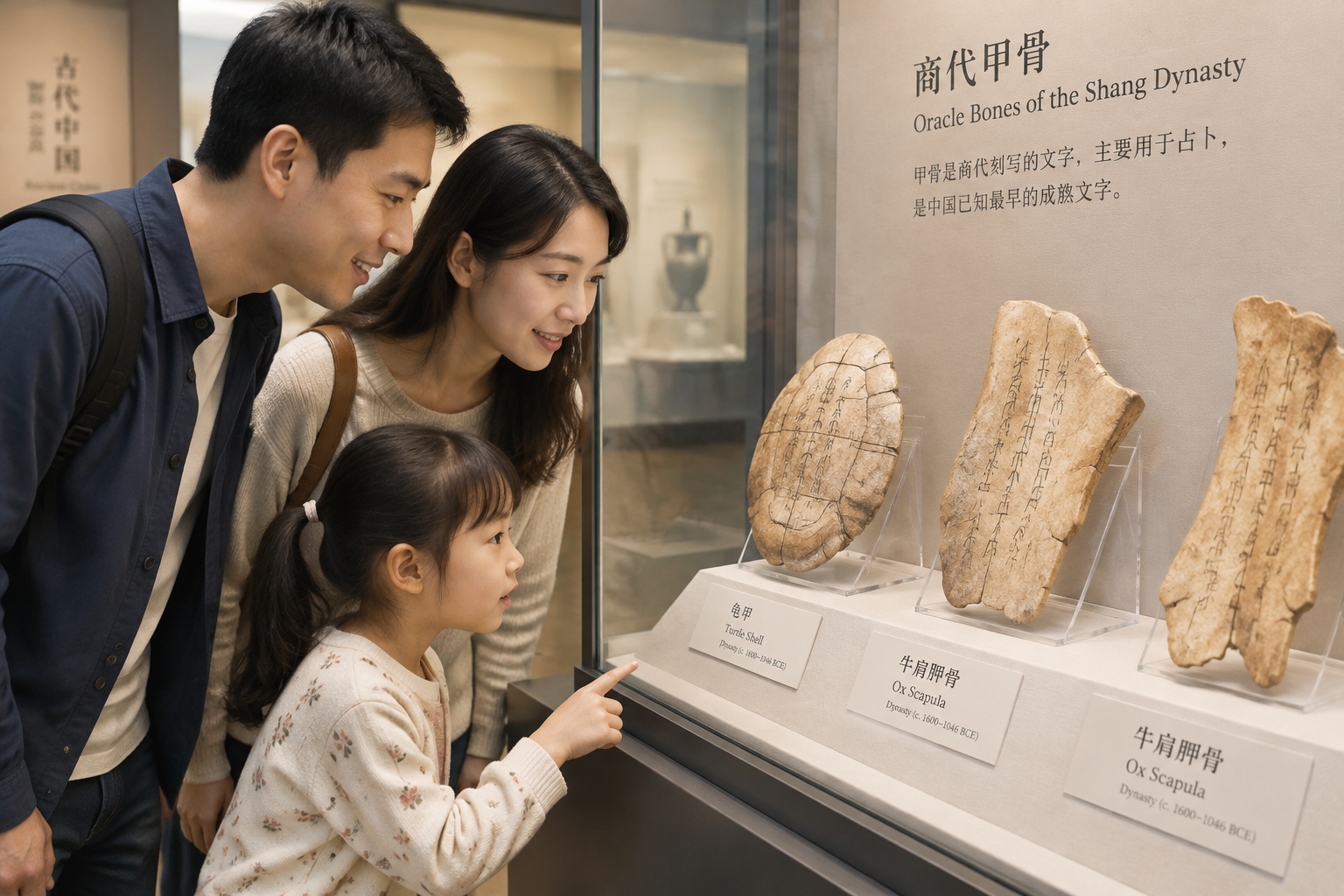
Oracle bone script was carved into turtle shells and ox shoulder blades about 3,200 years ago, mostly to ask questions — will the harvest be good, will the king’s toothache stop. A few characters survive almost intact: 日 (sun), 月 (moon), 山 (mountain), 水 (water). Most have changed enough that a modern reader needs training. But it is the same lineage, not a rediscovered cousin.
Scale is part of why it is still here. The Kangxi Dictionary, finished in 1716, lists just under 47,000 characters. A modern adult reads a newspaper with about 3,000. That gap has always been the cost of the system: a script this large is expensive to learn.
The Century China Panicked About the Keyboard
By the early twentieth century, many Chinese reformers were convinced the characters themselves were the barrier to mass literacy. The line often attributed to Lu Xun — “if the characters do not die, China will perish” — captures the mood. In 1956 the government simplified around 2,000 characters to cut the number of strokes children had to memorise. A second, more drastic round in 1977 was withdrawn nine years later after it caused confusion. Pinyin, adopted in 1958, was designed as a teaching aid and a romanisation standard, not a replacement.
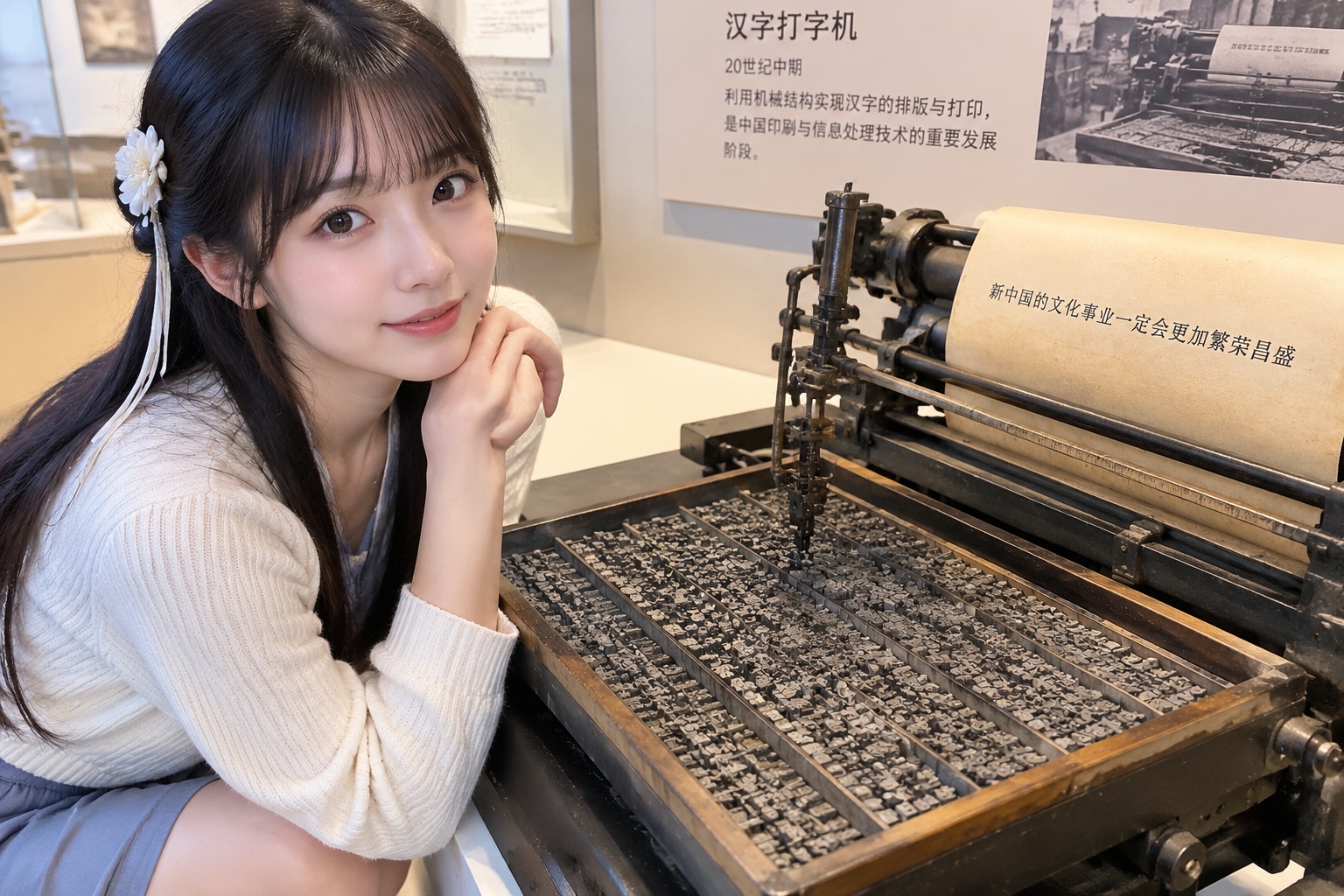
Typewriters made everything worse. A Latin keyboard has about 50 keys. A Chinese typewriter needed thousands of characters, laid out in a tray the size of a desk and picked out with a mechanical arm. The writer Lin Yutang spent years and a personal fortune on the MingKwai, an elegant 1947 machine that never found a market. Stanford historian Thomas Mullaney reconstructed the whole saga in The Chinese Typewriter (2017), and it reads less like a story about hardware than about a civilisation refusing to swap its script.
Then Computers Arrived and the Problem Flipped
In the 1980s Chinese newspapers ran worried pieces about a “character crisis.” Engineers raced to prove that hanzi could be typed as quickly as English. Wang Yongmin’s Wubi method, released in 1983, broke characters into shapes mapped onto 25 keys — fast in trained hands, punishing to learn.
What actually won was the opposite approach: type the sound, let the machine choose the character. On a Chinese phone today you tap nihao and 你好 appears. You barely look at the letters. Predictive text trained on huge corpora finishes phrases for you; four or five keystrokes can produce a whole sentence. When typing is too slow, people switch to handwriting recognition or hold a button and talk.
Mullaney has used the term “hypography” for this: a kind of writing where the keys you press do not correspond one-to-one with the marks that appear. You are not spelling a word. You are submitting a query, and the machine retrieves the character.
The keyboard was built for alphabets. Instead of reshaping the script to fit it, Chinese speakers reshaped the keyboard’s job.
What It Looks Like at Street Level
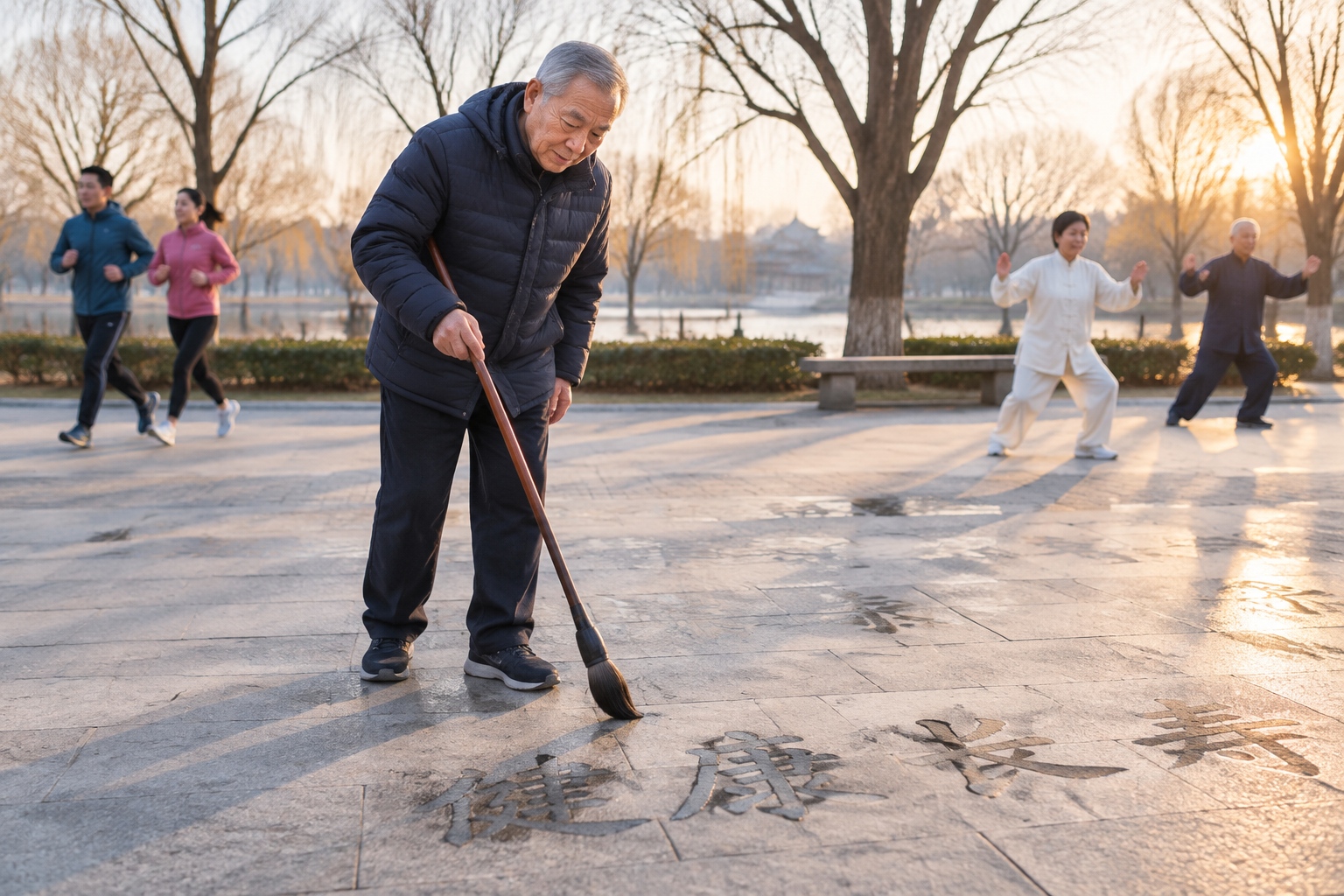
In a Beijing park at seven in the morning, retirees write large characters on the pavement with long-handled water brushes. The writing lasts a few minutes and evaporates. Nobody photographs it. It is just practice.
In primary schools, seven-year-olds trace stroke order on tablets while their parents argue online about whether handwriting still matters now that everyone types. A phrase has become popular for the feeling: 提笔忘字, “you pick up the pen and forget the character.” Adults who type all day often cannot write a word they use constantly.
The script is also a playground. A 2018 pop song called 《生僻字》 — “Rare Characters” — is essentially a list of obscure hanzi set to a beat, and it went viral. Homophone puns carry half of WeChat. Every December Japan picks a “character of the year” to sum up the past twelve months; China runs an annual language review with the same instinct.
A Fossil That Keeps Growing
Clay, bronze, bamboo slips, silk, paper, woodblock printing, movable type, the mechanical typewriter, the QWERTY keyboard, the touchscreen, voice input. Each new container forced an adjustment, and the script made it without becoming something else.
Museum logic says a 3,000-year-old writing system should be a relic. Chinese characters are the reverse: typed hundreds of millions of times a day, still absorbing slang, still finding new ways onto a screen. The continuity is not in the shapes standing still. It is in the fact that they never do.
Start the discussion at forum.chinacomes.com