

Why Liaoning’s Streets Tell a Different Story
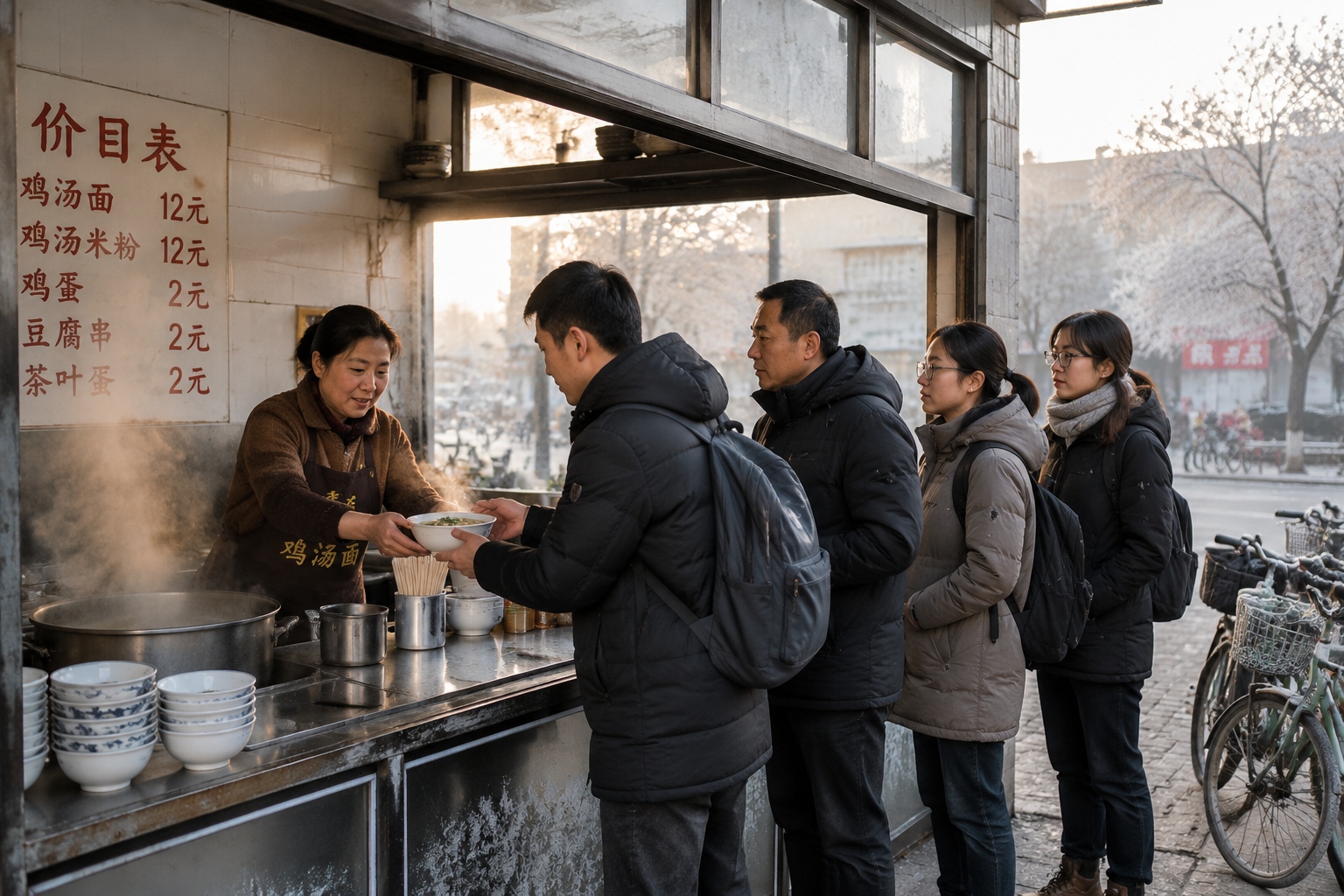
At 6:40 on a January morning in Tiexi, Shenyang, the temperature is minus 14°C. A woman in a puffer coat lifts the lid of a steel pot. Steam hits the window and turns it white. Six people are already standing in line, not for coffee, but for a bowl of noodles in chicken broth, 10 yuan, with a chicken rack on the side. A taxi driver eats standing up. A schoolgirl scrolls her phone. Nobody is taking photos. This is breakfast, not content.
If you travel to Liaoning with only one food name in mind, it is probably guobao rou: sweet-and-sour fried pork, the dish that shows up in every Northeast China travel video. It is good. It is also not what most people eat on a Tuesday. The street food of Liaoning is faster, cheaper, and more varied than that single famous plate suggests. It changes by hour, by neighborhood, and by season. The best way to understand it is to follow a normal day.
The Reality Check: Northeast Food Is Not Just Heavy
Overseas, Northeast Chinese food often gets described as heavy: big plates, thick sauces, lots of meat. There is truth in it. Winter is long. Cabbage, potatoes, and pork show up often. But street food in Liaoning is not a nonstop festival of oil and sugar. It is built around speed, warmth, and balance. In the morning, people want soup. At lunch, they want dumplings or a quick bowl of rice with one topping. At night, they want skewers, cold beer, and conversation. Late at night, they want something small and hot before going home.
The region also has a coastline. Dalian and Dandong sit on the Yellow Sea, so seafood dumplings, clams, and grilled fish are part of the local map. Inland cities like Shenyang, Jinzhou, and Fuxin have their own barbecue cultures, their own pickles, and their own noodle shops. Liaoning is not one flavor. It is a group of cities with different accents and different snacks.
Five Stalls, Five Hours of the Day
You do not need a reservation for any of these places. You need loose change, a translation app, and a little patience at peak hours.
1. 7 a.m. — The Noodle Window in Tiexi, Shenyang
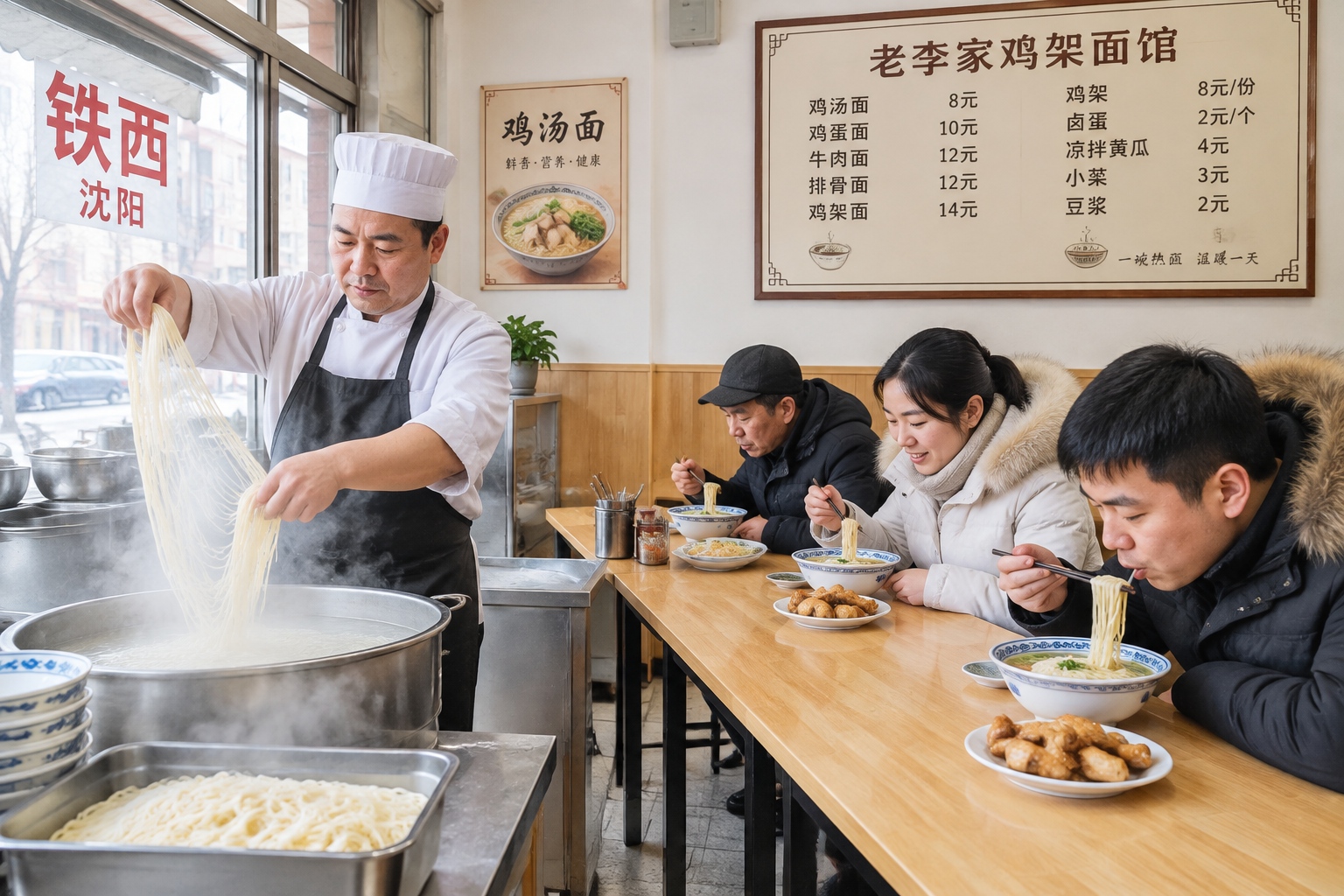
Look for a ground-floor apartment near Xinggong Street and Beier Road in Tiexi District. There is no big sign, just a red plastic board with white characters: chicken broth noodles, chicken rack, tea eggs. The noodles are pulled to order, dropped into boiling water for less than a minute, then covered with clear chicken broth, pickled mustard greens, cilantro, and a spoon of chili oil. A small bowl costs about 8 to 12 yuan. A chicken rack, the bony frame that locals tear apart with their hands, costs another 8 to 10 yuan.
The shop opens at 6 a.m. and closes when the broth runs out, often before 2 p.m. Office workers, construction crews, and retirees share the same long table. Nobody minds sitting next to a stranger. If you want to eat like a local, order the noodles and the chicken rack together, add vinegar, and do not ask for a fork.
2. 12:30 p.m. — The Family Dumpling Shop Behind a Dalian Market
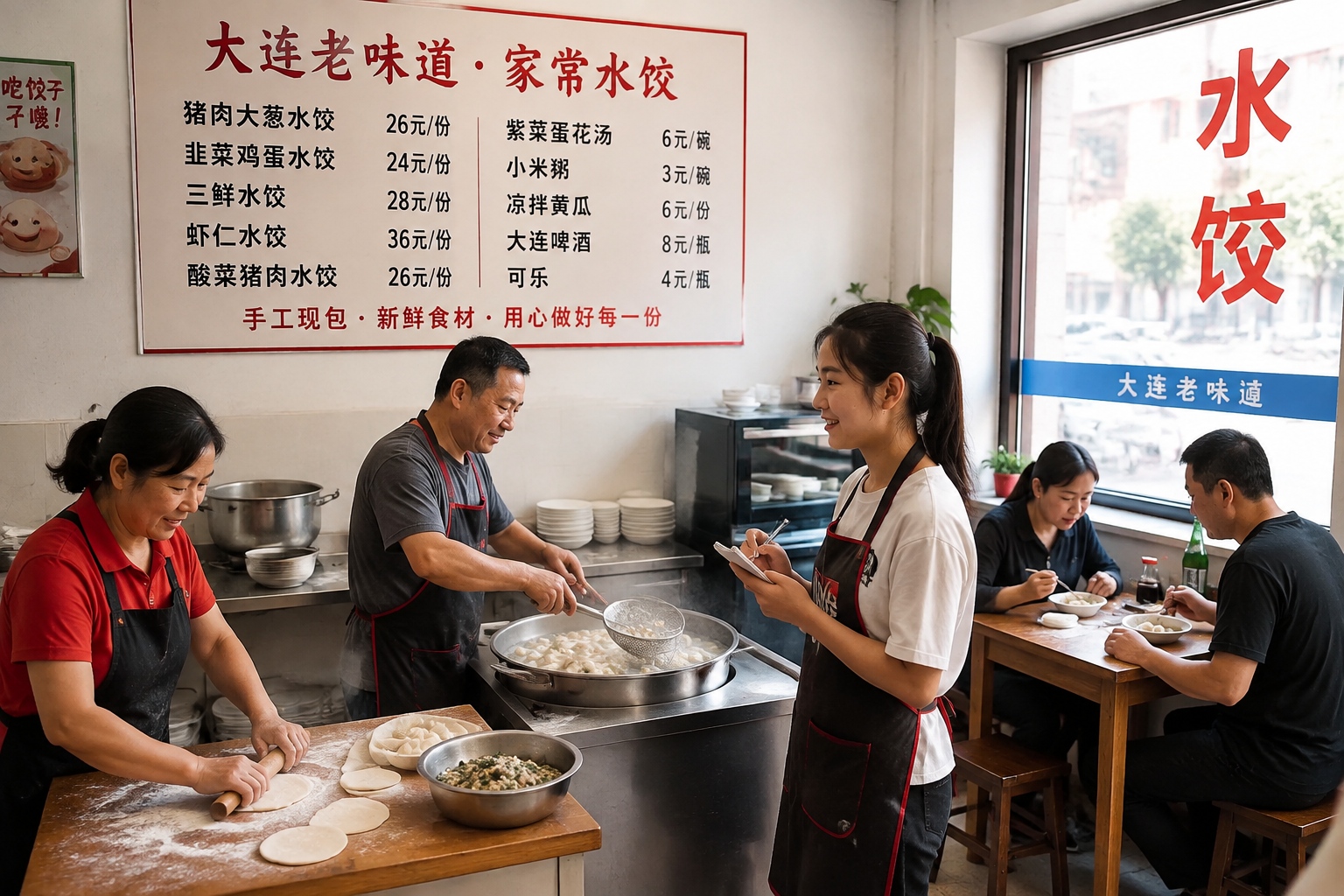
In Dalian, leave the main tourist streets around Zhongshan Square and walk five minutes into the back lanes near Tianjin Street. A family has been making dumplings in the same small room for more than twenty years. The mother rolls the wrappers. The father boils the water. Their daughter takes orders and argues gently with regulars about whether mackerel dumplings are better than pork and chive. The menu is on the wall, but most people just say, ‘the usual.’
At lunch, a plate of 15 dumplings costs about 22 to 30 yuan. The fillings change with the season: shepherd’s purse in spring, mackerel in summer, sauerkraut and pork in winter. The shop is small, maybe eight tables. If it is full, you wait outside, not in a line, just near the door. When a table opens, someone will nod at you. This is not a tourist performance. It is a family business with a mortgage, a school run, and a regular customer who has been eating here since he was a boy.
3. 7 p.m. — Jinzhou BBQ Skewers and Cold Beer
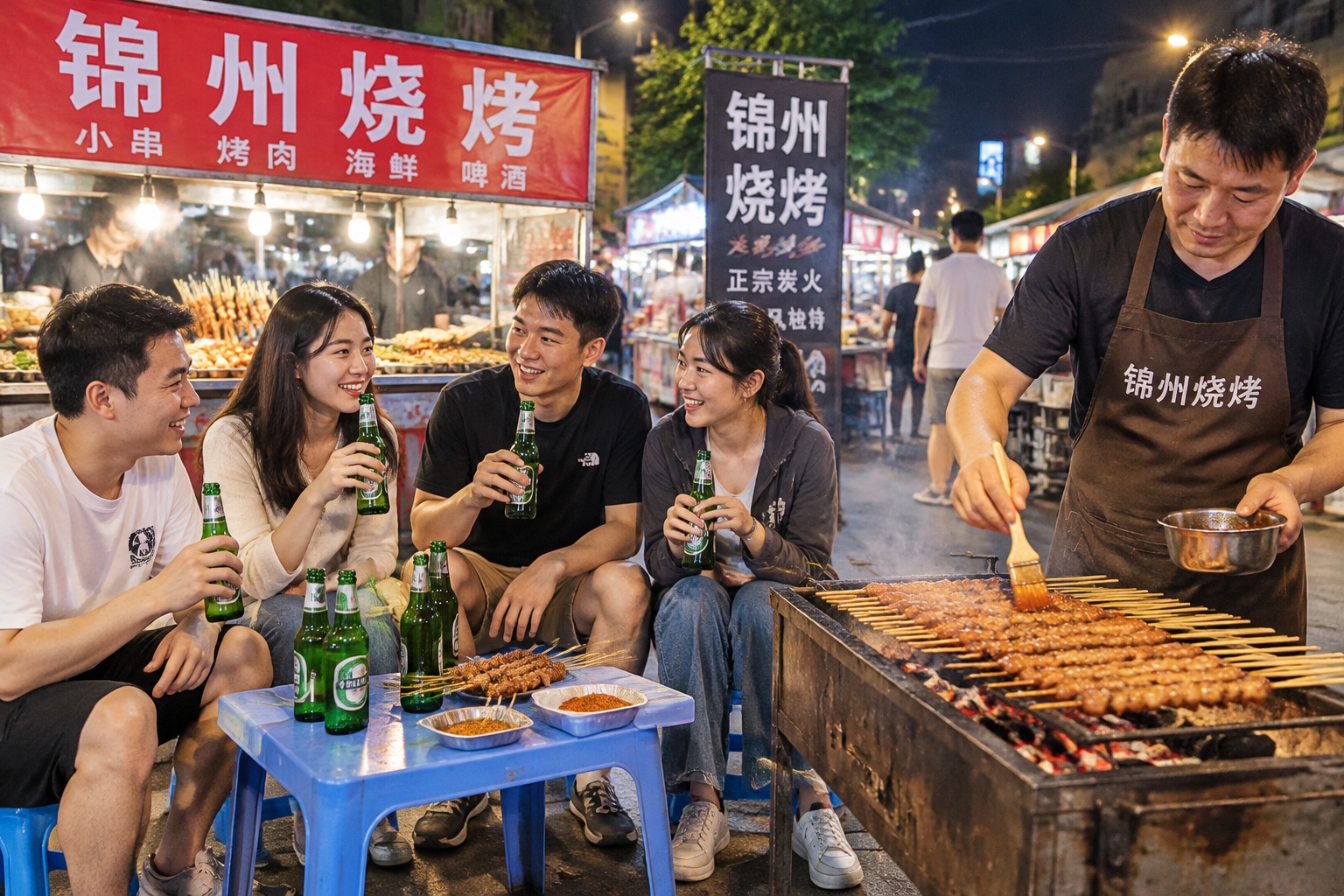
Jinzhou, in western Liaoning, takes barbecue seriously. The local style uses small skewers, heavy cumin, chili powder, and a slightly sweet brush of sauce. The night market near Linghe Park fills up after 6 p.m. Smoke rises from long charcoal grills. Vendors call out numbers. Friends sit on low plastic stools, order 30 skewers at a time, and drink local beer from green bottles.
Must-orders include grilled chicken rack, beef skewers, lamb skewers, grilled tofu skin, enoki mushrooms wrapped in bacon, and roasted eggplant covered with garlic. A big meal with beer usually costs 50 to 80 yuan per person. The atmosphere is loud and relaxed. People talk to the next table. Someone may offer you a skewer before you order. Say yes. It is not a trap. It is just dinner.
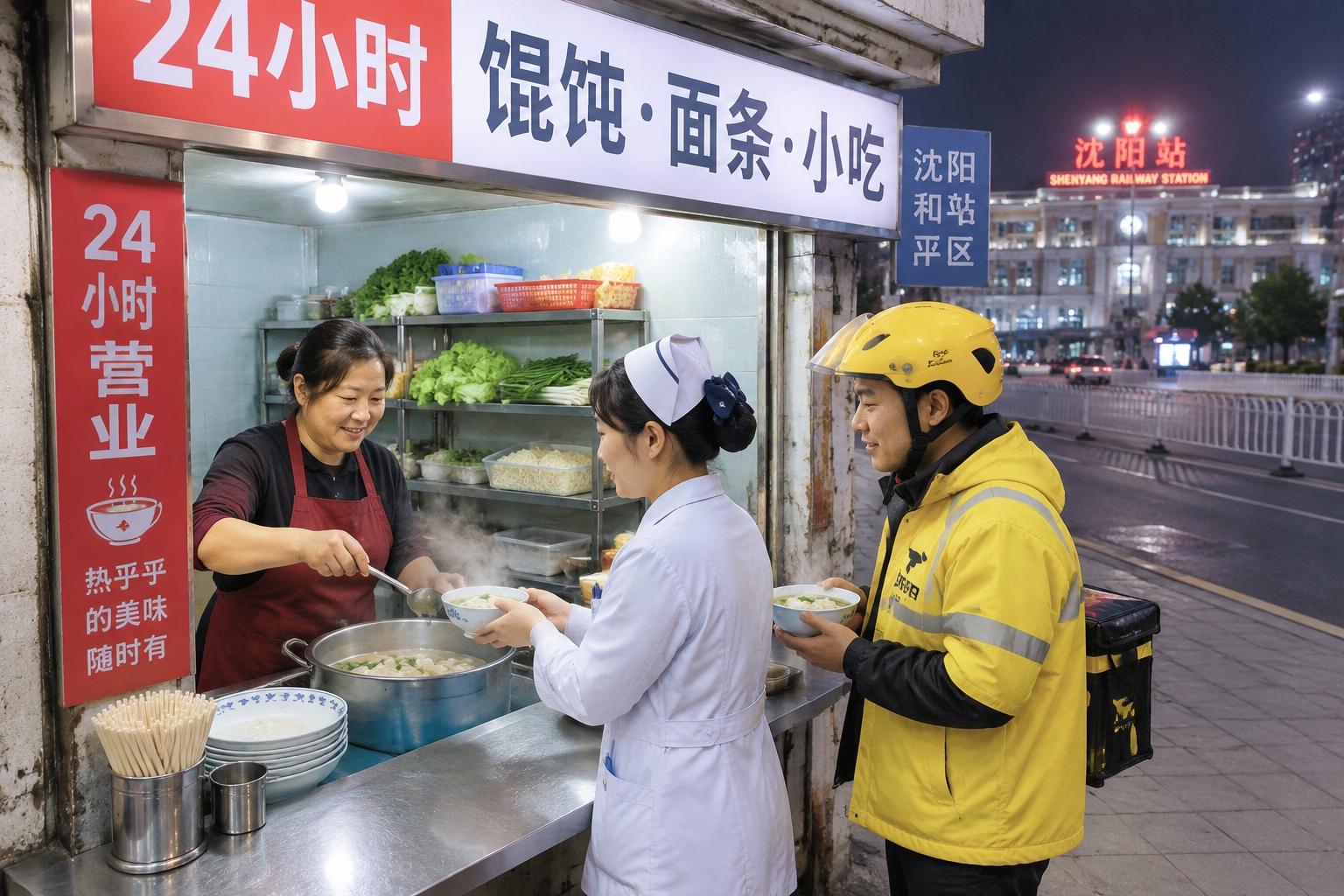
4. 1 a.m. — The 24-Hour Snack Stand in Heping, Shenyang
Near Shenyang Railway Station, in Heping District, a narrow snack stand stays open all night. It sells wonton soup, tea eggs, soy milk, steamed buns, and a simple spicy hot pot where you pick vegetables and noodles from a shelf. Nurses coming off shift, delivery drivers, and university students on their way back to dorms eat here. A bowl of wontons costs 10 to 15 yuan. A tea egg is 2 yuan.
At 1 a.m., the city feels quieter, but this corner is not empty. The owner has a small radio playing old pop songs. He knows the taxi drivers by their orders. For a visitor, it is a safe and cheap way to see the night side of a Chinese city without going to a club. Order by pointing. Pay with your phone if your app works; otherwise, cash is fine, but try to have small notes.
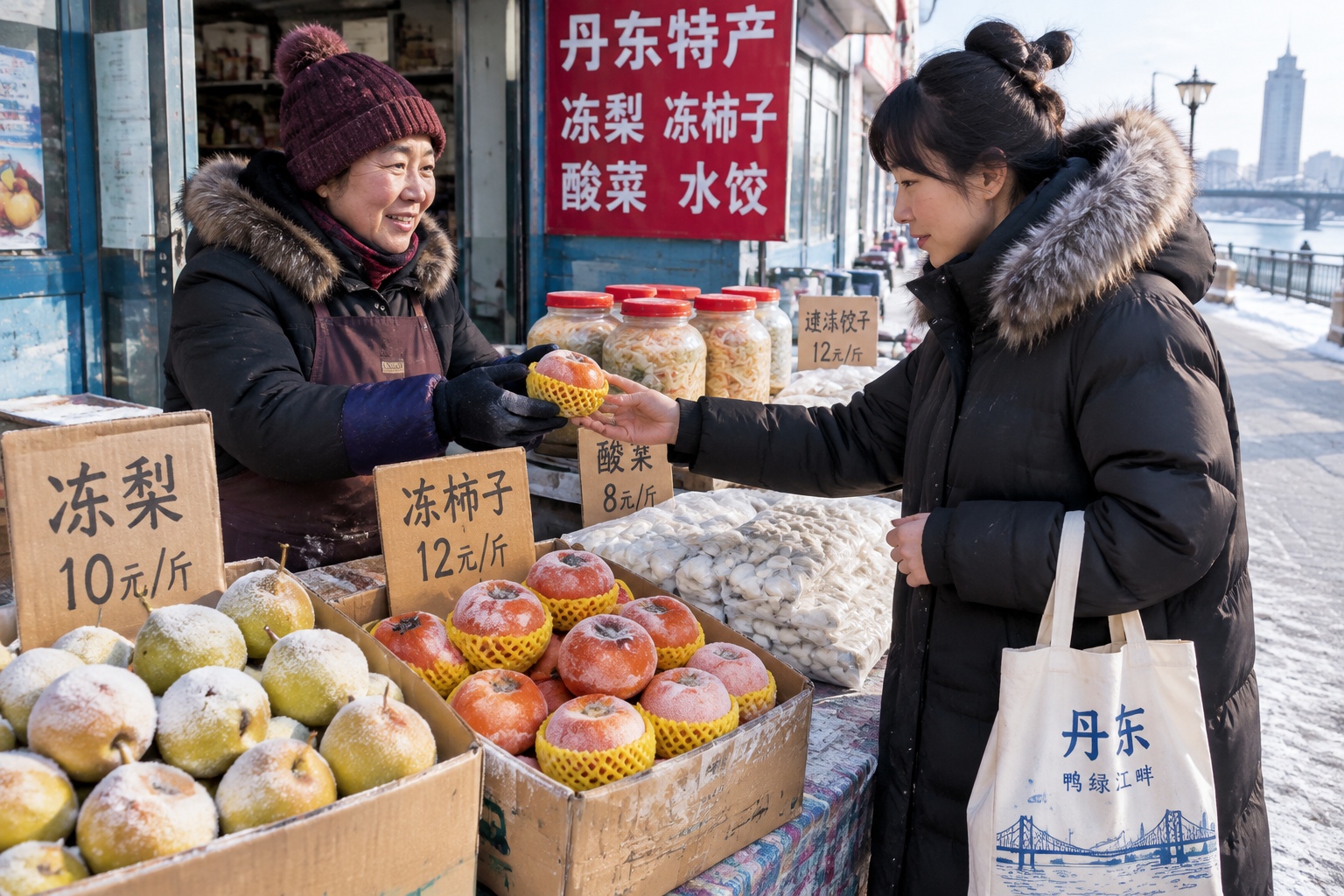
5. Winter — A Frozen-Pear and Sauerkraut Shop in Dandong
In Dandong, near the Yalu River, winter brings a specific street treat: frozen pears. They look like dark, hard rocks. Vendors sell them from cardboard boxes or hang them in nets outside small shops. You buy one for 5 to 8 yuan, take it home, and put it in cold water. After twenty minutes, the pear forms a shell of ice. You crack it, suck the soft, sweet inside, and feel your mouth wake up. Frozen persimmons work the same way.
The same small shops sell sauerkraut, frozen dumplings, and sticky bean buns for the New Year. Families buy a whole cabbage’s worth of sauerkraut and cook it with pork belly and blood sausage. The dish is sour, rich, and hot. It is not a restaurant dish in the usual sense. It is what people eat when the wind comes down from the north and the heating is on full blast.
What These Stalls Say About Life in Liaoning
These five places are not famous. That is the point. They show how daily life is organized around small, affordable businesses. A bowl of noodles for 10 yuan is not a novelty. It is part of the math of living in a city where salaries are lower than in Beijing or Shanghai, but rents are lower too. Retired people can afford to eat out for breakfast. Students can eat dinner for 15 yuan. Families can feed four people at a dumpling shop for under 100 yuan.
They also show how China’s digital life has reached the street. Almost every stall has a QR code for WeChat Pay or Alipay. Young customers use phones. Older customers often still use cash. Both work. During the pandemic, many small shops learned to use delivery apps and group-buying platforms. Some still do. A dumpling shop may sell frozen dumplings online. A barbecue stall may take orders through a local chat group. The tools changed, but the social function did not: these places are where people meet, gossip, complain about work, and check on each other.
There are limits, too. Many small shops face rising rents and long hours. Owners are aging. Young people do not always want to take over. Some street stalls have been moved indoors or cleaned up by city regulations. The result is more comfortable, but also less chaotic. If you want to see the older street style, go sooner rather than later.
Practical Tips for Eating Like a Local
Payment: WeChat Pay and Alipay are standard. Foreign cards can sometimes be linked, but not every small vendor knows how to handle foreign-card issues. Bring 100 to 200 yuan in cash as backup. Small stalls may not have change for a 100-yuan note early in the morning.
Language: English menus are rare outside major tourist areas. Take a photo of the Chinese menu and use a translation app. Or point at what someone else is eating. ‘Zhe ge’ means ‘this one.’ It works.
Finding places: Use Amap or Baidu Maps for walking directions. Dianping is China’s restaurant review app, but it is mostly in Chinese. Look for shops with many reviews from local users, not just high ratings. A 4.2 with 2,000 reviews is often better than a 4.9 with 20 reviews.
Timing: Breakfast noodles are best before 8 a.m. Dumpling shops are crowded from 12 to 1 p.m. Barbecue starts after 6 p.m. and peaks at 9 p.m. The 24-hour snack stand is quietest after 2 a.m.
Ordering: Portions are generous. If you are alone, order one main dish and one side. In barbecue places, order in small batches and add more later. Ask for ‘bu la’ if you do not want spicy. For dumplings, ask for vinegar and chili oil on the side.
Etiquette: Do not expect table service. Clean your table if the shop is busy. Sharing tables is normal. Tipping is not expected. A simple ‘xie xie’ when you leave is enough.
Final Bite
Guobao rou is a good introduction to Liaoning, but it is not the whole map. The real street food of Northeast China is a bowl of chicken broth noodles at 7 a.m., a plate of mackerel dumplings at noon, a tray of cumin-heavy skewers at night, a bowl of wontons at 1 a.m., and a frozen pear in winter. None of it is fancy. All of it is real. If you go, skip the tourist street for one morning. Walk into a residential neighborhood, find the shop with the steamed-up windows, and order what everyone else is having. That is the Liaoning that locals know.
Start the discussion at forum.chinacomes.com