

What you see at 2,400 meters
Most people outside China meet the giant panda as a photograph: a round black-and-white animal on a wooden frame, chewing bamboo while a crowd presses against the glass. That animal is real. It is also the least representative version of the species.
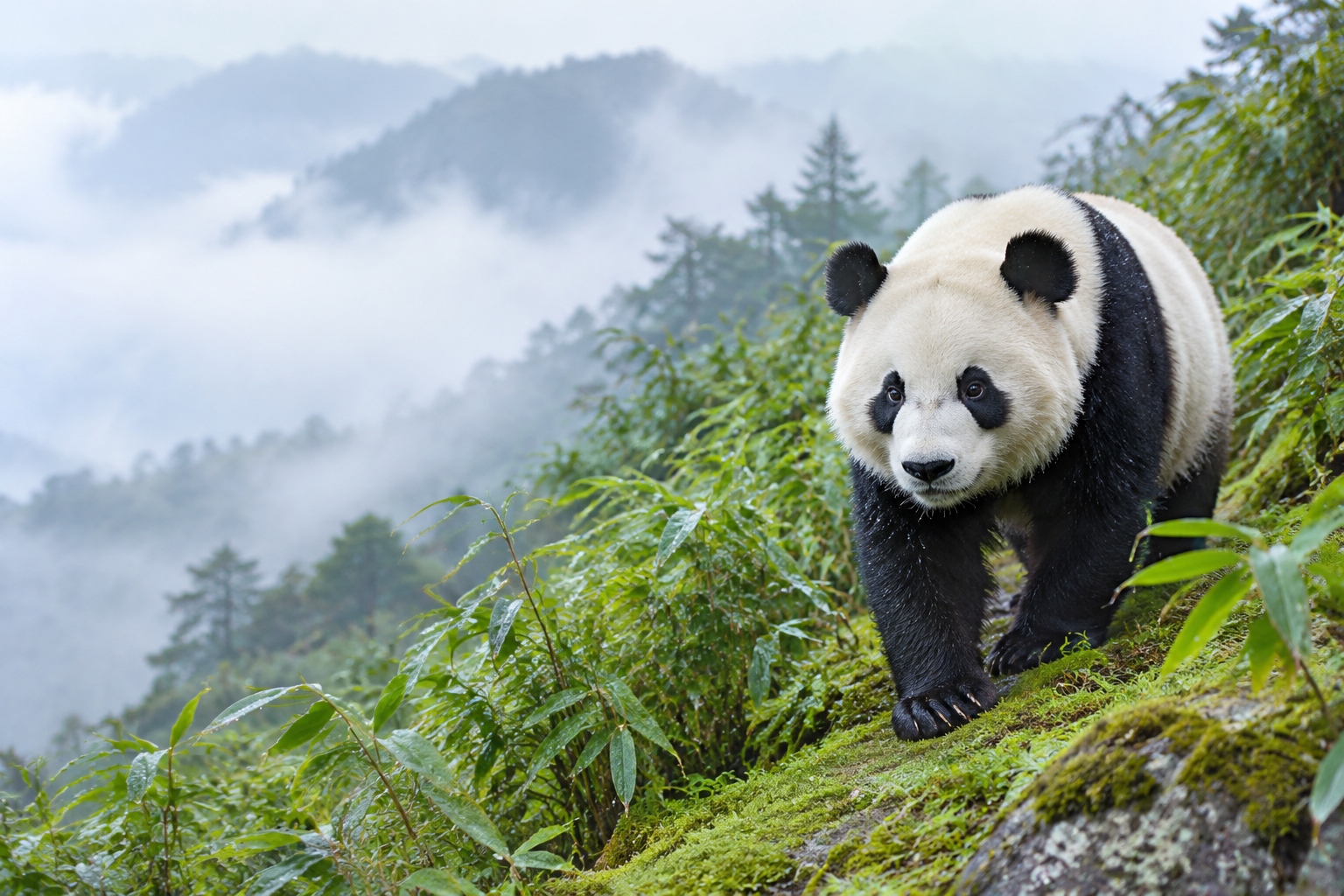
The other version lives on mountain slopes in the Qinling range of Shaanxi province, a long drive southwest of Xi’an and then a two-hour climb. Around 2,400 meters the forest is cold, wet and almost permanently fogged. Bamboo grows so densely that a 100-kilogram animal can stand a few meters off the trail and stay invisible. Field teams there do not see pandas on most days; they download camera-trap cards, swap batteries and count chewed bamboo stems.

First, the family tree: a panda is a bear
The giant panda’s scientific name is Ailuropoda melanoleuca. It belongs to Ursidae — the bears — as the only living member of the subfamily Ailuropodinae. Its closest living relative is not the raccoon and not the red panda, but the spectacled bear of South America. Molecular studies put the split between the panda lineage and the other bears in the Miocene, roughly 19 to 25 million years ago, depending on the method.
That sounds settled now. It wasn’t. For much of the 20th century, anatomists argued seriously that the giant panda was a very large raccoon, because its skull and jaw muscles look more raccoon-like than bear-like. The naming made it worse: “panda” was first used for the red panda, a much smaller animal from the eastern Himalayas. The red panda — 小熊猫, “small panda,” in Chinese — belongs to a different family, Ailuridae, and is more closely related to weasels and skunks. The two animals are not close relatives. They both just eat bamboo.
Where wild pandas actually live
The wild population is confined to a handful of mountain ranges in three provinces: Sichuan, Shaanxi and Gansu. The fourth national survey, carried out from 2011 to 2014 and published in 2015, counted 1,864 wild giant pandas — about 1,387 in Sichuan, 345 in Shaanxi and 132 in Gansu. A fifth survey has been under way since the late 2010s.
The habitat is narrow and specific. Most records fall between 1,200 and 3,400 meters, with the densest populations between roughly 2,000 and 3,000 meters. Annual average temperatures sit around 6 to 10 °C. Rainfall is heavy, cloud cover is common, and pandas live under a canopy of fir, birch and maple, with bamboo as the understory. These are not the warm lowland bamboo groves of popular imagination.
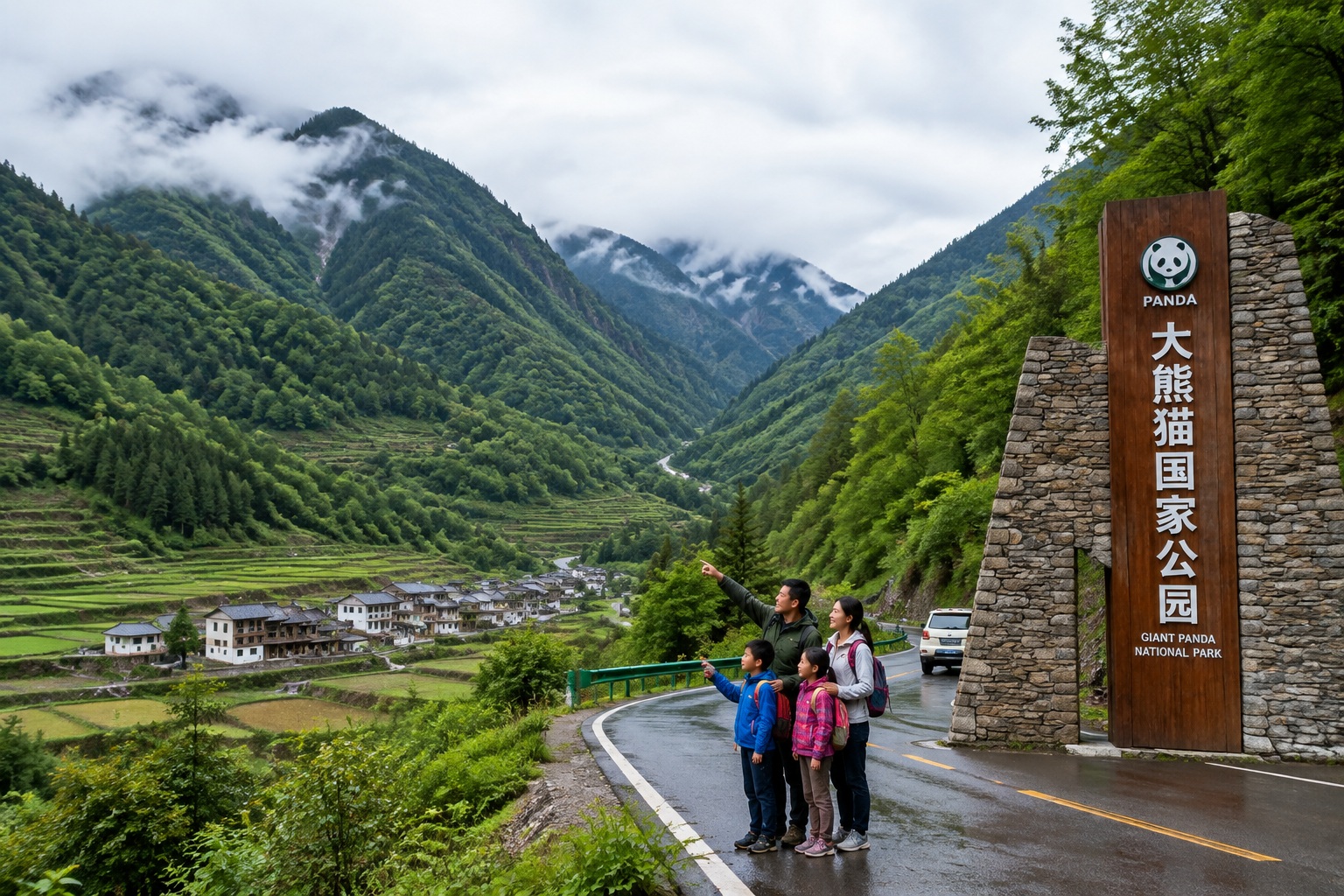
In October 2021, China assembled most of this range into the Giant Panda National Park — roughly 27,000 square kilometers across the three provinces, holding the large majority of wild pandas. The park was not built on empty land. It overlaps villages, farmland, hydropower stations, mining claims and roads. The unglamorous work of wildlife corridors, compensation schemes and moving some households is far slower than the announcement was.
The key numbers
- Size: adults are 1.2 to 1.8 meters long and weigh 70 to 125 kilograms; males are larger than females.
- Newborns: a cub weighs about 100 grams — roughly one nine-hundredth of its mother’s weight, among the most extreme ratios in mammals.
- Lifespan: about 20 years in the wild, over 30 in captivity.
- Diet: more than 99 percent bamboo, 12 to 38 kilograms a day depending on which parts it eats, and dozens of bowel movements a day.
- Digestion: poor. Pandas extract only about 17 percent of the dry matter they consume, and their gut microbiome resembles a carnivore’s.
- Energy: a 2015 study in Science measured daily energy expenditure at roughly 38 percent of what a mammal of that size would be expected to use. Slow movement is the strategy, not a flaw; thyroid hormone levels are unusually low.
- Hands: the famous “thumb” is a modified wrist bone, the radial sesamoid, used to grip bamboo stems.
- Eyes: giant pandas have vertical slit pupils, like a cat’s — unusual for a bear.
Why black and white? Three explanations
No other bear is black and white, and no other carnivore divides its body into dark and light zones the way a giant panda does. That oddity has attracted hypotheses for decades.
1. Camouflage, currently the strongest
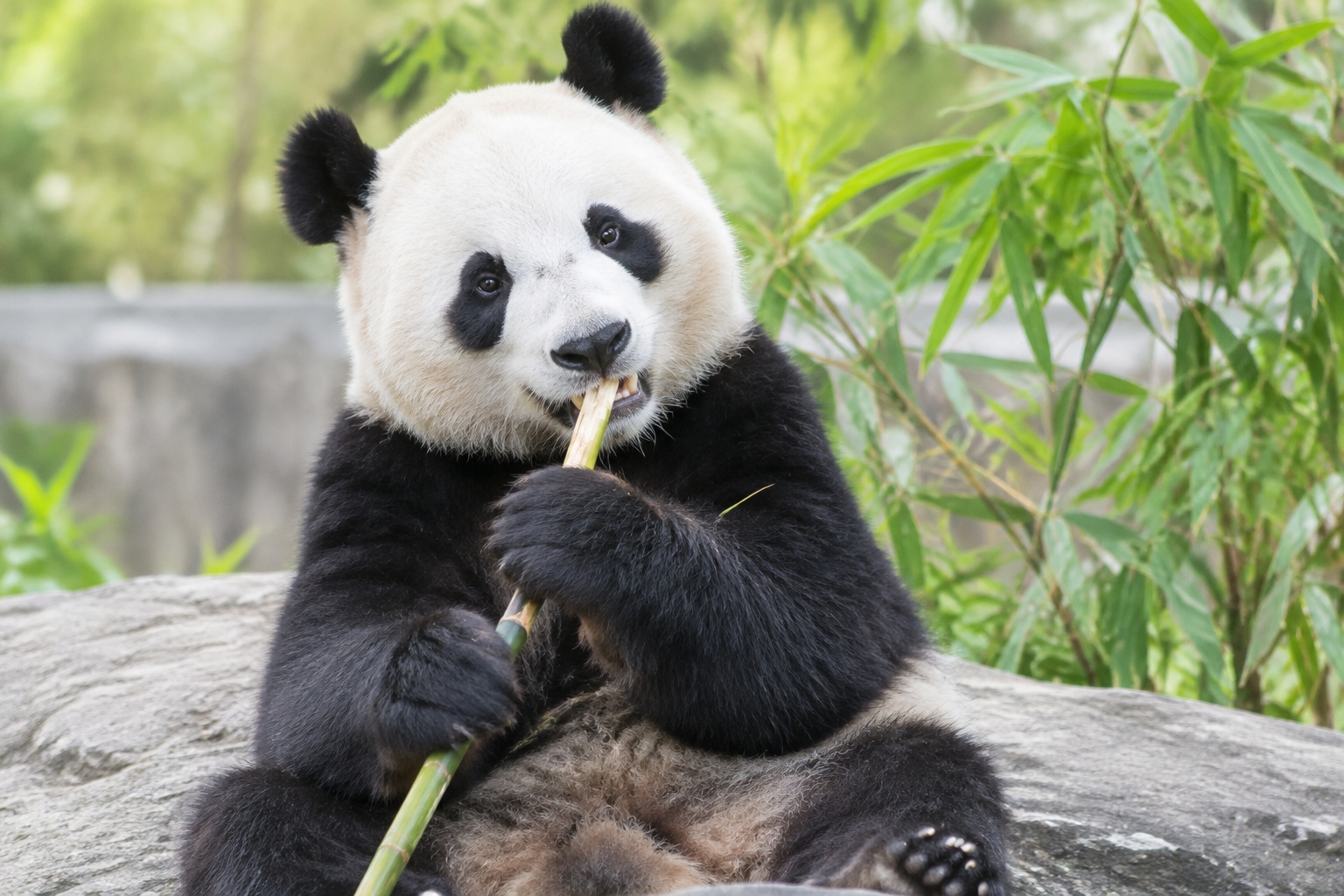
A 2021 study in Behavioral Ecology led by Tim Caro mapped the pattern precisely. The dark zones are the ears, eye patches, limbs and shoulder band; the light zones are the face, neck, belly and rump. The team compared this against the animal’s actual backgrounds and concluded that the white areas help it blend into snow, while the black areas break up its outline in shade. The panda is solving two camouflage problems at once, because it moves between bright ridgelines and dark forest floor.
2. Communication
Camouflage alone did not explain the head markings. Dark ears — which pandas enlarge and flatten during aggressive encounters — and dark eye patches, which make the direction of a stare easier to read, are better explained as signals. In a dense bamboo forest where animals rarely meet, being legible matters.
3. Temperature control
The old idea: black absorbs heat, white reflects it. It is partly true for the thin, poorly insulated ears and eye patches. But tested against the whole body pattern, it explains less than camouflage does, and it struggles with the white belly and dark back. The current honest answer: camouflage and signalling carry most of the explanation, heat a small part.
Five misunderstandings, checked
“A panda is a kind of raccoon.”
No. The raccoon hypothesis was a serious scientific position in the early 1900s, based on skull and tooth anatomy, and it was overturned by molecular data from the 1980s onward. The animal in this story that genuinely resembles a raccoon is the red panda, which is a separate lineage.
“A panda is a cat.”
No, though the slit pupils are genuinely cat-like. Pupil shape is a light-management solution, not a family tree. The Chinese name 熊猫 reads literally as “bear-cat,” a historical naming accident that has nothing to do with feline ancestry.
“Pandas can’t survive without humans.”
Wild pandas feed, breed and raise cubs without help. Reintroducing captive-bred animals has proved hard, but that is a fact about captivity, not about the species. Wild populations in intact habitat have grown modestly since their 1980s low.
“Pandas are lazy and stupid.”
They are slow, for a physiological reason: extremely low energy expenditure and a food source that yields little nutrition per bite. That is a working strategy, not a defect — it let them specialise in a plant no other large mammal in the region competes for.
“All pandas are black and white.”
Mostly. In the Qinling mountains, roughly a dozen brown-and-white giant pandas have been recorded since the mid-1980s, including a male named Qizai at the Foping reserve. Qinling pandas were recognised as a separate subspecies in 2005, on genetic and skull evidence.
What has actually changed
Two numbers tell the story. In the 1980s, the captive population was a few dozen animals and the wild population was shrinking. Today more than 700 pandas live in breeding centres and zoos, and the wild count has edged up from its low point. In 2016 the IUCN moved the giant panda from Endangered to Vulnerable, while warning that climate change could shift bamboo belts uphill and shrink habitat again.

What has not changed is the mountain. Bamboo flowers on its own schedule every few decades, then dies across a wide area, and pandas have to walk to the next patch. Roads still cut through valleys. Isolated populations still risk inbreeding. A panda is not a mascot that solves these problems. It is a 100-kilogram bear with a carnivore’s gut, eating a grass, in a shrinking strip of cold forest — and, on a good day for the researchers, walking past a camera trap unseen.
Start the discussion at forum.chinacomes.com