
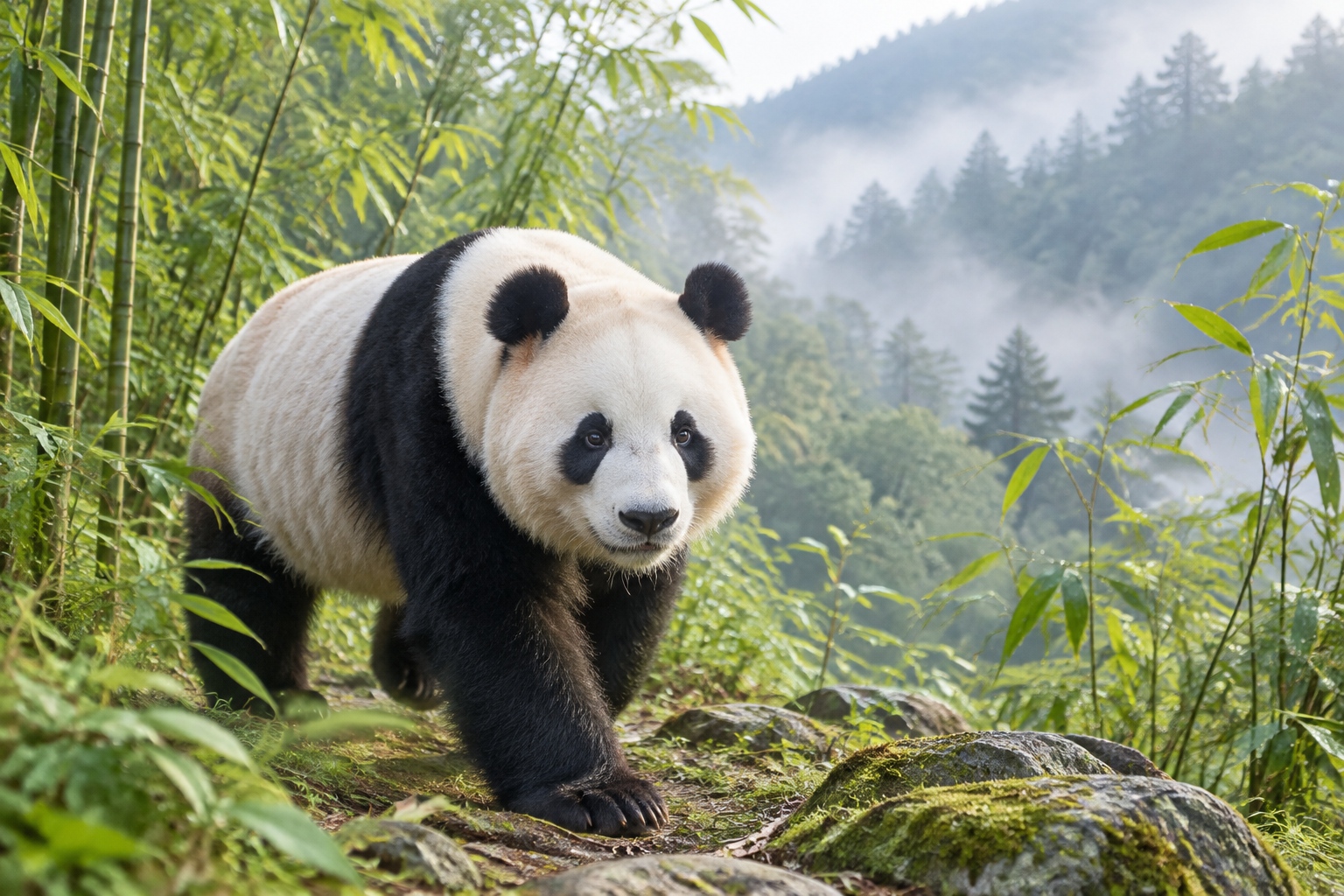

A camera trap in the bamboo forest
Just before dawn in a mountain valley in Sichuan, a wildlife ranger checks a camera trap strapped to a tree. On the small screen: a giant panda. A few days later, the same camera records a golden snub-nosed monkey, a takin, and a Temminck’s tragopan. Different animals, same forest, same narrow path.
For many people outside China, panda conservation looks like a feel-good story about a cute animal. It is that. But it is also something more practical: a way of protecting an entire mountain ecosystem that supplies water, stores carbon, and supports rare wildlife. The panda is the famous face. The forest is the point.

What is an umbrella species?
Conservationists use two terms that are worth knowing. A flagship species is an animal people already care about. It attracts donations, media attention, and political support. The giant panda is one of the world’s most successful flagship species. Its image sells calendars, zoo tickets, and conservation campaigns.
An umbrella species is different. It is an animal with such large habitat needs that protecting it automatically protects many other species. If you set aside enough forest for pandas, you also set aside enough forest for monkeys, birds, insects, and plants. The panda is both a flagship and an umbrella species. That combination is unusually powerful.
This is not a Chinese-only idea. In North America, conservationists have used the northern spotted owl and grizzly bear as umbrella species. In Europe, large carnivores like wolves and lynx play a similar role. But China’s panda program is one of the largest and best-funded examples in the world.
The neighbors in the same forest
Pandas live in temperate mountain forests, mostly in Sichuan, Shaanxi, and Gansu. These forests are not empty bamboo farms. They are mixed ecosystems with bamboo understory, broadleaf trees, moss, streams, and steep slopes.
When panda habitat is protected, other animals show up in the same camera traps. The golden snub-nosed monkey, with its blue face and golden fur, moves through the canopy. The takin, a large goat-antelope, walks along ridgelines. The Temminck’s tragopan, a brightly colored pheasant, scratches in the leaf litter. There are also red pandas, musk deer, black bears, and many bird species.
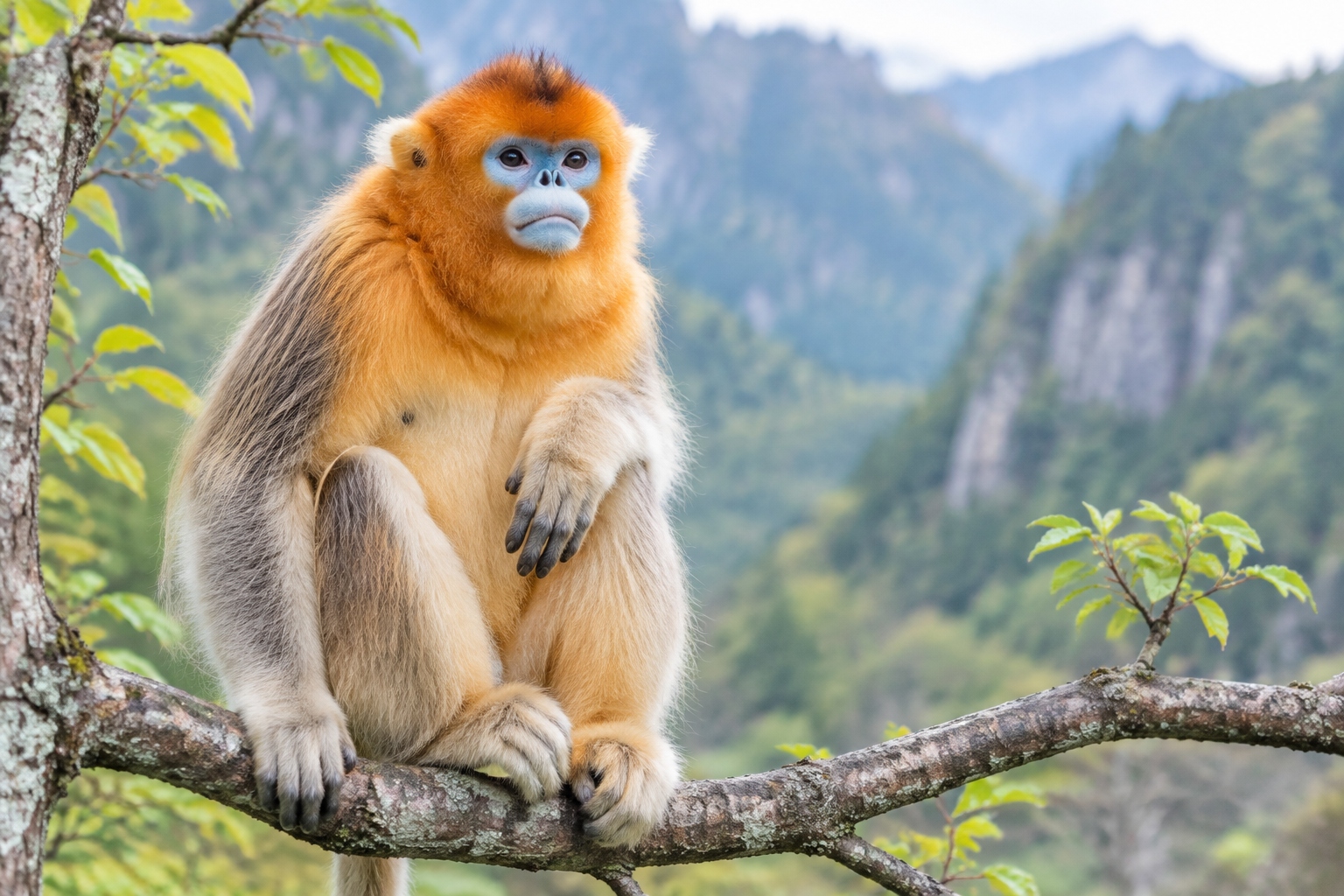
In one sense, these animals are lucky. They live in the same neighborhood as a global celebrity. Because governments and donors want to save the panda, they also fund ranger patrols, anti-poaching efforts, and habitat restoration that benefit everything else.
Forests are quiet water factories
For foreign readers, the idea of ‘ecosystem services’ can sound abstract. The simplest way to understand it is to follow a raindrop.
When rain falls on a healthy mountain forest, it does not rush straight down the slope. Bamboo roots, tree roots, moss, and leaf litter slow it down. The forest floor acts like a sponge. Water sinks into the soil, feeds streams slowly, and reduces the risk of flash floods and landslides.
This matters far downstream. Many of China’s panda reserves sit in the upper reaches of rivers that flow into the Yangtze basin. Cities like Chengdu, Mianyang, and Guangyuan depend on water from these mountain catchments. Farmers in the plains use it for irrigation. Hydropower stations use it to generate electricity. If the slopes erode, reservoirs fill with silt, canals clog, and water treatment costs rise.
China learned this lesson in a hard way. The severe floods along the Yangtze in 1998 helped trigger a nationwide logging ban in natural forests. Since then, protection of upper watersheds has become a national priority. Panda habitat protection is part of that larger shift.
A national park the size of New Jersey
In 2021, China officially established the Giant Panda National Park. It covers more than 20,000 square kilometers across Sichuan, Shaanxi, and Gansu—roughly the size of New Jersey. It is not a traditional park with a single gate and a souvenir shop. It is a patchwork of existing reserves, forest land, and local communities, managed with stricter rules.
The park protects more than 70% of wild giant pandas, according to official figures. The wild panda population is estimated at around 1,800, up from fewer than 1,200 in the 1980s. That is still a small number, and the species is not out of danger. But the trend is better than it was.
The national park model also tries to fix a problem: pandas were often isolated in separate reserves, unable to move between them. Roads, farms, and towns cut the forest into islands. The park aims to connect these islands with wildlife corridors, giving pandas and other animals more room to roam and breed.
What about the people who live there?
This is where the story gets more complicated. Conservation areas in China are not empty. People live in and around them. They farm, keep bees, raise livestock, and run small businesses. When logging and hunting are restricted, some lose income. When tourism grows, some gain.
One common model is to hire local residents as ecological rangers. They patrol forests, remove snares, record wildlife, and report illegal activity. The pay is not high, but it is steady. In places like Foping in Shaanxi and Tangjiahe in Sichuan, former loggers and farmers have become guides, drivers, cooks, and guesthouse owners.

In Foping, a county once known for timber, the main street now has signs for panda-themed guesthouses. In Tangjiahe, a small town called Qingxi has turned into a base for birdwatchers and nature photographers. Visitors come for the forest, not for a theme park. They stay in family-run inns, eat local vegetables, and hire local guides.
But the benefits are uneven. Tourism is seasonal. Not every village is on a good road. Some young people still leave for factory jobs in coastal cities. There are also tensions over land use, grazing, and access to bamboo shoots. Protecting a forest is not just a scientific question. It is a social one.
How is this different from parks in other countries?
China’s approach is more government-led and faster than many Western models. When Beijing decides to create a national park, it can move quickly on boundaries, funding, and relocation. That speed has advantages. It also creates risks if local voices are not heard.
The United States has a long tradition of national parks, but its endangered species debates are often fiercely contested. In China, panda protection enjoys unusually broad public support. Schoolchildren learn about pandas. Companies use pandas in logos. The animal is a national symbol in a way that few species are anywhere else.
That popularity is a kind of political capital. It helps explain why panda conservation gets money and attention that other less adorable species do not. The golden snub-nosed monkey is beautiful, but it does not sell as many plush toys.
If you want to see the forest, go quietly
For travelers who want to go beyond the Great Wall and Shanghai, panda country offers some of China’s most rewarding hidden landscapes. Tangjiahe National Nature Reserve in northern Sichuan is known for golden monkeys, takins, and rich birdlife. Wanglang Nature Reserve is quieter and more remote. In Shaanxi, Foping and the Qinling Mountains offer cool forests and a chance to learn about panda corridors.
Do not expect to see a wild panda. They are shy, solitary, and well camouflaged. A good visit might mean finding panda droppings, chewed bamboo, or claw marks on a tree. That is the real experience. If you do see a golden monkey or a takin, consider it a bonus.
Travel responsibly. Hire licensed local guides. Stay on trails. Do not use drones. Do not feed animals. Keep your distance. The goal is not to get the perfect selfie with wildlife. It is to leave the forest as wild as you found it.
The panda is the door, not the whole house
It is easy to love pandas. That is why they work as a conservation strategy. But the deeper achievement is not a single species saved from extinction. It is a network of mountain forests that still have monkeys, takins, pheasants, clean streams, and carbon-rich soils.
Protecting pandas is not only about protecting pandas. It is about protecting the conditions that allow a whole forest to function. For people living downstream, that means water. For the animals in the same habitat, it means survival. For China, it is a test of whether economic development and ecological protection can be balanced.
The next time you see a panda on a poster, look past the round face. Behind it is a mountain, a forest, a watershed, and a set of difficult choices. The cute animal is the beginning of the story, not the end.
Start the discussion at forum.chinacomes.com