

6:30 AM at the North Gate
The air smells of wet stone and pine needles. A few elderly men and women are already here, stretching by the stone lions. One of them, a man in a blue track jacket, tosses a Jianzi—a weighted shuttlecock—into the air and catches it on his instep without looking. The ticket window opens at 6:30. There is no line. This is the moment to enter the Summer Palace.
By 9 AM, the same gate will be a river of tour groups, selfie sticks, and bullhorns. The main halls—the Hall of Benevolence and Longevity, the Long Corridor, the Marble Boat—will be packed shoulder-to-shoulder. But right now, the 290-hectare imperial garden is mostly empty. And the best way to keep it that way is to do what the emperors did: take to the water.
Why the Summer Palace Deserves a Second Look
Most visitors treat the Summer Palace as a checklist. Enter at the East Palace Gate, walk the Long Corridor, snap a photo of the Marble Boat, and leave. It’s understandable—the place is a UNESCO World Heritage Site, and the highlights are genuinely impressive. But that route misses the point. The Summer Palace was designed as a retreat, a place to escape the Forbidden City’s rigid grids. Its soul is in the soft edges: the willows along Kunming Lake, the hidden courtyards, the way the Western Hills seem to float on the water.
Kunming Lake covers about 2.2 square kilometers—roughly three times the size of Beijing’s Forbidden City moat. Longevity Hill rises 60 meters above the shore. The whole layout mimics Hangzhou’s West Lake, but with northern bones. If you only walk the east side, you’re seeing maybe a third of it.
The lake itself is man-made. In 1750, Emperor Qianlong ordered it expanded to mimic Hangzhou’s West Lake. The dredged earth was piled up to form Longevity Hill. The whole project was a birthday gift for his mother. A century later, British and French troops burned the garden during the Second Opium War. Empress Dowager Cixi rebuilt it in 1888—allegedly with funds earmarked for the navy. That story is still told with a wry smile by Beijing tour guides.
The Emperor’s Route: Boat First, Walk Later
Here’s the thing about crowds: they move slowly and predictably. They cluster around the main halls, the gift shops, the toilets. They rarely venture onto the water or the far west shore. So flip the usual order. Start with a boat.
Renting a Boat on Kunming Lake
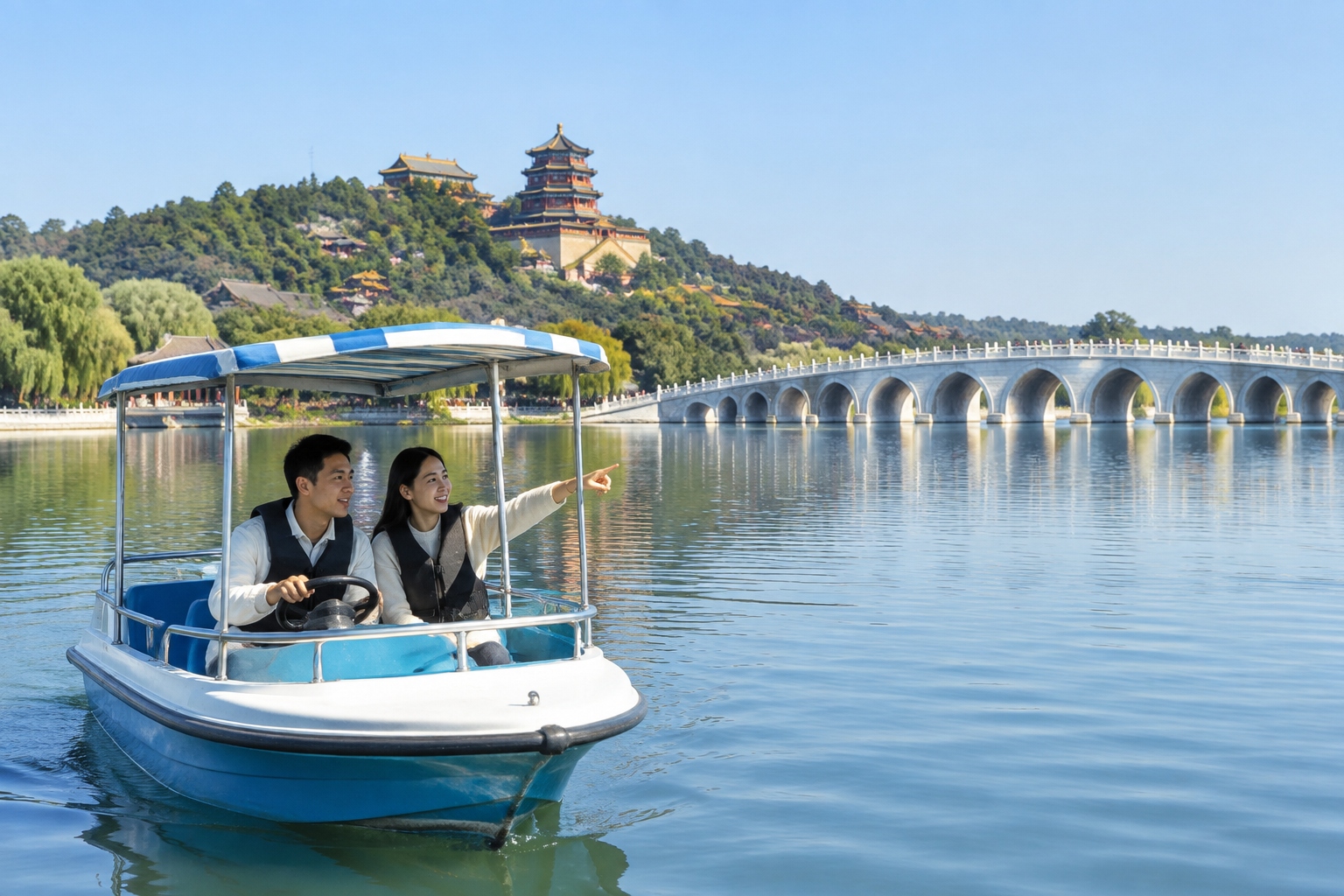
Boat rentals open at 8:30 AM (9:00 in winter) at several docks: near the Marble Boat, the South Lake Island, and the Seventeen-Arch Bridge. You can choose a pedal boat (about 60 RMB per hour for four people) or a small electric boat (around 120 RMB per hour for six). No license needed. The staff will give you a quick briefing in Chinese, but a map and hand gestures work fine.
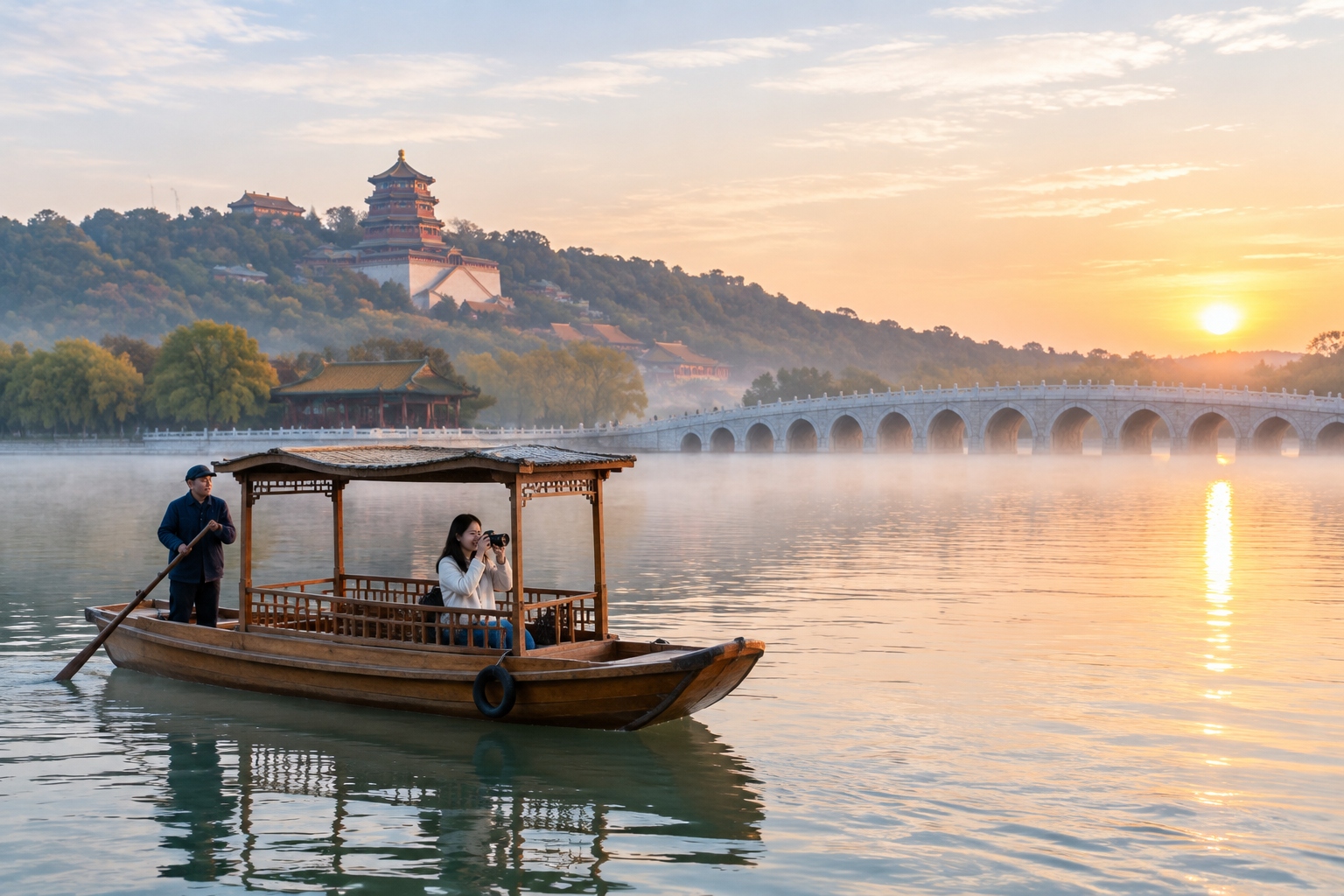
At 8:30 on a weekday morning, the lake is glass. Mist clings to the water near the Seventeen-Arch Bridge, and the distant Tower of Buddhist Incense looks like a painting. You steer past a few early-rising fishermen—no, not fishermen, just old men with long poles, practicing calligraphy on the stone paving with water. They look up and nod. You putter toward the West Causeway, where the willows trail their branches in the water like fingers.
As you pass under the Seventeen-Arch Bridge, look for the bronze ox on the east shore. It was placed there in 1755 to control the water, according to feng shui. The bridge itself has 544 stone lions, each with a different expression. You won’t count them all, but it’s a good excuse to slow down.
The West Causeway: Where Locals Walk
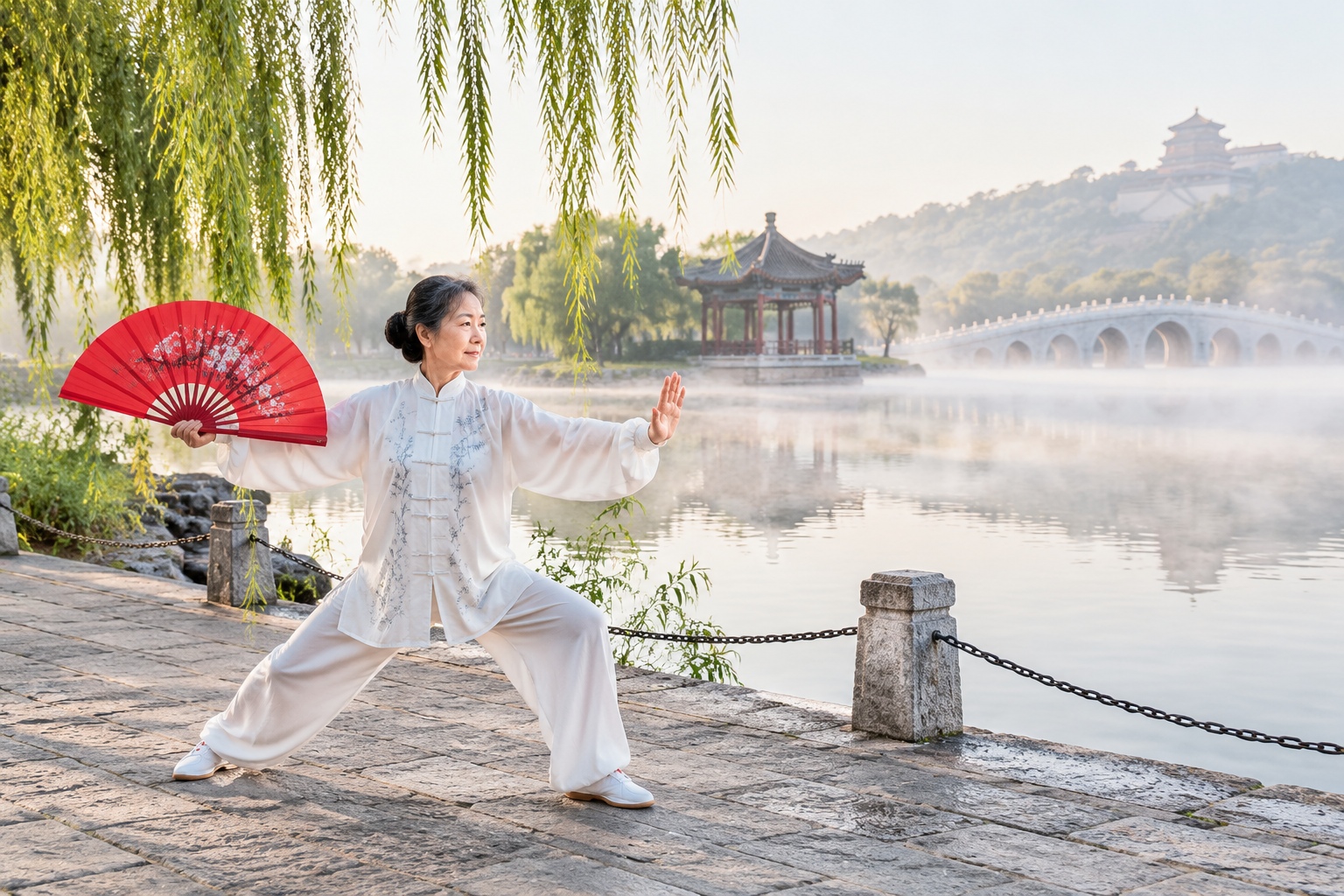
Dock your boat near the Jade Belt Bridge (玉带桥) and step onto the West Causeway (西堤). This is a one-kilometer path lined with six bridges, each with a different shape. It’s a copy of the Su Causeway in Hangzhou, but because it’s far from the main entrance, few tourists bother. Instead, you’ll see locals: a woman doing tai chi with a fan, a man cycling with a fishing rod strapped to his back, a group of retirees singing revolutionary songs under a pavilion. The air smells of lotus and damp earth. In spring, peach blossoms line the path. In autumn, the ginkgo trees turn gold.
Walk the entire causeway if you have time. It takes about 30 minutes at a stroll. On the far side, you’ll find the Mirror Bridge and a quiet stretch of shore where you can sit on a rock and watch the boats go by. No one will bother you.
What Most Tourists Miss
After the causeway, head north along the west shore. You’ll pass the Hall of Rippling Water and the Garden of Harmonious Interests. Both are worth a detour.
The Garden of Harmonious Interests (谐趣园)
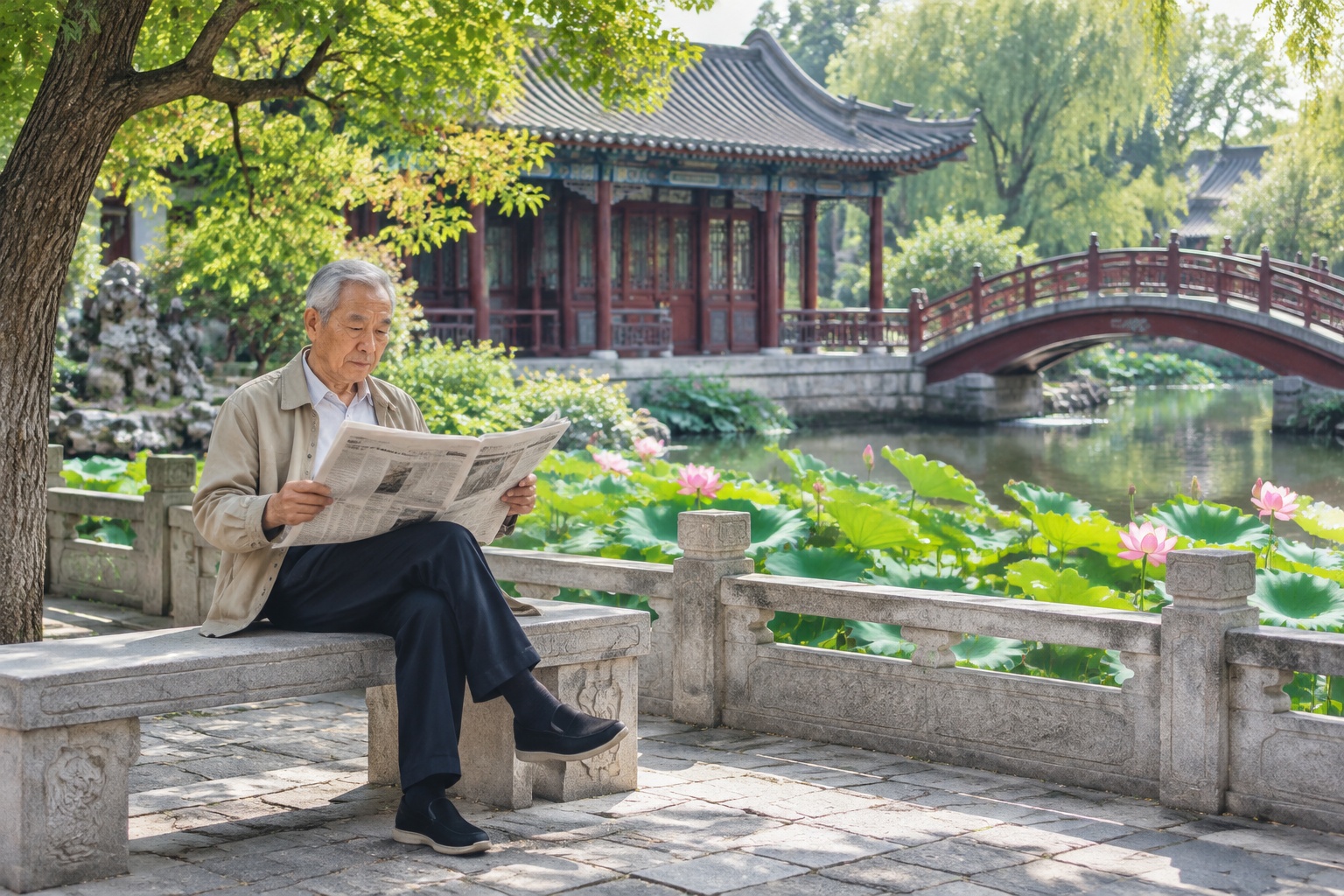
This is a small, walled garden built in 1751, modeled after the Jichang Garden in Wuxi. It has a lotus pond, a winding covered walkway, and a dozen tiny bridges. The name means “Garden of Harmonious Interests,” but a better translation might be “Garden of Pleasant Contradictions”—it’s a miniaturized version of a much larger landscape. Because it’s tucked behind Longevity Hill, tour groups rarely make it here. You can sit on a rock by the pond, drink tea from a thermos, and listen to the water trickle. An elderly man might be reading a newspaper on a bench. A cat might be sleeping on a windowsill. It feels like a secret.
In summer, the lotus flowers bloom, and the garden becomes a favorite spot for photographers. But even in winter, when the pond is frozen and the walkways are empty, it’s worth a visit. The layout is designed so that every window frames a view. Sit in the Hall of Clear Water and watch the light change.
The Back Lakes and Suzhou Street
If you have more time, exit the Garden of Harmonious Interests and walk north to the Back Lakes (后湖). This is a narrow, meandering waterway that runs behind Longevity Hill. In the 18th century, it was lined with shops and teahouses for the imperial court—a kind of theme park for the emperor. Today, Suzhou Street (苏州街) is a reconstructed version, with costumed staff and souvenir stalls. It’s a bit kitschy, but the walk along the back lakes is peaceful. You’ll see herons and turtles. The path connects to the North Gate, where you can exit.
A Practical Half-Day Route
Time: 6:30 AM – 11:00 AM (weekday, spring or autumn).
Entrance: North Gate (Beigongmen). Metro Line 4, Beigongmen Station, Exit D. The gate opens at 6:30 AM in peak season (April 1 – Oct 31) and 7:00 AM in off-season. Entrance fee: 30 RMB peak, 20 RMB off-season. Through ticket (includes all attractions): 60 RMB peak, 50 RMB off-season.
Route: Enter North Gate → walk south through Suzhou Street area → West Causeway → rent a boat at the dock near the Marble Boat (or the South Lake Island dock) → boat to West Causeway → walk the causeway → Garden of Harmonious Interests → exit via North Gate or East Gate.
Boat rental: 4-person pedal boat 60 RMB/hour; 6-person electric boat 120 RMB/hour. Deposit required (usually 200-400 RMB). Bring your passport.
Tea stop: There’s a small teahouse inside the Garden of Harmonious Interests. A cup of jasmine tea costs about 30 RMB. You can also bring your own thermos—locals do.
Food and restrooms: There are a few snack kiosks near the main halls, but they’re overpriced and crowded. Bring your own water and snacks. Restrooms are plentiful and free, but bring your own toilet paper—a common practice in China.
What to avoid: Weekends, Chinese public holidays (especially October 1-7), and the East Palace Gate entrance after 9 AM. The Long Corridor is a bottleneck—skip it or save it for a separate visit.
The Emperor’s View (and Yours)
By 10:30 AM, the lake is no longer yours. The tour boats are churning, the loudspeakers are crackling, and the Long Corridor is a slow-moving river of people. But you’re already on the West Causeway, or in a quiet teahouse, or walking back to the North Gate with the morning’s peace still in your ears. You didn’t see everything. That’s the point. The Summer Palace was never meant to be conquered—it was meant to be savored. And the best way to savor it is to do what the emperors did: get on a boat, drift for a while, and let the crowds have the rest.
Start the discussion at forum.chinacomes.com