

A cliff of Buddhas, half an hour from a coal city
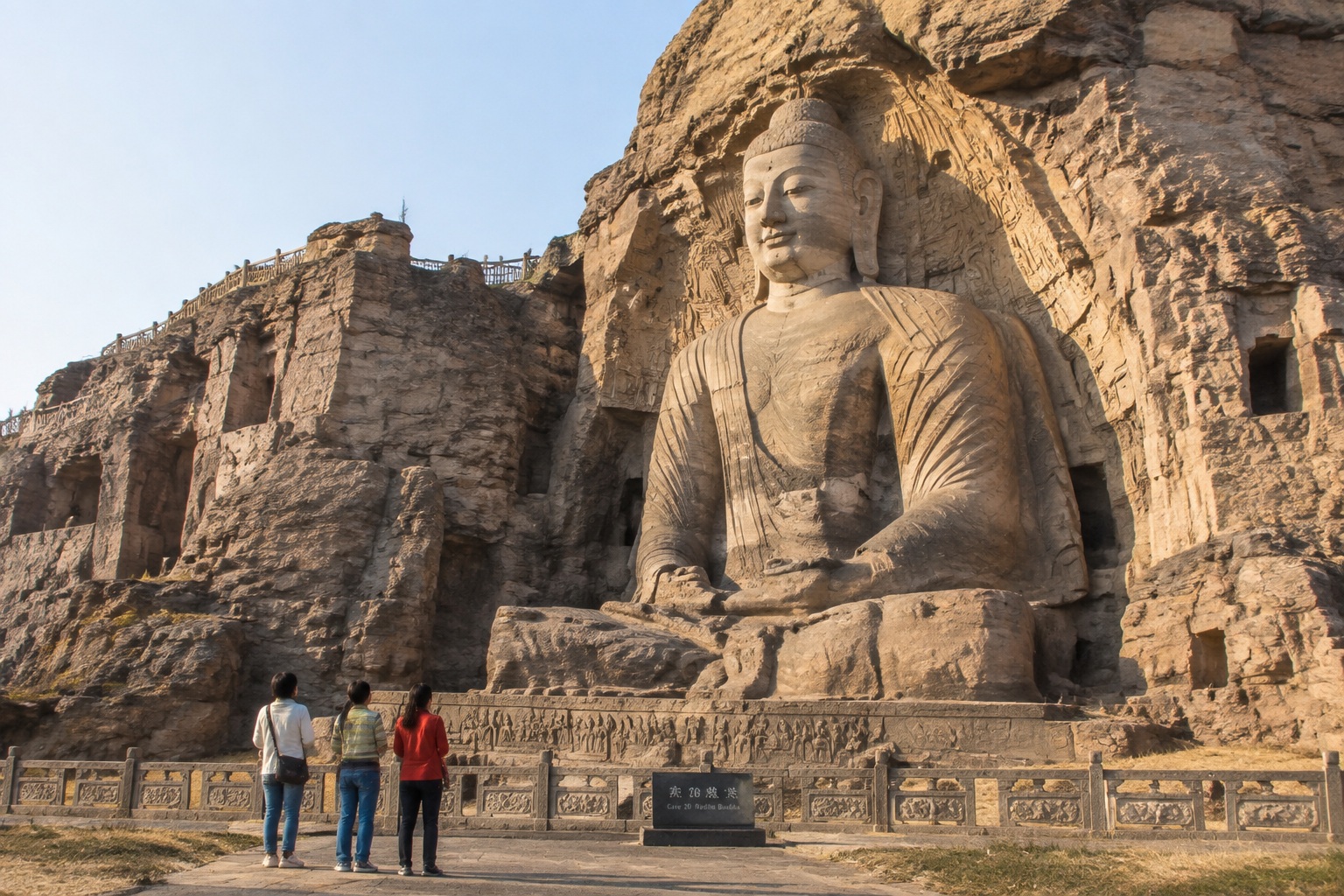
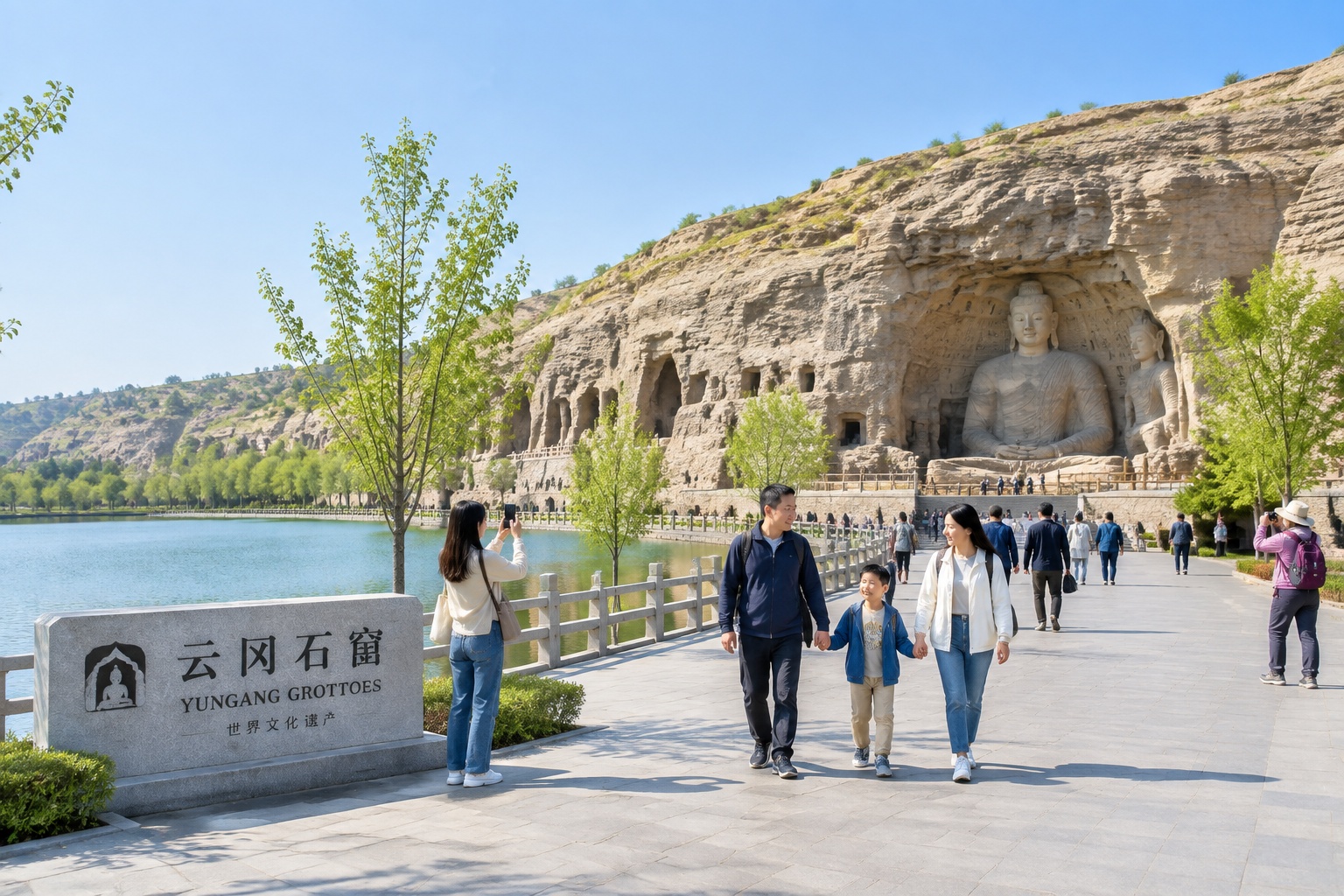
The taxi out of Datong takes about thirty minutes. You pass coal yards, apartment towers built in the last decade, a riverbed that is mostly sand. Then the road bends, and there it is: a kilometre of yellowish sandstone with holes cut into it.
Inside those holes are more than 51,000 carved figures. The Yungang Grottoes were chiselled into this cliff between roughly 460 and 525 CE, when Datong — then called Pingcheng — was the capital of the Northern Wei dynasty. UNESCO listed the site in 2001. It is one of the largest Buddhist cave complexes on earth, and it barely registers on the standard foreign itinerary of Beijing, Xi’an and Shanghai.
What stops people mid-step is not the scale. It is the faces.
The Buddha with the Greek nose
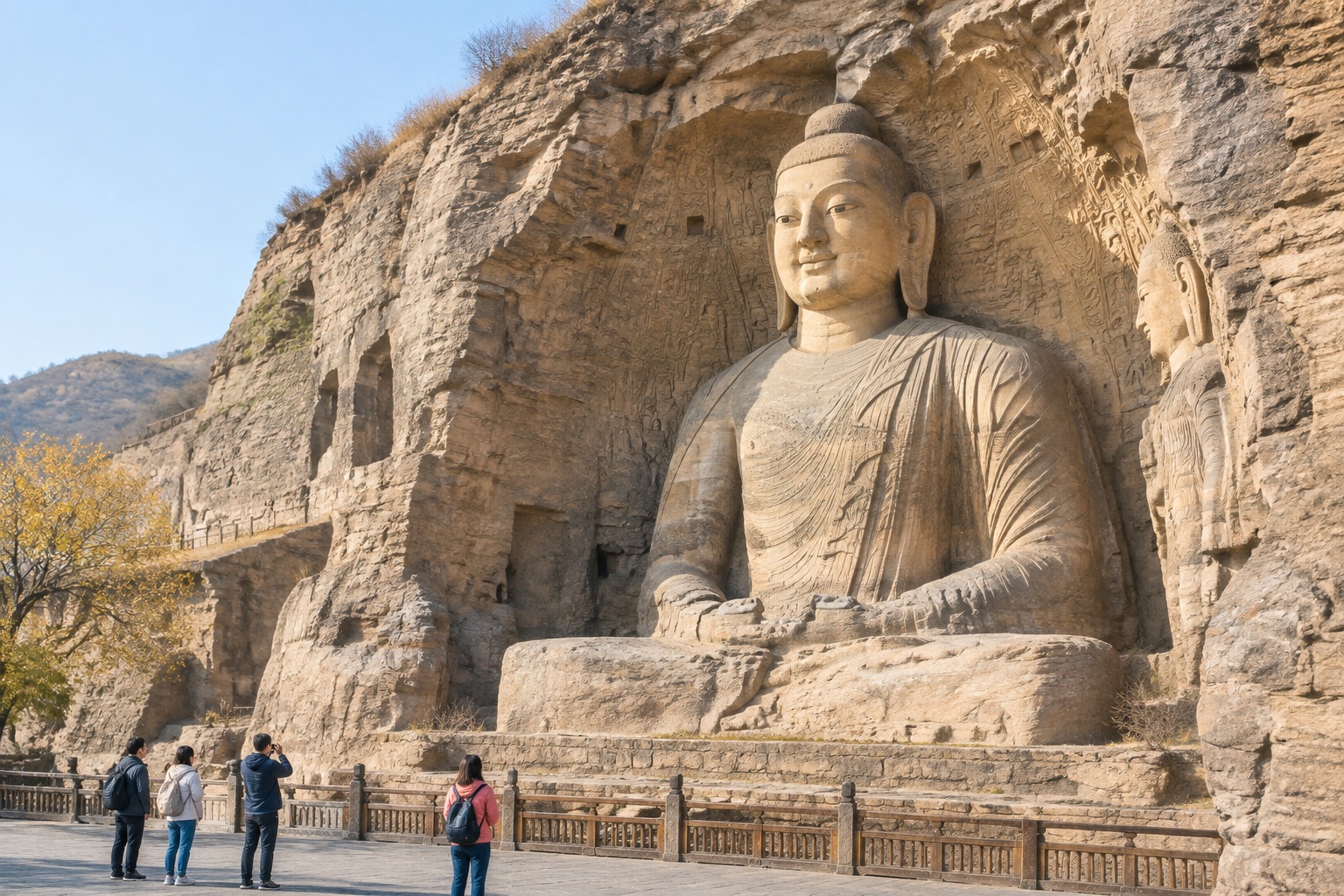
Stand in front of the 13.7-metre Buddha of Cave 20 and look at his hair. It curls. Not in the tight snail-shell spirals of a later Chinese temple statue, but in soft waves, closer to a Roman portrait bust. The nose is long and straight. The eyes sit deep. The robe falls in heavy, toga-like folds.
If you grew up in Europe or North America, that flicker of recognition can be genuinely disorienting. Why does a Buddha in a Chinese cliff face look faintly Mediterranean?
Because he does — and there is a paper trail. Alexander the Great’s successors ruled Greek-speaking kingdoms in Bactria and Gandhara, in what is now Afghanistan, Pakistan and Central Asia. When Buddhism took hold there during the Kushan period, roughly the first to third centuries CE, local sculptors had no inherited tradition for showing the Buddha as a human being. They borrowed the visual language around them: Greek and Roman faces, wavy hair, drapery, halos. Those workshops, in turn, fed the Silk Road.
By the time carving began at Yungang, three or four generations of Buddhist sculpture had already been moving east along the trade routes, mixing Gandharan ideas with the older Mathura style from central India — robes so sheer they seem wet, bodies with real physical volume. Monks, merchants and translators carried the pictures along with the texts.
Five emperors, carved in stone
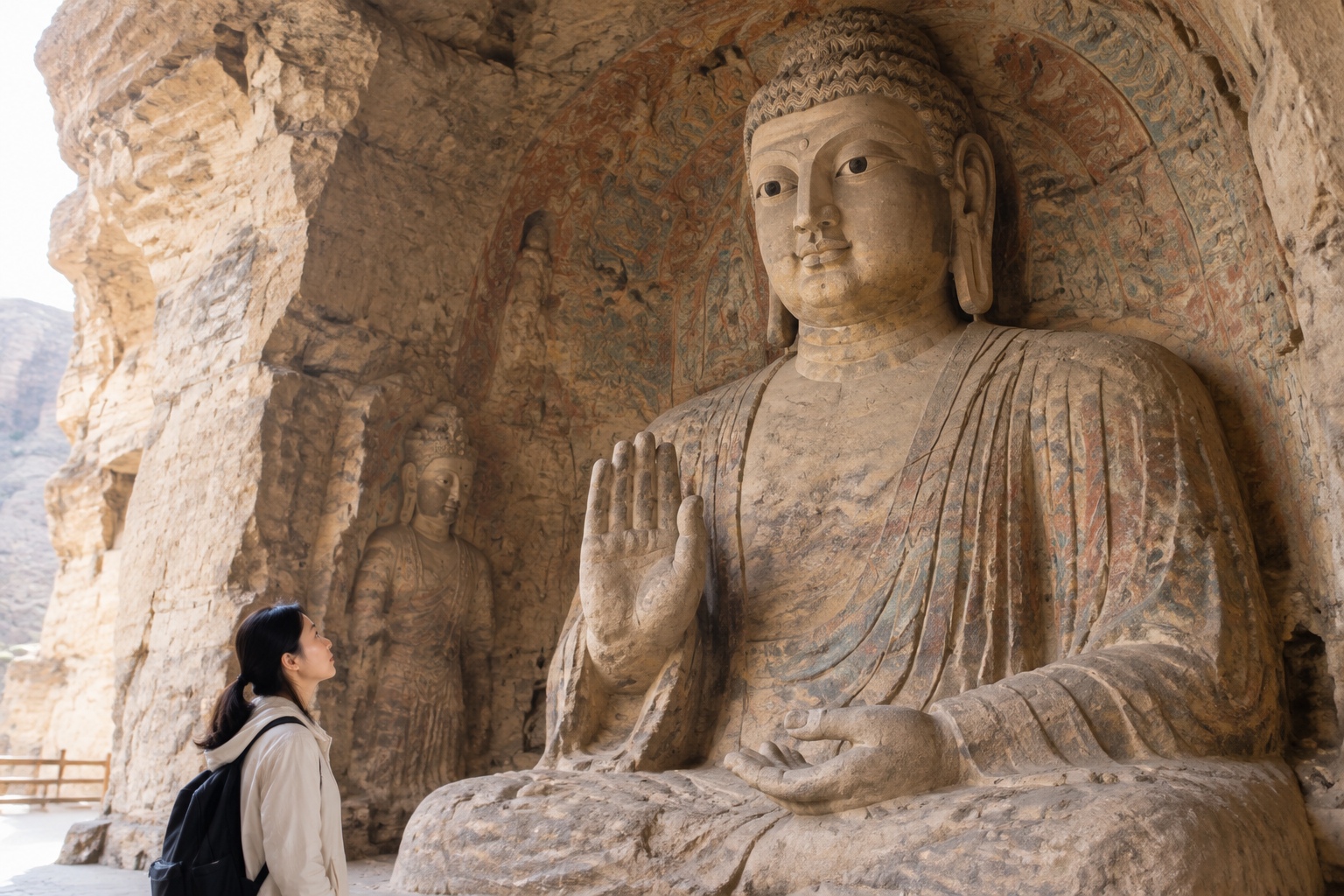
The first phase of the site, the five colossal caves numbered 16 to 20, was organised by a monk named Tan Yao around 460 CE. His idea was political as much as religious: each of the five giant Buddhas was to stand for one of the five Northern Wei emperors who had come before.
The Northern Wei were Xianbei, a steppe people from the north who ruled a large part of China and needed a way to make that rule feel legitimate. Buddhism, still relatively new to the region and outside the Chinese scribal tradition, offered exactly that. If a foreign religion could make an emperor look like a Buddha, everyone gained something — the throne got sacred authority, and the monastic community got state funding.
It is not so different from the way medieval European monarchs had themselves painted into the stained glass of the cathedrals they paid for. Same problem, different solution.
The Silk Road you can hear
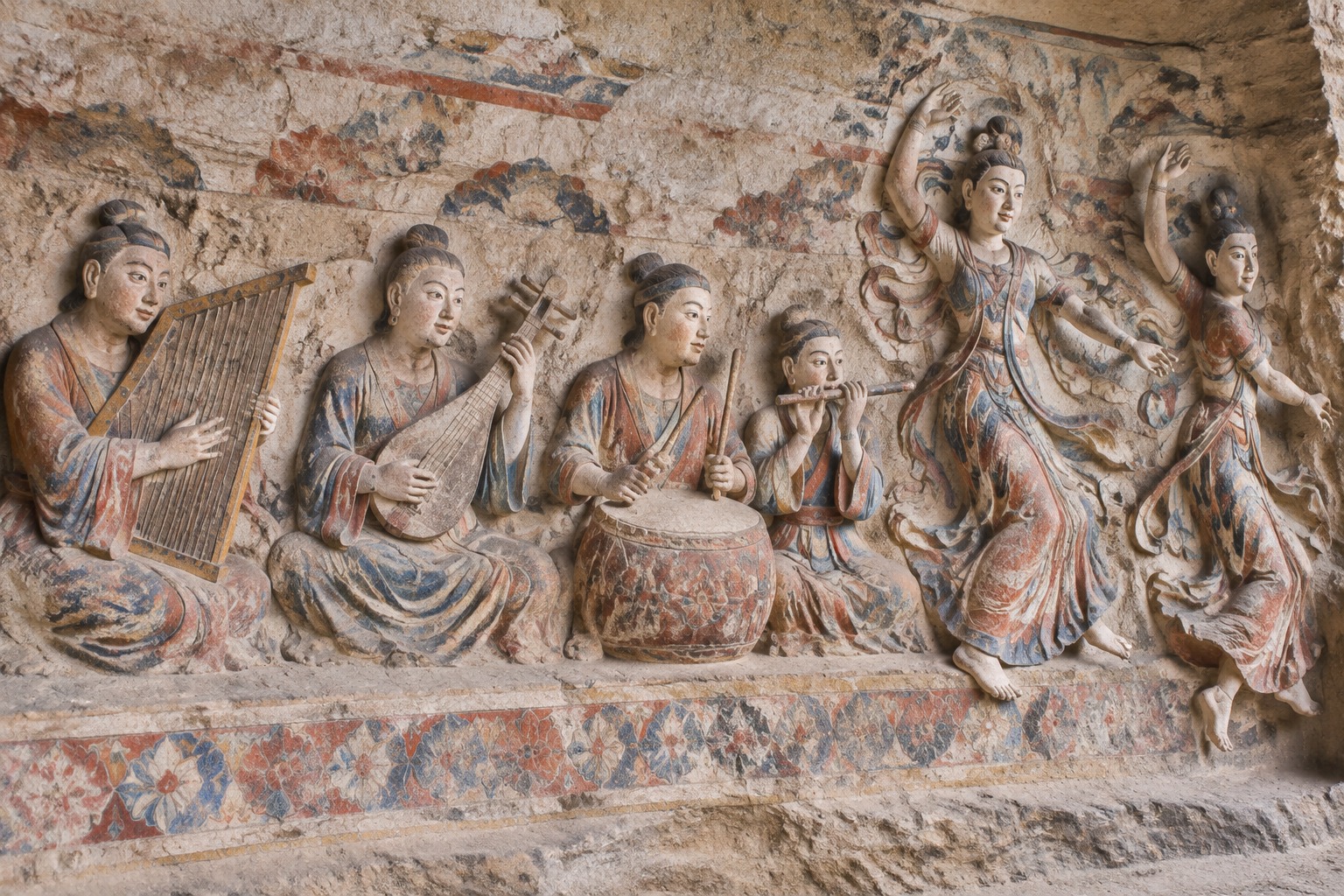
Walk into Cave 12 and the argument gets louder — literally. This is the “Music Cave”, and its walls are crowded with small carved orchestras: drummers, flute players, dancers caught mid-turn, and a set of instruments that would have sounded foreign to most Chinese ears at the time.
One figure holds an angular harp. It is an import from Persia and Mesopotamia, an ancestor of instruments played in Baghdad and Cairo centuries later. Another plays a pipa, a lute that travelled from Central Asia and eventually became the signature instrument of Chinese classical music. Put them in the same band and you have a decent picture of what a fifth-century frontier capital sounded like.
Datong in that period sat on the edge of the steppe, and its streets held Xianbei horsemen, Chinese officials, Sogdian traders, Indian and Central Asian monks. Sanskrit, Sogdian, Chinese and various Turkic languages were all in the air. That is the world the carvers worked in, and they put it on the walls.
Then the Buddha put on Chinese clothes
The most interesting thing about Yungang is that you can watch a shift happen inside the same cliff, across roughly sixty years.
In the earliest caves, the Buddha’s right shoulder is bare. His body is heavy and broad. His face is square, his features emphatic, his hair wavy. He looks like a visitor.
By the middle and later caves, the robe covers both shoulders and hangs in layered Chinese folds. The body thins out and becomes more elegant. The face softens into something closer to a Chinese ideal of the cultivated gentleman. This was not an accident of taste. Emperor Xiaowen pushed a deliberate programme of sinicisation in the 490s — Chinese surnames, Chinese dress, Chinese administrative language — and in 494 he moved the capital south to Luoyang, where carving continued at the Longmen Grottoes in an even more thoroughly Chinese style.
So the cliff is a record of assimilation in progress. A religion arrives from India with a Greek accent, and within two generations it is wearing Chinese robes. Most cultures have a version of this story. Yungang just happens to have carved the receipts into stone, at a scale you can walk past.
The parts that aren’t beautiful
Sandstone does not last forever. Rain, wind, freeze-thaw cycles and, for much of the twentieth century, coal dust from the mines around Datong have all taken a toll on the softer figures.
There is also the theft. In the early 1900s, foreign collectors, dealers and expeditions removed a significant number of sculptures. Today you can find Yungang pieces in museums in Europe, North America and Japan, often displayed as highlights of a collection. Staff at the site will tell you about it without much drama — it is simply part of these objects’ history now.
What changed more recently is the setting. In the late 2000s, the city rerouted the coal-hauling road that ran close to the cliff, shut down nearby mining operations, relocated residents and built a park, a lake and a new visitor centre in front of the grottoes. Conservators have mixed feelings about how much of that is archaeology and how much is landscaping, but the air is cleaner than it was, and the statues are no longer sitting beside heavy traffic.
If you go
Datong is about two hours from Beijing by high-speed train, which has turned this from a minor expedition into a realistic day trip. From Datong South station, the grottoes are roughly a thirty-minute taxi ride west; local buses also run there. Tickets cost around 100–120 yuan depending on the season.
Go early, or go late. Cave 20 is at its best in low afternoon light, when the folds in the Buddha’s robe pick up shadow. Flash photography is banned inside the caves — the pigments, where they survive, are fragile. A weekday in spring or autumn is the difference between sharing a cave with forty people and having it almost to yourself.
Why a Chinese cliff has a Greek nose
People sometimes describe Yungang as proof that Chinese civilisation was always open. That framing is a bit tidy. What the caves actually show is messier and more interesting: a steppe dynasty using an Indian religion with Greek visual habits to justify its rule over Chinese subjects, then gradually turning the whole package into something Chinese.
You do not have to be Chinese, or Buddhist, or particularly interested in art history to feel the oddity of that. You just have to stand in front of a 1,500-year-old face that seems to be looking back at you from two places at once.
Start the discussion at forum.chinacomes.com