
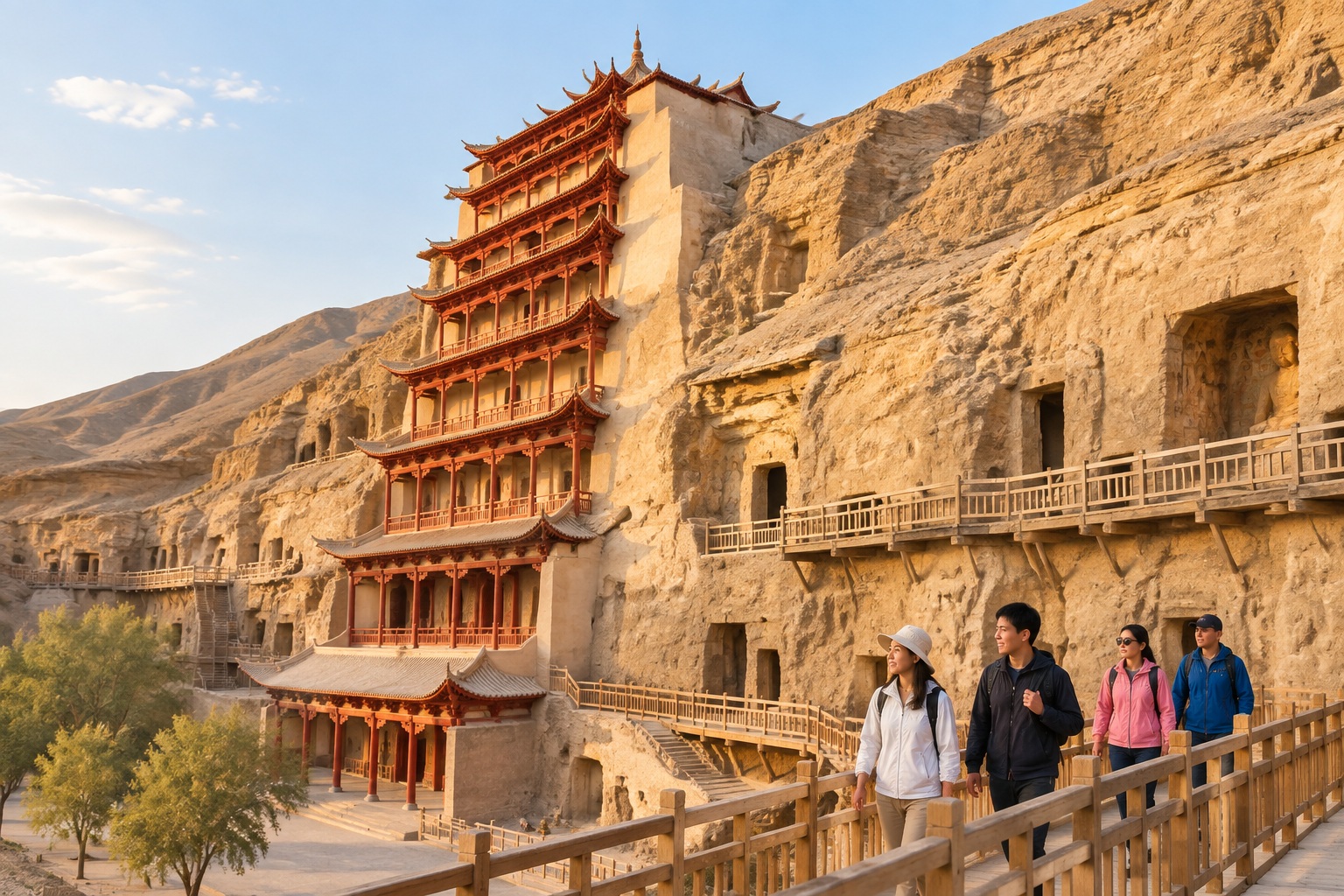

At 7:20 a.m., the Line Starts Moving
About 15 kilometers from the cliff, in the desert outside Dunhuang, sits a low sand-colored building with a parking lot that fills before sunrise. This is the Mogao Caves Digital Exhibition Center, and it is the first stop for everyone with a standard ticket.
Inside, a woman from Melbourne checks in with her passport and a QR code she booked 26 days earlier. She has what the Dunhuang Academy calls an A ticket: two films, a shuttle bus, a guide, and eight caves.
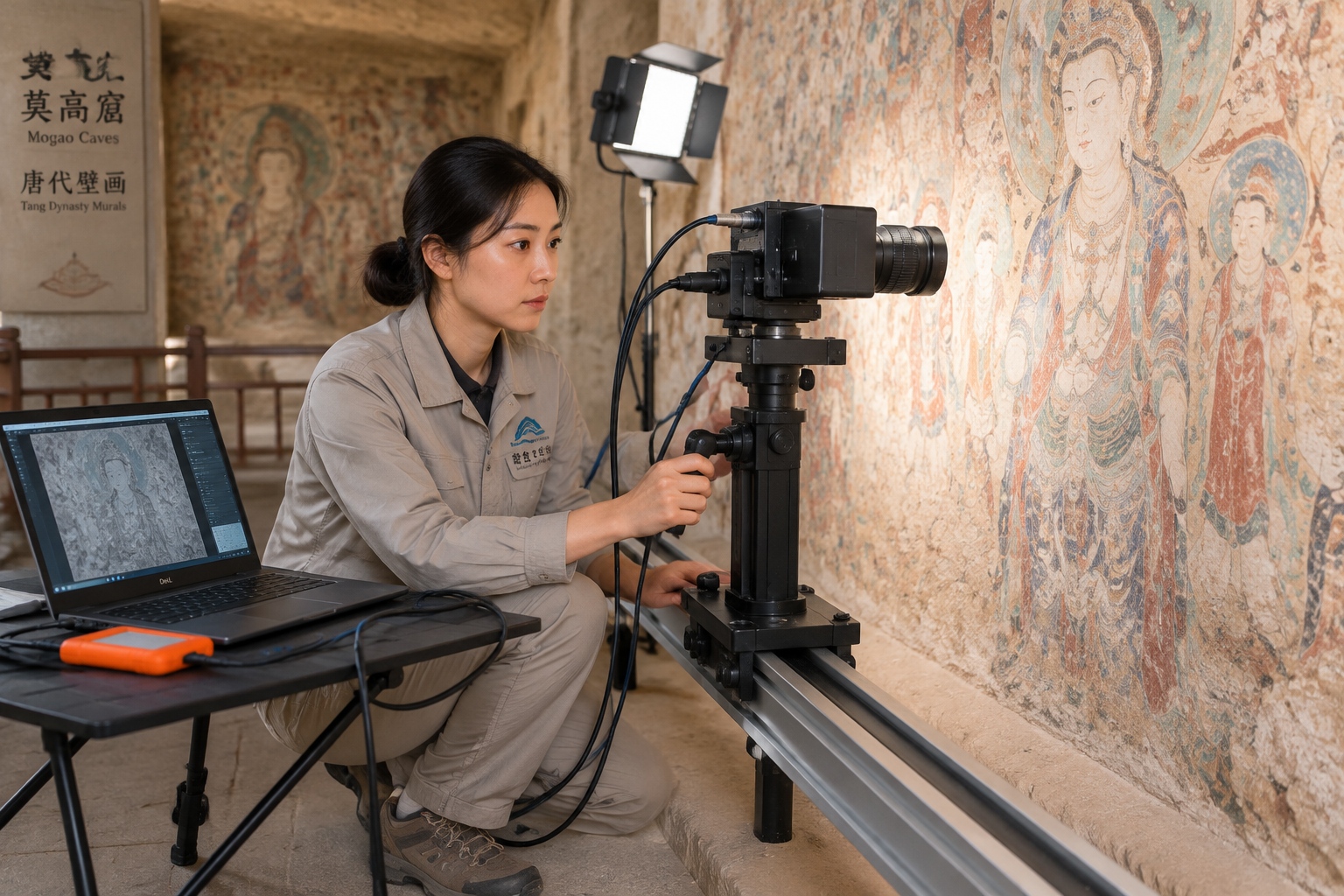
Mogao has 735 caves. She will walk into eight of them, in a group of about 25 people, for five to eight minutes each. The doors are locked behind her. The rest of the site stays closed.
Eight Caves Out of 735
The caves were carved into a sandstone cliff at the edge of the Gobi starting in the 4th century, and monks, merchants and donors kept adding to them for roughly a thousand years. Of the 735, about 492 still hold murals and painted sculpture: around 45,000 square meters of painting and more than 2,000 figures. UNESCO listed the site in 1987.
Scale is exactly why the number 6,000 exists. If you could sell 20,000 tickets a day, the academy would. It does not, because the murals are not built to survive that.
Why the Cap Is 6,000, Not 20,000
The limit is a conservation figure, not a marketing one. The paintings at Mogao sit on earthen plaster, made from local clay, sand and plant fiber, finished with a thin white ground and then painted with mineral and organic pigments. That surface is far more responsive to air than a canvas or a stone wall.
Each visitor changes the room. An adult at rest exhales roughly 35 to 40 grams of water vapor an hour and warms the air immediately around them. Put 25 people inside a small cave for eight minutes and the humidity and carbon dioxide readings move — measurably, on instruments.
The real damage is salt. Soluble salts in the plaster, mainly sodium chloride and sodium sulfate, are stable when the air is dry. When humidity rises past a threshold, they dissolve. When it drops again, they crystallize, expand, and push pigment and plaster off the wall. A cave can lose part of a Tang dynasty figure in a single bad season. Conservators have studied this cycle for decades; the Getty Conservation Institute worked with the Dunhuang Academy inside Cave 85 for more than a decade, mapping how moisture, salt and visitors interact, and the resulting conservation plan became a model for how visitor limits get set at Mogao.
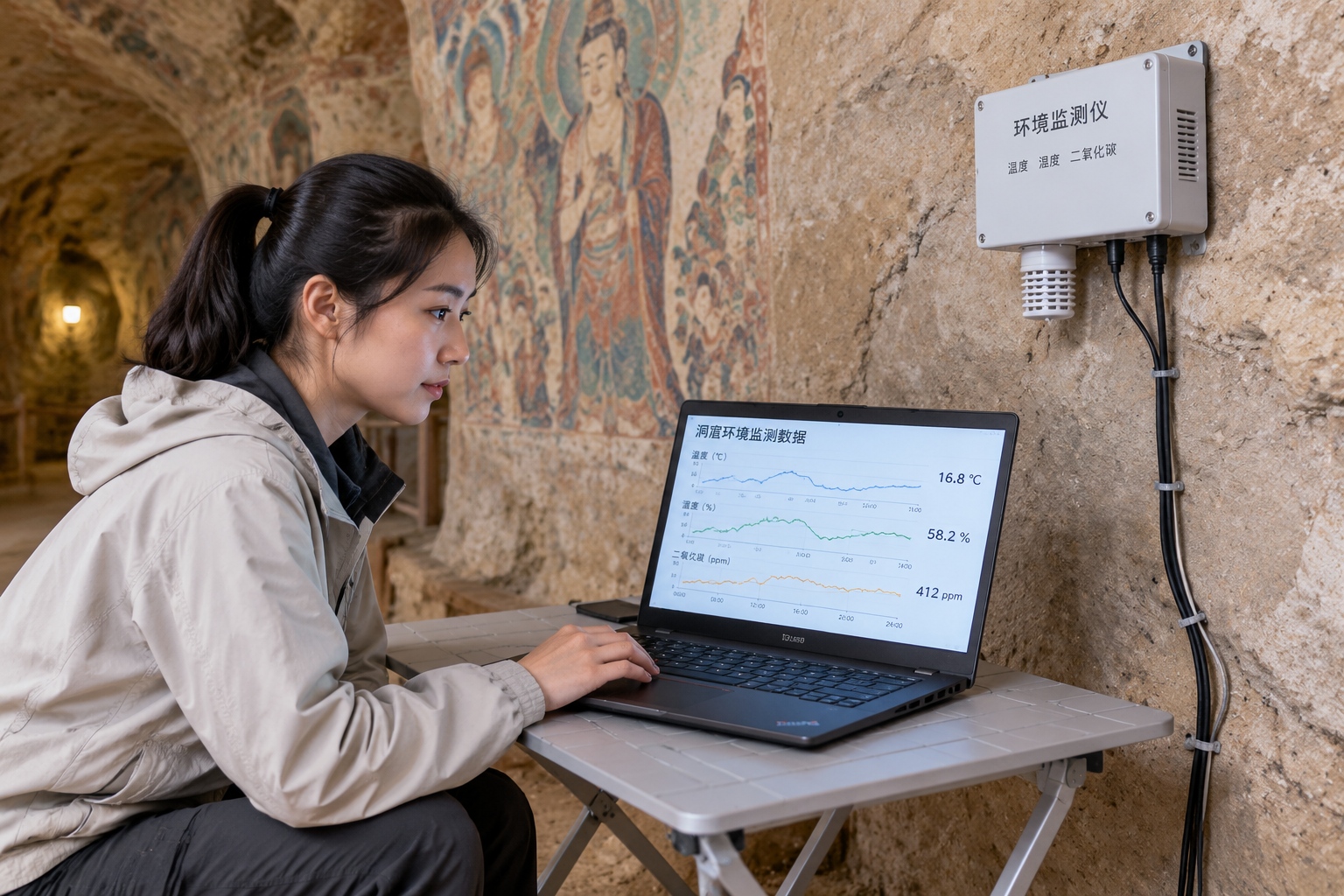
That is why the caves are instrumented. Temperature, relative humidity and carbon dioxide sensors sit inside many of them. If readings cross a threshold, that cave comes off the route — for a day, sometimes for weeks.
Before the digital center opened in 2014, the academy commissioned a formal carrying capacity study. The 6,000 figure balances three things: what the painted surfaces can tolerate across a season, how many groups can physically rotate through the open caves in one working day, and whether a visitor standing at the back of a room can actually see anything.

How the Ticket System Actually Works
Rules are adjusted almost every year, so check the official site before you plan. The structure, though, has been stable since 2014.
Peak season
May 1 to October 31. Daily cap: 6,000. A standard A ticket costs 238 yuan (about US$33) and includes the two films at the digital center, the shuttle to the cliff, a guide, and eight caves.
Off-season
November 1 to April 30. The ticket drops to 140 yuan, and the standard visit usually includes more caves — commonly 12 instead of 8 — because there is room in the day.
Emergency tickets
On the busiest days, in late July, August and the National Day holiday in early October, A tickets sell out weeks ahead. The academy then releases a cheaper emergency ticket, around 100 yuan, which gets you in with a shorter, thinner visit: fewer caves, no films. This is the pressure valve. It pushes the day’s total above 6,000 even though the number on the booking page has not moved.
Booking
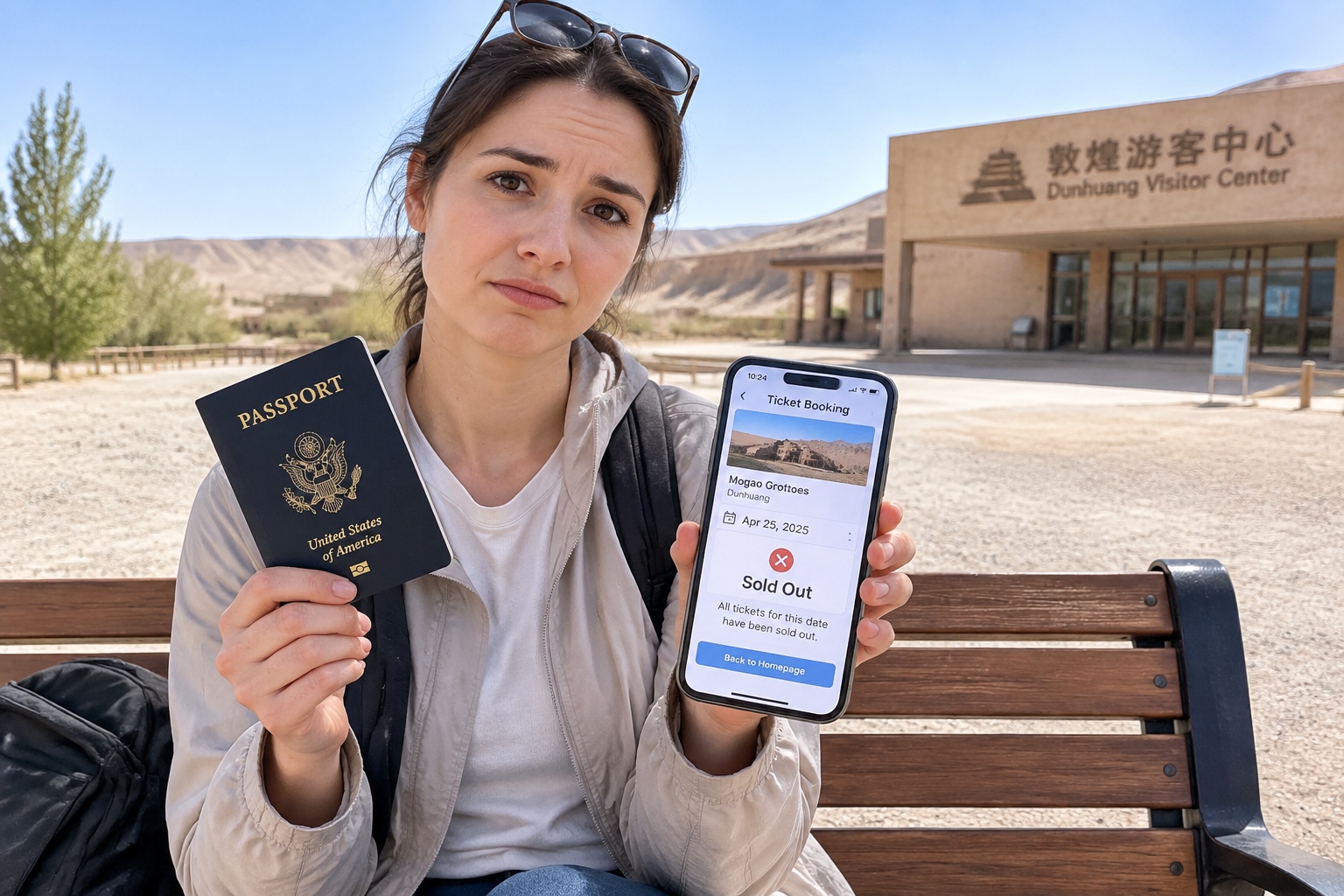
Reservations open 30 days in advance on the academy’s official site (mgk.org.cn) and its WeChat account, which also has an English-language booking page. Foreign visitors register with a passport number and must bring that passport on the day. Photography is banned inside the caves, bags stay at the entrance, and the wooden walkways are narrow. It is a daytime site in a desert: bring water, a hat, and no expectations of air conditioning.
The Caves You Cannot Enter — and Their Digital Copies
Even with 12 caves in the off-season, you are seeing roughly 1.5 percent of the site. Some caves are closed because conservators are working inside. Some are too small to hold a group. Some are reserved for scholars. Others are simply too fragile to open at all.
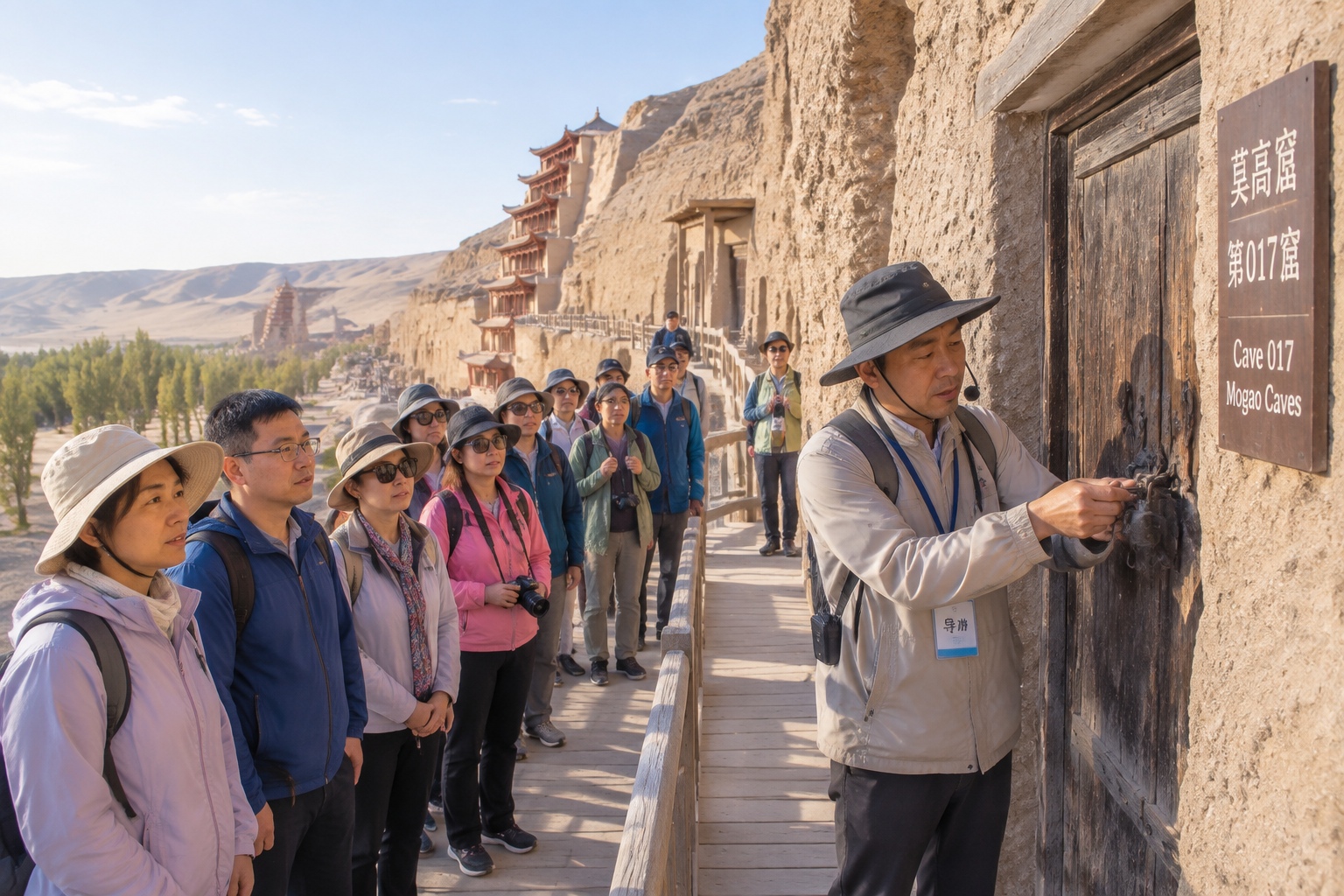
Since the early 2000s, the Dunhuang Academy has been photographing them anyway. The work is slow and physical: a camera rig on a rail, stepped across a wall in millimeter increments, producing thousands of overlapping frames that are later stitched into one seamless image. Sculptures get structured-light scans. Multi-spectral imaging pulls out faint underdrawings and later repairs invisible to the eye. A single large cave can generate hundreds of gigabytes.
By the early 2020s the academy had completed digital capture for roughly 290 caves, with the stated goal of covering every painted one. As of now, no one has a complete set for all 735, and the project is measured in decades rather than years.
Part of the archive is free and public. The Digital Dunhuang website (e-dunhuang.com), launched in 2016, offers high-resolution panoramic views of dozens of caves that you can pan and zoom on a phone. In 2020 the academy and Tencent released “Cloud Tour of Dunhuang,” a WeChat mini-program that turns murals into interactive animations. In 2023 came the Digital Library Cave, a game-engine reconstruction of Cave 17 — the small room where, in 1900, a caretaker named Wang Yuanlu found tens of thousands of manuscripts, most of which left China between 1907 and 1914 and now sit in London, Paris, St. Petersburg and Tokyo. The International Dunhuang Project has been putting those scattered pages back together online since 1994.
What This Means If You Are Planning a Trip
Book on the first day reservations open — 30 days out — if you want peak season. Late July, August and the first week of October are the hardest. Late October and April are the sweet spot: cheaper tickets, more caves, thinner crowds, and cool enough to stand on a walkway without wilting.
If Mogao is fully booked, look beyond it. The Yulin Caves, about 170 kilometers east, hold 43 caves with paintings from the same tradition and a fraction of the visitors. The Western Thousand Buddha Caves sit roughly 35 kilometers from Dunhuang city. Further east near Lanzhou, the Bingling Temple grottoes are reached by boat. None of them has a 6,000-person line.
And do not treat the digital center as a consolation prize. The dome-screen film recreates several caves in close detail, including ones you cannot walk into, at a scale and brightness no flashlight can match.
The Part That Is Not Settled
Not everyone believes 6,000 is safe. Some conservation scientists argue that concentrating that many people into a few hours a day still puts the most popular caves under more stress than the paintings can absorb indefinitely. Sand, wind and shifting moisture patterns add pressure that no ticket cap controls. Demand keeps rising: Dunhuang as a whole now draws millions of visitors a year, and every one of them wants the same eight caves.
Digitization has limits of its own. Hard drives fail, file formats age, color calibration drifts, and a scan of a wall is not the wall. Fan Jinshi, the archaeologist who arrived at Mogao in 1963 and later led the academy, spent decades making the argument that became this system: the caves could never be fully opened, so the copies had to be good enough to carry the knowledge instead. She has spoken of the digital archive as a way of preserving the site indefinitely — while noting that indefinitely requires constant maintenance.
At Four in the Afternoon
The woman from Melbourne comes out of her eighth cave, blinking in the flat desert light. The guide locks the door and moves on to the next group. By five o’clock the last shuttle is heading back to the digital center, and the cliff goes quiet except for the sensors, which keep logging temperature, humidity and carbon dioxide through the night.
Somewhere in a server room, a stitched image of a cave she will never enter is sitting on a hard drive. She can open it on the plane home. That is the trade the 6,000 figure buys: fewer people inside the caves, and everyone else looking at something that was made to last longer than the building it came from.
Start the discussion at forum.chinacomes.com