
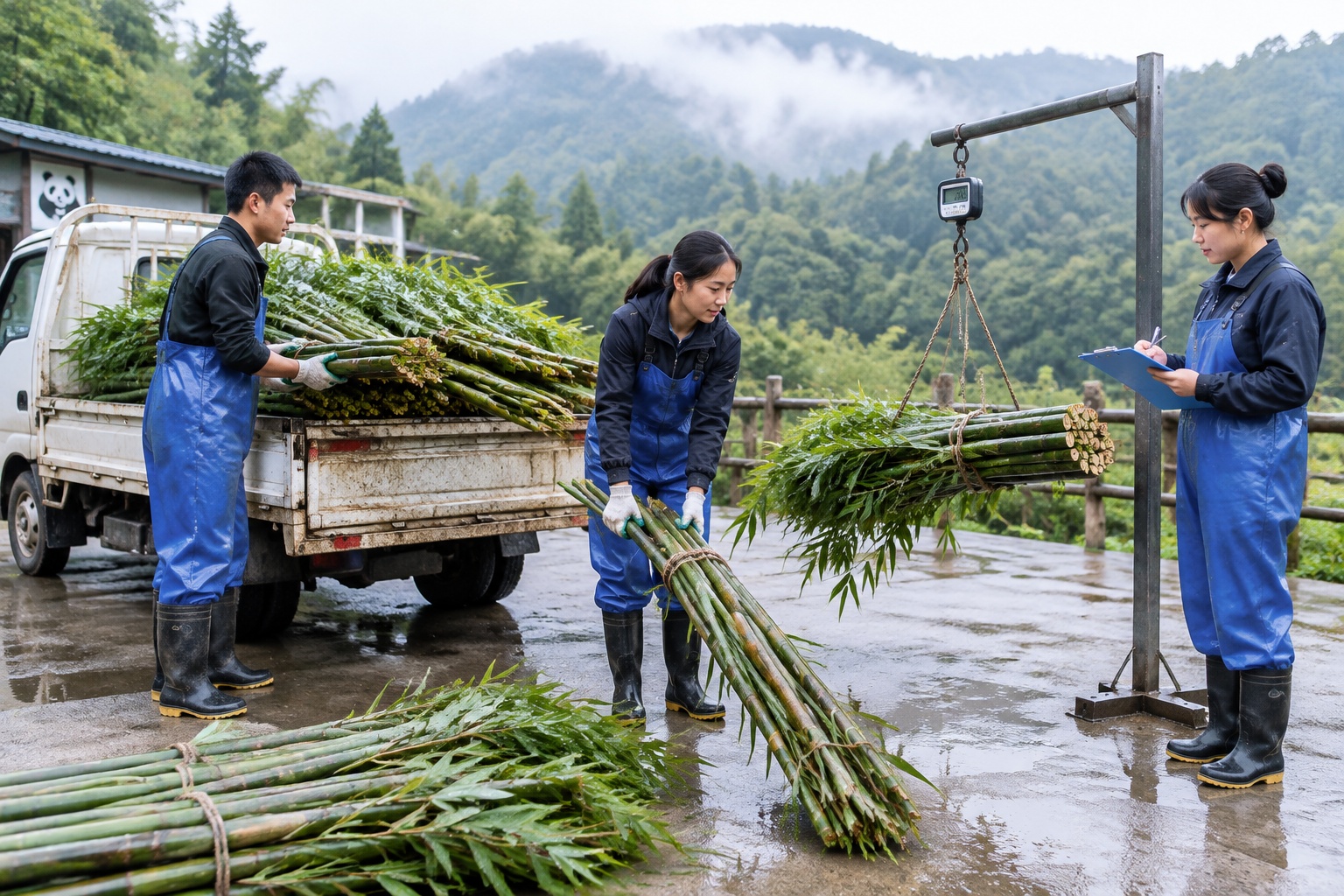

6:40 a.m., and the bamboo truck is already unloading
At a panda base in the hills west of Chengdu, the first delivery arrives before the visitors do. A truck backs onto a concrete pad, and workers in rubber boots throw down bundles of bamboo cut the night before, stems still damp. A keeper notes the weight, the species, the field it came from. By mid-afternoon the pile is gone.
Anyone who walks into a panda enclosure at noon sees something different: an animal flat on its back, one arm draped over a half-eaten stalk, asleep. Visitors ask the same question every day. Is it sick? Is it lazy?
It is neither. A giant panda’s day is mostly a very long meal, interrupted by naps, because the food it depends on gives back almost nothing for the effort of eating it.
A carnivore’s gut doing a vegetarian’s job
The giant panda belongs to the order Carnivora. Its closest living relatives are bears, and its digestive tract still looks like a bear’s: a short, simple, single-chambered stomach, a short small intestine, a short colon, no enlarged cecum, no multi-chambered fore-stomach. A cow has four stomach chambers and hours of fermentation. A rabbit has a huge cecum. A panda has neither.
That matters because bamboo is roughly 80 percent structural fiber — cellulose, hemicellulose and lignin — packed with silica and defended by secondary compounds. Without a fermentation vat, a panda cannot break much of it down. Studies of wild and captive animals place dry-matter digestibility of bamboo at roughly 17 to 27 percent, depending on which part of the plant is eaten. A sheep on good pasture digests well over half.
The panda’s solution is volume and speed. Instead of extracting a lot from a little, it extracts a little from a lot, and pushes the rest through quickly. Retention time in the gut is short, which keeps the throughput high, which keeps the animal alive.
Twelve to 38 kilograms, ten to 16 hours
The numbers are the story. A wild giant panda spends 10 to 16 hours a day feeding and consumes roughly 12 to 38 kilograms of bamboo in that time, depending on body size, bamboo species and season. That is a substantial fraction of its own body weight — an adult male weighs about 85 to 125 kilograms — swallowed and mostly excreted.
The energy budget stays thin. A 2015 study in the journal Science measured daily energy expenditure in captive and wild pandas and found it to be around 38 percent of what a mammal of the same body mass would normally burn, comparable to a sloth. The researchers linked it to unusually low levels of thyroid hormone. Pandas also lack the physical activity of similar-sized bears: they move slowly, avoid steep climbs when they can, and nap in several bouts across the day.
One contrast is easy to remember. Brown bears eat salmon and berries in the autumn, put on fat, and sleep through winter. Pandas cannot store enough energy in fat from bamboo to hibernate. Instead, as winter approaches, they walk downhill to where bamboo stays green.
The thumb that is not a thumb
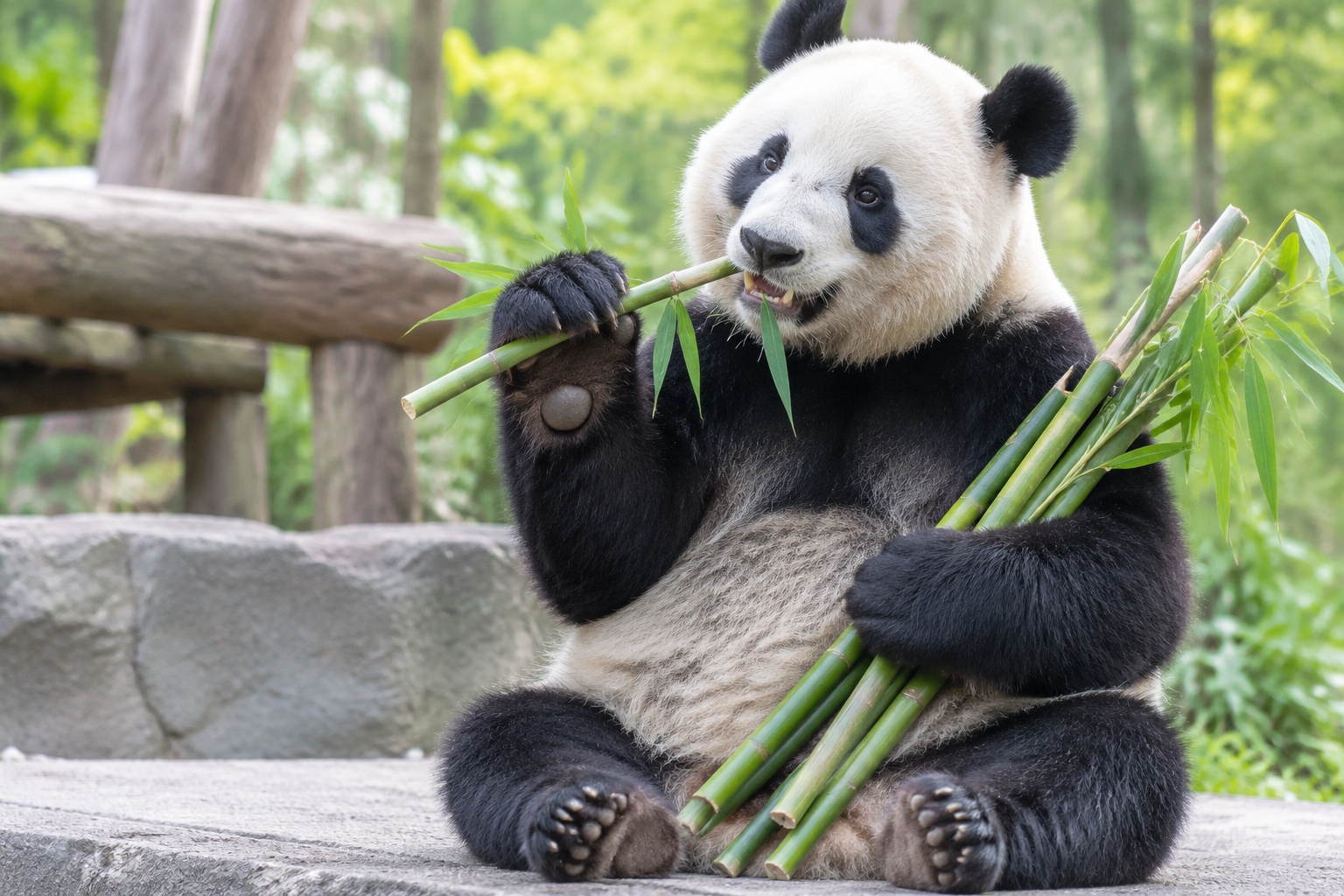
Eating bamboo is a handling problem before it is a digestion problem. Bamboo stems are smooth, hard and springy, and they must be peeled, snapped or stripped of leaves hundreds of times a day.
The panda’s answer is an enlarged radial sesamoid bone in the wrist, sitting opposite the other digits and functioning as a sixth finger. Biologist Stephen Jay Gould wrote a famous 1978 essay about it, calling it a clumsy but workable patch on an inherited design. Later anatomy work shows the bone is only half the mechanism: a fleshy pad and the arrangement of the carpal bones complete the grip. Watch a panda for a few minutes and you see the result — it sits upright like a person in a chair, holds a culm in one hand, tears a strip with its teeth, and reaches for the next one, often with several stalks already tucked under one arm.
Its skull is built for the same job. Broad, flat molars, powerful jaw muscles and a pronounced ridge on top of the skull let it crush fibrous stems that a dog’s jaw would simply slide off.
What the gut bacteria are actually doing
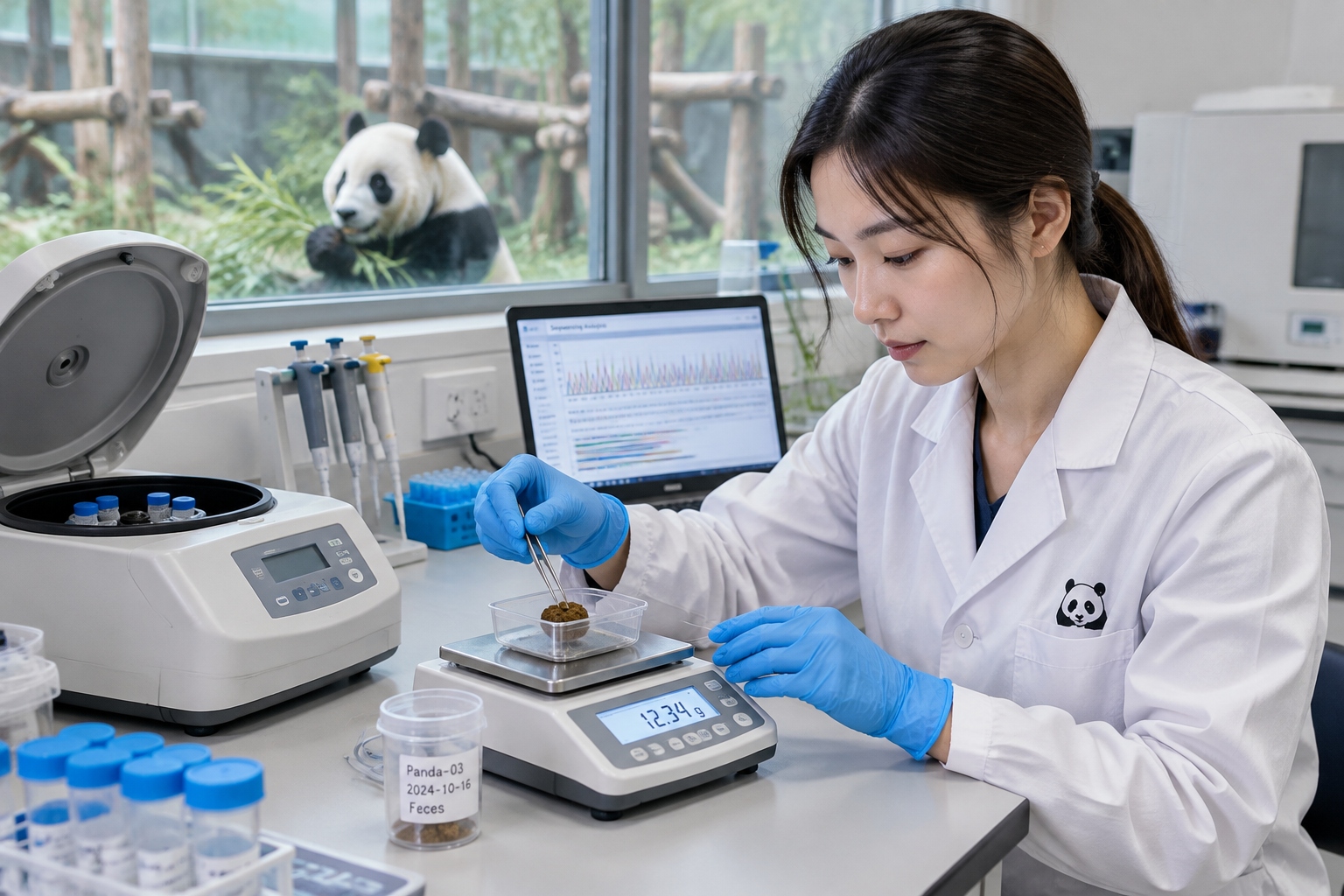
If the panda’s own enzymes cannot unlock bamboo, the obvious next question is whether its microbes can. The answer, from more than a decade of sequencing work, is nuanced.
Panda gut communities are dominated by a handful of groups, including Clostridium and Escherichia/Shigella, and are far less diverse than those of cattle, sheep or even pandas’ bamboo-eating neighbors. Genes for breaking down cellulose show up, but at low frequency. A frequently cited 2011 study in PNAS found no evidence of a specialized fiber-digesting community that would put a panda on par with a ruminant.
The more interesting finding is that the community changes with the menu. When pandas switch from culms to shoots in spring, the bacterial mix shifts too, and groups associated with handling plant secondary compounds become more common. That fits the chemistry: bamboo shoots contain cyanogenic glycosides, and pandas eat a lot of shoots for a few weeks each year. Researchers suspect the microbiome helps detoxify what the animal cannot avoid, rather than being a major source of calories. Captive pandas, fed a diet supplemented with steamed corn-and-soybean cakes, carry gut communities that look noticeably different from wild ones.
Put simply: the panda gets a little help from its bacteria, not a lot. The rest of the burden falls on eating more.
Bamboo has seasons
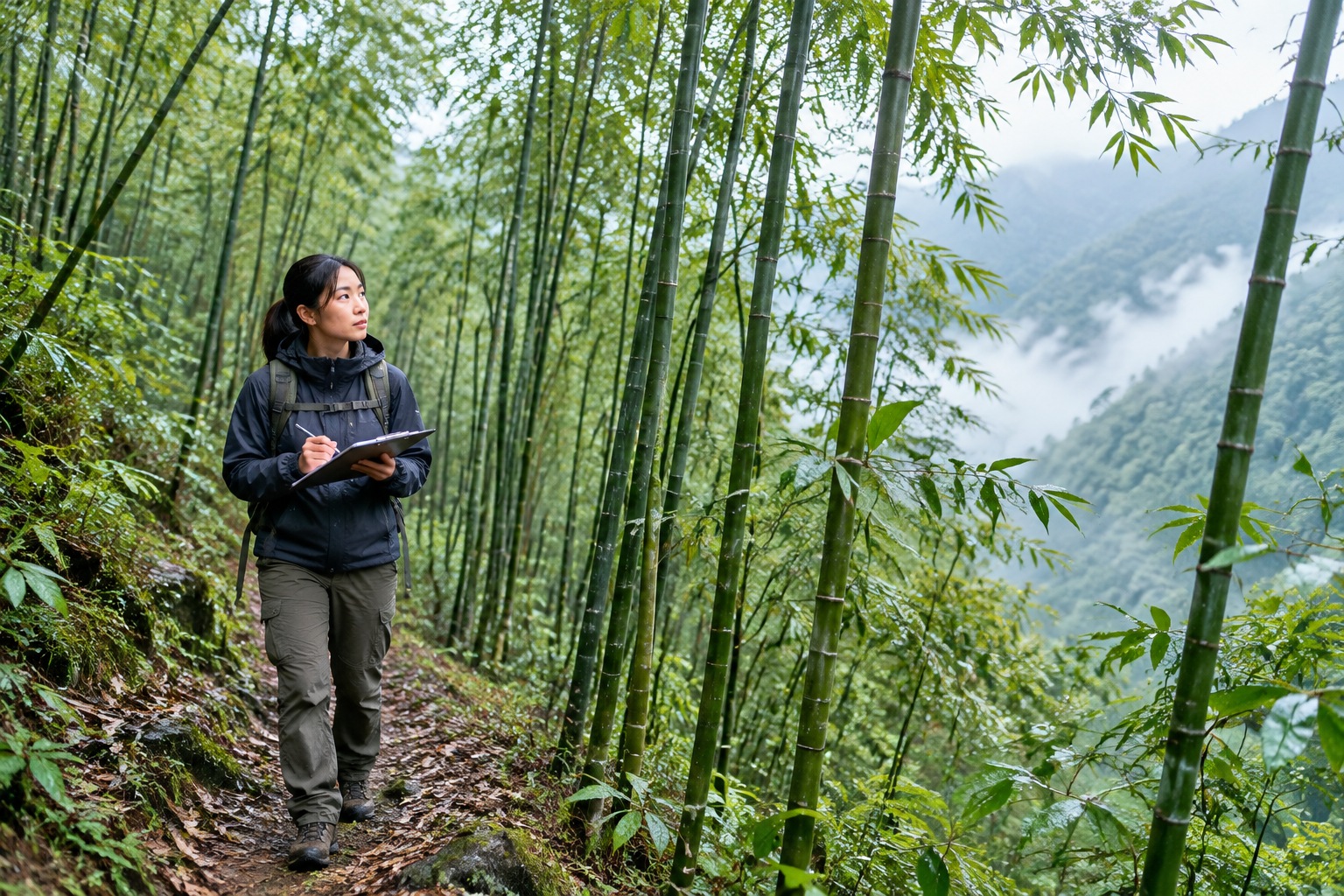
The diet is not one food but a rotating menu. In Sichuan, pandas feed on bamboo species such as Fargesia robusta and Bashania faberi; in the Qinling Mountains of Shaanxi, the mainstays are Fargesia qinlingensis and Bashania fargesii.
From April into June, the priority is shoots — soft, water-rich, high in protein and low in fiber. This is when pandas eat the most and gain weight. Through summer they shift toward leaves, which are more nutritious than stems but more work to gather. In late autumn and winter they take more culms and leaves, and move to lower, warmer slopes where bamboo keeps its leaves.
Occasionally the whole system lurches. Bamboo species flower on long cycles — decades apart — then die over large areas at once. Die-offs in the 1970s and 1980s in Sichuan left starving pandas in the news and helped trigger the modern conservation apparatus. The safety valve is diversity: forests with several bamboo species let animals move to what is still alive.
The people inside the bamboo loop
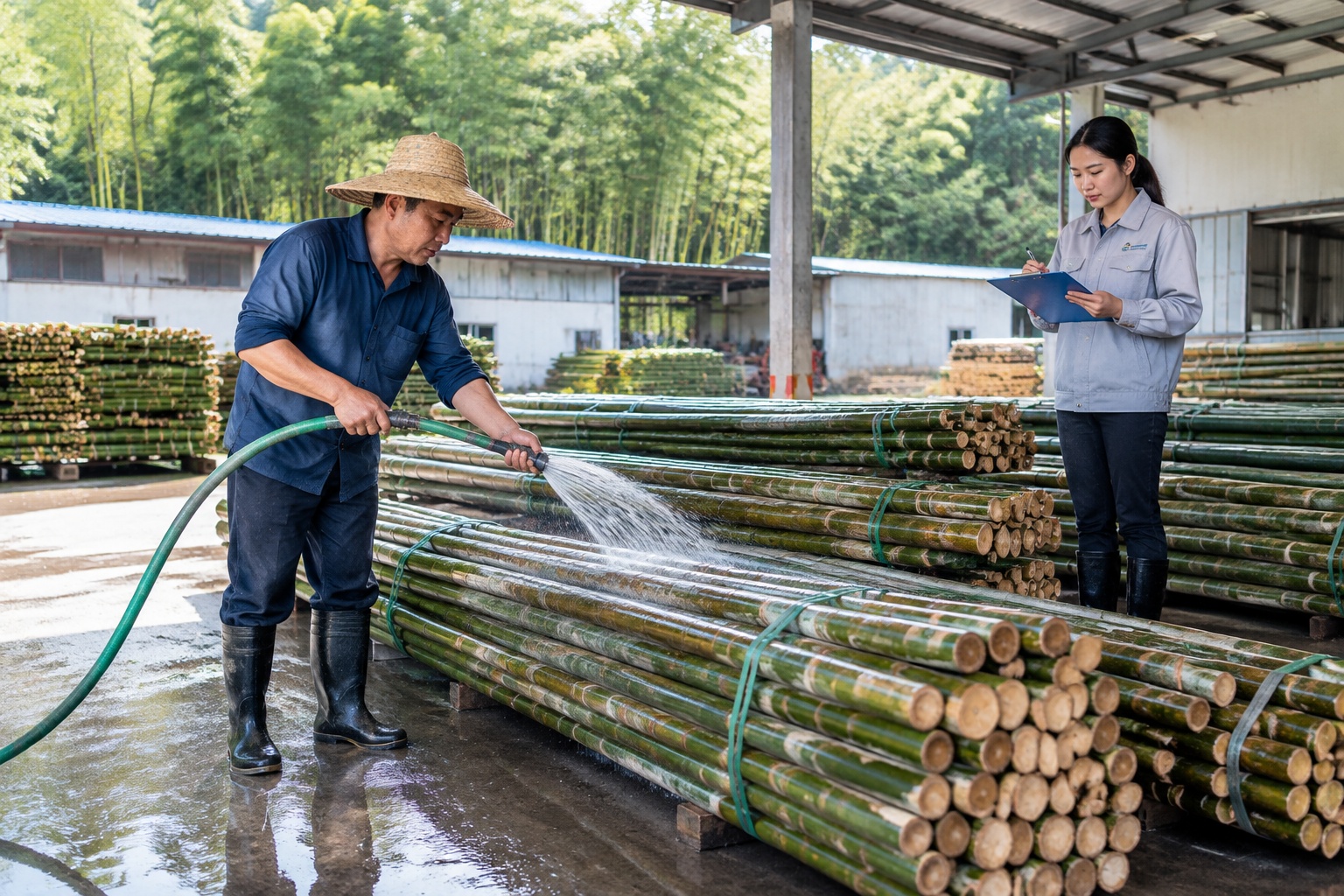
Bamboo does not walk to Chengdu by itself. Stand outside the gate of a large breeding base early in the morning and you watch a supply chain that most visitors never think about: trucks from neighboring counties, cut-and-carry schedules, cool rooms where bundles are stacked and hosed down in summer to slow the drying of leaves, and keepers who spend the first hour of the day weighing and sorting.
Around that routine sits a much bigger structure. The Giant Panda National Park, formally established in 2021, covers about 27,000 square kilometers across Sichuan, Shaanxi and Gansu — larger than several small countries — and links habitats that were once separated by roads, farms and logging sites. China’s fourth national panda survey counted 1,864 wild giant pandas, up from roughly 1,100 in the 1980s. In places like Foping in Shaanxi, villagers who once logged now earn income from guiding, monitoring and growing bamboo for bases and nurseries.
What the noon crowd misses
Nothing about the panda’s daily life is decorative. The sleeping animal on the platform is the visible end of a chain of consequences: a bear’s gut that never evolved a fermentation chamber, bamboo that yields a few percent of usable energy per bite, an extra wrist bone that makes thousands of bites possible, and a mountain landscape patched together with corridors and park boundaries so that the whole arrangement keeps working.
Stand at the fence a little longer, and the arithmetic becomes obvious. The panda is not eating all day because it enjoys it. It is eating all day because bamboo does not give it a choice.
Start the discussion at forum.chinacomes.com