


On the main street of Muyu Town — a strip of guesthouses, noodle shops and souvenir stalls wedged into a valley in western Hubei — you can buy a stuffed “wild man” (a furry brown ape with an apologetic grin), a jar of wildflower honey and a packet of dried bamboo shoots, usually from the same shelf. Ask the woman behind the counter whether she has ever seen the wild man and she will laugh, then point at the toys. “Only these.”
That is roughly where things stand with the Yeren, China’s answer to Bigfoot. The difference is that Shennongjia has spent nearly fifty years and a serious amount of public money looking for it — and in the process accidentally built one of the country’s most carefully guarded forests.
A forest that also happens to be a local government
Shennongjia is not a park in the way foreigners usually mean it. It is an administrative district: 3,253 square kilometers of mountain, county-level in rank, directly under Hubei Province, with fewer than 80,000 residents. Its name comes from Shennong, the Divine Farmer of Chinese legend, who is said to have climbed these cliffs on wooden frames to taste hundreds of plants and work out which were medicine and which were poison. Tea, by one traditional account, was found here.
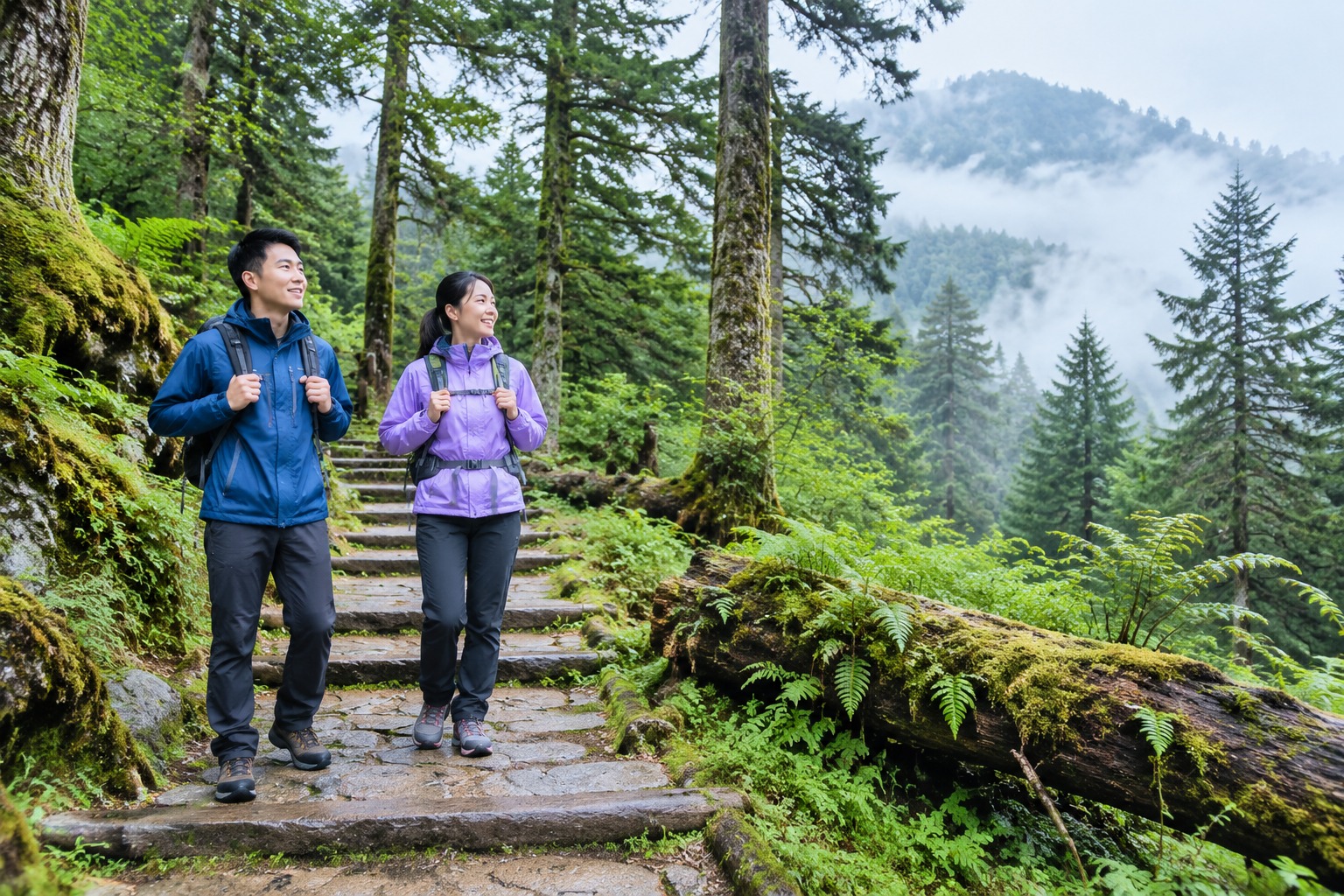
The land runs from 398 meters above sea level to 3,106 meters at Shennong Peak — the highest point in central China. That vertical range, from subtropical valley to alpine summit, is why UNESCO made it a biosphere reserve in 1990 and a World Heritage Site in 2016. Going up, the forest changes several times: broadleaf, then mixed woodland, then bamboo understory, then wind-bent fir.
The wild man: what actually happened
The Yeren story is not just folklore. On a night in May 1976, five local officials driving through the forest reported a creature crossing the road. The report was detailed enough that the Chinese Academy of Sciences organized an expedition the following year — more than a hundred researchers, soldiers and local guides, combing caves and ridges for months. More surveys followed in the 1980s.
What they collected: hair samples, footprints in mud, second-hand accounts and a lot of plaster casts. What they did not collect: a body, a bone, a skull, or a single piece of DNA belonging to anything unknown. Modern camera traps — hundreds of them, running year-round — have photographed bears, monkeys, gorals and poachers, but never an upright ape.
The most common scientific reading is mundane. Fog in these valleys is thick enough to hide a truck; a Tibetan macaque standing upright, a black bear walking on its hind legs, or an endangered golden snub-nosed monkey glimpsed at 2,500 meters can all become one story by the time it reaches town. In the local museum, the evidence sits in glass cases next to questions rather than answers.
What the cameras actually catch
The animal that really lives here looks stranger than a wild man, and it does not need a legend. The golden snub-nosed monkey has a blue face, a flat pug nose and a coat that shrugs off minus 20 degrees Celsius. Shennongjia holds the easternmost population of the species — more than 1,400 animals in recent counts — and rangers track them the way other districts track traffic.
The wider inventory is hard to overstate: over 3,700 species of vascular plants, more than a thousand of them used medicinally, plus bears, leopard cats, musk deer, giant salamanders and a long list of insects that specialists still argue about. The area is also known for an odd pattern of white animals — white snakes, white deer, white bears — recorded often enough to fill a display case and still not fully explained.
The men who used to cut these trees
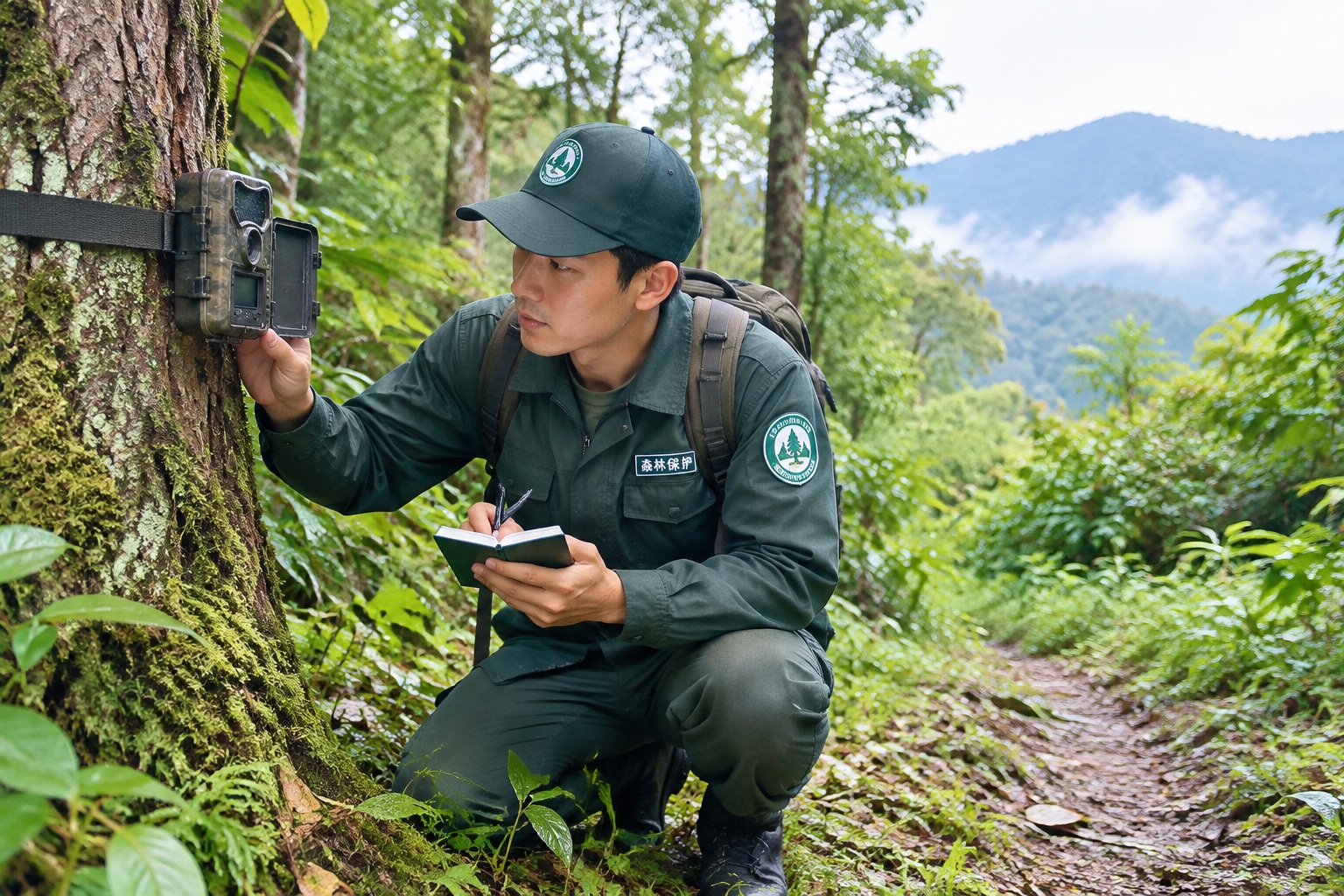
Until 2000, Shennongjia was a logging district. That was the point of the place: harvest timber, ship it out. When commercial logging was banned that year under China’s natural forest protection program, tens of thousands of forestry workers had to find something else to do. Many stayed. Today they are rangers, guides, drivers, cooks, guesthouse owners, honey sellers.
A ranger’s day is not romantic. You walk ten kilometers of trail, check the batteries in infrared cameras, note fresh droppings, clear a blocked path, and walk back. The pay is modest. What has changed is the direction of the work: fewer trees leave, more people arrive.
A high wetland, a ski slope, and a calendar with a hole in it
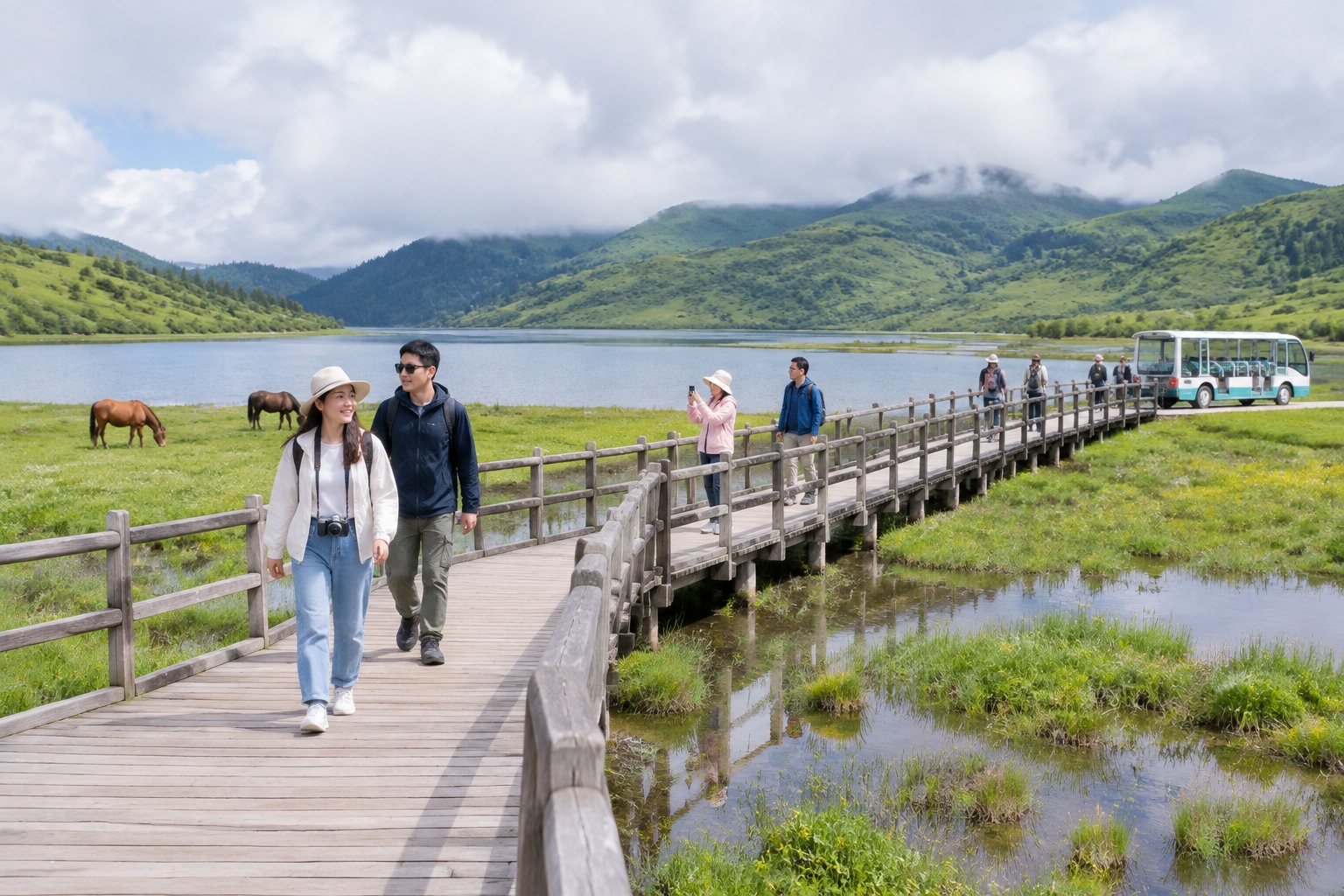
Dajiu Lake sits at about 1,700 meters, a rare alpine wetland where nine shallow lakes and their meadows were, until the 2010s, farmed by villagers who lived inside them. Those families were moved to a new town a few kilometers away, and the wetland became a boardwalk-and-shuttle circuit. It is beautiful in June, mobbed in August and genuinely empty in January.
That seasonality is the real story of Shennongjia’s economy. The district sells summer: cool air, 22 degrees when Wuhan is at 38. In recent years it has tried to sell winter too, with a ski resort and snow scenery. It works, partly. Hotels that are full every night in July still shut their doors in December.
Getting there stopped being the hard part
A decade ago, reaching Shennongjia meant a long, winding bus ride. Then came an airport in 2014, built at 2,580 meters — among the highest in China — and, in 2021, an expressway link to the national network. Tourists now take high-speed rail to a nearby city and finish the trip by car or shuttle. Homestays in Muyu Town take bookings through WeChat, and the cash drawer stays closed.
It has created a small, uneven boom. Families who once farmed now rent out six rooms, cook breakfast and run a shop. In peak season, a room that costs 150 yuan in April can go for 600 in August, and everyone in town knows it.

So what is the wild man actually for?
He sells things. Plush toys, beer labels, a cave, a valley, a museum, a festival. The district’s tourism marketing leans on the Yeren because it works, and locals are relaxed about it — nobody is offended by a joke that pays the bills.
But there is an older irony worth noticing. In the 1970s, when the search for the creature was at its peak, the alternative use for this land was the chainsaw. The expeditions, the newspaper coverage and the national attention made Shennongjia a place people watched. By the time the logging ban arrived, the forest had a reputation to protect.
A legend about an animal that probably does not exist may have helped preserve a mountain that holds thousands that do.
What you actually find there
Not a monster. You find fog that rolls in at four in the afternoon and turns a valley into a white room. You find monkeys that ignore you. You find a fir more than a thousand years old with a trunk you cannot get your arms around. You find a town of guesthouses where the owner’s grandmother still dries herbs on the roof, and a shop that will sell you honey and a stuffed ape on the same receipt.
You also find the thing that overseas visitors tend to remember longest: how quickly the road stops and the forest starts. Half an hour out of Muyu, the phone signal drops, the houses disappear, and the mountain is simply a mountain — with or without anyone in it.
Start the discussion at forum.chinacomes.com