

The Cave That Named Both a Species and a City
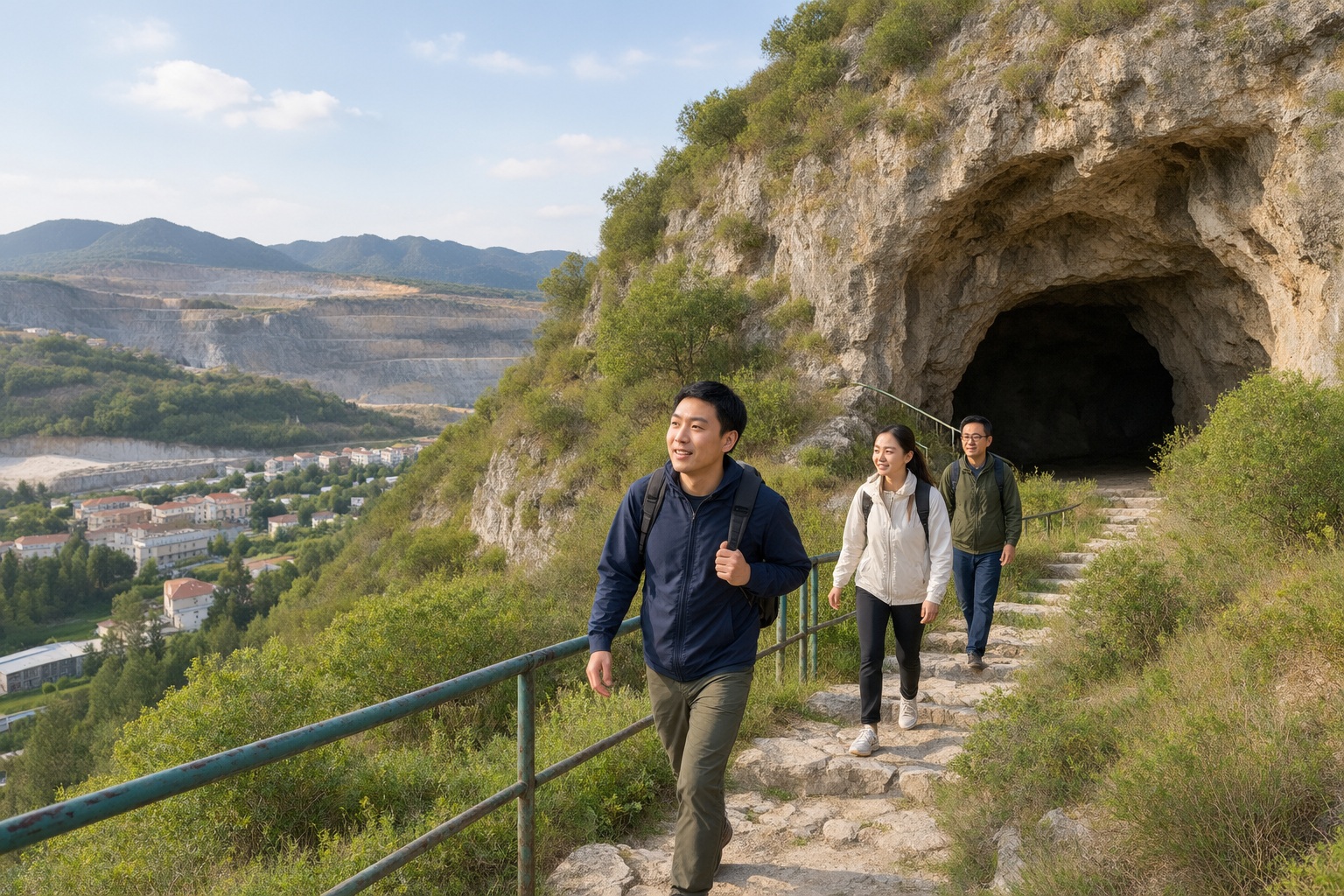
On a hillside about 50 kilometres southwest of Tiananmen Square, a limestone ridge is pitted with caves. One of them, a sloping fissure whose mouth is roughly the height of a two-storey house, carries a name that every Chinese schoolchild learns and almost no foreign visitor knows: Zhoukoudian.
The ridge is called Longgu Shan, Dragon Bone Mountain. For generations, villagers dug fossil bones out of the rock and sold them to medicine shops as “dragon bones,” a standard ingredient in traditional remedies. That trade is how science found the place.
The fossils picked up a second name too: 北京人, “Peking Man.” In everyday Chinese today, those same characters mean something completely different — a person who holds a Beijing household registration, the kind of resident who talks about rent, hukou and which district has the better primary school. In palaeoanthropology, the phrase refers to Homo erectus pekinensis, whose remains came out of this hillside in the 1920s and 1930s. One name, two entirely different scales of time.
How Two Teeth on a Laboratory Table Changed the Field
In 1921, the Swedish geologist Johan Gunnar Andersson and the Austrian palaeontologist Otto Zdansky were surveying limestone deposits near the village of Zhoukoudian when local quarrymen led them to a cave full of fossil bone. Zdansky collected two teeth that, on closer study back in Sweden, turned out to be human. Andersson announced the find in Beijing in 1926, and the news travelled quickly: here, at last, was an early human from Asia.
Money followed. The Rockefeller Foundation, which funded the Peking Union Medical College, paid for a proper excavation, and a young Chinese geologist named Pei Wenzhong was put in charge of the digging.
On 2 December 1929, in the cold, at the end of the season, in a cave now labelled “Locality 1,” Pei’s team lifted out a skullcap. It was the first nearly complete early human braincase found anywhere in East Asia, and it made Zhoukoudian a global reference point overnight.
More followed. Between 1929 and 1937, excavators recovered fossils of roughly 40 individuals — skullcaps, jawbones with teeth still set in them, limb bones — along with thousands of stone tools and animal bones. In 1936, Jia Lanpo, then in his twenties, found three skullcaps in eleven days. The Canadian anatomist Davidson Black named the species Sinanthropus pekinensis. After Black died in 1934, Franz Weidenreich, a German-Jewish anatomist who had left Nazi Germany, took over the detailed descriptions.
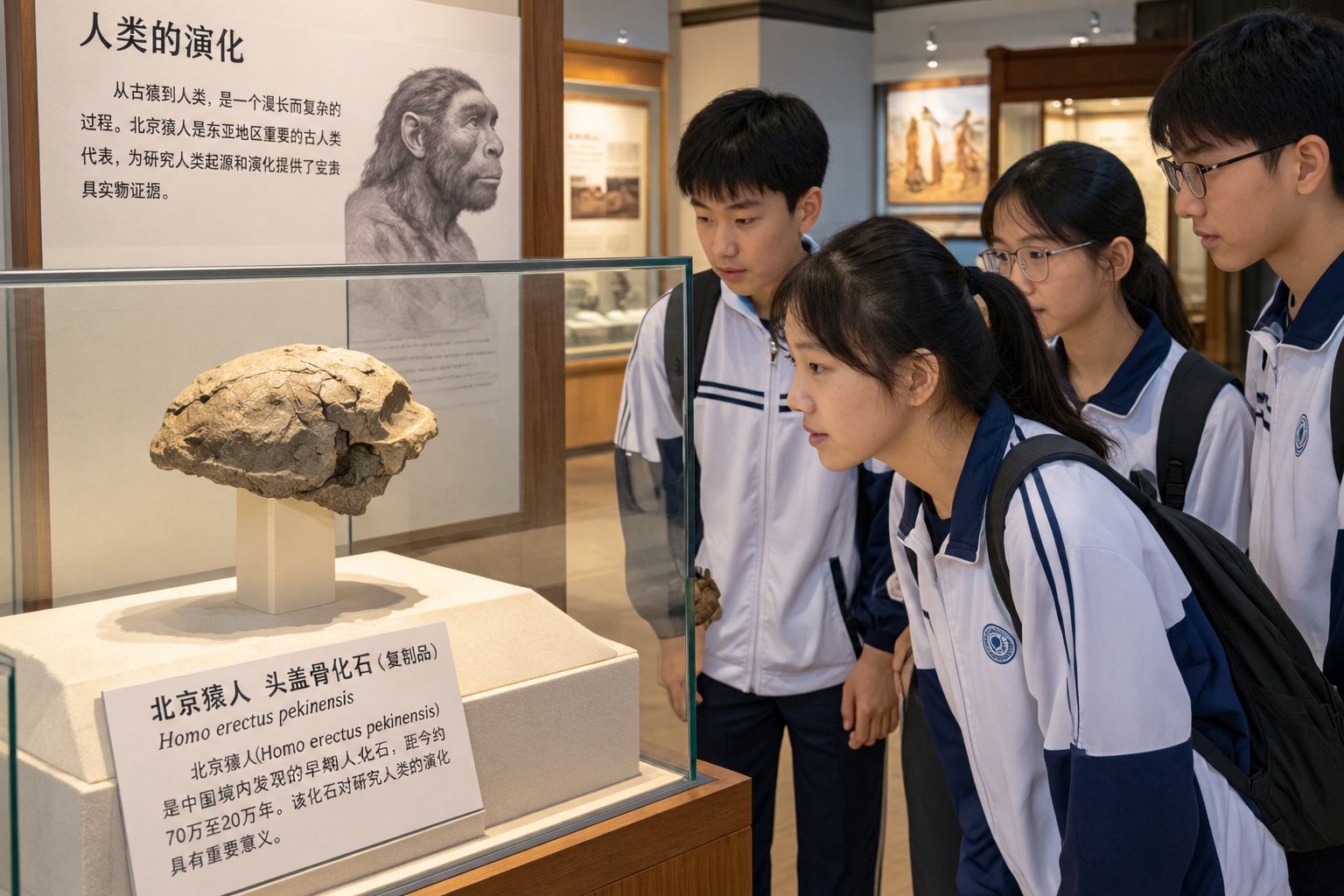
Then came the war. In 1941, with Japanese forces advancing, the fossils were packed into crates for shipment to the United States. They never arrived. Two crates of original Zhoukoudian material — arguably the most valuable collection of early human fossils in Asia — have not been seen since. The skull on display in the site museum is a plaster cast, one of the copies Weidenreich had made while the originals were still in his hands.
What the Site Actually Tells Us
Set aside the “missing link” language of the 1920s. The real value of Zhoukoudian is the depth of its record: a stack of cave sediments that documents one corner of northern China over hundreds of thousands of years, with stone tools, animal bones and ash mixed through it.
- People: remains of about 40 Homo erectus individuals have been identified from Locality 1, from infants to adults.
- Time: the fossil-bearing layers are usually given as roughly 700,000 to 200,000 years old. Newer dating work, including cosmogenic nuclide burial dating, pushes the lower layers toward 770,000 years, which is why Chinese museums now often round the story to “700,000 years ago.”
- Tools: more than 100,000 stone artefacts have been catalogued from the site, mostly small flakes and simple choppers. Nothing elegant, but the sequence is long, and length is what palaeoanthropologists need.
- Fire: there are thick ash layers, burnt bones and charred hackberry seeds. Whether this proves Peking Man could start a fire at will, or simply took advantage of natural burns, has been argued over for decades. The ashes are not a settled question.
- Animals: giant deer, rhinoceros, horse, hyena. Hyenas used the cave as a den, which is one reason some researchers think at least part of the human material was dragged in rather than buried where it fell.
There is a second chapter further up the hill. The Upper Cave, or Shandingdong, was excavated in 1933 and produced the remains of modern humans who lived roughly 27,000 to 30,000 years ago, buried with red ochre, shell and stone ornaments, and a bone needle. It is among the earliest evidence of symbolic behaviour in East Asia. Those fossils disappeared in the same 1941 shipment.
One thing the site does not show is that humans evolved in China. Homo erectus pekinensis is an older, related population; the genetic and fossil evidence points to Homo sapiens arriving from Africa much later. Zhoukoudian matters not because of who came first, but because of how long this one cave kept a record — and how much of it survived.
A World Heritage Site With a Bus Stop Out Front
The journey there is part of the story. From central Beijing, the subway’s Fangshan Line runs southwest past furniture malls and new apartment blocks, and a taxi from the last stop covers the final stretch. City buses also run from the Tianqiao hub toward Fangshan and stop at the Zhoukoudian junction — check current route numbers on a map app, since Beijing renumbers buses fairly often.
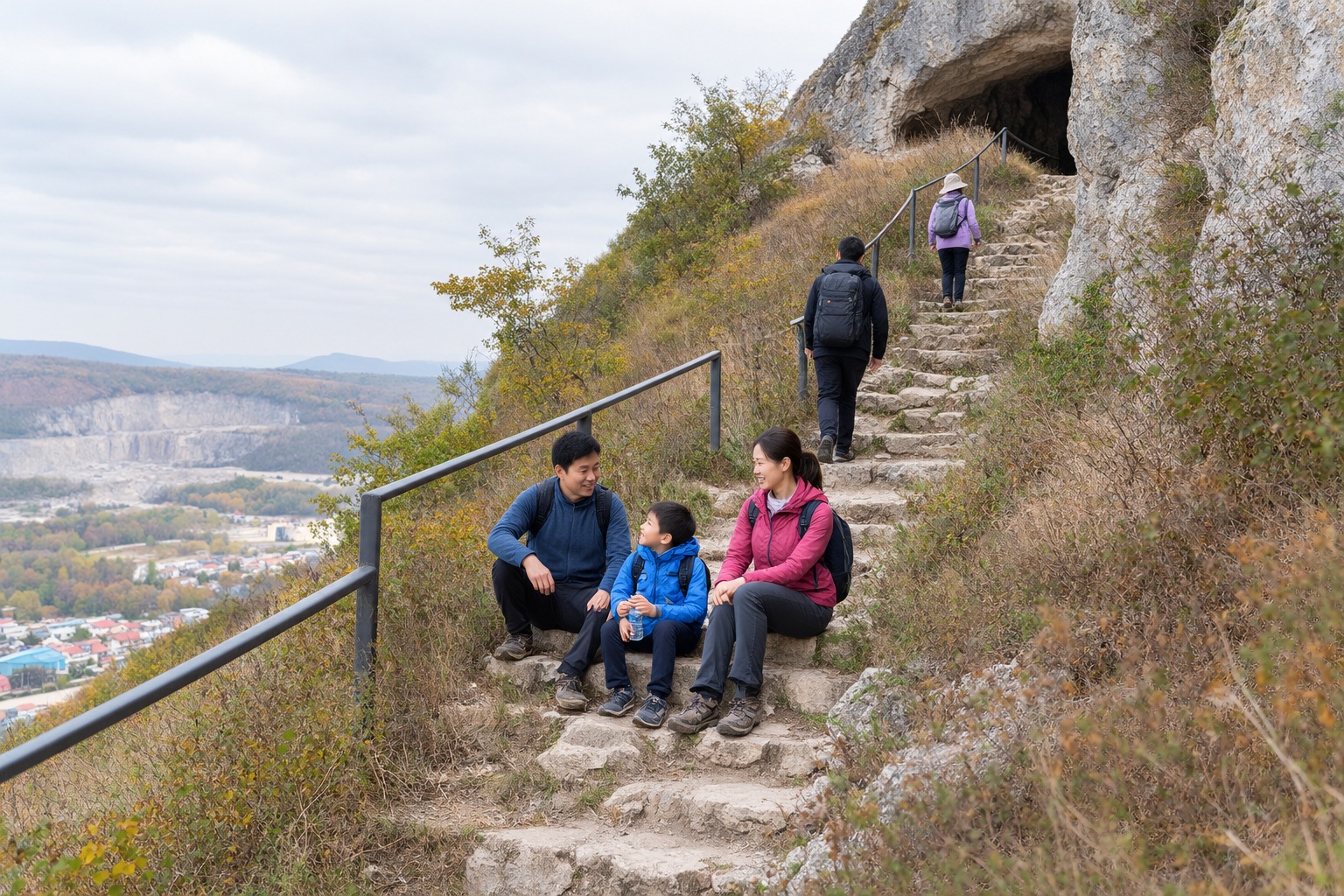
The village itself is a working town, not a tourist set piece: noodle shops, a small market, low buildings, and quarry walls still cut into the hillsides nearby. Many of the region’s cement quarries have been shut or greened over in the past decade, but the landscape still reads as a place where rock has been taken out of the ground for a living. Five minutes from the main road, you pay a few dozen yuan at the gate and walk up a paved slope to the museum.
Inside, the displays are straightforward: casts of the skulls, stone tools under glass, animal fossils, and a wall of photographs from the 1930s excavations. On a weekday morning the loudest thing in the room is usually a school group being told to stop touching the glass.
Outside, a short climb leads to the mouth of Locality 1, where a metal fence protects the excavation face and a small marker notes where the 1929 skullcap came out. It is not a cathedral of science; it is a cave in a hillside with weeds around the entrance and a view over a small town. That, honestly, is what makes it memorable. The Upper Cave is another ten or fifteen minutes uphill on stone steps, a steep enough walk to remind you that nobody in the 1930s was doing this in air conditioning.
Visitor numbers make the point about how under-visited the place is. The Palace Museum in central Beijing logs more than 17 million visits a year. Zhoukoudian, one of China’s first UNESCO World Heritage sites and the reason the phrase “Peking Man” exists in any language, draws a small fraction of that. In winter you can stand at the cave entrance and hear nothing but wind and the occasional car.
The Research Isn’t Finished
This is not a closed, settled museum piece. A new round of excavation and conservation at the caves was approved in the early 2020s — the first systematic digging there in decades — with plans attached for a larger archaeological site park and updated exhibition space.
Meanwhile, old material is being re-read with tools the original excavators could not have imagined: micromorphology to work out how the ash layers formed, cosmogenic nuclide dating to pin down their age, and protein and sediment analysis to look for biological traces that DNA does not survive long enough to preserve in a warm cave.
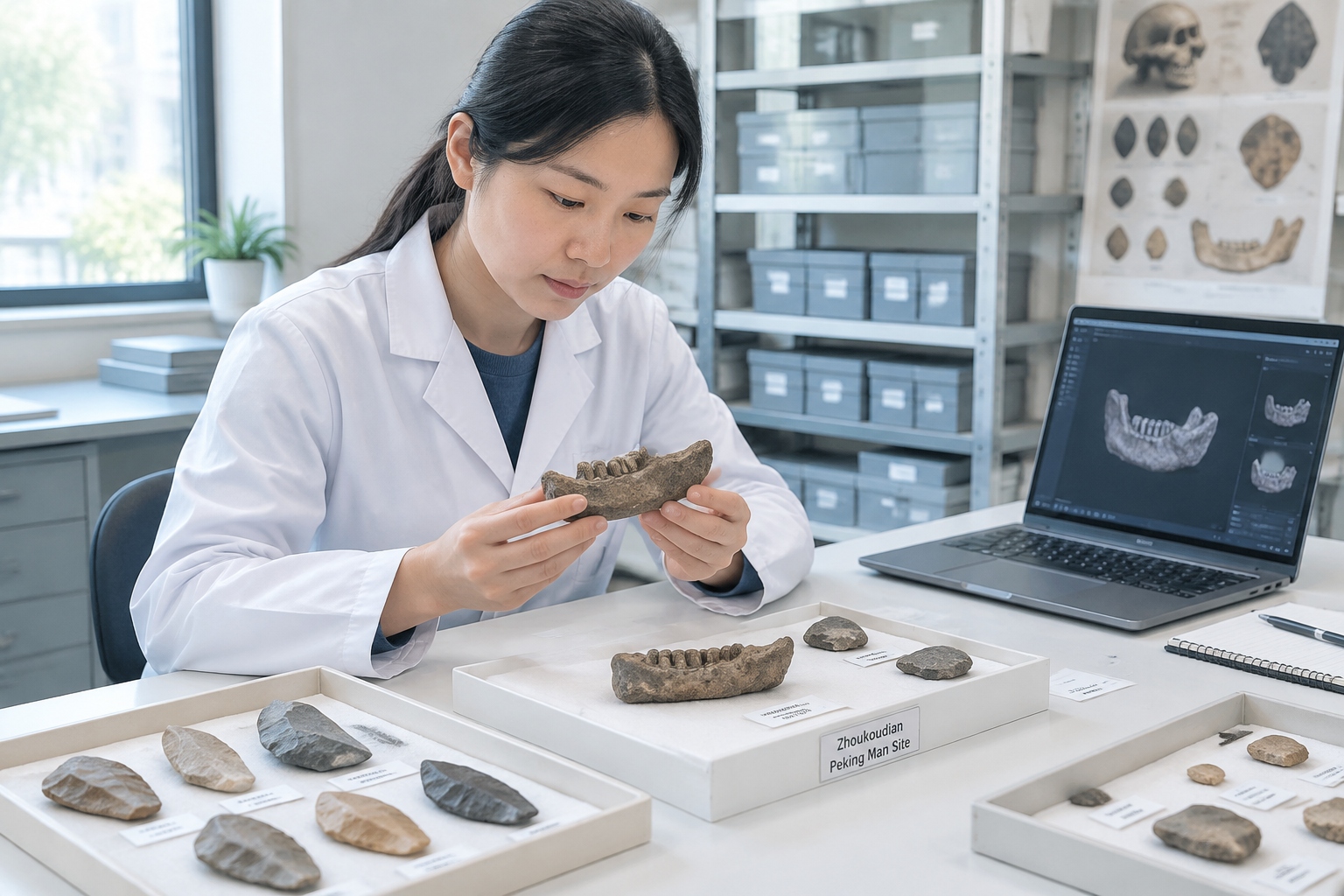
The wider field has changed too. Chinese palaeoanthropology now has Yunxian in Hubei, Xujiayao in Shanxi, and the Harbin cranium, described in 2021 as Homo longi and dated to about 146,000 years ago. Each new find gets compared with Zhoukoudian, because Zhoukoudian is still the yardstick. A century after the first tooth was identified, the site’s main contribution is what it has always offered: an unusually long, unusually well-preserved slice of time.
If You Go
Getting there: allow 1.5 to 2 hours each way from central Beijing by subway plus taxi, or take a bus from the Tianqiao hub toward Fangshan and get off at Zhoukoudian. A taxi for the final leg is the simplest option.
Tickets and hours: entry costs a few tens of yuan for the site and museum together. Like most Chinese museums, the exhibition halls close one day a week, usually Monday, so check before travelling.
Time needed: two to three hours for the museum, Locality 1 and the walk up to the Upper Cave. Half a day if you take it slowly.
Combine it with: Yunju Temple, about half an hour away by car, where more than 14,000 stone tablets carved with Buddhist sutras were sealed into caves from the 7th century onward — a different and equally quiet kind of endurance.
Bring: water, decent shoes for the steps, and a translation app. Museum labels are increasingly bilingual; the village is not.
Why Half a Day Here Resets the Rest of Your Trip
Beijing’s famous sights compress about 600 years into a few square kilometres: the Forbidden City, the Temple of Heaven, the summer palaces. Zhoukoudian compresses 700,000. Standing at the mouth of Locality 1, you cannot see the city at all — no towers, no ring roads, just a quarry-scarred ridge and a path where a team of diggers once worked through the winter.
That contrast is the reason to come. Not because the site is spectacular, but because it quietly resets the scale of everything else you will see in China: a country that talks constantly about its five thousand years of history also happens to sit on some of the oldest human ground in East Asia, and it is still digging.
Start the discussion at forum.chinacomes.com