
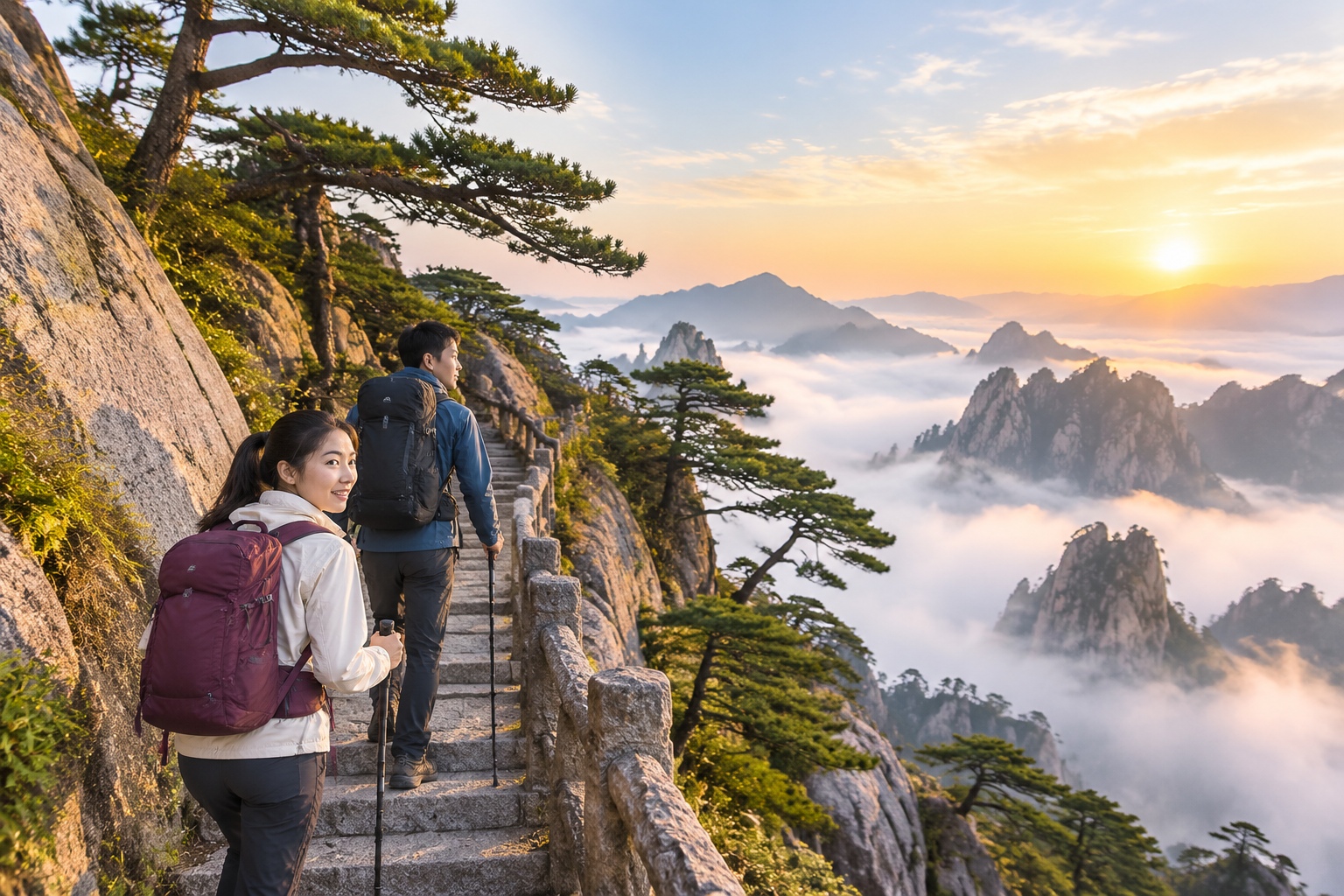

9:07 a.m., Yuping Cable Car Station
The line is already 200 people deep. Tour flags, selfie sticks, a school group in matching yellow hats. Everyone is walking to the same tree — the Guest-Greeting Pine, the one printed on the 100-yuan note and in every brochure since 1980. It’s a ten-minute walk from the cable car exit. By 9:30 a.m. the viewing platform looks like a stadium emptying out.
That is the Huangshan most foreign visitors see. It is also the least interesting version of it.
Huangshan isn’t crowded in some vague, unavoidable way. It’s crowded at specific hours in specific places, and nearly all of that is avoidable with a few decisions made before you get on the train. Here’s what they are.
First, What You’re Actually Visiting
Huangshan — Yellow Mountain — isn’t a single peak. It’s a cluster of granite spires in southern Anhui province, topping out around 1,860 metres, and a UNESCO World Heritage site since 1990. It’s famous for what Chinese guides call the four wonders: oddly shaped pines growing straight out of bare rock, granite peaks, hot springs, and clouds that settle into the valleys and look like an ocean.
Several million people visit each year. The infrastructure is good — three big cable cars, stone steps almost everywhere, hotels on the summit. You don’t need to be a mountaineer. You do need to be ready for stairs. Tens of thousands of them.
Decision One: Sleep on the Mountain
Most visitors do Huangshan as a day trip. They arrive at the transfer centre at nine, queue for a cable car, follow the main loop, and head down by four. That means they get roughly the same eight hours as everybody else.
Between 4:30 p.m. and 7 a.m., the mountain becomes a different place. The tour groups can’t stay — their buses leave. What’s left is a few hundred people, long shadows on the granite, and a very quiet dinner.
There are a handful of hotels up top: Beihai, Shilin, Xihai, Baiyun. Dormitory beds run roughly 200–400 RMB a night; a proper room is closer to 800–1,500 RMB, more on a holiday weekend. Trip.com handles English bookings reasonably well.
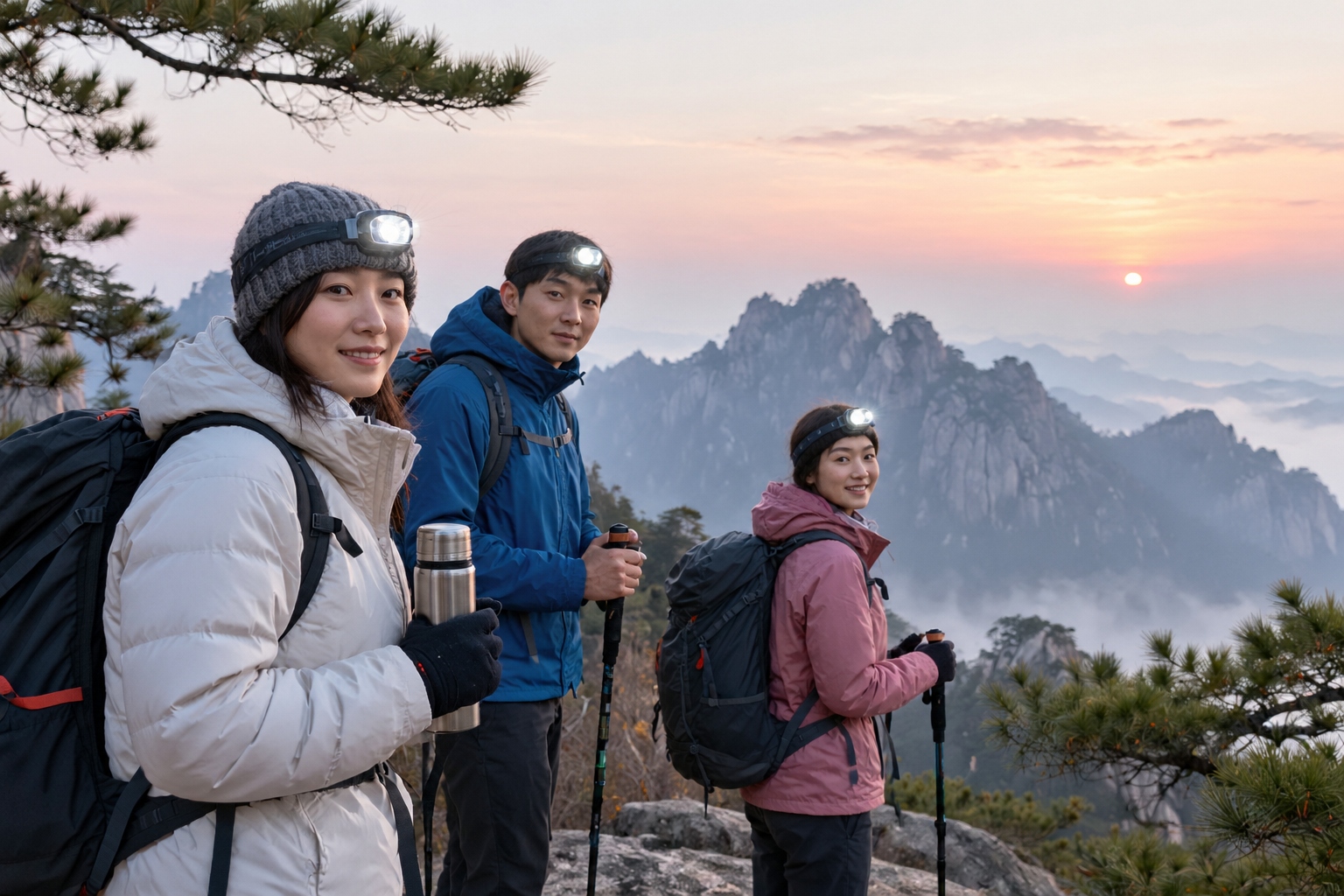
Use the night properly. Watch sunset from Danxia Peak, near the northern cable car, which gets a fraction of the crowd that squeezes onto Bright Summit. Then set an alarm for 4:45 a.m., walk out in the dark with a headlamp, and be standing on a ridge when the light arrives.
Decision Two: Enter From the North, Not the South
Nearly every foreign visitor comes in through the south gate at Tangkou, because that’s where buses from Huangshan North Railway Station drop you. The south side has two cable cars, Yungu and Yuping, and both are busy from eight in the morning.
The north side has one: the Taiping cable car, climbing from Songgu’an up to Danxia Peak. You reach it by road from Huangshan District, the old Taiping county town, about an hour by taxi or pre-booked car from the station. Fewer buses, less English signage — which is exactly why it’s quiet.
If the north gate feels like too much logistics for a first trip, take the middle path: go up the Yungu cable car early, cross the mountain, and come down the Taiping cable car, then arrange a car back. You still get the quiet side, going the quiet direction.
Decision Three: Walk the West Sea Grand Canyon
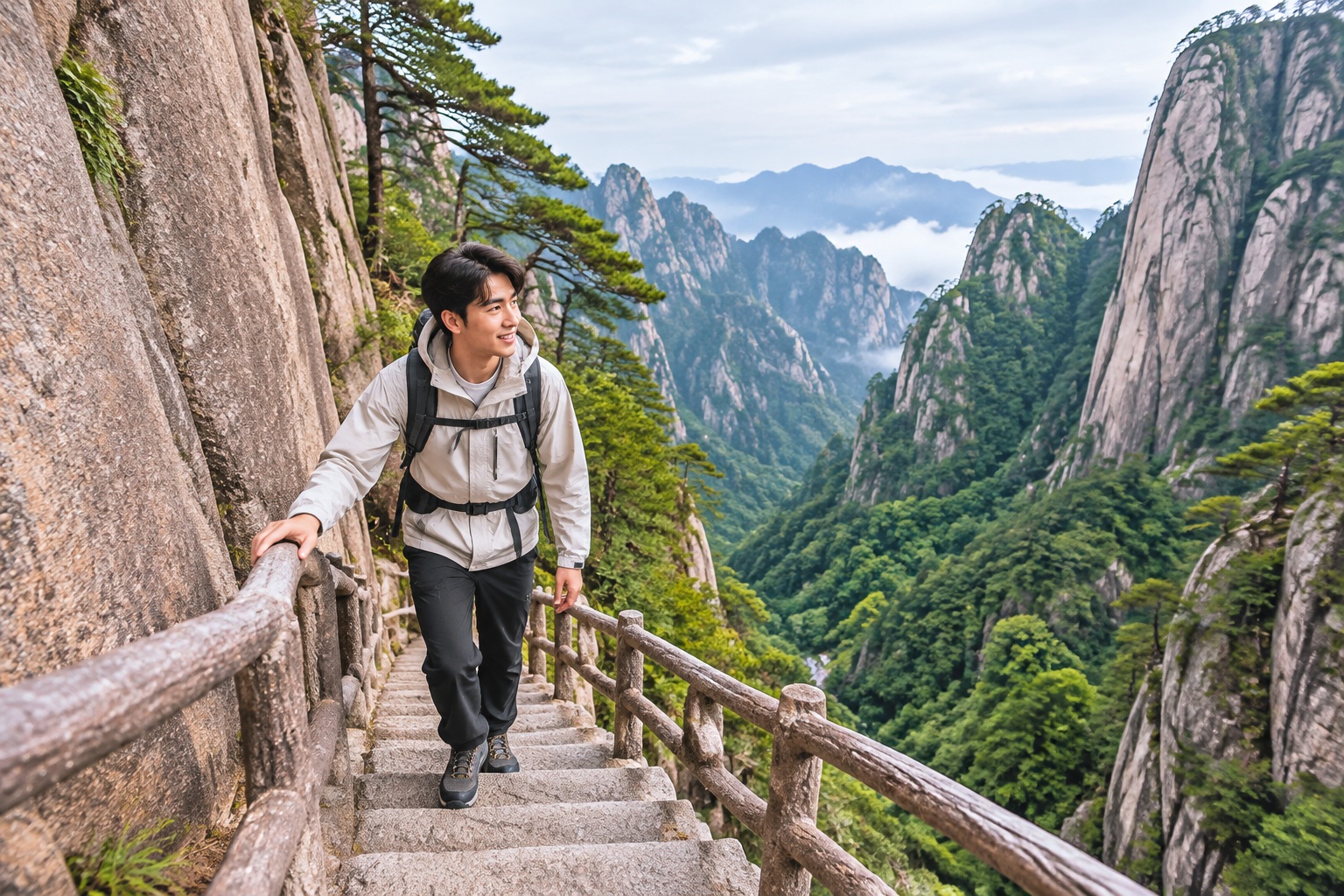
This is the section tour operators skip, and it’s the best walking on the mountain. The West Sea Grand Canyon — the Chinese name literally means “Dream Scenic Area” — opened in the early 2000s. It’s a huge loop of stone staircases cut into cliffs, dropping hundreds of metres into a gorge. A stretch called the Second Ring is one of the strangest, most beautiful walks in China.
Allow four to six hours. A small funicular, the West Sea ground cable car, lifts you out of the bottom if your knees have had enough.
Two warnings. The canyon usually closes in deep winter, roughly December to March, because of ice — check before planning around it. And it is steep in both directions. Down is harder on the knees than up, and the classic mistake is to descend in the afternoon and have to climb out in fading light.
Decision Four: Check Which Peak Is Open
Lotus Peak, at 1,864 metres the highest point, and Tiandu Peak, the sharp one that looks like a brush painting, take turns closing for several years at a time so the vegetation can recover. Whichever is open will be the busiest trail on the mountain. Start it at 6:30 a.m. or don’t start it.
About That Sea of Clouds
Here’s the honest version. Huangshan is foggy or cloudy on something like 200 days a year. A true sea of clouds — peaks floating on a flat white layer — needs a specific combination: rain the day before, a temperature inversion, early morning. It happens most often in winter and spring. It is never guaranteed.
Postcards have trained people to feel cheated by fog. Fog isn’t a failure. There’s a reason Chinese landscape painting looks the way it does, and about four minutes into a walk through it, you’ll understand.
Winter, incidentally, is the cheapest and quietest season, with the best odds of clouds and rime ice on the pines. Some trails close and cable car hours shorten, and you’ll need real cold-weather clothing. But you’ll have the ridges to yourself.
The Quieter Half of the Trip: Villages and Tea Hills
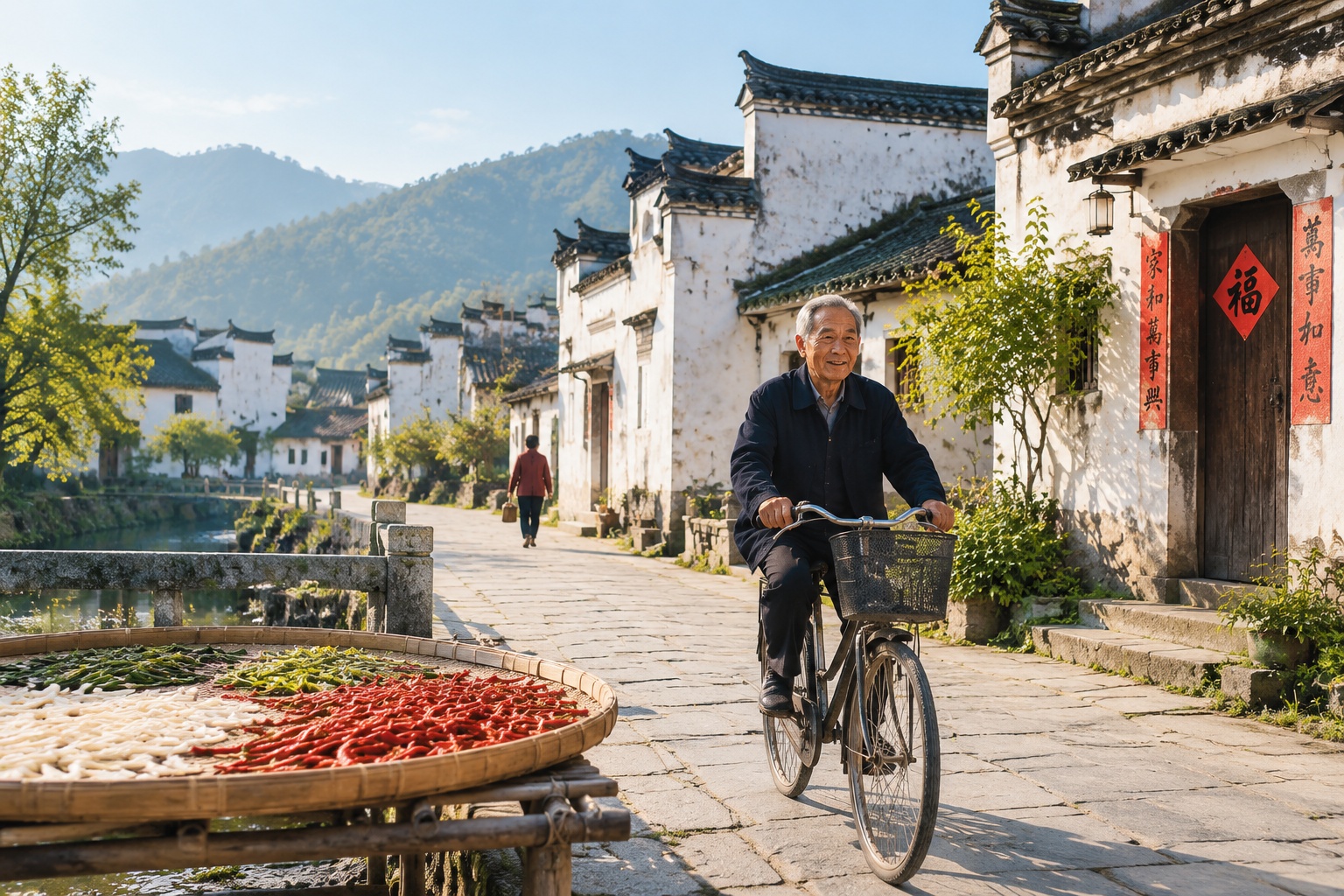
Most visitors do Huangshan, then Hongcun, then fly home. That’s a shame, because the valleys are where the mountain’s other story lives — the Huizhou merchant culture that paid for all those white walls and horse-head gables.
Hongcun and Xidi are UNESCO-listed and worth it, but go at 6:30 a.m. or accept that you’ll be walking in a queue. Better alternatives, all within about an hour:
- Chengkan — an 1,800-year-old village laid out on bagua principles, with more atmosphere and far fewer tour groups than Hongcun.
- Bishan — a working farming village with a lovely bookstore in a restored ancestral hall, a barbershop that’s been there for decades, and small guesthouses. Rent a bike and ride through the fields.
- Qiyun Mountain — a Taoist mountain about 40 minutes from Tunxi, with red cliff inscriptions and a cable car. A fraction of Huangshan’s traffic.
- Taiping Lake — a reservoir between the north gate and the city, ringed by tea hills. Good for a slow afternoon.
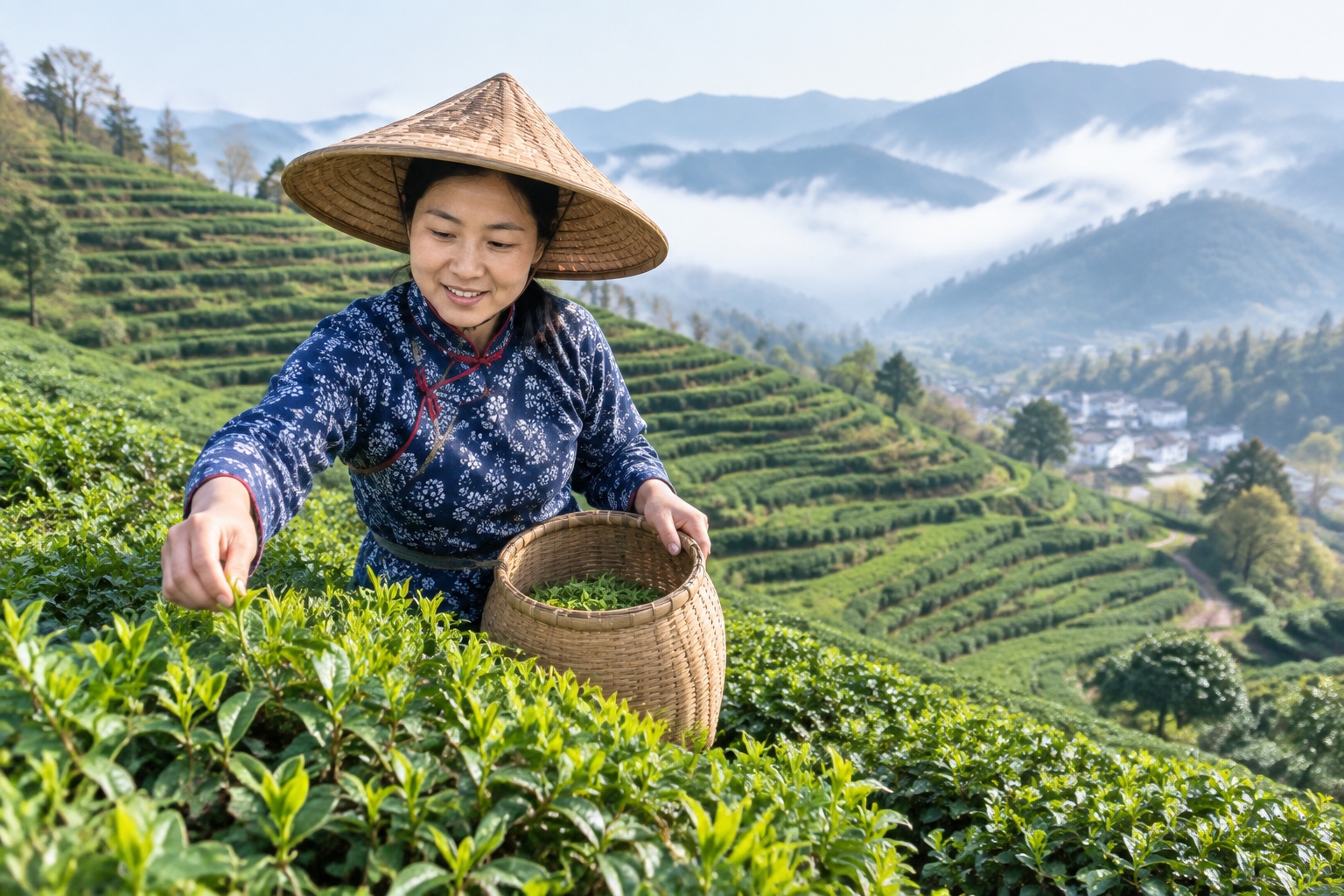
And tea. This is one of China’s great tea regions. Taiping Houkui, the long flat-leafed green tea, grows in villages around Houkeng near the north gate, and picking happens in April. Keemun black tea comes from Qimen county, an hour west. Farm visits are easy to arrange, and spring is the season.
The Practical Bits
- Tickets are real-name. Bring your passport; it gets scanned at the gate. Book through the official Huangshan WeChat mini-program, or ask your hotel to book for you — usually the easiest route for a foreigner.
- Prices: about 190 RMB for the scenic area in peak season, 150 RMB in low season, plus 80–100 RMB per cable car. They change, so check before you go.
- You can’t drive up. Private cars stop at the Tangkou or north gate transfer centres; a shuttle takes you to the trailheads. Not optional.
- Payments. Alipay and WeChat Pay now accept foreign cards and cover almost everything. Keep 200–300 RMB in cash anyway, for a village noodle shop or a tea farmer.
- Signal is fine, even on the summit. English signage exists on main routes; side trails are Chinese-only. Download offline maps and a translation app.
- Gear: trekking poles, knee support, a rain poncho (sold everywhere for about 10 RMB), and layers. The summit can be 8–10°C colder than the base.
- Give way to the porters — men carrying 50–80 kg of supplies up the steps on bamboo poles. They always have right of way.
When to Go
Avoid the first week of October, the first week of May, Chinese New Year, and summer weekends. These aren’t “a bit busier.” They’re a different mountain.
Best windows: mid-to-late November, after the October crowds and before the ice; late March to April, for tea and green hills, with more rain; January and February, for quiet, low prices and the best cloud odds.
And go on a weekday. The difference between a Tuesday and a Saturday on Huangshan is bigger than the difference between two seasons.
What You’ll Actually Remember
Probably not the pine tree. Probably a ridge at 6:40 a.m., eleven other people on it, fog below turning from grey to gold, and nobody saying anything.
That version of Huangshan isn’t hidden. It’s just scheduled differently.
Start the discussion at forum.chinacomes.com