
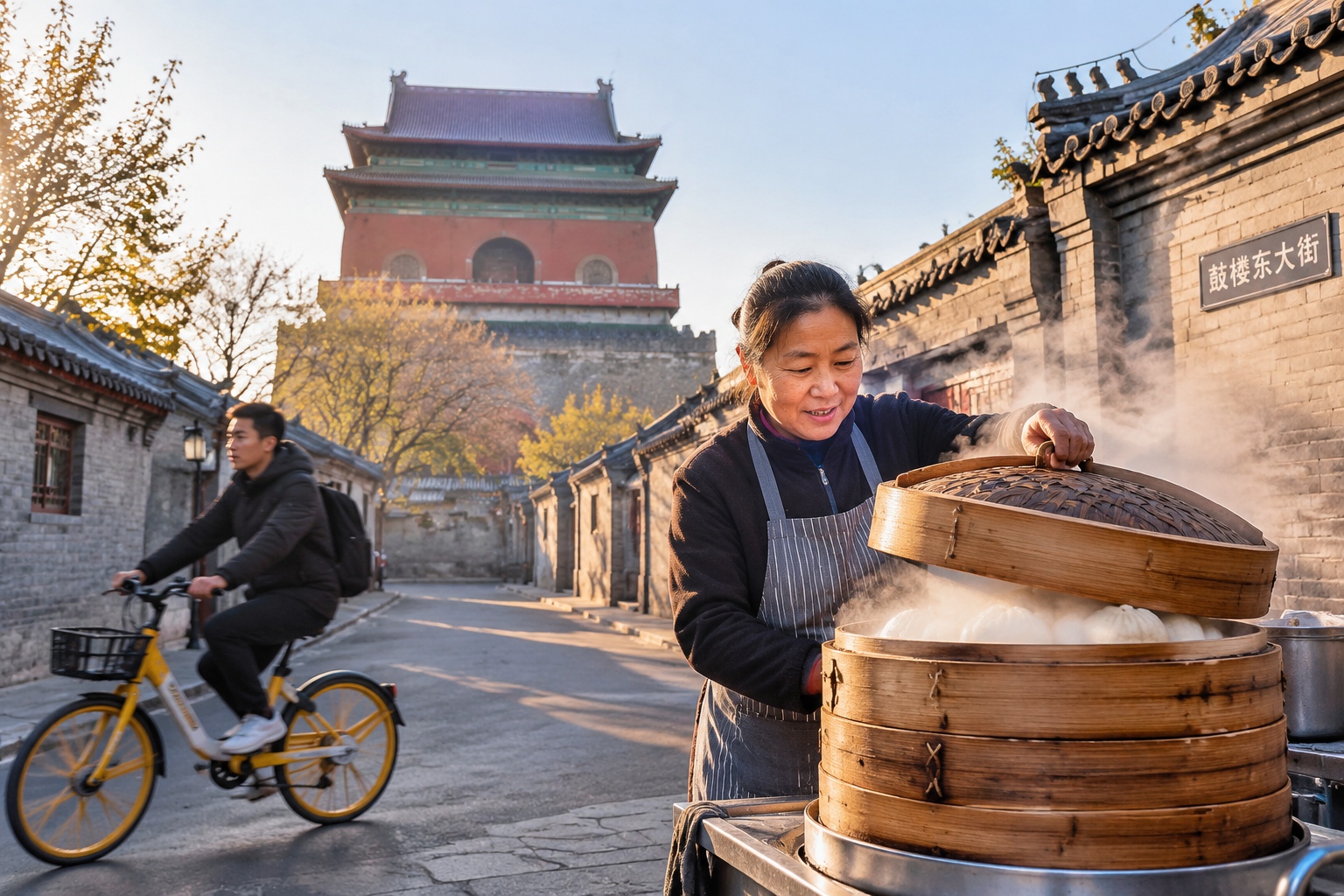

5:40 a.m., North of the Drum Tower
The first sound on Beijing’s Central Axis isn’t a bell. It’s a broom — a bamboo one, dragged in slow strokes across the flagstones of Zhonglouwan Hutong, where the gray brick walls of the courtyard houses still hold yesterday’s heat. A man in a blue vest is sweeping. Two meters away, a woman lifts the metal lid off a steamer, and what comes out — pork, star anise, fermented bean paste — is the smell of a Beijing morning.
Behind them stands the Drum Tower, a squat red-and-gray block of timber that has been telling this city the time since 1272. In the Yuan, Ming and Qing dynasties, drums beat at dusk and the bell rang at dawn, and the whole city organized its day around that sound. The bell hasn’t rung officially since 1924. The morning starts anyway, just with different cues: the steamer lid, the broom, and the click of a shared bike being unlocked.
This is the northern end of the Beijing Central Axis — a 7.8-kilometer line running due south through the old city to Yongdingmen. In July 2024, UNESCO added it to the World Heritage List, which is how most foreign visitors first hear about it. The listing describes 15 building ensembles: palaces, altars, bridges, gates. What it doesn’t describe is that the line runs through people’s commutes.
The Bridge That Never Stopped Working
Six hundred meters south of the Drum Tower, the axis crosses water. The Wanning Bridge — a single stone arch built in 1285, when Kublai Khan’s capital was laid out here — still carries traffic. Not tourists: cyclists, delivery riders on electric scooters, a woman wheeling a cart of vegetables toward the market. The stone balustrade is worn smooth where people lean.
This is Houhai, the rear lake of Shichahai, and at 6:15 a.m. it belongs to swimmers. Men in their sixties and seventies, some with caps, some without, walk down concrete steps and lower themselves into water that can’t be much above 20°C. They swim a slow loop and climb out talking loudly, as if the cold were a joke they are all in on.
Notice the layers. A Yuan dynasty bridge. Qing-era lakeside houses, now bars and cafés. Twenty-first-century shared bikes parked three deep. This is the part of the axis that heritage documents flatten into a diagram — and the part where you can see that a “historic line” is really just a street that never stopped being used.
Climbing a Hill Before Work
Jingshan, or Prospect Hill, is the highest point on the axis, and it is entirely artificial. The earth dug out to make the Forbidden City’s moat was piled here in the 1420s. From the Wanchun Pavilion at the top you can see the whole line: gold roofs to the south, the two towers behind you, and on a clear day the outline of the Western Hills.
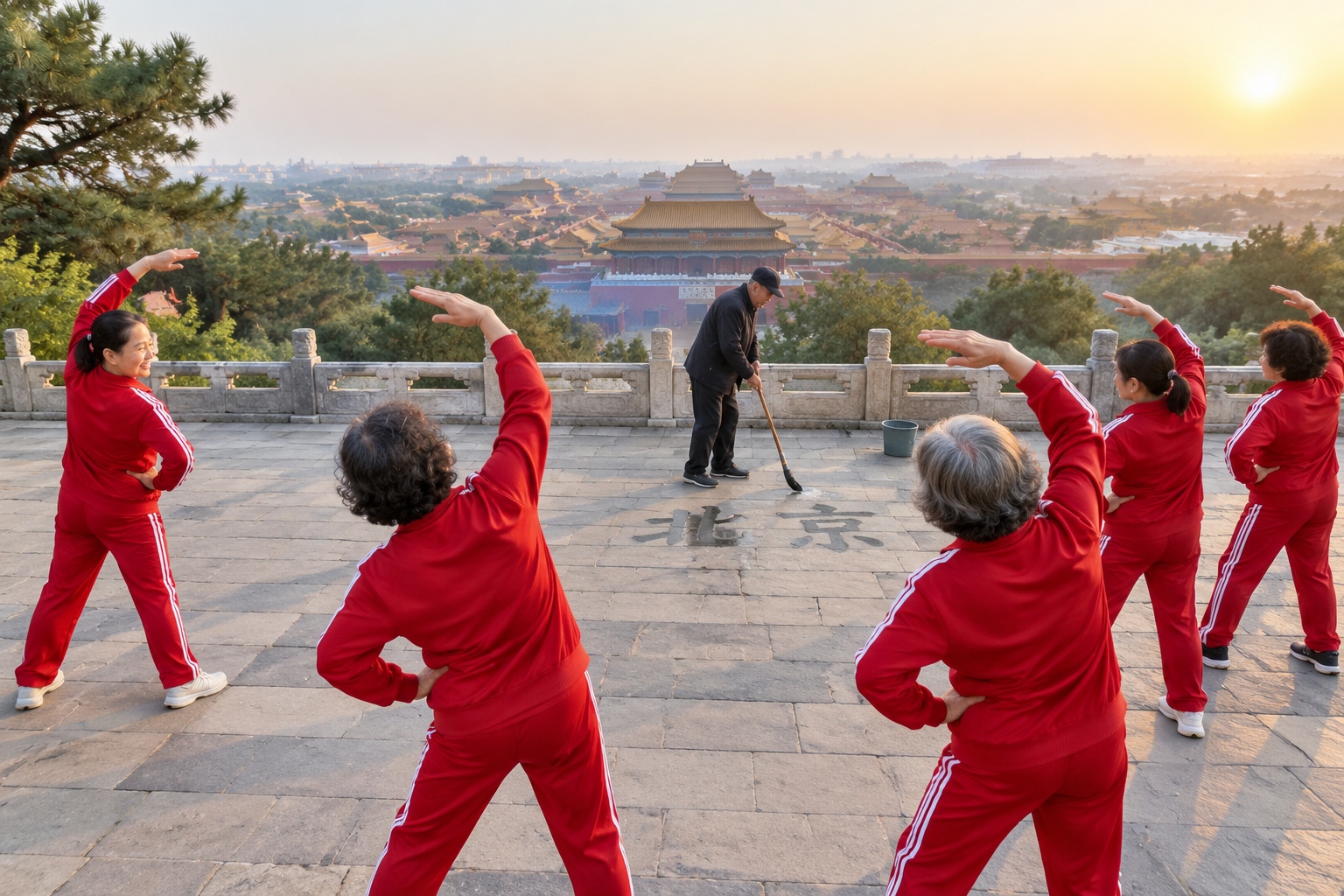
Entry costs 2 yuan — about 30 US cents. Gates open at 6 a.m. in summer. What you find inside at that hour is not a tourist site. It’s a neighborhood gym.
Retired women in matching red tracksuits stretch in unison near the east gate. A man in his eighties writes Chinese characters on the paving stones with a long brush dipped in water; the strokes evaporate in about ninety seconds, which is the point. Below the pavilion, a small group sings 1960s songs through a portable speaker. A hundred meters away, another group moves through a slower, older form of tai chi. Nobody coordinates. Everyone shares the hill.
Most people up here at dawn are over sixty. Beijing is aging quickly — roughly one in five registered residents is 60 or older — and the city’s parks have quietly become its largest public living rooms. A 2-yuan ticket buys a view. What most people come for is the company.
Sunrise on the Moat
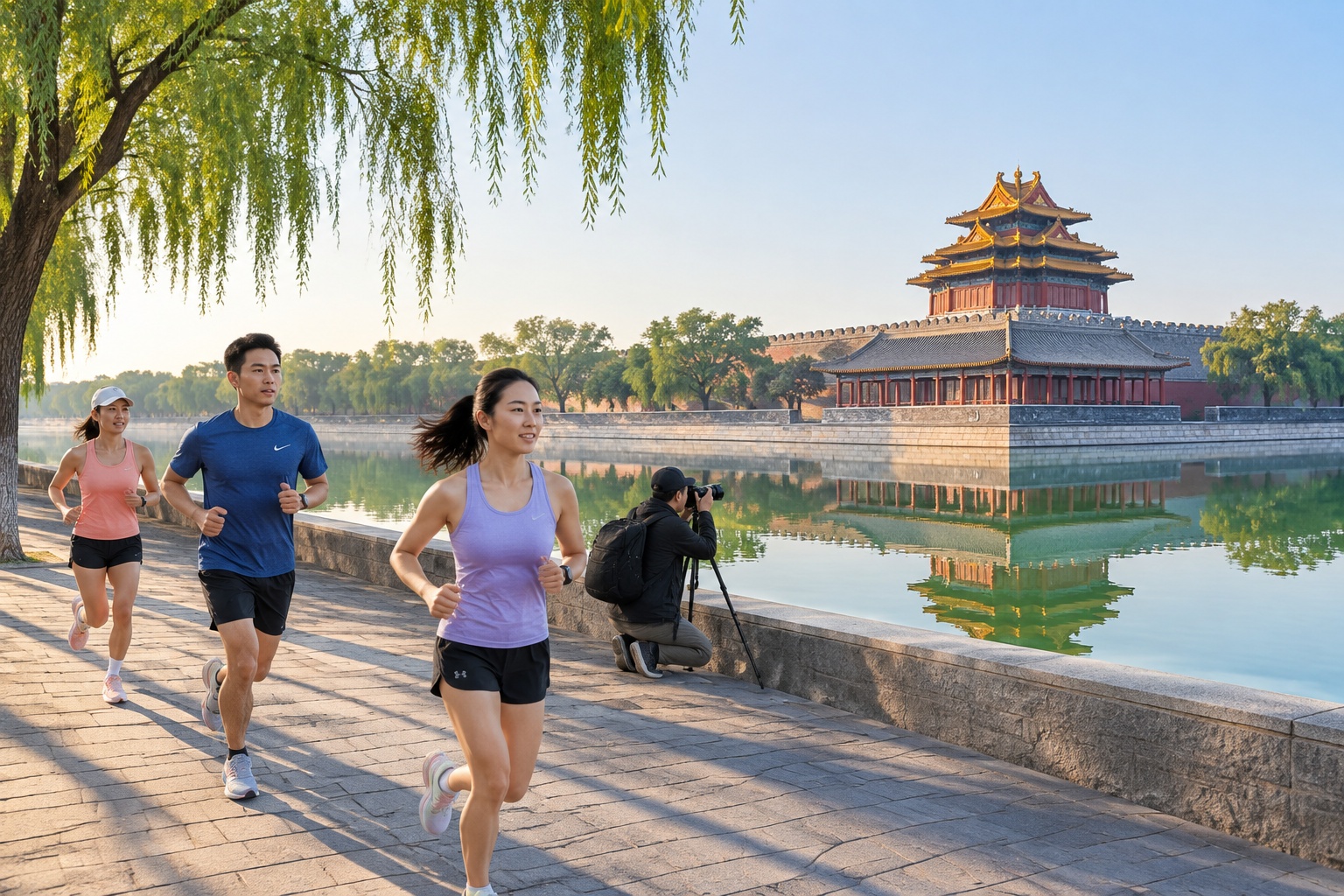
Down the hill and south, the axis becomes the Forbidden City. At 7 a.m. the palace isn’t open — tickets must be booked online about a week ahead, and the complex closes on Mondays — but the moat outside is already busy.
Along the Tongzi River, the channel that wraps the palace walls, runners do laps on a path shaded by willows. Photographers set up tripods opposite the northeast corner tower, waiting for the moment the sun hits the yellow glazed tiles and lands in still water. Wedding photographers arrive later, trailing brides in red.
There’s a practical reason this stretch is popular at dawn: it’s free, it’s flat, and the loop is about three kilometers with almost no cars. On a weekday morning you’ll pass more people in running shoes than in tour groups.
The Flag, the Square, and the Line Underground
At Tian’anmen Gate you pass under the portrait and into the square — 440,000 square meters of paving, roughly 62 football fields. Time it right and you can catch the flag-raising ceremony at sunrise. In midsummer that means arriving before 4:50 a.m.; in January, around 7:30. Visitors need an advance online reservation and a passport. It is solemn, quiet, and over in ten minutes.
Underneath all of this runs the axis’s fastest version: Line 8 of the Beijing subway, which follows the line for much of its route. Stations at Shichahai, Nanluoguxiang, National Art Museum, Qianmen, Zhushikou, Tianqiao, Yongdingmenwai. On a weekday morning, Line 8 carries commuters from southern residential districts into office towers in the north. The city’s subway handles more than 10 million rides on a busy day. Most of those passengers will never think of themselves as traveling along a World Heritage site. They are, though. The axis is literally their route to work.
Breakfast at Qianmen
By 8 a.m., south of the square, Qianmen Street is opening. The storefronts here are restored — this is the axis’s most polished stretch — but step one lane west into Dashilan or Meishi Street and the older rhythm is still there.
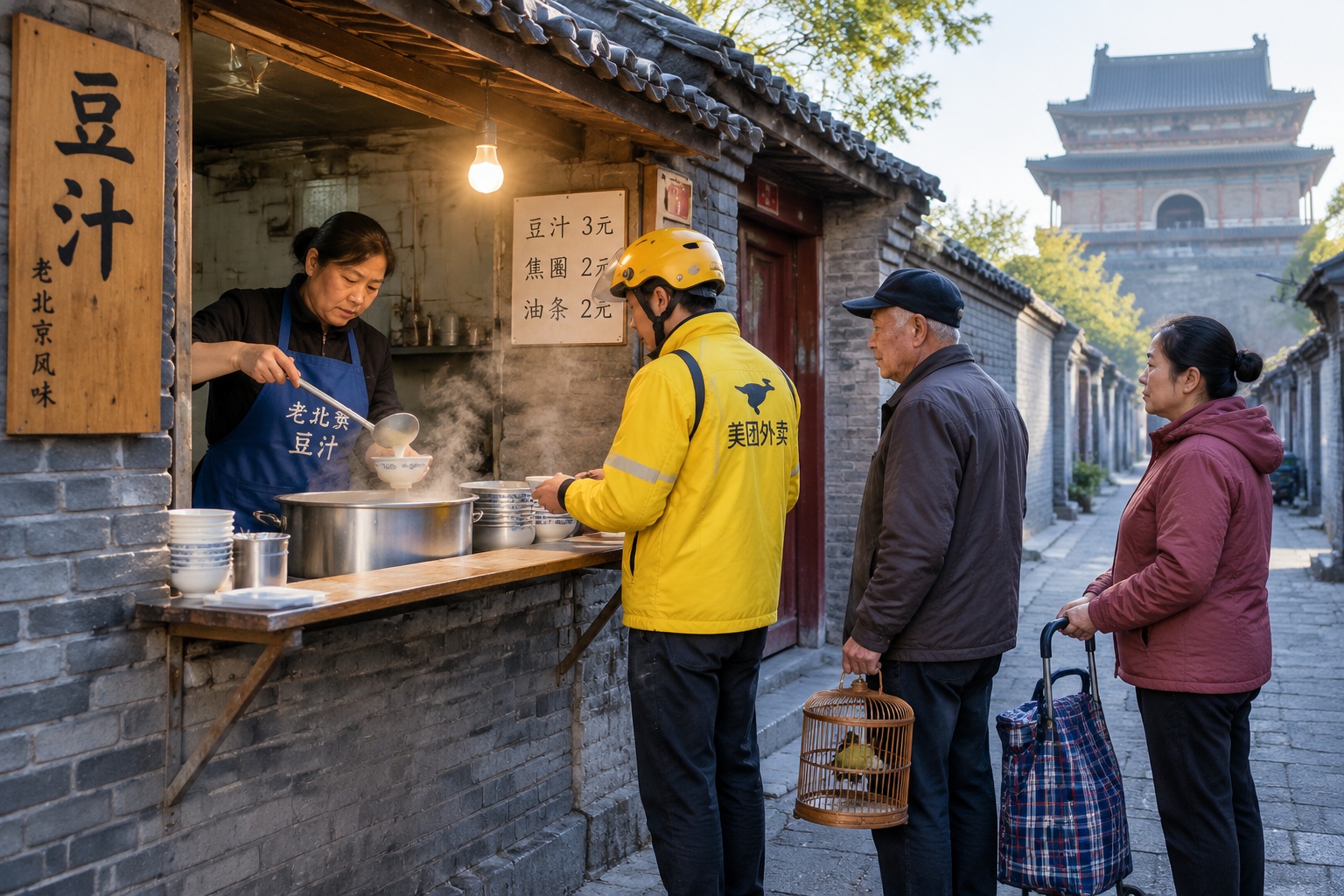
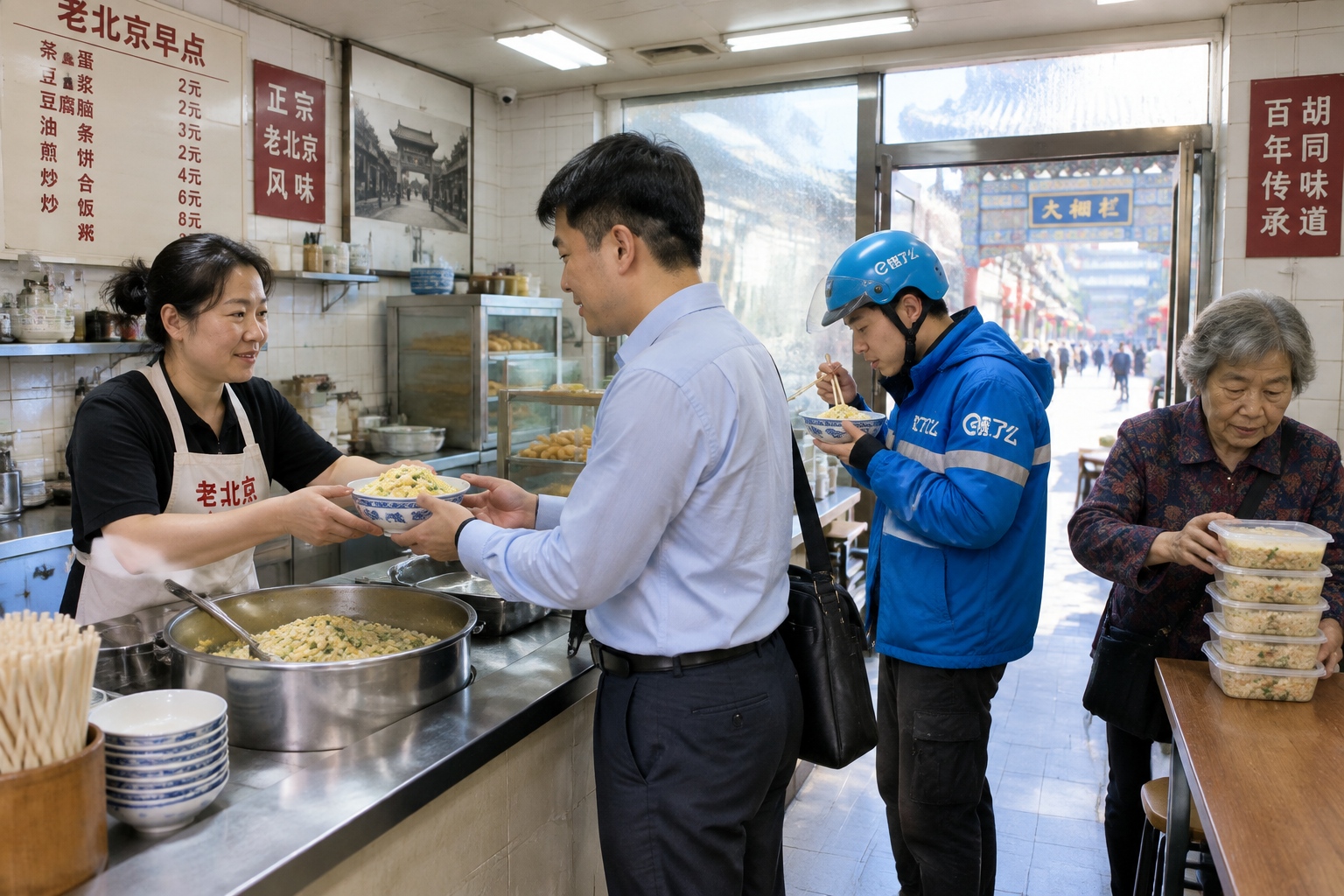
Breakfast in this part of Beijing is a specific thing, and it is not for everyone. Douzhi, fermented mung bean milk, grayish-green and famously sour, comes with pickles and a fried dough ring. Beijingers in their seventies drink it standing up. If you’re not ready, order chaogan: pork liver and intestines in a thick garlicky sauce over steamed buns. Or a plain jianbing from a cart, folded around a crispy cracker, for 8 yuan.
What’s striking is who’s eating. Delivery riders bolt a bun in two bites before their next order. An office worker in a pressed shirt eats the same thing at the same counter. A grandmother buys six portions to take home. Breakfast counters are one of the few places in a Chinese city where the price of entry is identical for everyone.
Where the Line Ends
Keep going south — past Tianqiao, past the Temple of Heaven and the Ancient Architecture Museum on either side — and the buildings get shorter and the streets wider. At the end is Yongdingmen, the Gate of Perpetual Peace.
It’s a rebuild. The original gate was demolished in 1957 to make room for traffic; the current structure went up in 2004, using old photographs and architectural records. Some Beijingers will tell you it’s a fake. Others point out that the axis was never a fixed object — the Drum Tower burned and was rebuilt, the palace has been repaired in every century, and the city has been editing this line since the 1260s.
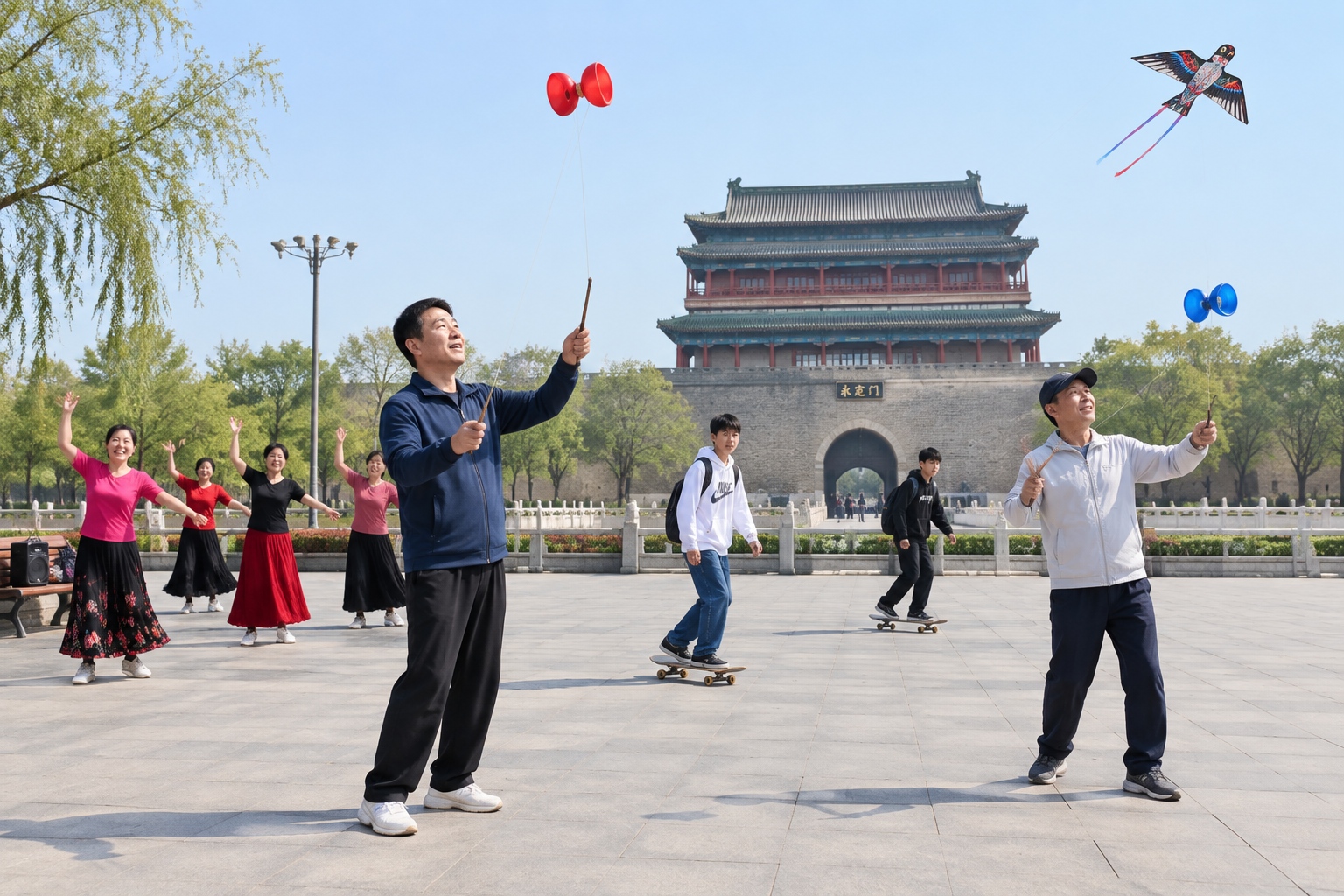
At 9 a.m. on a Saturday, Yongdingmen Park is in full swing. A man launches a swallow-shaped kite and lets out 200 meters of string. A dozen women dance to a speaker propped on a bench. Two men spin diabolos and toss them four meters into the air. Teenagers on skateboards weave between them, headphones in, oblivious.
Stand at the gate and look north. You can’t see the Drum Tower; 7.8 kilometers and 750 years of city are in the way. But the line is there, running under your feet, through a subway tunnel, past a bridge from 1285 and a breakfast stall that opens at five.
That’s the thing the UNESCO plaque doesn’t say. The Central Axis isn’t a monument you visit and leave. It’s the route someone takes to work, the hill someone climbs before breakfast, and the strip of water where a 70-year-old swims every morning before the city gets loud.
Walking the Axis: Practical Notes
When to go
Early morning, between 5:30 and 9. The light is better, the crowds haven’t arrived, and the parks are at their most interesting. Summer sunrises come around 4:50 a.m.; winter ones around 7:30.
Getting there and around
Start at Shichahai or Guloudajie station (Line 8) for the Drum and Bell Towers. Finish at Yongdingmenwai station, also Line 8 — the same line covers most of the route, so you can walk a section and ride the rest. Fares run 3 to 7 yuan depending on distance; tap a Yikatong card or the app QR code.
Tickets and hours
Jingshan Park: 2 yuan, opens 6 a.m. Temple of Heaven: 15 yuan for the park, 34 for the combined ticket that includes the Hall of Prayer for Good Harvests. The Forbidden City requires an online reservation, usually released seven days ahead, and is closed Mondays. Tian’anmen Square needs a free advance reservation and a passport; the flag-raising ceremony requires a separate early slot.
Food along the way
Breakfast is cheap: 5 to 10 yuan for a jianbing, 10 to 20 for chaogan or a bowl of noodles. Qianmen and Dashilan have the highest concentration of old-name breakfast shops; the hutongs north of the Drum Tower are quieter and cheaper.
What to watch for
Carry your passport — it’s checked at several points near Tian’anmen. Bring water in summer; shade is scarce on the square and along the southern stretch. And don’t try to cover all 7.8 kilometers and every site in one day. Two half-days, north and then south, works better. The point isn’t to finish the line. It’s to notice how many people are living on it.
Start the discussion at forum.chinacomes.com