
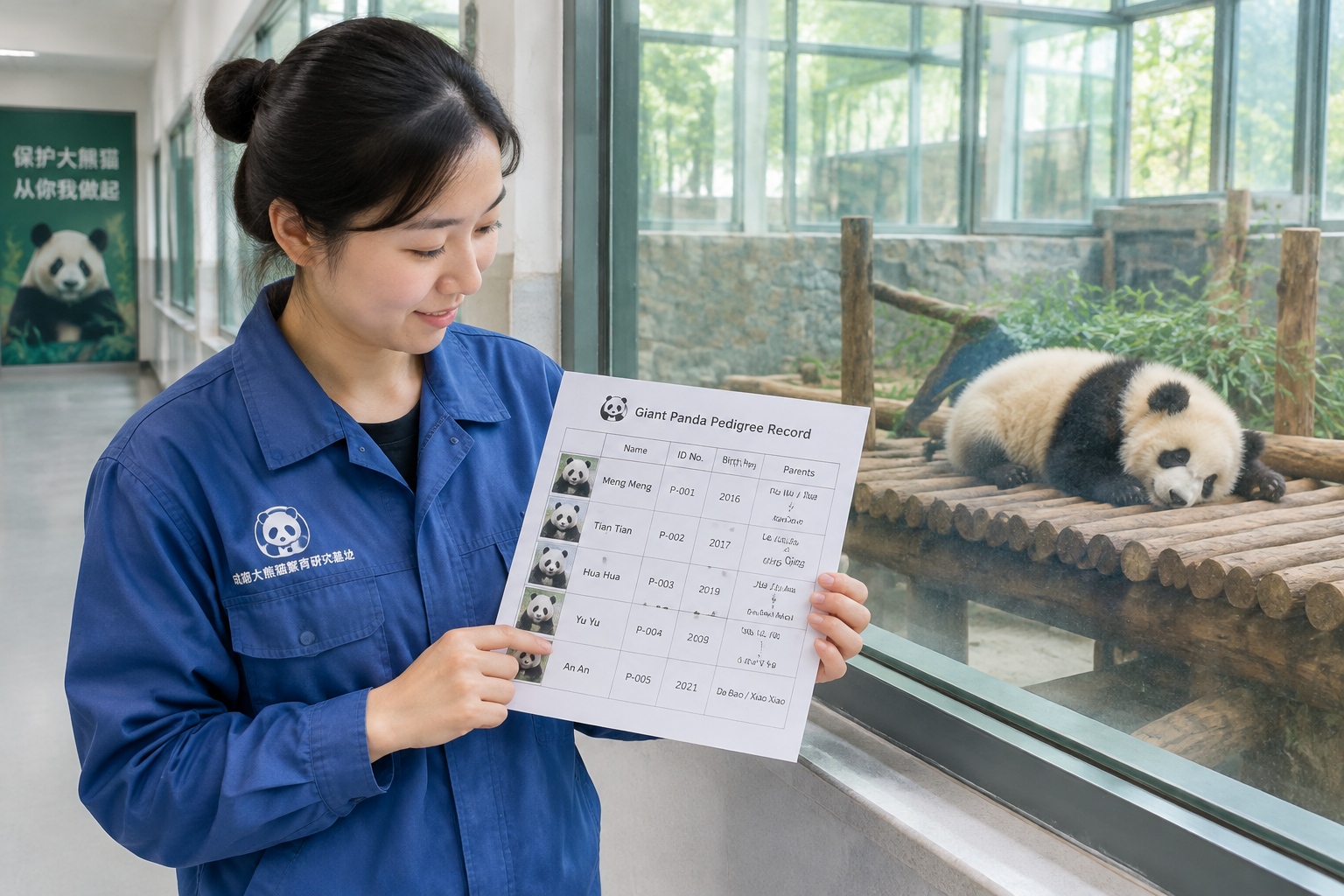

A 72-hour window decided by a spreadsheet
Every spring, keepers at the Chengdu Research Base of Giant Panda Breeding start testing urine and tracking hormones. A female giant panda ovulates once a year. Her fertile window lasts somewhere between 24 and 72 hours. Miss it, and the next chance is twelve months away.
What happens inside that window looks less like romance than like a database query. Before any pairing, staff open the international studbook — the master family tree of every giant panda in human care, each animal recorded with a number, its parents and its date of birth. Software then runs the numbers: how closely related are the two candidates, and how much of the population’s remaining genetic variation would a cub from this match carry forward?
Often the male chosen is not the most impressive animal in the enclosure or the crowd favourite on the viewing platform. It is the one whose genes the population needs most. Some males sit out for years. Others have semen frozen and stored so that their genetic contribution can still be used long after they are dead.
This is the machinery that keeps a species with roughly 1,900 wild individuals and a little more than 700 in captivity from slowly turning into one enormous extended family.
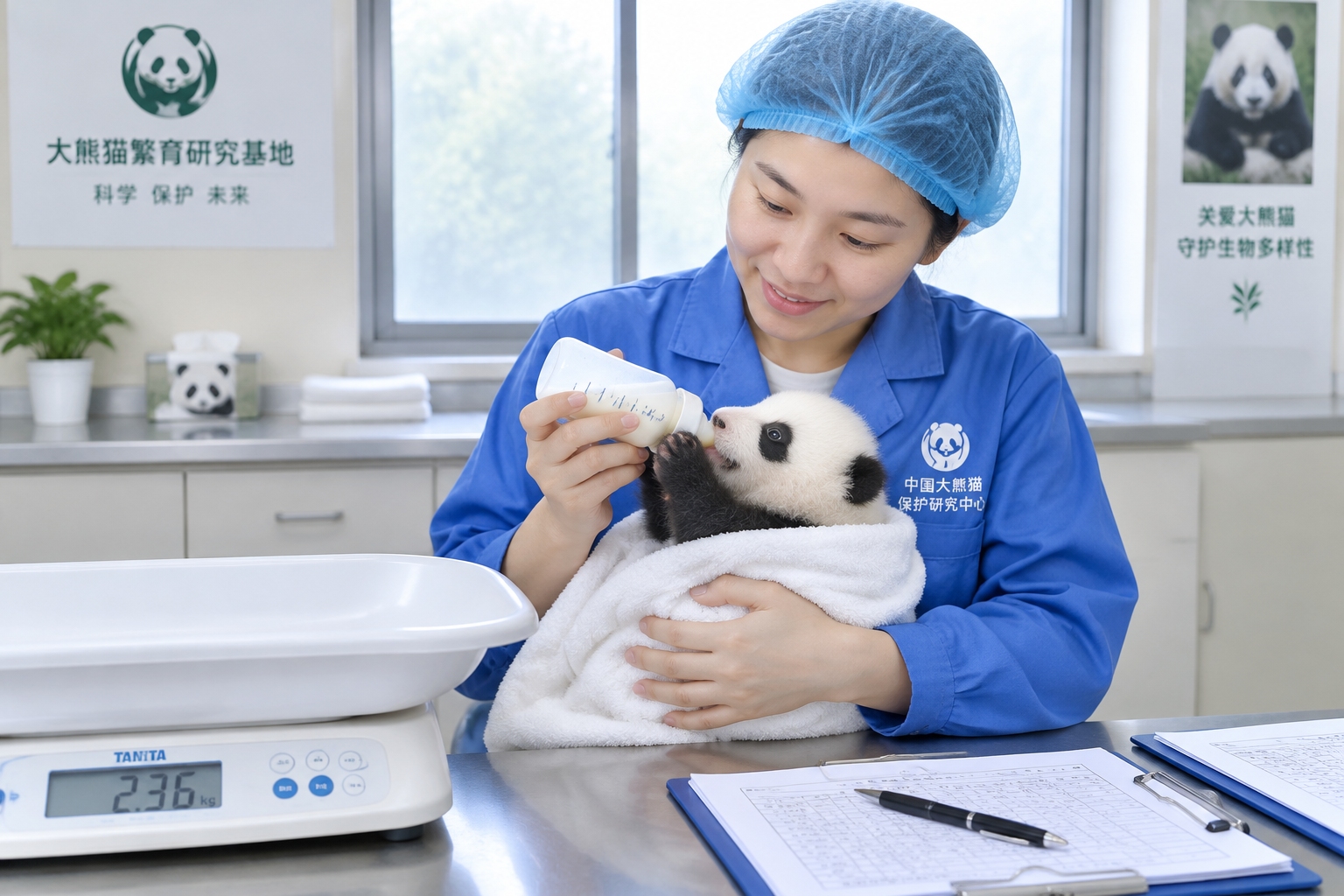
What a genetic bottleneck actually means
Start with a simple idea. If a population falls to a few dozen animals and then recovers, the recovery carries only the genes of the survivors. The species may climb back to thousands, but the variation that existed before the crash has already been lost. That is a bottleneck, and it leaves a mark that can still be measured decades later.
Giant pandas have been through at least one. Their genome, sequenced in 2010 by a Chinese-led team and published in Nature, showed unusually low genetic diversity compared with other bears. The same work flagged an odd detail: pandas carry a disabled version of T1R1, a gene involved in tasting savoury flavours. It fits an animal that switched to bamboo millions of years ago and never switched back.
Pandas also have a map problem. Wild individuals live in six mountain ranges across Sichuan, Shaanxi and Gansu provinces. Roads, towns, farmland and cleared hillsides cut those ranges into dozens of small subpopulations, some of them numbering only in the low dozens of animals. A male panda will travel between valleys when he can, but he avoids highways, villages and open ground. When the route closes, the gene flow closes with it.
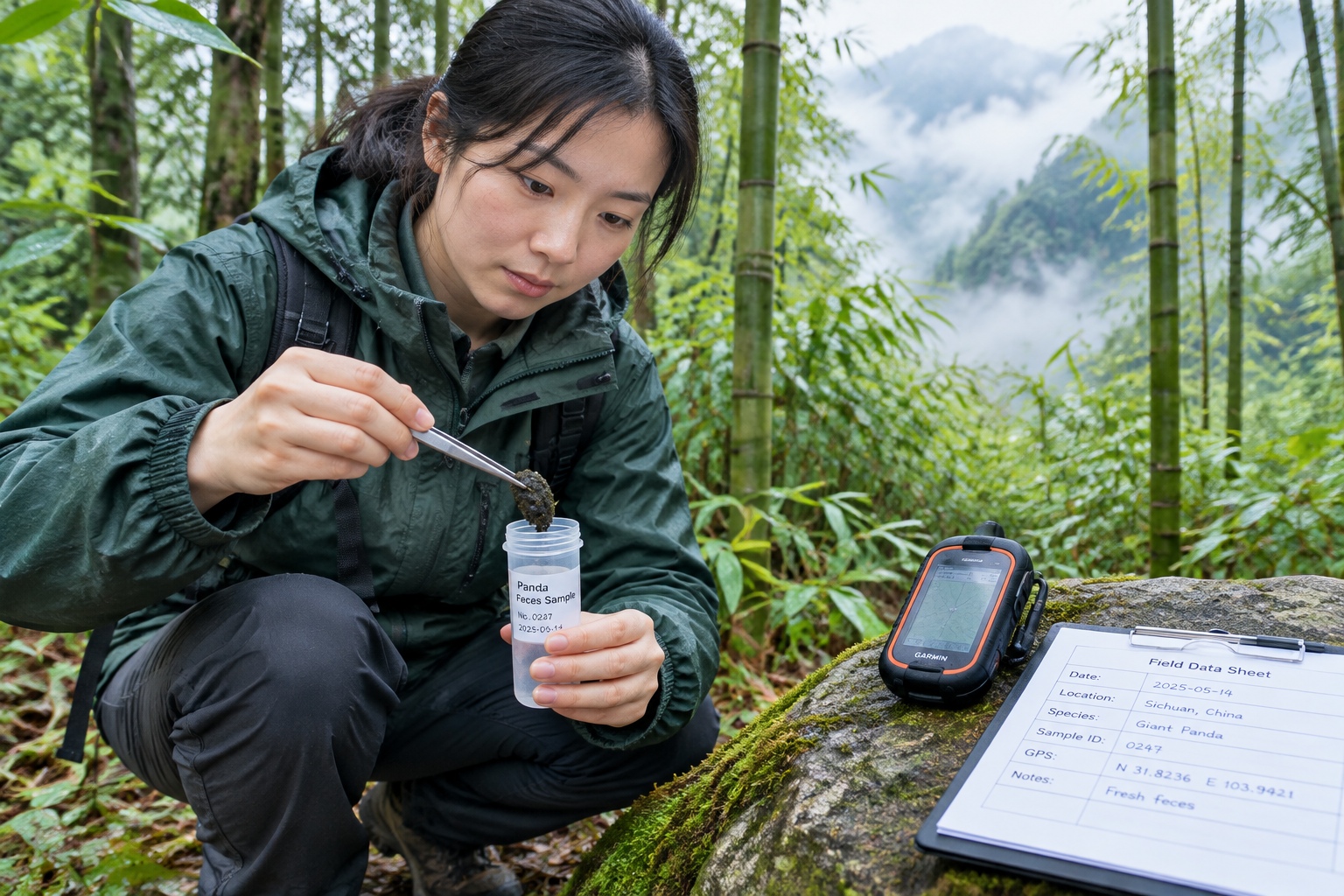
DNA from droppings identifies individual pandas without ever catching them.
The studbook: matchmaking by kinship score
A studbook is not a sentimental record. It is an accounting ledger of ancestry, and for pandas it is the single most important document in the breeding programme. Every cub born in a breeding centre or a zoo is entered with its parents, and the file now runs to more than 700 living animals and thousands of entries reaching back to the first pandas ever held in captivity.
Population managers work from a metric called mean kinship. For each animal, it estimates how closely related that individual is to the population as a whole. The lower the number, the more genetically valuable the animal — and the more a cub from it will widen the population’s genetic base. Pair a low-kinship male with a low-kinship female and you have done more for the species than you would by breeding two famous pandas together.
The other half of the job is correcting old mistakes. Through the 1980s and 1990s the captive population grew slowly and many cubs died young. When breeding success finally improved, a handful of prolific males sired a disproportionate share of the next generation through artificial insemination. Those lineages are now over-represented. Today, managers deliberately sideline them. Some well-known, popular animals are quietly removed from the breeding pool for no other reason than that their family line is already too common.
DNA turned counting into a science
For most of the twentieth century, counting pandas meant walking ridgelines, measuring bamboo bite marks and estimating. The numbers swung wildly, and nobody could say which animal was which.
That changed with non-invasive genetics. Survey teams now walk transects through the mountains and collect panda droppings. Each sample goes to a laboratory, where DNA is extracted and genotyped. Because every panda has a unique genetic profile, the same individual can be identified from scat collected kilometres apart, and a single hair or dropping can confirm that a valley thought to be empty still has residents.
This is how China’s national panda surveys work today. The fourth survey, carried out between 2011 and 2014, counted 1,864 wild pandas; more recent monitoring suggests the total has edged past 1,900. The headcount matters, but the genotypes matter more. They show which subpopulations are isolated, which are still exchanging genes, and where a single wildlife corridor would do the most good.
In captivity, DNA testing does something more mundane and just as essential: it establishes paternity. A female may mate with several males, or be inseminated with a mixture of semen. A paternity test tells the studbook who the actual father is. Without it, a studbook is an educated guess, and one wrong entry can accidentally pair half-siblings twenty years later.
Whole-genome sequencing has added the wider picture. A 2013 study in Nature Genetics sequenced 34 wild pandas and identified three genetic clusters. The Qinling pandas of Shaanxi — recognised as a separate subspecies — turned out to be distinct enough that they need to be managed as their own unit. That finding changed how breeding pairs are chosen between the centres in Sichuan and the one in Shaanxi.
Why genetic diversity is not an abstract virtue
Immune genes are the clearest example. A group of genes called the major histocompatibility complex helps vertebrates recognise pathogens. The more variants a population carries, the more likely some individuals will survive a new disease. A population down to a handful of variants is a population where one outbreak can move through everyone.
Inbreeding also shows up in ordinary biology rather than in theory: smaller litters, weaker cubs, lower sperm quality, higher cub mortality. Zoos and breeding centres have documented these effects in pandas and in many other species.
Then there is adaptation. Giant pandas eat several bamboo species, and those species flower and die off on cycles that last decades. Climate change is pushing bamboo zones upslope. A population with genetic variation has a chance of coping; a genetically uniform one has far fewer options. Standing variation is the raw material that lets a species respond to conditions nobody can predict in advance.
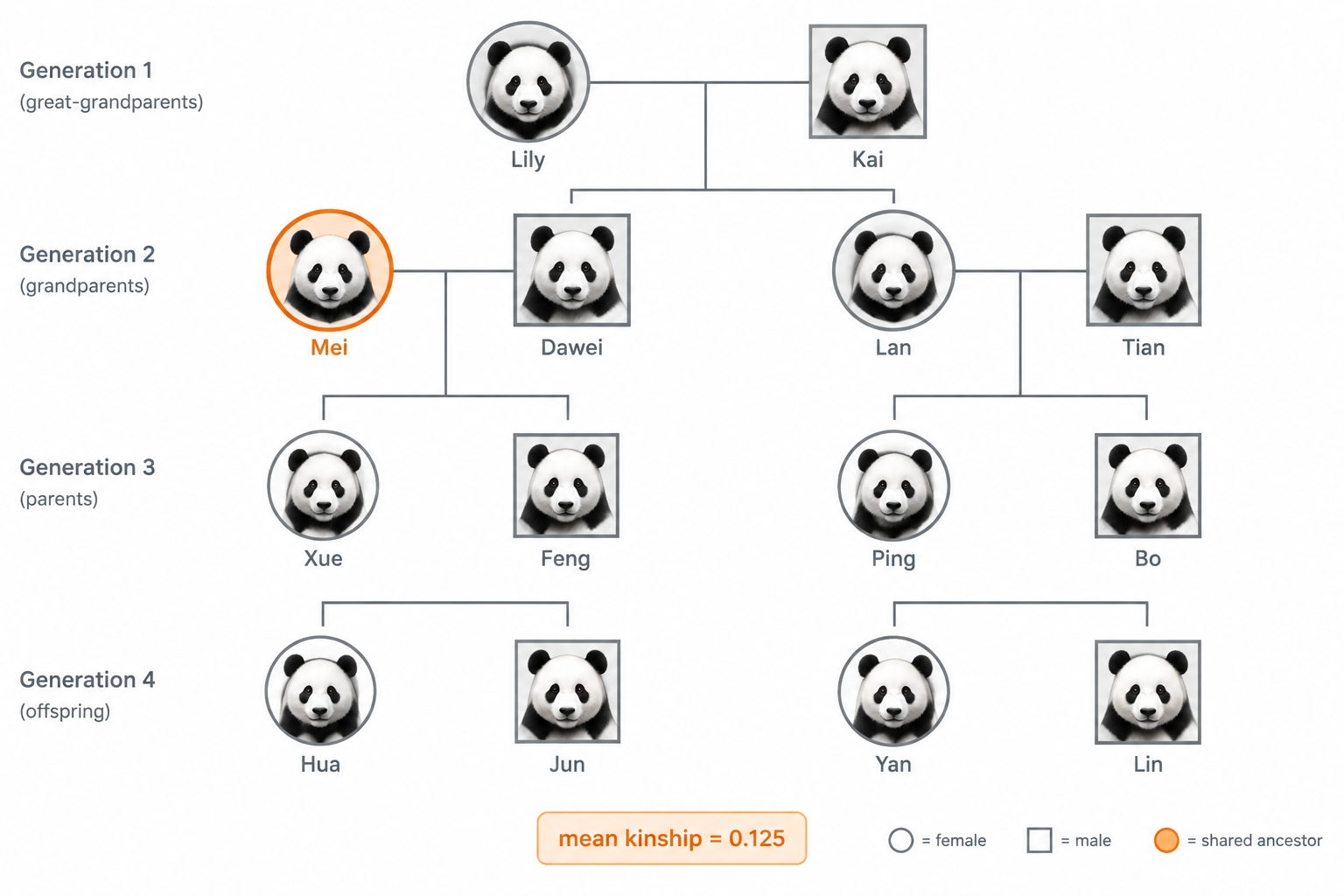
A basic pedigree: two pandas sharing a single great-grandsire are already close relatives in genetic terms.
Where the limits still are
Breeding centres cannot fix the wild problem. Fragmentation is a land-use issue, and its solution is dirt, concrete, trees and negotiation. The Giant Panda National Park, formally established in 2021, covers about 27,000 square kilometres across Sichuan, Shaanxi and Gansu. Its purpose is not to fence pandas in but to stitch habitat back together — closing logging roads, building wildlife crossings under highways, restricting grazing and mining, and compensating villagers who lose access to land inside the park boundary.
Reintroduction is harder than it looks. Over the past fifteen years, a small number of captive-bred pandas have been released into the wild in Sichuan, with mixed results. Some settled in; some did not survive. A panda raised in a nursery does not automatically know how to find clean water, choose the right bamboo at the right elevation, or back away from a rival.
There is also a quieter risk that geneticists worry about: adaptation to captivity itself. In a breeding centre, the animals that reproduce most reliably are those that tolerate people, noise and enclosure life. If those traits are partly heritable, generations of captive breeding can slowly tune a population for the wrong environment — a problem the panda programme tries to manage by keeping the studbook honest and by minimising the number of generations any bloodline spends in captivity.
What other endangered species are taking from it
The panda toolkit — a studbook, genetic testing, cryopreserved semen, habitat corridors — is now standard practice in conservation biology, and China’s own endangered species programmes have borrowed heavily from it.
The crested ibis is a useful comparison. In 1981, seven wild birds were found in Yangxian, Shaanxi. Today there are more than 10,000, spread across China, Japan and South Korea. It is a spectacular recovery and also a genetic bottleneck on a scale the panda has never faced: every living crested ibis descends from those seven birds. 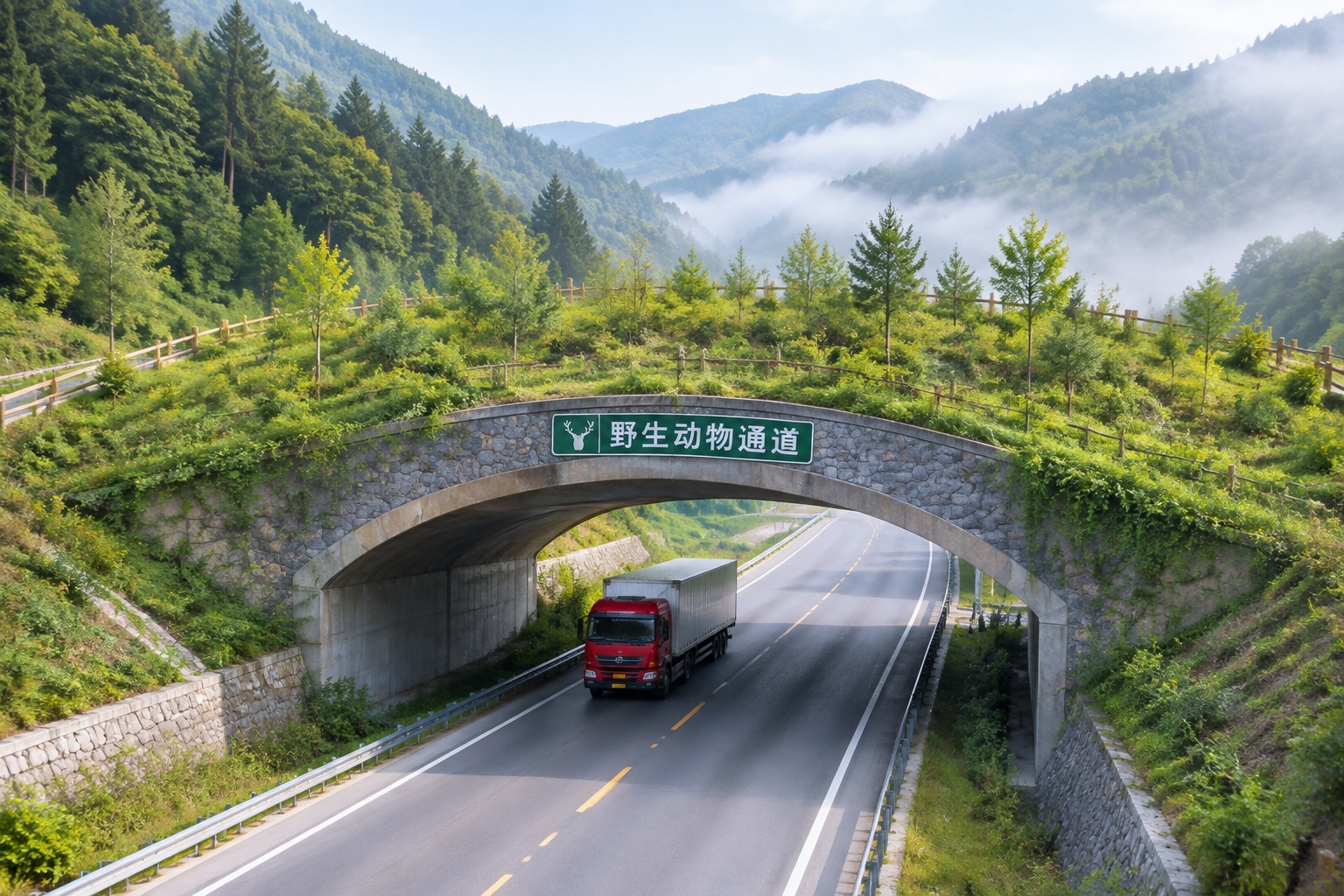
A cub with a number before it has a name
At the breeding base in Chengdu, the cubs born this spring already have studbook entries. Each has a number, a mother, a father confirmed by DNA, and a mean kinship value that will follow it for life. The name comes later, usually from a public vote or a naming campaign.
Years from now, when that cub reaches its first spring estrus or is considered as a mate for another animal, the first thing anyone will check is not how it looks on the viewing platform. It will be that number, and the family tree behind it. The giant panda’s survival stopped depending on romance a long time ago.
Start the discussion at forum.chinacomes.com