

A quiet morning in Xi’an
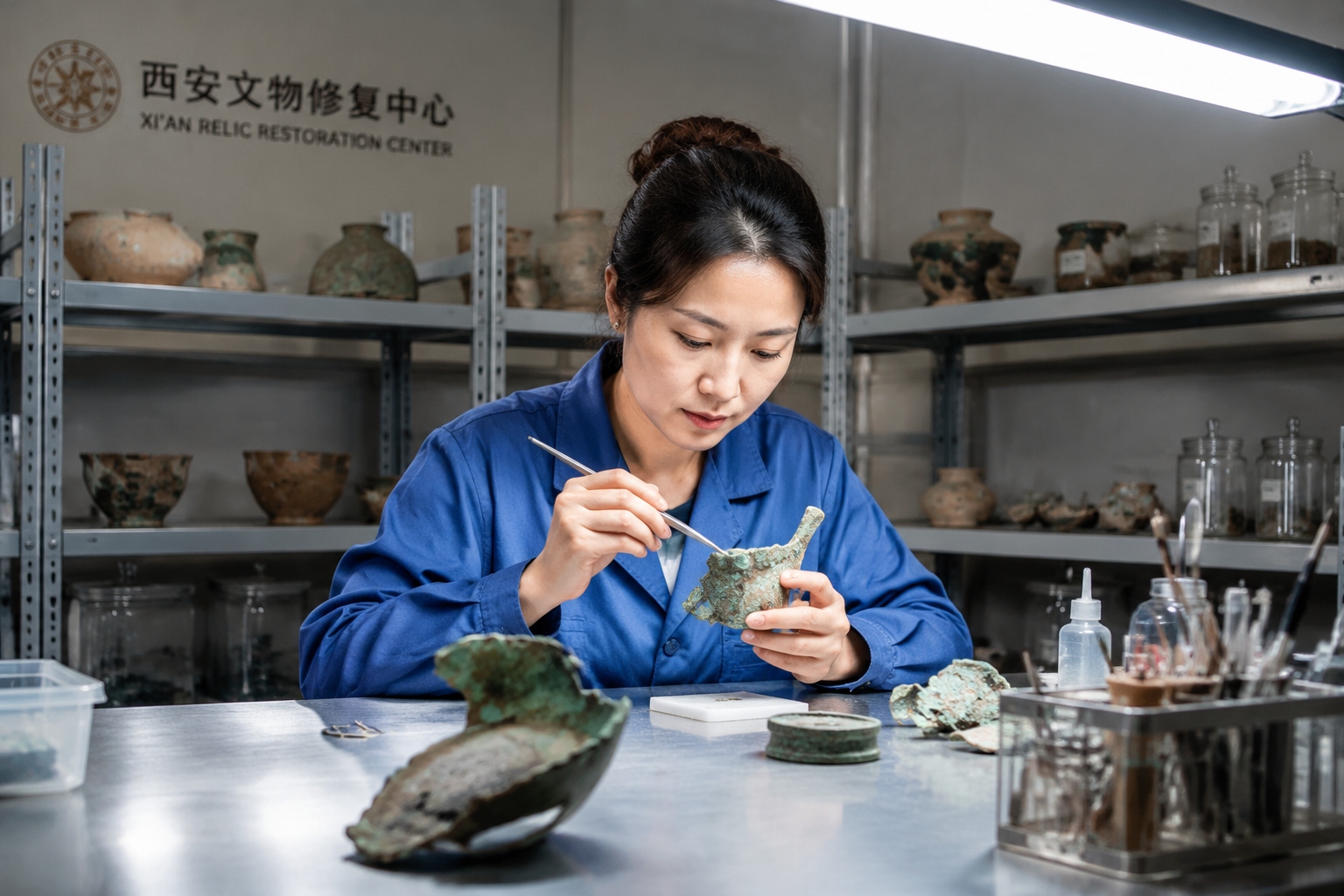
The light is pale and fluorescent. Inside a low-ceilinged workshop at the Shaanxi History Museum, a woman in a blue cotton lab coat sits at a steel table. Her left hand steadies a bronze fragment no bigger than a palm; her right hand moves a dental pick across its green surface, scraping away rust that has taken centuries to form. The room smells of acetone and old soil. On the shelf behind her are glass jars filled with shattered pottery, tiny bones, and bronze shards. No music. No conversation. Only the occasional tap of metal on stone.
This is the world of China’s relic restorers. In Shaanxi province—home to the Terracotta Warriors, the tomb of Emperor Qin Shi Huang, and thousands of tombs and temples—there are perhaps fewer than 500 people formally certified to repair cultural relics. They are few, the demands are many, and time is never on their side.
Why the rush?
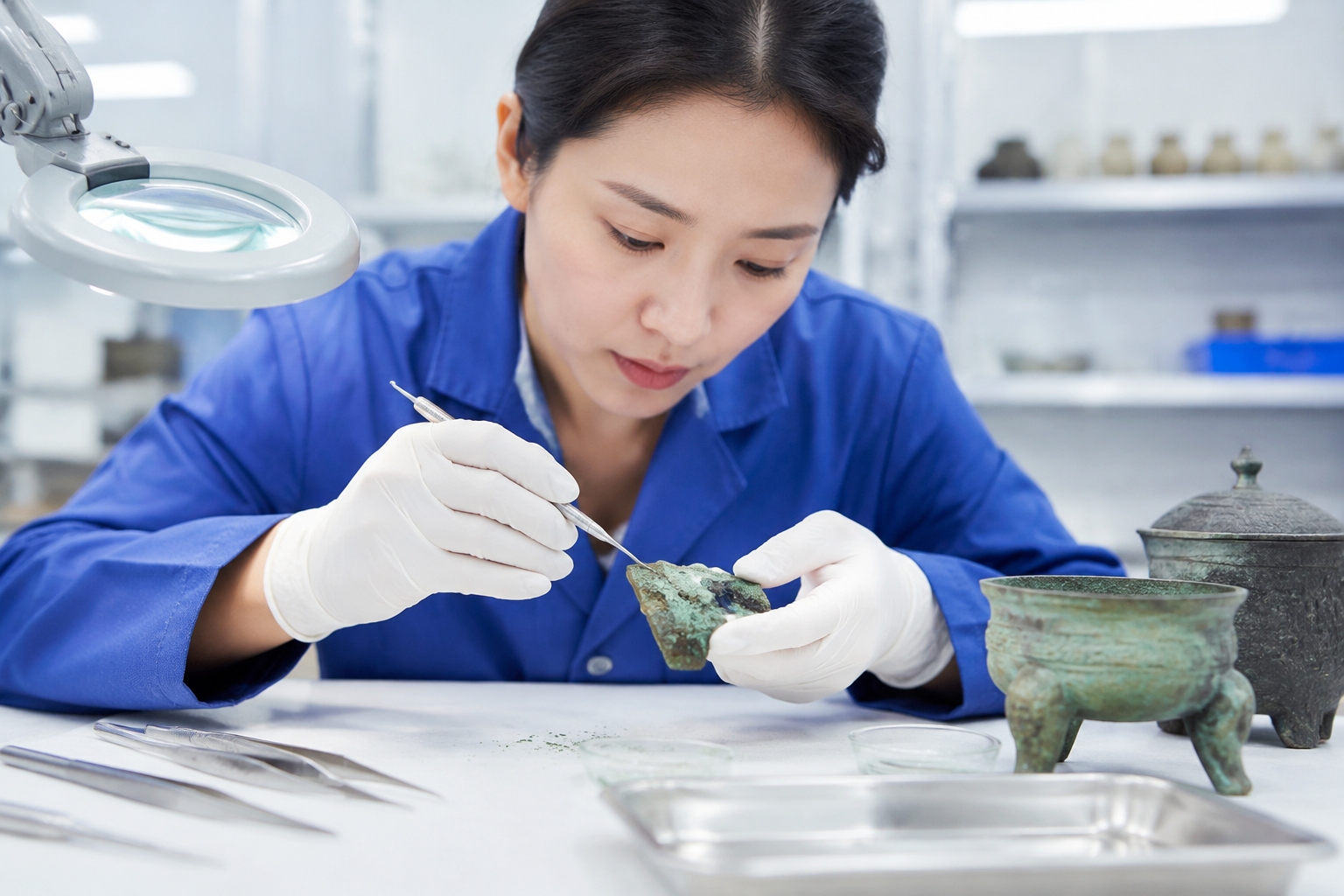
Every relic is dying. Bronze develops “bronze disease,” a form of corrosion that can consume metal if not treated. Ancient silks turn to dust. Murals lose their pigment within years once exposed to air. And as China’s infrastructure boom plows through ancient sites—every new subway line or highway in Shaanxi is a potential archaeological dig—the amount of unearthed material is growing faster than the restoration teams can process it.
“A tomb can be dug in weeks. Restoring one jade artifact from that tomb can take months,” says Master Lin, a 47-year-old restorer who has worked at the museum for 22 years. “We are not competing with the diggers. We are competing with time. Every day the air, the humidity, even touching changes the object.”
More than patience
Restoration is meticulous, but it is not just craft. Modern labs like this one are half-workshop, half-science lab. On another table, a young assistant feeds a fragment into a CT scanner. The scans create a 3D model, allowing restorers to see internal cracks without opening the artifact. 3D printers produce missing parts in transparent resin first, to test the fit before any new bronze is cast.
Still, the final decisions are made by hand. “A machine can tell us the composition of the metal. It cannot tell us whether the original artisan wanted the handle tilted five degrees,” says Master Lin. He picks up a small pottery dog from a tray. It came from a Tang dynasty tomb and is missing its left ear. Using a silicone mold, he will create a replacement ear, paint it to match the glaze, and then age it with fine sandpaper so it looks a thousand years old.
Racing against time at the Terracotta Warriors
Perhaps no place in Shaanxi feels this pressure more than the Terracotta Warrior pits. Thousands of figures shattered by roof collapses and centuries of burial have been excavated piece by piece since 1974. Today, restorers at the site work like detectives. Each fragment is numbered, scanned, and stored in a database. Algorithms help them match pieces—a shoulder muscle here, a braid there—but the final layout is done by eye, on large metal tables.
“We have recovered about 2,000 warriors so far,” says Wang, a restorer at Emperor Qinshihuang’s Mausoleum Site Museum. “We are restoring about 20 to 30 a year. At this pace, it will take centuries just to finish Pit 1.” He smiles, not with irony but with resignation. “We learn to live with the fact that we are only passing on the pieces to the next generation.”
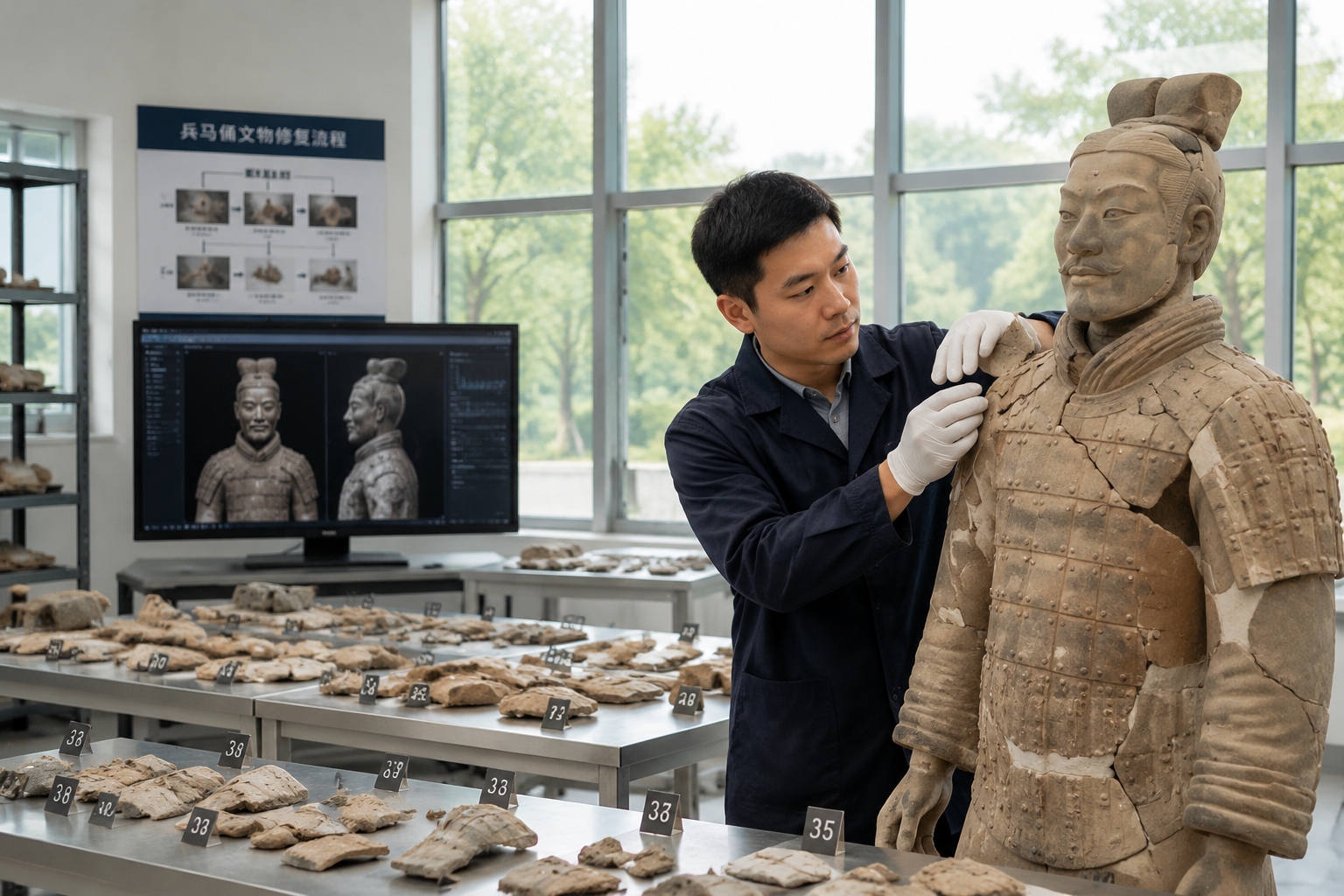
Wang’s team has also started using AI to match fragments. “It’s a helping hand. But the final bond is made with an adhesive that we mix ourselves, using a recipe that has not changed much in decades.”
Learning to be slow
The job requires a particular temperament. In a country where ordinary workers often change jobs every few years, restorers stay for decades. The youngest in the Shaanxi History Museum workshop is 26-year-old Chen Qin. She majored in cultural heritage at a university in Xi’an and has been at the museum for three years. “My friends make money in tech. They envy me for my job—but they also say I live like a monk,” she says. “I spend four hours a day polishing a single piece of bronze. It’s not glamorous. But when the object finally leaves my hand, I feel like I’ve talked to the person who made it.”

The training is still largely apprenticeship-style. New restorers shadow senior masters for years before they are allowed to work on high-value relics. There are now university programs, but in a country with more than 100 million artifacts spread across 2,500 museums, the gap between the number of relics and the number of trained restorers is massive. According to the National Cultural Heritage Administration, there are about 21,000 officially employed restorers in China—far too few for the estimated 40 million artifacts that need repair.
Time is both enemy and ally
Restorers are always aware that they are losing the race. Yet the tools of their trade—the patience, the repetition, the refusal to cut corners—are precisely what makes them victorious in a larger sense. Each restored relic becomes a time capsule. A broken Tang mirror, rejoined, tells a new story. A bronze cauldron, cleaned, reveals inscriptions that rewrite history.
“You cannot fix everything,” Master Lin says. “You can only do what you can do, well enough that another person, one hundred years from now, will still be able to undo your work and do it better.”
That is the paradox of the restorer: they work against time, but their work only survives through time. The adhesives they use are chosen to be reversible. The pigments they mix are documented. They are not making permanent monuments; they are writing temporary footnotes in a conversation that has been going on for thousands of years.
Leaving a scar
By late afternoon, the woman in the blue coat—her name is Liu Fang—has finished cleaning the bronze fragment. She holds it up to the light. The green surface glows, and a thin line of gold glints through the corrosion. “A lucky piece,” she says. “It fell in a way that didn’t break the pattern.”
She places the fragment in a foam-lined box, then reaches for the next one. On the wall above her desk is a handwritten notice: “If you must make a mistake, make a reversible one.”
Outside, the city of Xi’an hums with the sound of construction, traffic, and new life. Inside, the restorers stay bent over their tables, patiently, stubbornly, giving the past a little more time.
Start the discussion at forum.chinacomes.com