
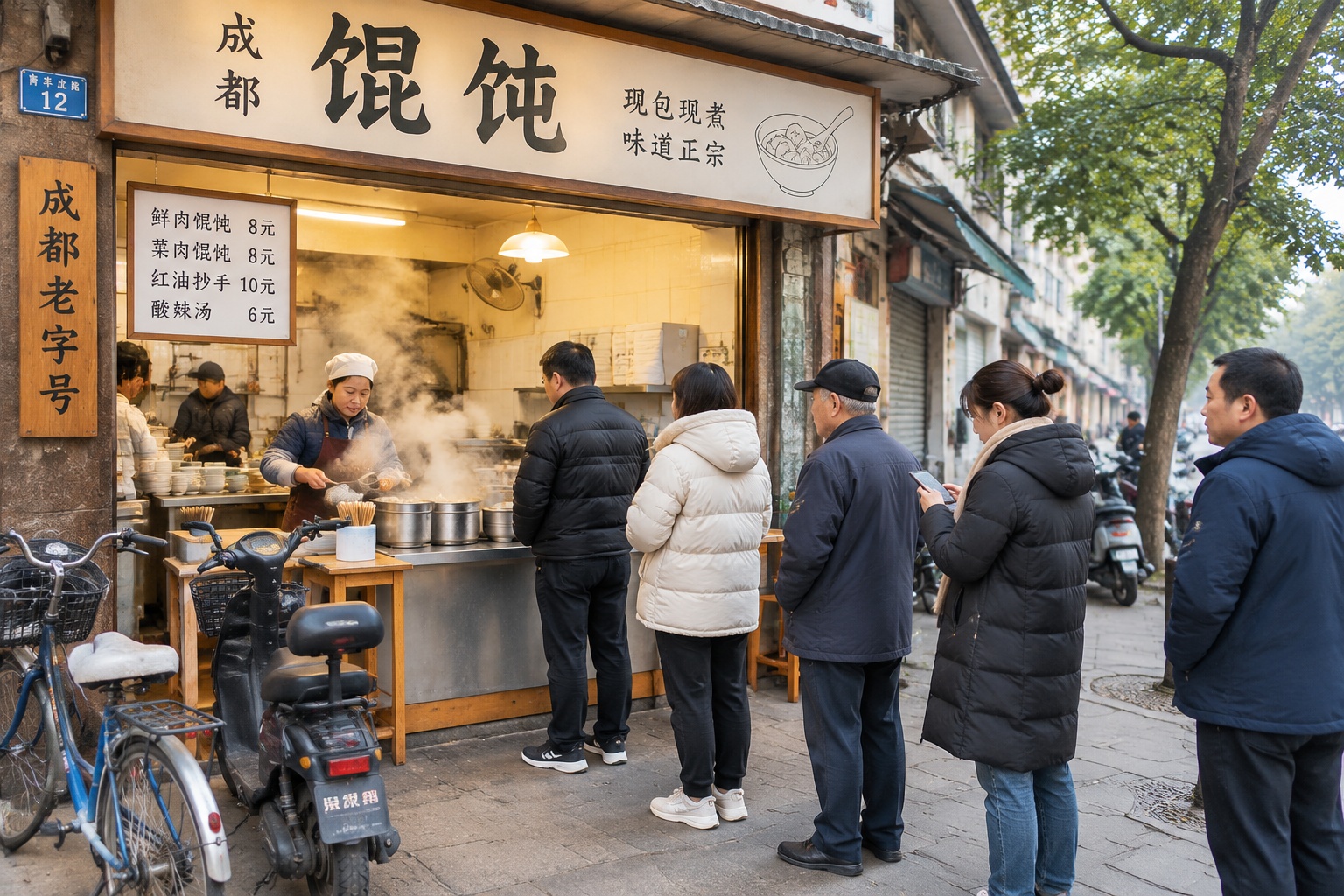

7 A.M. on a Chengdu Side Street
It’s 6:50 on a Tuesday morning in Chengdu’s Qingyang District. The sky is still grey. A woman in a puffer jacket parks her electric scooter, joins the end of a line that already curves past the doorway of a small chaoshou shop, and pulls out her phone. She doesn’t seem annoyed. Neither do the twenty people ahead of her.
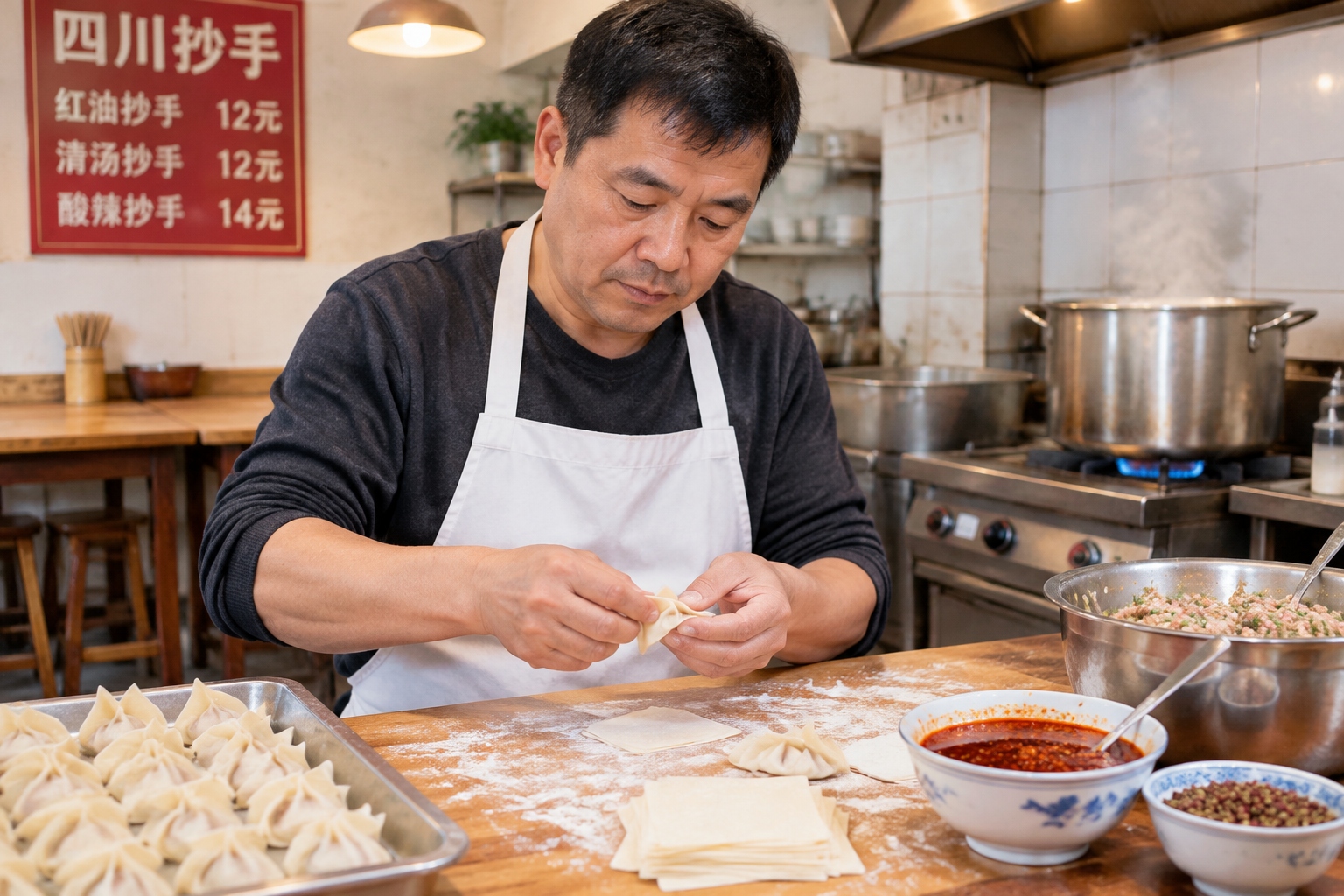
Inside, a man in a white apron is folding wontons by hand—one every two seconds—dropping them into a pot of boiling broth. His wife ladles red chili oil into ceramic bowls. The smell of roasted Sichuan peppercorns drifts into the street.
This is not a tourist attraction. It’s just breakfast.
If you’re from a culture where breakfast is something you grab on the go—a coffee, a granola bar, a sandwich eaten at your desk—the idea of standing in line for 20 minutes for a bowl of wontons might seem strange. But in Sichuan, it’s completely normal. The question isn’t why people queue. The question is: why this bowl?
What Exactly Is a Chaoshou?
If you know wontons from Cantonese dim sum or the wonton soup you’ve had in a Chinese restaurant abroad, you’re close—but not quite there. In Sichuan, the same basic thing is called chaoshou (抄手), and it has its own personality.
The wrapper is thinner and silkier than what you’ll find in most Cantonese versions. The filling is usually pork, finely minced, sometimes with a bit of ginger water mixed in to keep it tender. But the real difference is what happens after the wontons are boiled.
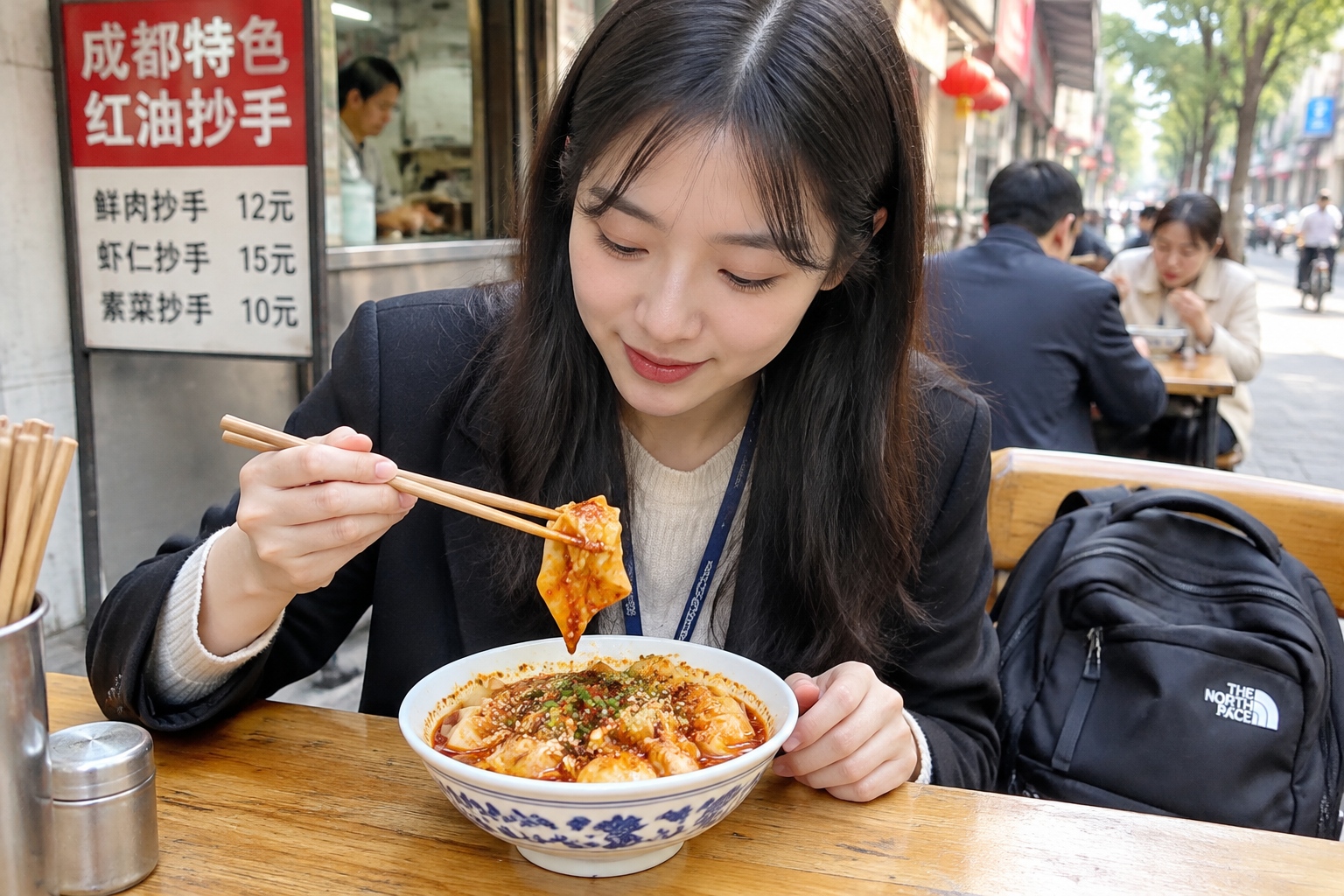
Cantonese wontons swim in a clear, delicate broth. Sichuan chaoshou get drowned in red oil—chili oil, sesame paste, soy sauce, garlic, and a hit of ground Sichuan peppercorn that leaves your lips buzzing. Some shops serve them hong you (red oil) style; others offer qing tang (clear broth) for purists. Most regulars have a strong opinion about which is correct.
“If the peppercorn isn’t fresh, you can taste it immediately,” says Li Wei, a 34-year-old IT worker who eats at the same shop three mornings a week. “The numbness should hit after the chili. Not before.”
That numbness—ma in Chinese—is the signature of Sichuan cuisine. It’s not spicy hot. It’s a tingle, a vibration, a slight electric hum on your tongue. For people who grew up with it, breakfast without it feels incomplete.
The Default Breakfast
Ask anyone in Chengdu what they ate this morning, and you’ll hear a short list: chaoshou, dan dan noodles, guokui (stuffed flatbread), soy milk, or youtiao (fried dough sticks). Chaoshou sits near the top.
“I’ve been eating here for eleven years,” says Zhang Yulan, a 62-year-old retiree who walks ten minutes every morning to a neighborhood shop near Wenshu Monastery. “I tried making it at home during lockdown. It wasn’t the same. The dough, the oil, the fire—it’s a craft.”
For younger office workers, chaoshou is fast, filling, and cheap—usually 10 to 15 yuan (about $1.50 to $2) for a bowl. It’s quicker than cooking, cheaper than a café, and more satisfying than a protein bar.
“I don’t have time to sit down for long,” says Chen Lu, a 26-year-old graphic designer. “But I also don’t want to eat something sad at my desk. Chaoshou is the compromise. I stand in line, I eat in ten minutes, I’m out.”
Why the Queue? The Business of Making It Slow
Here’s the paradox: chaoshou is fast food, but the best shops are deliberately slow.
Most old-school chaoshou shops don’t pre-fold. They wrap each wonton to order. The dough is rolled fresh. The broth is simmered overnight. The chili oil is house-made, often from a recipe the owner won’t share.
“If I fold them in the morning and let them sit, the wrapper dries out,” says Wang Jianguo, who has run a six-table shop near Kuanzhai Alley for 23 years. “People can taste the difference. They won’t come back.”
This means limited supply. When the filling runs out, the shop closes—sometimes by 10 a.m. Regulars know this. They come early. They queue.
There’s also the social layer. A chaoshou shop is not a restaurant. It’s a neighborhood hub. The auntie at the front of the line knows the owner’s daughter’s name. The man behind her argues about football with the guy at the next table. You hear the same voices every week.
“I don’t come here just for the food,” says Liu Gang, a 45-year-old taxi driver. “I come because I know everyone. It’s my morning news.”
That sense of belonging is hard to replicate. It’s why people won’t switch to a faster shop down the street. The queue isn’t a bug. It’s part of the product.
A Changing City, A Stubborn Bowl
Chengdu has changed fast. In the last decade, the city’s GDP has more than doubled. Subway lines have multiplied. Tech companies have moved in. Rent in central districts has climbed.
For old chaoshou shops, the pressure is real. Some have closed. Others have moved to cheaper neighborhoods. A few have become famous—written up in guidebooks, photographed for social media—and now serve tourists who want the “authentic” experience.
Purists complain about this. “The ones on the internet, they change the recipe,” says Zhang Yulan. “More sugar. Less pepper. For the tourists.”
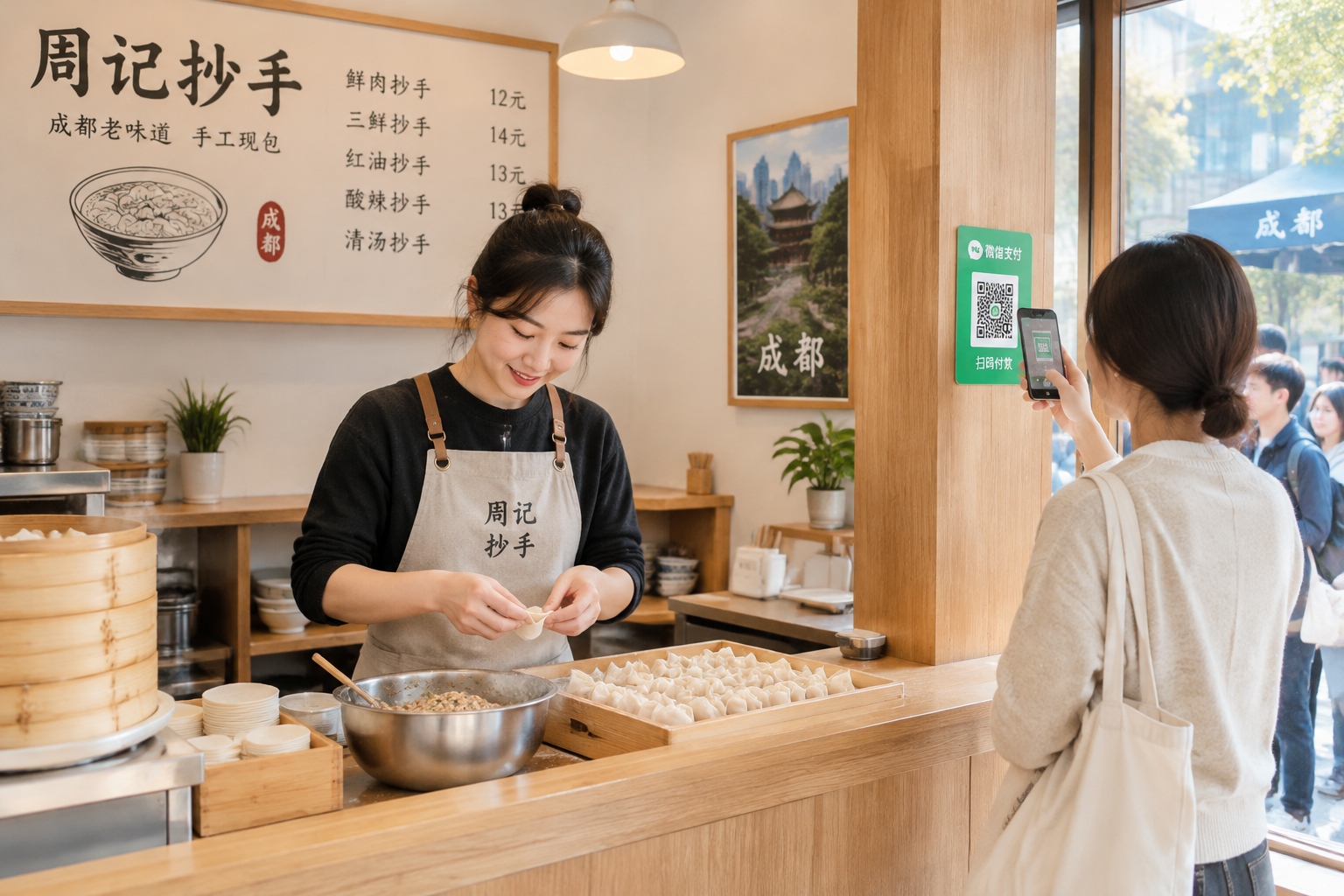
But others see opportunity. Younger owners are opening new shops with better design, English menus, and WeChat ordering. They still fold by hand. They still make their own oil. They just also have an Instagram account.
“My father thought I was crazy,” says 29-year-old Zhou Min, who left a job at a tech company to open a chaoshou shop in a gentrifying neighborhood. “He said, ‘You went to university for this?’ But I wanted to make something real. And people still line up. That means something.”
Breakfast as Identity: A Cross-Cultural Look
If you’re reading this from New York or London, your breakfast might be a bagel and coffee, a croissant, or a smoothie. It’s efficient. It’s often eaten alone. It’s designed to get you to work.
In Sichuan, breakfast is slower—even when it’s fast. The food is hot, oily, and assertive. It wakes you up. It demands attention. And it’s rarely eaten in isolation.
“In the West, you have coffee culture,” says food writer Fuchsia Dunlop, who has written extensively about Sichuan cuisine. “In Sichuan, you have breakfast culture. It’s not about caffeine. It’s about flavor, texture, and the ritual of starting the day with something that makes you feel alive.”
That ritual matters. It’s a small anchor in a rapidly changing world. The city gets taller, the subway gets longer, the jobs get more demanding. But the bowl of chaoshou tastes the same as it did ten years ago.
More Than a Meal
So why do Sichuan people queue for a bowl of wontons?
Because it’s not just a bowl of wontons. It’s a hand-made thing in a machine-made world. It’s a conversation with a neighbor. It’s a reminder that some things are worth waiting for—even at 7 a.m. on a Tuesday.
“I could eat something else,” says Li Wei, the IT worker. “But then my day feels off. Like I skipped a step.”
That step—that small, daily ritual—is what the queue is really about. It’s not about efficiency. It’s about meaning.
And in a city that never stops changing, that’s worth standing in line for.
Start the discussion at forum.chinacomes.com