
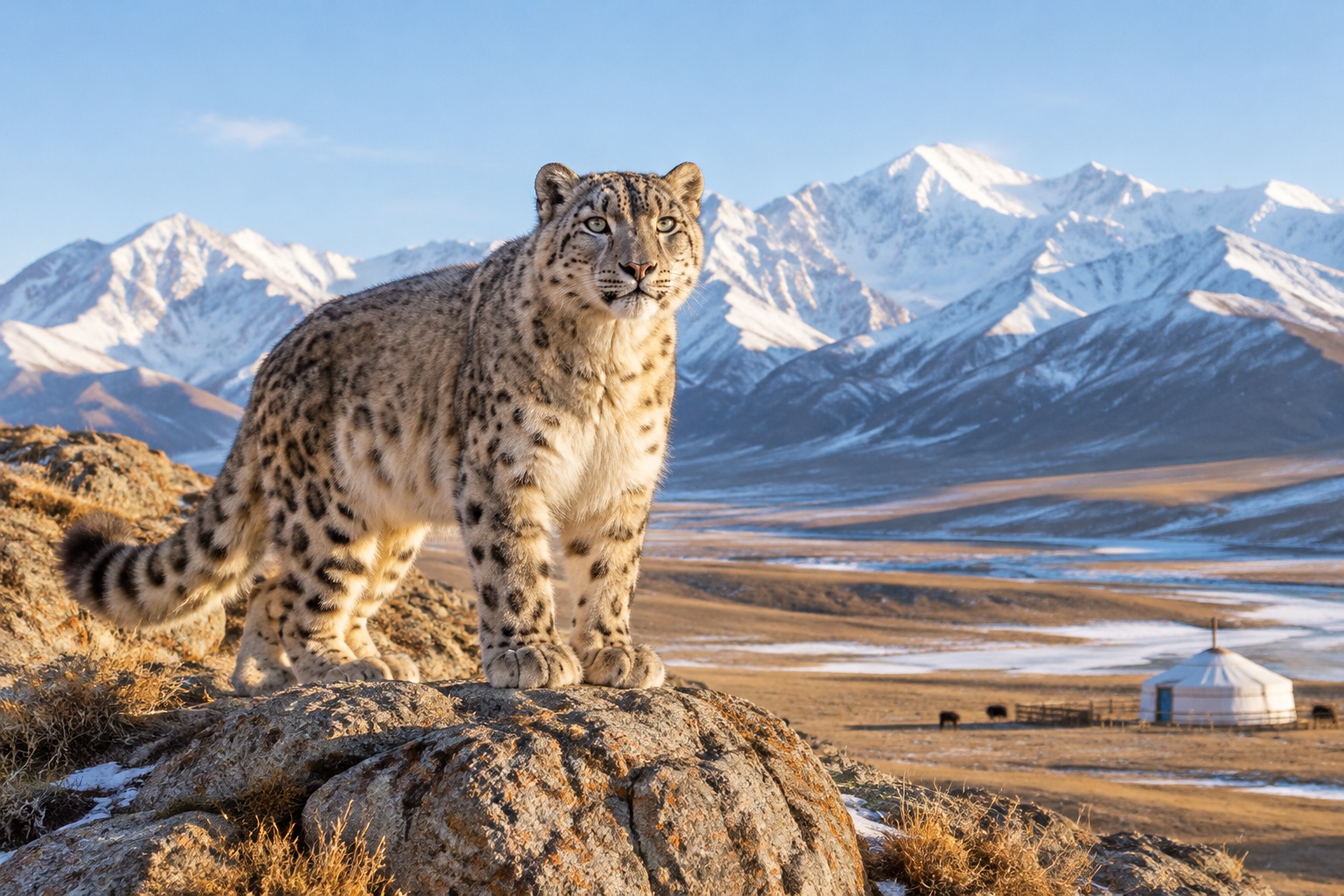

Dawn in the Sanjiangyuan
The first light hits the snow-capped peaks of the Kunlun Mountains at 6:15 a.m. in Qinghai Province. Dorje, a 54-year-old Tibetan herder, pulls on his worn sheepskin coat and steps out of his yurt. The temperature is minus 15 degrees Celsius. He scans the ridge line with binoculars, not for his yaks — they are grazing a kilometer away — but for a gray shadow that has been appearing on a rocky outcrop for three consecutive mornings. It is a female snow leopard, recognizable by the notch in her left ear and the two cubs that sometimes follow her.

Fifteen years ago, Dorje would have reported such a sighting to the local wildlife authority with a mix of anger and despair. Snow leopards killed his livestock — a single attack could take half a dozen sheep — and he, like many herders at the time, saw the cats as a threat to his livelihood. Poisoned carcasses were not uncommon. By 2010, China’s snow leopard population had plummeted to an estimated 2,000 individuals, fragmented across the vast, inhospitable highlands. Western headlines painted a bleak picture: “China’s Snow Leopards Facing Extinction” (National Geographic, 2008); “Poaching and Habitat Loss Push Silent Icon to the Edge” (BBC, 2011). The narrative was grim, and for good reason.
A Crisis Mapped in Data and Distrust
To understand the turnaround, you have to start with the numbers. In 2010, the most comprehensive survey — conducted by the Chinese Academy of Sciences and Panthera — estimated China’s snow leopard population at just 2,000–2,500 individuals, a decline of roughly 40% from the 1990s. Poaching for pelts and bones, retaliatory killings by herders, and infrastructure projects that fragmented migration corridors had pushed the species into isolated pockets. The “roof of the world” was becoming a prison.
Equally damaging was the absence of any coordinated protection. China’s first national park — Sanjiangyuan National Park (Three-River-Source National Park) — wasn’t established until 2015 as a pilot, and legal enforcement against poaching was weak. “In the early 2000s, you could buy a snow leopard fur in the black markets of Xining for 3,000 yuan,” recalls Zhao Xiang, a ranger with the Shanshui Conservation Center who has worked in the region since 2008. “There was no system to stop it.”
The Strategy: National Parks, Not Paper Parks
The turning point came with a paradigm shift in Chinese conservation policy. In 2013, the government announced a plan to build a “national park system” that would designate large, contiguous protected areas managed by a single authority. Sanjiangyuan, at 123,100 square kilometers (roughly the size of Greece), became the flagship. By 2020, it was officially established as China’s first national park, with a budget that allowed for continuous patrols, scientific monitoring, and a radical new approach: paying herders to protect instead of hunt.

The strategy had three pillars. First, an anti-poaching network: 1,800 full-time rangers — many former herders like Dorje — now patrol the park year-round, equipped with GPS trackers and infrared camera traps. Poaching incidents dropped by 80% between 2010 and 2020, according to the Qinghai Forestry and Grassland Bureau. Second, a compensation scheme: when a snow leopard kills livestock, the government pays market value for each animal, removing the incentive for retaliation. Third, community engagement: herders are hired as “wildlife monitors” to report sightings, maintain cameras, and even lead eco-tourism treks for domestic and international visitors.
The Numbers That Changed the Story
The results are striking. A 2021 survey by the Qinghai government and the World Wildlife Fund (WWF) estimated at least 5,000 snow leopards now roam China’s mountain ranges — more than double the 2010 figure. Sanjiangyuan alone hosts around 1,000 individuals, making it the single largest snow leopard population in the world. The Chinese national snow leopard census, completed in 2023, put the national population at between 5,500 and 6,000 animals, a recovery rate far faster than in other range countries like Mongolia or Kyrgyzstan.
These aren’t just government numbers. “We’ve seen a real increase in density in core areas of the park,” says Dr. Li Juan, a wildlife ecologist at Peking University who has studied snow leopard ecology in Sanjiangyuan for 12 years. “Camera traps caught a single female with four cubs last spring — extremely rare. It suggests prey is abundant and human disturbance is very low.” Satellite tracking shows that snow leopard territories have expanded eastward by 15% since 2015, into areas where they had not been seen in decades.
Dorje’s Story: From Enemy to Livelihood
“I used to hate them. But now they pay for my daughter’s school fees,” Dorje says, smiling. Dorje became a ranger in 2017, earning a monthly salary of 3,000 yuan — more than his herding income in a good year. He sets up camera traps, records sightings in a mobile app, and participates in anti-poaching patrols. When a snow leopard killed two of his sheep last winter, he received compensation of 1,500 yuan within a week. “I don’t even get angry anymore. The compensation covers the loss, and the tourists who come to see the leopard pay for homestays.”

Dorje’s transformation is not unique. In the five counties within Sanjiangyuan National Park, over 5,000 herders have enrolled as part-time or full-time monitors. The program has paid out more than 45 million yuan in compensation for livestock losses since 2015. A 2022 study in the journal Conservation Biology found that herder tolerance toward snow leopards had risen from 38% in 2010 to 86% in 2021. “The economic incentive is crucial,” says Dr. Li. “But so is the pride. Herders now compete to take the best camera-trap photos and share them on WeChat. It’s become a game.”
Lessons for the World
China’s snow leopard recovery offers a blueprint for predator conservation in other developing nations. The model — combining massive protected areas, direct compensation, and community employment — addresses the root causes of poaching and retaliatory killing. India, which has an estimated 500–700 snow leopards, sent a team of forestry officials to Sanjiangyuan in 2022 to study the approach. Kyrgyzstan, whose snow leopard population has dropped below 200, has begun piloting compensation schemes inspired by China’s.
“China has shown that a people-centered approach works better than fences and guns,” says Dr. Charudutt Mishra, co-founder of the Snow Leopard Trust. “The key is making snow leopards economically valuable to the people who live with them.” The same principle is now being applied to other species: Tibetan antelope, whose population has recovered from 50,000 to over 300,000; and the wild yak, which has rebounded from 10,000 to 40,000 in the same region.
The Future: Connectivity and Climate Change
Challenges remain. Climate change is pushing the treeline higher, shrinking the alpine meadows where snow leopard prey like blue sheep graze. Infrastructure corridors — highways and railways — still cut through the park’s edges, creating barriers. Illegal mining for gold and copper continues in some legal gray zones. But the direction is clear: China is now the world’s strongesthold for the snow leopard, a title few would have predicted 15 years ago.
As the sun climbs higher over the Qinghai Plateau, Dorje lowers his binoculars. The female snow leopard has appeared again, this time with both cubs. They are climbing a steep scree slope, their thick gray fur glowing in the morning light. Dorje pulls out his phone, takes a photo, and uploads it to the monitoring app. “Look at the young ones,” he says in Tibetan-accented Mandarin. “They will have a future here.”
Start the discussion at forum.chinacomes.com